A new global "industrial cycle" is emerging

Wallstreetcn
2026.02.12 05:55
portai
I'm PortAI, I can summarize articles.

Bank of America research report points out that the global asset narrative is shifting from "technology dominance" to "industrial and credit expansion." Multiple high-frequency indicators and semiconductor recovery signals indicate that a new industrial cycle is starting. As bank regulations loosen and credit capital is released, the manufacturing sector will experience organic growth, with profits potentially exceeding expectations in 2026. Currently, industrial stocks and gold, as "expansion assets," are performing well but have low capital allocation, presenting opportunities outside of crowded trades

The narrative of global assets may shift from "technology standing out alone" to "industrial and credit expansion."

According to the Wind Trading Desk, the RIC team at Bank of America, in their latest research report, combined a set of public data with their own high-frequency indicators and concluded: Manufacturing orders, Asian exports, and semiconductors (especially analog chips) are all signaling the same message — a new industrial cycle may be starting, which means there is room for earnings in 2026 to exceed consensus.

Bank of America investment and ETF strategist Jared Woodard stated, "We may be on the threshold of a new global industrial cycle." He views "strong hard data + warming soft data + strengthening industrial momentum indicators" as a combination of evidence, directly pointing to asset allocation: opportunities are more likely outside crowded trades.

Bank of America attributes the bottlenecks in manufacturing expansion over the past few years to unfavorable credit terms rather than insufficient demand; if lending guidelines, capital requirements, and other regulatory constraints continue to loosen in 2026, the banking system could release over $1 trillion in new capital, and the sustainability of industrial expansion would not rely solely on sentiment and inventory replenishment.

At the same time, Bank of America is also reminding of another line: when liquidity and leverage retreat from "unknown corners," opaque and hard-to-exit varieties such as SPACs, crypto assets, and private credit will be the first to expose problems.

Clues of the Industrial Cycle: Hard Data Leading, Proprietary Indicators Rising

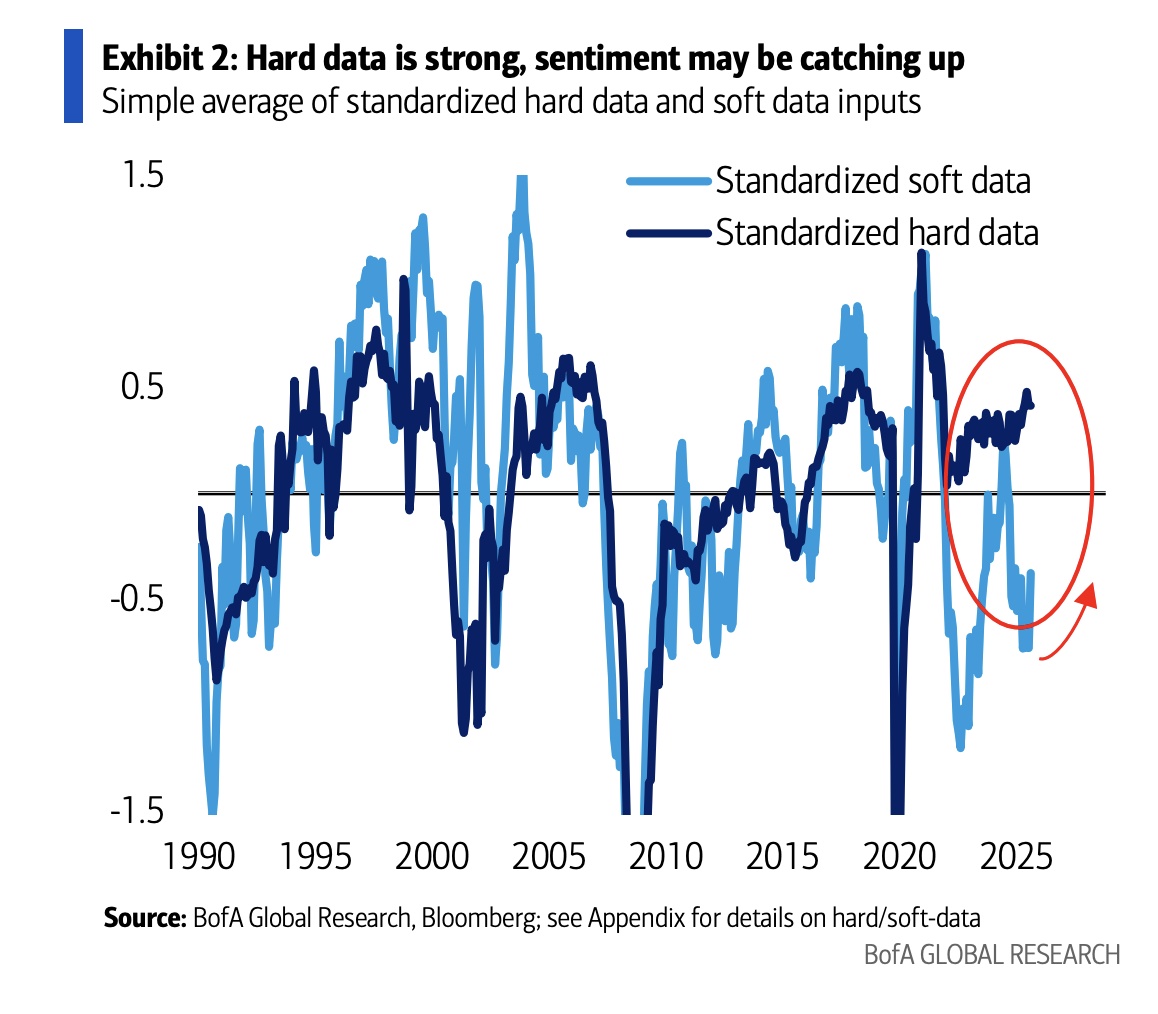
Bank of America first standardized the comparison between "hard data" and "soft data": January's hard data is 0.4 standard deviations above the long-term average, while survey-based sentiment indicators have returned to their highest level since May of last year (still 0.4 standard deviations below the long-term average). The University of Michigan Consumer Confidence Index rose to 57.3 in February, the highest since August of last year.

More importantly, several proprietary high-frequency indicators from BofA have simultaneously strengthened:

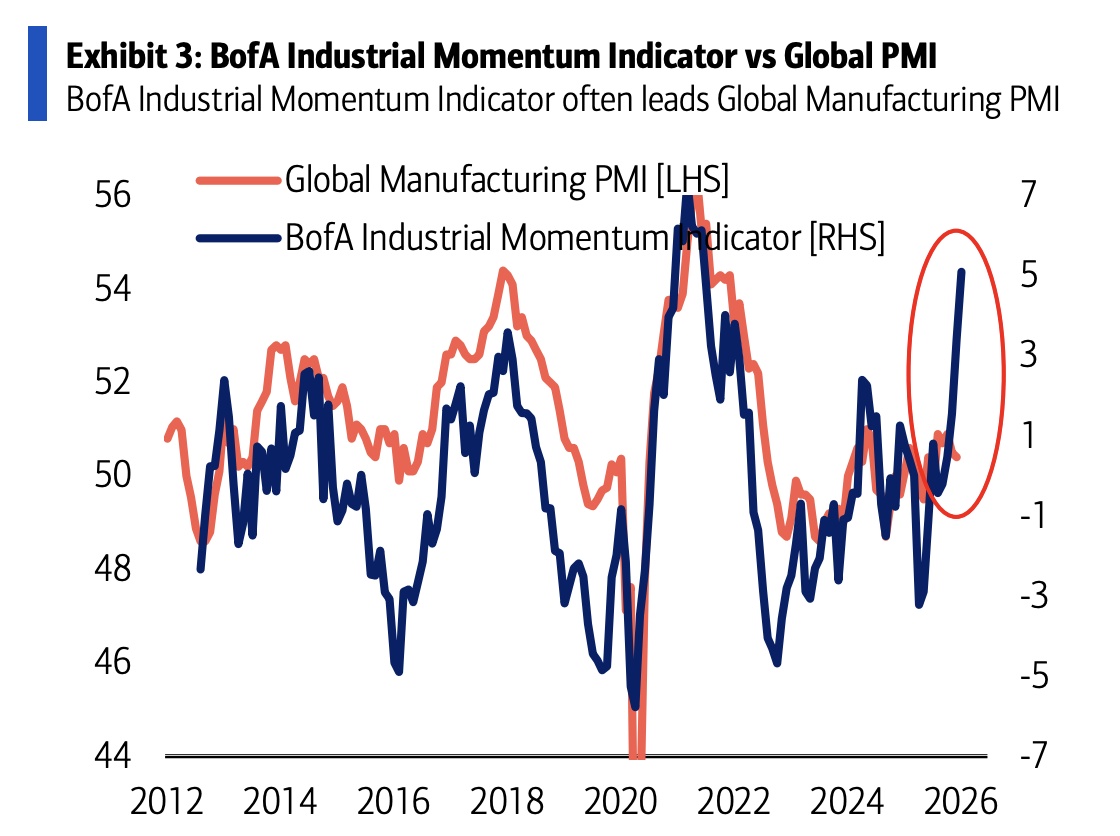
The industrial momentum indicator has reached its best level since December 2021 and is used to infer that "future global manufacturing PMI still has upward space";

The global outlook of the fluid power survey has risen to 73; in the truck freight survey, "demand" has broken above 60 (the best since April 2022), and capacity is tightening (the lowest since March 2022);

Storage indicators have already exceeded the 2021 peak.

They collectively point to one judgment: this market cycle may no longer be entirely driven by "debt-fueled consumption" or "fiscal transfers," the "organic growth" on the industrial side is beginning to become visible.

Credit Conditions May Be the Missing Puzzle Piece: Lending Reforms Extend the Cycle

Bank of America believes that the obstacles to manufacturing expansion lie in "unfavorable credit terms." Private credit can only fill part of the gap and is more costly; if regulations and guidelines shift, the banking system would be the larger variableSeveral sets of data in the research report are used as evidence for "credit improvement worth betting on":

  • The NACM Credit Managers' Survey shows that manufacturing sales are at their highest level since 2022, corresponding to a historical relationship that could imply about 4% U.S. GDP growth (r²=0.47).

  • The rise in "new orders" in the ISM Manufacturing PMI historically corresponds to a GDP implication of over 3.5% (r²=0.36, with samples starting from 1948). The report also acknowledges that the survey is highly volatile and should not be used for predictions, but it reinforces the tendency of being "above consensus" in direction.

On the banking side, the report provides more specific constraints and loosening paths: large U.S. banks hold an average of 3.4 percentage points more excess capital than regulatory requirements; capital requirements are expected to decrease by nearly 1 percentage point by 2026. Potential reforms mentioned by Ebrahim Poonawala include: adjusting GSIB additional capital requirements could bring CET1 requirements down to 13% (the lowest since 2011), as well as adjustments to the Basel End Game and the $100 billion asset threshold, reducing the financing division distorted by "regulatory arbitrage" between banks and non-banks.

These details are the core of the report that extends the "industrial cycle" from a data rebound into a "tradable macro mechanism."

Chips Drive the Cycle Globally: Resonance of Analog Chips and Korean Exports

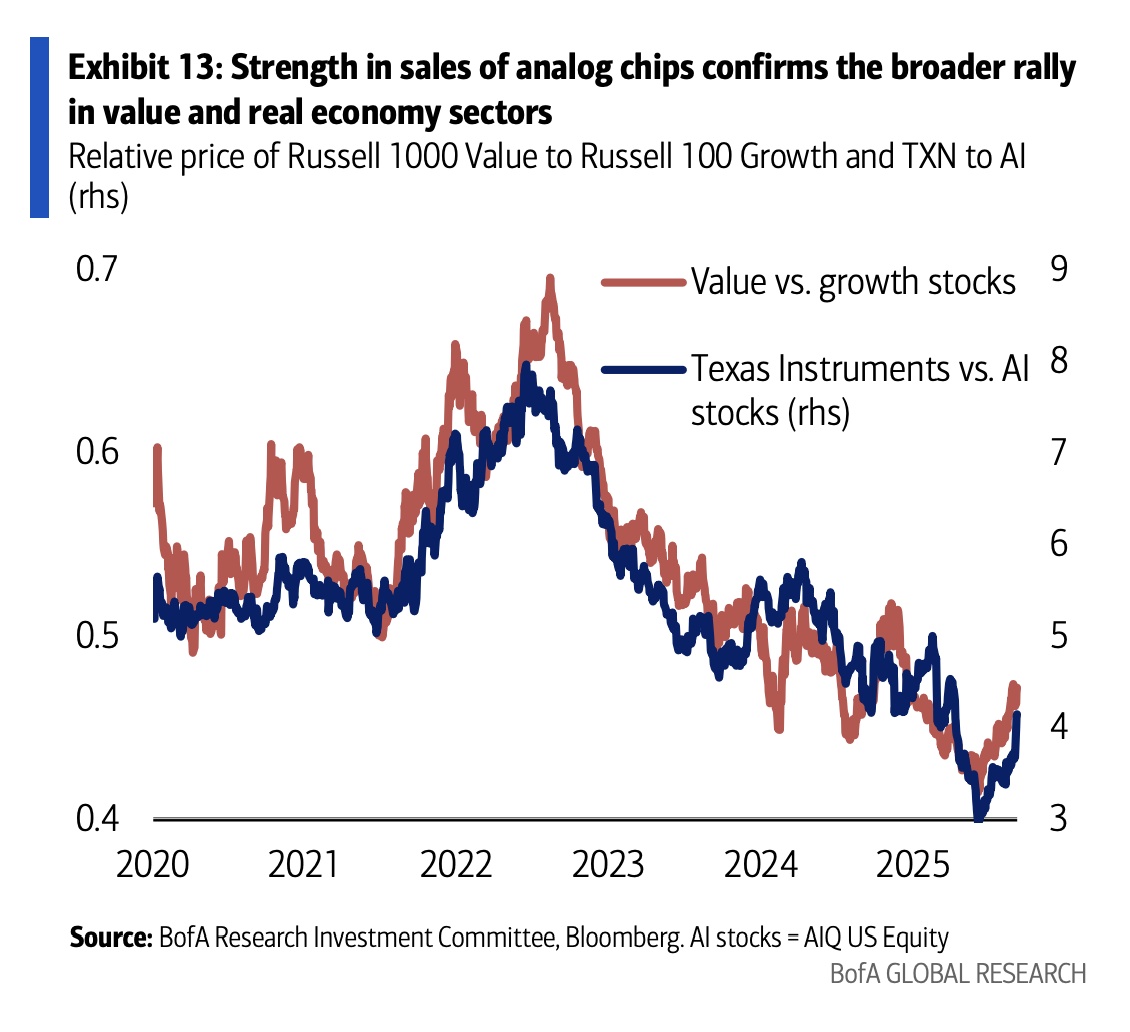
The report treats semiconductors as a "leading indicator" of the industrial cycle and deliberately emphasizes analog chips: they are often more closely aligned with the demand for industries, defense, and electricity.

Bank of America expects that chip sales are projected to grow by 30% year-on-year in 2026, likely ushering in the first-ever "trillion-dollar year." The structure is a 48% rebound in memory and a 22% growth in non-memory core semiconductors; the performance of memory prices this year has already exceeded expectations.

Another global clue comes from South Korea. Bank of America explained the nearly 34% year-on-year increase in exports in January: memory chip prices rebounded sharply, AI demand accelerated while supply tightened, and some traditional memory capacity and capital expenditures were redirected to AI data center products, which in turn pushed up the prices and export amounts of broader consumer memory. The report also links "changes in Korean exports" with "MSCI ACWI forward EPS growth," suggesting that this relationship implies that ACWI EPS growth could reach 27% in the coming year, significantly higher than the market consensus of 13%.

What it wants to express is not that "Korea can decide the world," but rather: when exports and chip prices strengthen in the same direction, the risk of upward revisions in global profits may be underestimated.

Expansion Trades Are Profitable, but Funds Still Favor "Stagnant Assets"

The report puts "expansion trades" on the table with returns from this year: small/mid-cap industrial stocks up 22%, nuclear energy 20%, gold 18%, global defense 15%, emerging markets excluding China 14%, and developed market small-cap value 13%. In contrast, the S&P 500 is only up 2%, U.S. Treasuries are close to 0%, large-cap U.S. growth stocks are down 3%, and traditional 60/40 portfolios have returns just slightly above 1%The problem is that the position structure has not kept up. The RIC team used fund and ETF capital flow statistics to state that over the past decade, the cumulative inflow of "expansion assets" has been $1.3 trillion less than that of "stagnant assets": the former is about $0.3 trillion, while the latter is about $1.6 trillion. In other words, trading is no longer a secret, but allocation remains scarce.

This is also why the research report repeatedly emphasizes: investors are still overweighting the winners of the past twenty years (large-cap technology, high-rated bonds), while the "scarcity of reliable returns" is changing.

The Tide of "Unknown Corners" Recedes: Old Accounts of Leverage, Liquidity, and Transparency Must Be Settled

The research report categorizes SPACs, crypto assets, and private credit into the same category: against the backdrop of a reduced supply of listed companies (the number of listed companies in the U.S. has halved over the past 30 years), combined with ample liquidity and scarce growth, funds are being pushed into more "unknown" corners; and a downturn starting in the third quarter of 2025 has made old risks expensive again.

It listed several striking contrasts:

  • In 2025, the announced transaction size of U.S. SPACs reached $37.6 billion, making it the third-largest year in history; however, the average return after mergers is "not worth the risk." A "leading publicly traded SPAC" index has only risen 9% over the past five years, significantly underperforming small-cap U.S. stocks (+41%). The report also cites research indicating that for every $10 raised by SPACs, there may be $3 in fees.

  • The valuation discussion of Bitcoin remains inconclusive (no cash flow, unclear utility value, lack of a long-term "stable store of value" history), and it notes that its annualized volatility often exceeds 100%.

  • The exit restrictions of private credit are stated very plainly: with a quarterly redemption limit of 5%, a complete exit may take five years; at the same time, the exposure of BDCs and private credit to the software industry (18%) is higher than that of bank loans (12%) and high-yield bonds (2%). Over the past 12 months, a BDC/fund index with significant exposure to private credit has fallen 16%, while CLO ETFs, syndicated loans, and high-yield bond ETFs have returned between 5% and 8%.

The report ultimately compresses the lessons into two sentences: Leverage + illiquidity + opacity is an unstable combination; uncompensated risks are the most harmful—therefore, valuation is always important.