


Profit to the left, net assets to the right: Analyzing the "surface" and "substance" of the performance of unlisted life insurance companies

In 2025, the net profit of non-listed life insurance companies surged to 66.6 billion yuan, but net assets shrank by nearly 10 billion yuan, indicating a structural divergence of "profit increase without capital increase." The median comprehensive investment return rate dropped from 8.39% to 2.73%. Several insurance companies, such as BOC Samsung Life and CEB Grand China Life, despite achieving record high net profits, saw a significant decline in net assets, reflecting the impact of new financial instrument standards and market conditions
This is a financial report season filled with "illusions."
In 2025, non-listed life insurance companies delivered a rather confusing set of accounts.
If we only consider net profit as a reference, it seems to be a long-awaited bumper year, with the total net profit of non-listed insurance companies reaching 66.6 billion yuan, a staggering increase of 165% compared to 25 billion yuan in 2024.
After experiencing performance stagnation and the pains of transformation, many leading and mid-tier insurance companies achieved record high net profits. However, just as investors were preparing to toast to the new achievements, the "substance" of the accounts presented a different picture:
In 2025, the median comprehensive investment return rate of non-listed insurance companies suffered a "knee-jerk" drop, plummeting from 8.39% the previous year to 2.73%; despite the doubling of net profits, the total net assets of the entire industry shrank by nearly 10 billion yuan.
Profits are soaring, but the foundation is thinning.
This is a grand drama co-directed by the new financial instrument standards (IFRS 9) and a turbulent market environment.
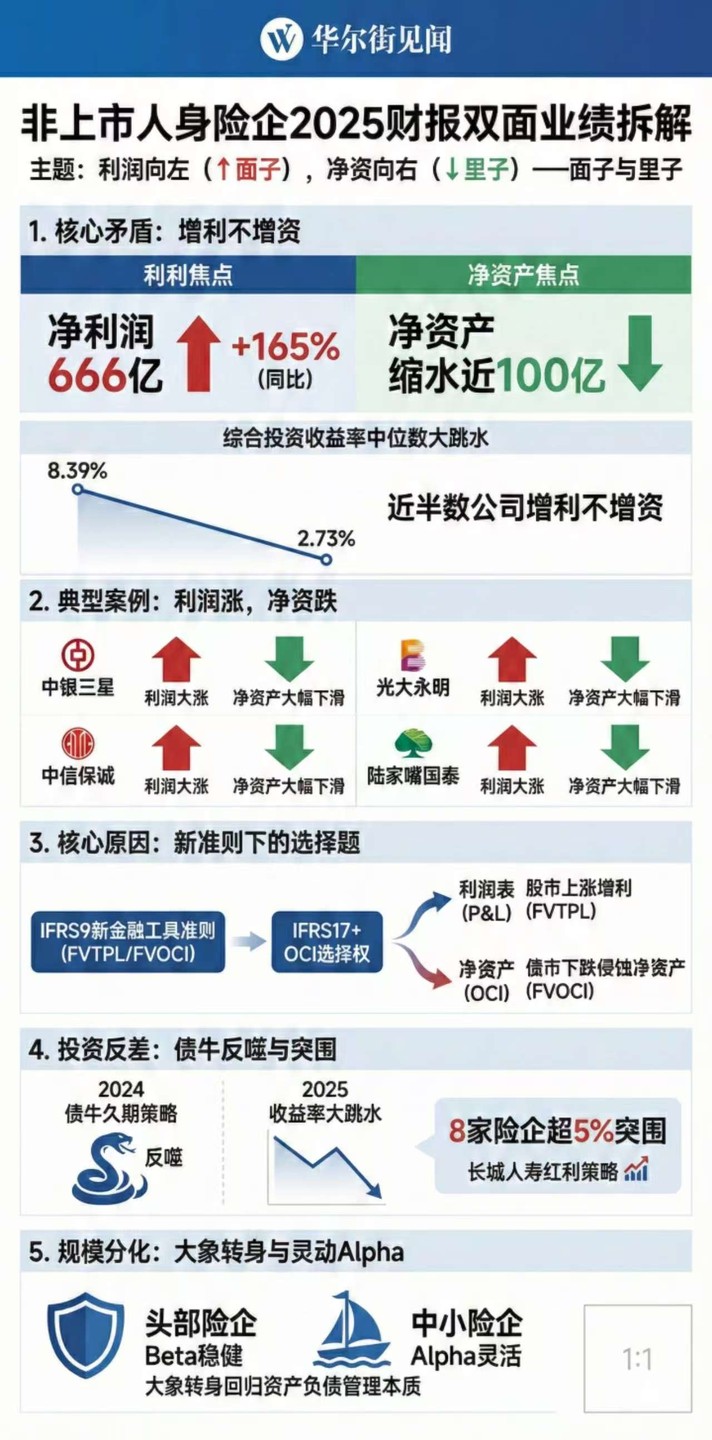
Surface and Substance
In 2025, the insurance industry seems to be caught in a structural divergence of "increased profits without increased capital."
For a long time, the net profit and net assets of insurance companies have often maintained a tacit agreement of moving in the same direction, but this convention is being broken in the era of a full switch to new accounting standards.
Bank of China Samsung Life is a typical example of this phenomenon.
In 2025, the company achieved a net profit of 708 million yuan, soaring by 44.7% year-on-year.
For a mid-sized insurance company in a transitional period, this is a report that should make the management "stand tall"; however, in stark contrast to the impressive profit, its net assets plummeted to 670 million yuan, shrinking by nearly 90% year-on-year.
This is not an isolated case; during the same period, CEB Life turned a profit, achieving a net profit of 110 million yuan, but its net assets shrank by 37.7%;
CITIC Prudential Life's net profit of 5 billion yuan reached a historical high, yet its net assets shrank by 21.4%;
Lujiazui Cathay Life's net profit surged 7.5 times to 1.05 billion yuan, while its net assets conversely shrank by 35.8%.
Xinfeng statistics found that nearly half of non-listed life insurance companies in 2025 exhibited the characteristic of "increased profits without increased capital."
What exactly caused this extreme divergence between "surface" and "substance"?
Several industry veterans analyzed for Xinfeng that this phenomenon stems from the "chemical reaction" produced by capital market fluctuations and the switch in accounting standards.
While insurance companies enjoy the profit "dividends" from the rising equity market, they also swallow the "bitter fruit" of net asset declines caused by bond market fluctuations and reserve re-evaluations.
Zhou Jin, managing partner of Tianzhi International Insurance Consulting, pointed out that the triple-digit profit growth of non-listed life insurance companies is primarily driven by the investment side. "In 2025, the major A-share indices rose by around 20%, and combined with the income from high dividends, this should be the main contributing factor to the rising investment return rates and profits of non-listed insurance companies." Under the new accounting standards, the positive impact of equity market trends on life insurance companies may be further amplified.
On one hand, this stems from the influence of financial asset classification methods.
According to the new standards, financial assets can be classified into FVTPL (financial assets measured at fair value with changes recognized in profit or loss) or FVOCI (financial assets measured at fair value with changes recognized in other comprehensive income) accounts.
The former is intended for short-term trading, with fluctuations directly reflected in the income statement, while the latter is aimed at strategic holding, with value changes retained in the balance sheet;
The former is represented by stocks that have experienced an upward trend in 2025, while the latter is represented by medium- to long-term bonds with weak performance.
Wang Guojun, a professor at the School of Insurance of the University of International Business and Economics, pointed out that, based on the practices of listed insurance companies, many companies choose to classify equity assets as TPL, with stock price increases directly reflected in net profit;
Meanwhile, the decline in government bond yields leading to a decrease in the book value of bond assets directly lowers net assets under the new standards.
On the other hand, the OCI option set by the new standards has also exacerbated the divergence between profits and asset trends.
Under the old standards, insurance companies were required to set aside reserves based on the 750-day moving average government bond yield curve;
The 750 curve has been replaced by the spot yield under the new standards, but the newly established OCI option allows insurance companies to allocate changes in liabilities caused by discount rates across various periods' profits and losses, shifting net profit fluctuations to net asset fluctuations.
To smooth out performance, many insurance companies exercise the OCI option, resulting in net asset fluctuations far exceeding net profit fluctuations in recent years.
In short, the current appearance of "increased profits without increased capital" is due to some insurance companies accounting for the joy of making money in the stock market in the income statement, while hiding the pain of floating losses in the bond market and the pressure of reserve provisions entirely in the balance sheet.
Research from institutions like Soochow Securities indicates that all insurance companies will face a new normal of intensified fluctuations in net profit and net assets in the future. This is no longer a simple operational issue but an extreme challenge to the asset-liability management capabilities of insurance companies.
In the future, finding a balance between "attractive financial statements" and "solid financial foundations" will become a critical challenge that executives of insurance companies must confront.
The Boomerang of the Bond Market
Stripping away the filter of accounting standards, the substantial shrinkage of net assets is essentially a reckoning regarding aggressive strategies in the bond market.
Profit and loss are two sides of the same coin, an eternal rule in financial markets.
Xinfeng noted that the median comprehensive investment return rate for non-listed life insurance companies in 2025 has dropped from 8.4% the previous year to 2.7%. Some companies that ranked at the top of the yield list in 2024 have appeared at the forefront of the decline list in 2025.
The most typical example is Tongfang Global Life Insurance.
Looking back to 2024, this company boasted a comprehensive investment return rate of 17.93%, firmly positioned at the top tier of the industry; however, as the clock turned to 2025, its comprehensive investment return rate had fallen to -1.13%.
The shift from nearly 18% positive returns to negative returns is not just a numerical fluctuation but a reflection of strategic failure Similarly experiencing a roller coaster ride are Zhonghe Life Insurance and Heng'an Standard Life Insurance, with the former's comprehensive investment return rate dropping from 14.42% to -2.26%, and the latter's falling from 15.57% to 0.83%.
Behind the dramatic fluctuations in data is the backlash of strategy.
In the one-sided bond bull market of 2024, many insurance companies adopted extreme duration extension strategies to enhance returns. This strategy created astonishing paper returns through capital gains when interest rates were on a downward trend.
However, there has never been a myth in the bond market that only rises without falling. The "high Beta" strategy can create myths in favorable conditions but becomes a deadly poison in adverse conditions.
When the interest rate center began to fluctuate upward in 2025, or when market expectations underwent slight adjustments, the previously accumulated massive bond floating profits instantly turned into floating losses.
There is also a one-time impact of accounting standard switching behind this.
Zhou Jin pointed out that some life insurance companies reclassified their bond investment accounting in 2024 to cope with the impact of the new standards, releasing a large amount of historical floating profit dividends from existing bonds, significantly boosting that year's comprehensive investment returns, even exceeding 10%.
"However, the rise in bond investment returns in 2025 brought about floating losses from bond revaluation, which lowered the comprehensive investment return rate, leading to dramatic fluctuations when comparing the comprehensive investment return rates of the past two years," Zhou Jin stated.
Nevertheless, the market is not entirely in collapse. In the gap between bond market fluctuations and stock market divergence, equity investments have shown a clear "K-shaped divergence," with some insurance companies even achieving breakthroughs against the trend.
Xinfeng statistics found that in 2025, there were still eight life insurance companies, including Xiaokang Life, Junlong Life, Allianz Life, and Great Wall Life, with comprehensive investment return rates above 5%.
Taking Great Wall Life as an example, according to the rating reports from Zhongxin International and United Ratings, the company increased its allocation to stocks and other equity assets in 2024, and in the first three quarters of 2025, mainly focused on fixed-income assets as the primary asset allocation direction, with a decrease in the proportion of equity assets.
As of the end of the third quarter of 2025, the company's fixed-income and equity asset proportions were 71.25% and 17.54%, respectively;
In the secondary market, Great Wall Life completed four equity stakes in 2025, targeting China Water Affairs, Datang New Energy, Qin Port Co., Ltd., and Xintian Green Energy, attempting to increase the allocation of quality dividend assets to seek higher long-term returns.
Zhou Jin pointed out that although the stock market saw significant gains in 2025, due to various uncertainties in the international situation and domestic economic growth, there is also the possibility of short-term market corrections, thus requiring attention to market fluctuations and proper risk prevention;
He stated that the "dividend strategy" will still be the main allocation strategy in the industry, obtaining stable returns similar to fixed income through dividends, and then gaining enhanced returns through equity appreciation.
The Elephant Turns Around
It is important to note that in the dual context of low interest rates and high volatility, there is a complex tension between asset scale and investment return rates: Scale remains the "ballast" against risk, but it also poses stricter tests on the efficiency of capital utilization.
Xinfeng noted that in 2025, the investment performance of non-listed insurance companies showed significant strategic differentiation. The top ten insurance companies by asset size maintained an average comprehensive investment return rate of around 2.5%, a stable range.
Among them, "runner-up" China Post Life, with over 680 billion yuan in assets, along with China Construction Bank Life and Agricultural Bank Life, which have asset sizes exceeding 300 billion yuan, reported comprehensive investment return rates of 0.74%, 1.94%, and 1.65%, respectively.
In contrast, Xiaokang Life, with assets of less than 16 billion yuan, maintained an exceptionally high return rate of 11.6% for two consecutive years, demonstrating strong aggressiveness.
This data contrast is not a failure of large-scale insurance companies, but an inevitable division determined by the attributes of capital.
Insurance giants with assets in the hundreds of billions or even trillions need to allocate massive amounts of interest rate bonds and high-grade credit bonds as a base to match long-term liabilities. In the context of historically low long-term interest rates, large funds can only passively accept the market's Beta, and their allocation's margin for error is far smaller than that of small and medium-sized institutions.
The flexibility of smaller companies allows them to seek Alpha in non-standard assets, private bonds, or specific equity strategies.
This does not mean that scale is ineffective; rather, it signifies a shift in competitive dimensions: the competition among leading insurance companies is no longer a game of single-point assets but a contest of strategic stability in major asset allocation and refined management capabilities.
However, whether winning with the flexibility of "light cavalry" or steadily crossing with "heavy armor," all insurance companies will ultimately face the same ultimate judgment.
When the tide recedes, the tranquility embellished by accounting standards and the short-term bursts gained through aggressive speculation will eventually come to an end. The insurance industry will return to its most fundamental essence—this is a race against time, where the competition is no longer about single-year explosiveness but about the resilience of the balance sheet across cycles.
In the long-cycle game, only those companies that can maintain the "face" of current profits while safeguarding the "substance" of net assets can truly survive until the next spring.
Risk Warning and Disclaimer
The market has risks, and investment requires caution. This article does not constitute personal investment advice and does not take into account the specific investment objectives, financial conditions, or needs of individual users. Users should consider whether any opinions, views, or conclusions in this article align with their specific circumstances. Investment based on this is at one's own risk
