


Congo's copper exports grew by 10% last year, while cobalt exports fell by nearly 80%

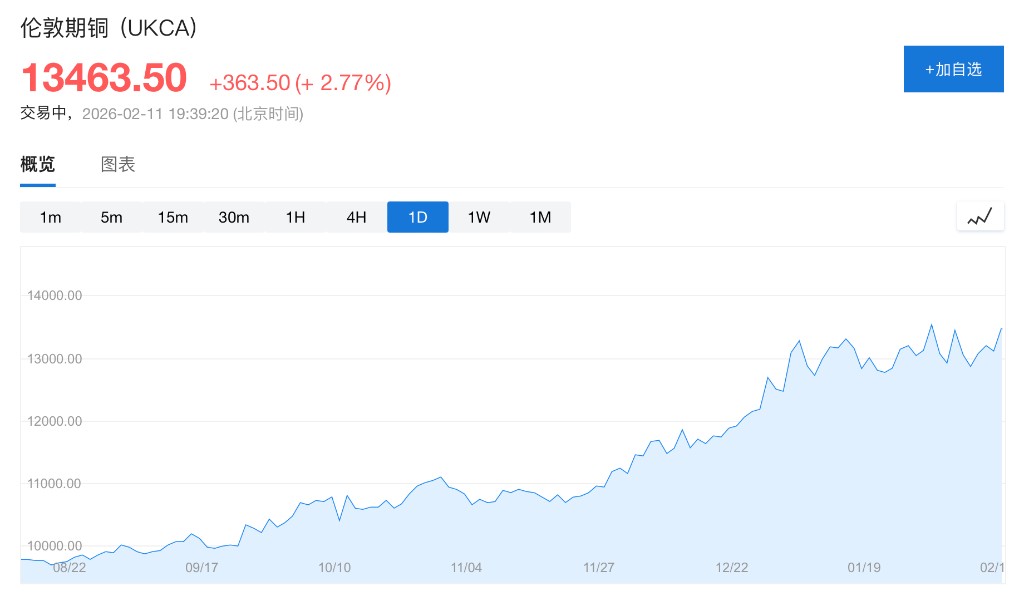
Congo's copper export volume is expected to grow by nearly 10% to 3.4 million tons in 2025, consolidating its position as the world's second-largest copper producer. Chinese enterprises dominate capacity expansion, providing a crucial buffer for the globally tight market, with copper prices rising 40% during the same period to reach new highs. In contrast, cobalt exports plummeted by 80% to 44,500 tons due to government bans and quotas. Under the co-mining of copper and cobalt, the supply trajectory is clearly diverging
The Democratic Republic of the Congo's copper exports are expected to grow nearly 10% year-on-year to 3.4 million tons in 2025, further solidifying its position as the world's second-largest copper producer, second only to Chile. This growth is primarily driven by the expansion of mines operated by foreign enterprises, providing a crucial buffer for the global copper market under supply pressure.
According to preliminary data released by the Congolese government at the Cape Town Mining Conference, the country's copper exports are projected to increase from 3.1 million tons in 2024 to 3.4 million tons in 2025. Foreign mining companies dominate its copper production, with the Tenke Fungurume mine and the Kisanfu project producing 519,000 tons and 228,000 tons respectively for the entire year.
Capacity expansion is injecting supply into the tight global copper market. Over the past year, copper prices have risen by 40%, breaking through USD 14,500 per ton at the end of January 2026, setting a new historical high. The price increase is driven by frequent mining accidents and operational disruptions globally, coupled with a structural demand surge driven by the transition to clean energy and the development of artificial intelligence.
In contrast, the Democratic Republic of the Congo's cobalt exports are expected to plummet nearly 80% to 44,500 tons in 2025, primarily due to the government's export ban implemented in February and the transition to a strict export quota system in October. This policy shift coincides with the United States seeking to reduce reliance on a single supply source through critical mineral cooperation agreements, as the Congolese cobalt industry faces dual adjustments in geopolitical landscape and market rules.
Chinese Enterprises Lead Copper Production in the Congo
Chinese companies are deeply involved in the development of copper mines in the Congo. Data from the Congolese Ministry of Mines shows that Luoyang Molybdenum operates the first and third largest copper mines locally; the Kamoa-Kakula mine, a joint venture between Canadian Ivanhoe Mines and Zijin Mining, ranks second, with a projected copper production of 400,000 tons in 2025.
Robert Friedland, founder and co-chairman of Ivanhoe Mines, stated this week:
"The Congo will become the world's leader in copper production."
Chile remains at the top globally with an estimated annual production of 5.3 million tons according to the U.S. Geological Survey. However, the Congo has rapidly climbed the rankings in recent years, surpassing Peru and China, with its contribution to global supply more than doubling over the past decade.
Supply Tightness Drives Copper Prices to New Highs
The continued release of production from the Congo provides a crucial buffer for the global copper market, which has been severely impacted by supply disruptions. Over the past year, frequent mining accidents and operational obstacles, coupled with difficulties in launching new projects, starkly contrast with the structural demand expansion driven by energy transition and the wave of artificial intelligence.
Under supply tightness, copper prices have risen by 40% over the past 12 months, breaking through USD 14,500 per ton at the end of January, setting a new historical high. The market expects that with the continued expansion of clean energy and high-tech industries, copper demand will maintain a long-term growth trend The Democratic Republic of the Congo is also the world's largest cobalt supplier, which is a key material for electric vehicle batteries and military aerospace. However, by 2025, the country's cobalt export volume is expected to plummet by nearly 80% to 44,500 tons. A sudden policy shift is the main reason, as the government imposed an export ban starting in February and further transitioned to strict quota management in October.
Since copper and cobalt are often mined together in Congolese mines, the abrupt change in cobalt export policy has significantly impacted the global supply chain. The supply trajectories of these two strategic minerals are showing increasingly apparent divergence
