


Earnings guidance below expectations, NVIDIA software supplier's stock price plummets 20%!

French industrial software giant Dassault Systèmes reported fourth-quarter revenue of €1.68 billion, a year-on-year decline of 4.1%. The full-year performance and growth guidance for 2026 both fell short of expectations, leading to a 21% drop in stock price on Wednesday, nearing the largest intraday decline in history. The company provides generative 3D virtual environment software for NVIDIA, and although NVIDIA CEO Jensen Huang described the collaboration as "revolutionary," the market remains skeptical about its transformation effectiveness. The company is facing dual pressures from declining demand in the automotive and pharmaceutical industries and the accelerated replacement of traditional software business by AI tools
Due to disappointing fourth-quarter performance and a weak outlook for 2026, French industrial software giant Dassault Systèmes SE saw its stock plunge by 21% during early trading on Wednesday, nearing its largest intraday drop since its listing. The stock triggered a brief trading halt after opening on the Paris Stock Exchange, and it currently maintains a decline of around 19%.
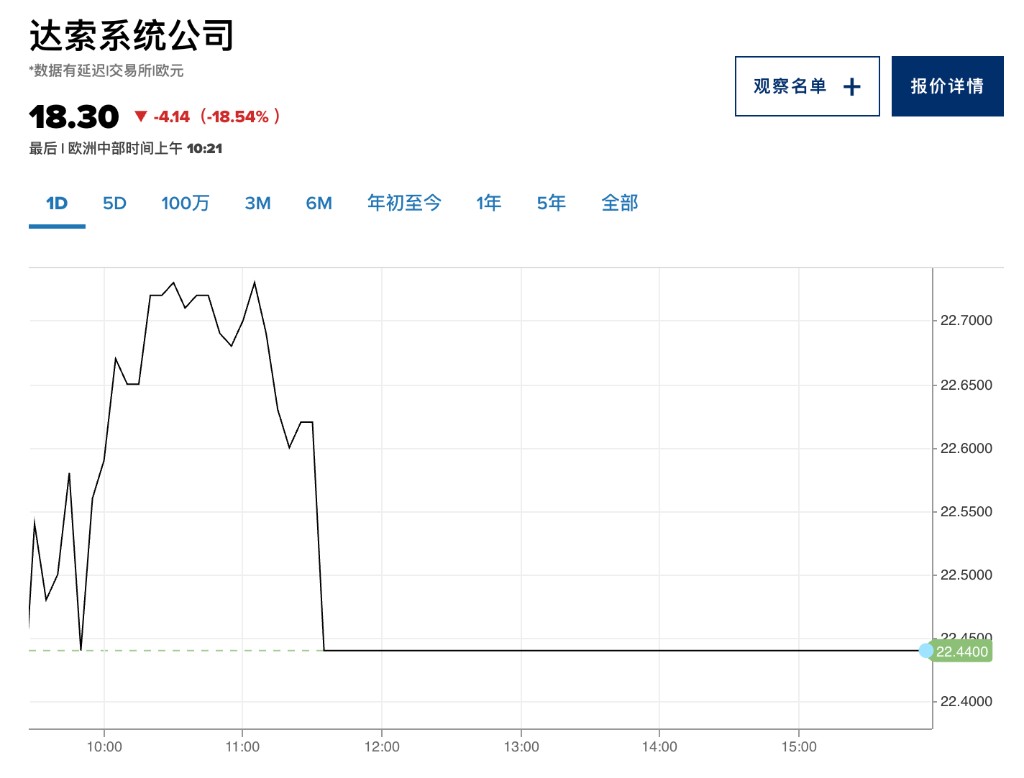
According to data compiled by Bloomberg, Dassault Systèmes reported fourth-quarter revenue of €1.68 billion (approximately $2 billion), a year-on-year decline of 4.1%, falling short of market expectations of €1.74 billion. The company expects non-IFRS revenue growth of 3% to 5% for 2026, which also did not meet analysts' expectations. This company, once referred to as the "frontier center of industrial AI" by NVIDIA CEO Jensen Huang, is facing concerns that its traditional software business is being rapidly replaced by emerging AI tools.
Although the company previously viewed the wave of AI technology as a significant driver for upgrading industrial software, the latest performance reflects that its transformation process is not meeting expectations. A team of analysts from JP Morgan, led by Toby Ogg, noted in their report that the growth forecast provided by the company "is even below the most pessimistic investors' expectations." In the face of competition from emerging tools like generative AI, Dassault Systèmes' weak guidance has further intensified market concerns about the narrowing moat of traditional industrial software businesses.
NVIDIA Suppliers Face Setbacks
Despite NVIDIA being one of Dassault Systèmes' clients, with the latter providing generative 3D virtual environment software, this partnership has not alleviated the market's strong reaction to the weak performance.
NVIDIA CEO Jensen Huang stated in an interview with CNBC last week that the company has fully integrated CUDA-X, AI, and Omniverse platform technologies into Dassault Systèmes' toolkit for the first time, calling this move "completely revolutionary." However, the capital market's optimism about technological synergy was quickly offset by the weak performance guidance.
In response to investor concerns, Dassault Systèmes is accelerating the commercialization of its industrial AI product 3D UNIV+RSES, claiming that the platform will "lead the industrial AI transformation." CEO Pascal Daloz stated:
"Dassault Systèmes will lead the industrial AI transformation through its industrial AI product 3D UNIV+RSES. This is not a short-term goal, but a long-term commitment aimed at redefining innovation, operations, and competition across industries. In 2025 and 2026, we will focus on rigorous execution, integrating resources around strategic priorities to achieve measurable, industry-significant impacts."
Performance Falls Short of Expectations
Dassault Systèmes' fourth-quarter financial report released on Wednesday showed that software revenue declined by 5% year-on-year, dragging total annual revenue to remain flat at €6.24 billion (approximately $7.43 billion), below the market expectation of €6.3 billion from Refinitiv. Annual software revenue recorded €5.64 billion, with overall growth continuing to be weak. **
The financial report also disclosed that the adjusted earnings per share and revenue of €1.75 billion for the fourth quarter both fell short of analyst expectations as per FactSet. The company provided a cautious outlook for 2026, expecting full-year revenue to be between €6.29 billion and €6.41 billion, with earnings per share between €1.30 and €1.34, while the market had previously expected €6.58 billion and €1.37.
Due to a decline in demand from key customers in the automotive and pharmaceutical industries, Dassault Systèmes' fourth-quarter performance and full-year guidance both fell short of expectations. The company disclosed its annual recurring revenue (ARR) metric for the first time, measuring core subscription and recurring revenue, but this metric has only grown by 6% since the fourth quarter of 2023.
Jefferies analyst Charles Brennan pointed out that in the current context of the software industry accelerating its shift to a subscription model, this growth rate "may be seen as disappointing."
Facing pressure from slowing growth, CEO Pascal Daloz emphasized in a statement that the company is advancing its long-term strategic transformation. He stated that true transformation takes time and is not about pursuing short-term goals. He said:
“Our vision is built on decades of industrial and scientific knowledge, and we are now building the capability to turn that vision into reality.”
"SaaS Apocalypse" Trading Spreads
Dassault Systèmes' stock price plummeted, becoming a microcosm of the widespread sell-off in the software-as-a-service (SaaS) industry recently. Last week, the company's stock price fell over 4% due to concerns about competition among software and data providers triggered by Anthropic's release of new AI tools.
Moneta Senior Investment Advisor Aoifinn Devitt stated that Wednesday's plunge is the latest manifestation of the so-called "SaaS Apocalypse Trade." She said:
“The market is generally concerned about the group of winners that led last year.”
Although Dassault Systèmes' executives view the wave of AI technology as a strategic expansion opportunity for industrial software business, investors remain significantly skeptical about the pace of its transformation and execution effectiveness. In the context where European software companies are facing emerging AI tools accelerating the replacement of traditional product lines, market confidence restoration awaits clearer fundamental signals
