


How did SK Hynix surpass Samsung and achieve a profit margin greater than Taiwan Semiconductor to become the "invisible leader" in the AI storage field?

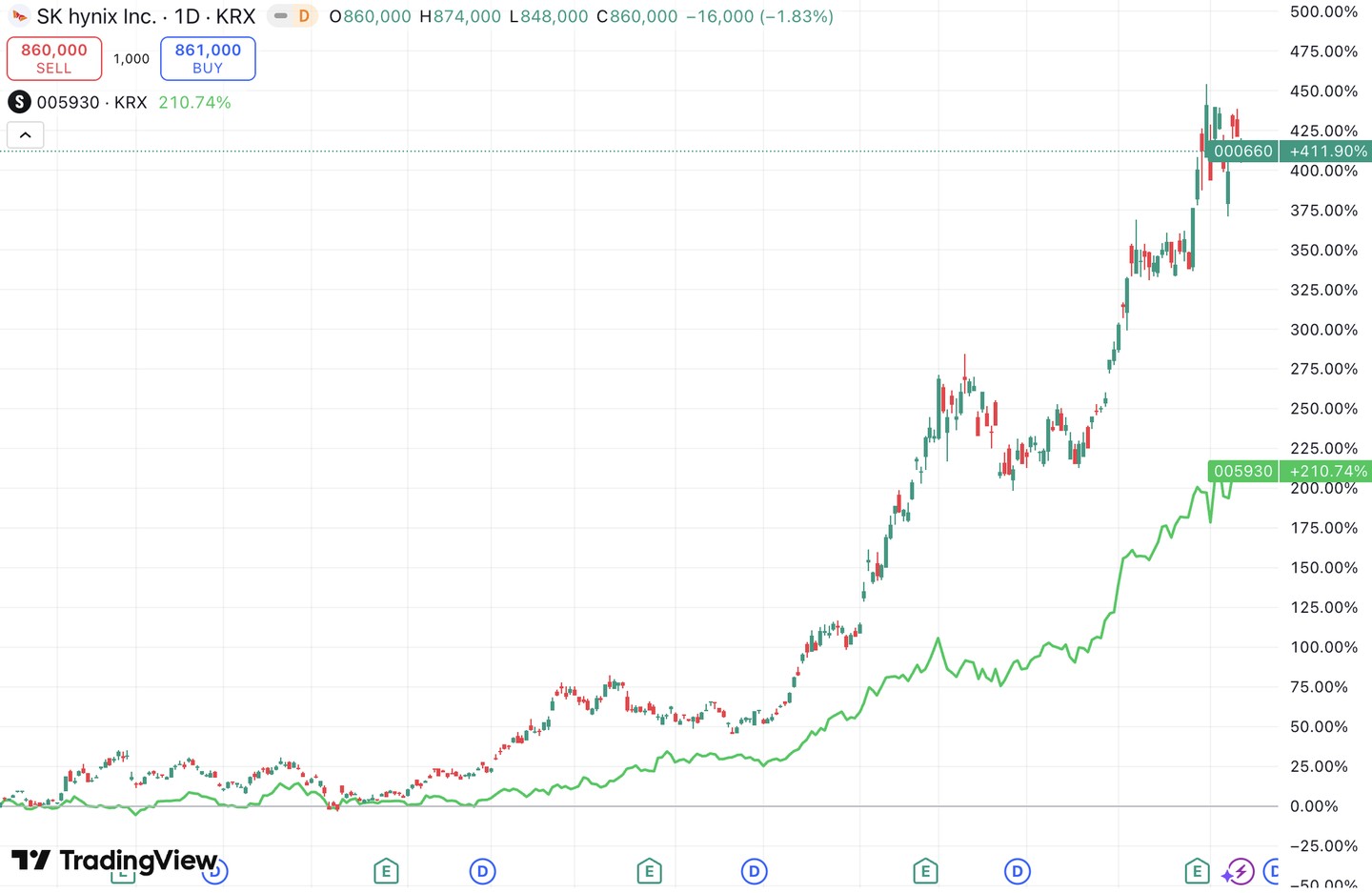
SK Hynix's market value has soared 340% in the past 12 months, reversing from a "zombie company" controlled by creditors to a price setter in the AI industry chain. With its first-mover advantage in HBM, it has deeply bound itself to NVIDIA and Microsoft amid the surge in AI demand, capturing over half of the global HBM market share; its market share surpasses Samsung, and its profit margin exceeds that of Taiwan Semiconductor
SK Hynix, leveraging its first-mover advantage in high-bandwidth memory (HBM), has transformed from a follower once regarded as a "zombie company" into a key price setter in the AI industry chain, amid the expansion of AI servers and a shortage of storage chips, achieving a surpassing performance over traditional strong players in terms of profitability and capital market performance.
The latest financial report highlights this leap. According to the Financial Times, SK Hynix's revenue in the fourth quarter increased by 66% year-on-year, with an operating profit margin of 58%, surpassing the world's largest foundry, Taiwan Semiconductor. Over the past 12 months, the company's market value has risen by approximately 340%, reaching 640 trillion Korean won.
The change in supply and demand structure is the core driving force. The phase shortages of HBM, DRAM, and NAND have driven up prices, with SK Hynix, as the leader in HBM, benefiting directly, leading to rapid profit margin expansion, and the market has thus adjusted its "leverage ratio" in the AI cycle.
More crucially, customer binding. SK Hynix has secured over half of the global HBM market share and is a major HBM supplier for NVIDIA, and "was recently selected by Microsoft as a supplier for its self-developed AI chips."
Against the backdrop of SK Group Chairman Chey Tae-won's proposal to use AI as the "fourth quantum leap," the company also plans to invest $10 billion, positioning itself from "making chips" to "AI solutions company," but competition, customer bargaining power, and geopolitical factors are simultaneously raising uncertainties.
Long-term Bet on HBM: R&D Priority and a "Battle-Ready" Organizational Culture
SK Hynix's turning point was not achieved overnight. The company was established in 1983 under the Hyundai Group conglomerate, and after the Asian financial crisis of 1997-1998 and the DRAM oversupply in the early 2000s, it survived as a "zombie" enterprise controlled by creditors for a long time. In 2002, Micron made a $3.2 billion acquisition offer, but the deal fell through as it refused to assume $6 billion in debt.
It wasn't until 2011 that SK Group acquired the company for 34 trillion Korean won, ending what outsiders referred to as "The Curse of Hynix." Chey Tae-won subsequently appointed senior engineer Park Sung-wook as CEO, who promoted a strategy of "long-term R&D over short-term financials," leading the team to continue investing even when HBM was not widely recognized.
The company's R&D spending grew at an average annual rate of 14% from 2010 to 2024. Chris Miller points out in his book that it was not until ChatGPT ignited demand for AI servers that SK Hynix's years of bets truly paid off.
HBM Shortage and AI Explosion, Driving Up Prices and Profit Margin Ceiling
The value of HBM lies in providing high-speed data throughput for AI training and inference, becoming a key bottleneck for AI servers. As demand surged, the shortage on the storage side began to dominate industry profit distribution, and SK Hynix's high profit margins are a result of this structural "squeeze effect." **
According to an HSBC research report, the HBM market size is expected to grow from USD 1 billion in 2022 to USD 16 billion in 2024, and is projected to reach USD 87 billion by 2027.
Professor Kwon Seok-joon from Sunkyunkwan University believes that the storage tightness may persist until the fourth quarter of 2027, stating, “Forward capacity has been locked in early, and everyone agrees that storage is the current bottleneck.”
During this cycle, SK Hynix's revenue has increased from 44.6 trillion won to 97.1 trillion won over the past three years, indicating that its benefit level has extended from “price up” to “share up.”
The Key Battle to Surpass Samsung: Over Half of the Market Share Bound to NVIDIA and Microsoft
In the core AI component of HBM, SK Hynix has “outperformed” more well-known chip companies, including long-time rival Samsung, capturing over half of the global HBM market share and becoming a major supplier for NVIDIA. Kwon commented that SK Hynix, which was previously a “follower,” is now becoming an industry “shaper.”
The quality of the customer structure is also improving. In addition to NVIDIA, the company has also “recently been selected by Microsoft,” entering its self-developed AI chip supply chain. Such orders not only signify current shipments but, more importantly, create first-mover barriers in defining next-generation products, customization capabilities, and yield requirements.
From Chips to “AI Solution Company,” USD 10 Billion Capital Expenditure Bets on the Next Phase
During the HBM boom period, SK Hynix has chosen to continue investing in AI. The company is preparing to invest USD 10 billion in capital, shifting its business focus from merely manufacturing chips to expanding into an “AI solution company.” Chey Tae-won stated that AI will become SK Group's “fourth quantum leap.”
The expansion is not limited to the chip sector. Last summer, SK and its affiliates, including SK Hynix, launched South Korea's largest AI data center project in Ulsan, with a scale of approximately 7 trillion won. Chey Tae-won mentioned at the event that the company will build “the most efficient AI infrastructure” through a combination of “semiconductors and power and energy solutions.”
“New Worship” and Capital Migration: SK Hynix Becomes the New Target for Young People in Korea
The change in industrial status is also reflected at the social level. According to the Financial Times, a survey of young job seekers shows that SK Hynix has replaced Samsung as the most favored employer in Korea. Seoul National University student Lim Hee-jin stated that it has “high future potential,” and if a friend joins, “they would be envious.”
For investors, this trend of “talent and capital concentrating on AI memory” means that SK Hynix's advantages come not only from a cycle of economic upturn but also from its position changes in HBM supply, customer certification, and technology iteration. The real test lies in whether the company can convert the current excess profits into product and ecosystem control in the next phase when HBM transitions from scarcity to normalization, and when customer demands increase and competitors close in
