Core inflation rebounds and gradually improves - January inflation data commentary

Wallstreetcn
2026.02.11 07:21
portai
I'm PortAI, I can summarize articles.

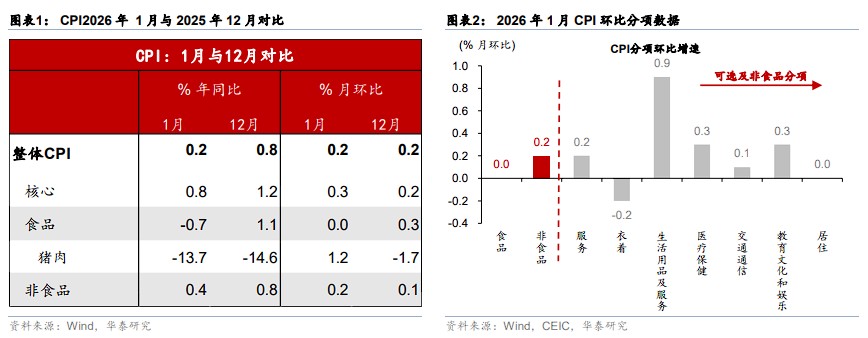
In January 2026, China's CPI increased by 0.2% year-on-year and remained flat at 0.2% month-on-month; the PPI's year-on-year decline narrowed to -1.4%. The Spring Festival effect impacted the January CPI, but a significant rebound is expected in February. The core CPI rose to 0.3% month-on-month, the highest in nearly six months, indicating a moderate recovery in domestic demand. External demand remains robust, and the rebound in service sector demand is expected to support the core CPI

In January 2026, China's CPI year-on-year was 0.2% (previous value 0.8%, Bloomberg consensus expectation 0.4%), and the month-on-month growth rate remained flat at 0.2% from December; PPI year-on-year was -1.4% (previous value -1.9%), slightly higher than Bloomberg consensus expectation of -1.5%, and month-on-month increased from 0.2% in December to 0.4%.

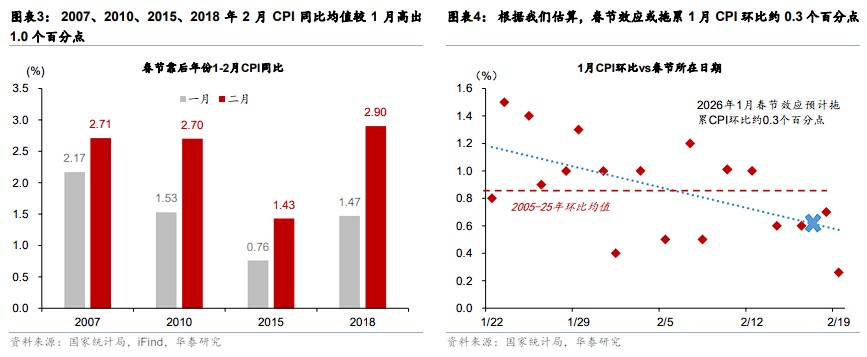
The misalignment of the Spring Festival suppressed the year-on-year reading of January CPI, but a significant rebound is expected in February. The core CPI continued to rise month-on-month, which may indicate a steady increase in the inflation center, with rising prices of non-ferrous metals and communications driving January PPI to exceed expectations. January CPI fell from 0.8% in December to 0.2%, remaining flat at 0.2% month-on-month. The year-on-year decline was mainly influenced by the Spring Festival effect, with a pulse-like rebound in consumer demand before and after the festival, which may have boosted the current CPI reading. However, this year's Spring Festival is later than last year, which may suppress January CPI but boost February CPI year-on-year (see "How the 2026 Spring Festival Effect Affects Macroeconomic Data - Preview of January Economic Activity Data." 2026/2/5). In years with similar Spring Festival dates (2015/18), January CPI recorded year-on-year rates of 0.8%/1.5%, while February saw a significant rise to 1.4%/2.9%. Notably, the core CPI continued its recovery trend, rising from 0.2% in December last year to 0.3% in January this year, the highest in nearly six months, indicating a mild recovery in domestic demand. Correspondingly, the month-on-month PPI for living materials also slightly rose from 0% in the fourth quarter of last year to 0.1% in January this year. The year-on-year decline in January PPI further narrowed from -1.9% in December last year to -1.4%, with a month-on-month increase of 0.4%, mainly driven by rising prices in the non-ferrous sector and the computer communications industry. The continuous promotion of a unified national market has also improved prices in industries such as cement, steel, batteries, and photovoltaics. However, coal/oil and gas prices remain a drag.

Looking ahead, high-frequency indicators show that external demand maintains a high level of prosperity, while on the domestic demand side, this year's Spring Festival travel is active, and hotel bookings and air ticket prices during the holiday have rebounded year-on-year, but construction starts and real estate transactions are relatively weak year-on-year. Considering the disciplined expansion of corporate capacity under the promotion of a unified national market, the optimization of the supply-demand structure is gradually becoming apparent. If total demand stabilizes and rebounds, PPI is expected to continue to narrow its decline, while the recovery in service sector demand is still expected to support improvements in core CPI. At the beginning of 2026, global PMI showed overall strength, with composite/manufacturing/service PMI rising month-on-month by 0.54/0.50/0.37 percentage points, respectively. In January, RatingDog's China Composite PMI further rose to 51.6, while South Korea's export growth surged from 13.4% in December to 33.9%, and further rose to 44.4% in the first ten days of February, indicating active global trade activities. Meanwhile, data at the meso and micro levels show that most traditional industries have gradually slowed their capacity expansion since mid-2023 The capital expenditure growth rate of all A-share non-financial real estate listed companies has slowed down after mid-2023, turning negative in the second quarter of 2024—continuing to decline for six consecutive quarters (see "Dialectical View on the 'Price Surge'", 2026/2/9). The focus going forward will be on the sustainability of real estate demand improvement in first- and second-tier cities after the holiday, as well as the downstream price transmission effects.

1. The Lunar New Year Shift Lowers January CPI Year-on-Year Reading

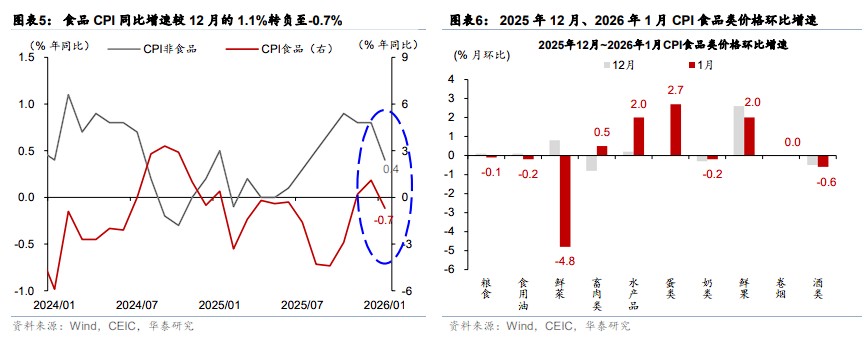
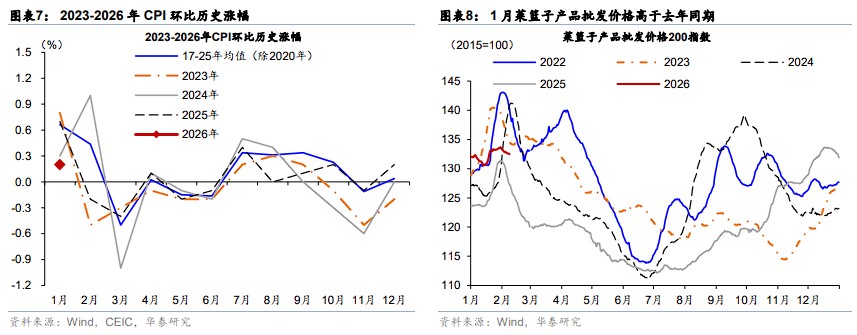
Under the influence of the Lunar New Year misalignment effect, the year-on-year growth rate of January CPI slowed from 0.8% in December last year to 0.2%, with the month-on-month growth rate remaining flat at 0.2% in December, lower than the seasonal level of 0.72% over the past decade (2016-2025, same below). In terms of components, food prices, under a high base, turned negative from 1.1% in December to -0.7%, impacting January's CPI year-on-year from a boost of 0.21 percentage points in December to a drag of 0.11 percentage points; non-food CPI year-on-year slowed from 0.8% in December to 0.4%, while month-on-month increased from 0.1% in December to 0.2%. Additionally, the core CPI, which is more related to domestic demand, slowed from 1.2% in December to 0.8% year-on-year, and slightly increased from 0.2% in December to 0.3% month-on-month, still significantly higher than the seasonal level of 0.2% in years with a similarly late Lunar New Year, reflecting a gradual recovery in core inflation and signs of continued stabilization in domestic demand. Specifically:

  • Under a high base, the year-on-year growth rate of food CPI turned negative from 1.1% in December to -0.7%, with its impact on the CPI year-on-year reading shifting from a boost of 0.21 percentage points in December to a drag of 0.11 percentage points, where the year-on-year growth rates of fresh vegetables/fresh fruits slowed from 18.2%/4.4% in December to 6.9%/3.2%; the year-on-year decline in pork prices slightly narrowed from 14.6% in December to 13.7%. Month-on-month, the growth rate of food CPI in January slowed from 0.3% in December to 0%, lower than the seasonal levels of 2.25%/1.7% in the past 10 years/late Lunar New Year years, with the month-on-month growth rate of pork turning positive from -1.7% in December to 1.2%, higher than the seasonal level of 0.72% over the past 10 years; the month-on-month growth rate of fresh vegetable prices turned negative from 0.8% in December to -4.8%, still below the seasonal levels of 9.87%/5.64% in the past 10 years/late Lunar New Year years.
  • Non-food CPI year-on-year slowed from 0.8% in December to 0.4%, and the core CPI year-on-year growth rate slowed from 1.2% in December to 0.8%. Year-on-year, service prices slowed from 0.6% in December to 0.1%, with its contribution to CPI also slowing from 0.25 percentage points in December to 0.05 percentage points; among the components, healthcare/living goods service prices increased by 1.7%/2.6% year-on-year, while rental prices decreased by 0.1% year-on-year In terms of month-on-month comparison, the non-food CPI increased from 0.1% in December to 0.2%. Among them, the prices of transportation and communication/education, culture, and entertainment rose from 0%/0.1% in December to 0.1%/0.3%. The prices of air tickets and travel agency fees increased by 5.7% and 2.0% month-on-month, mainly boosted by the approaching Spring Festival holiday and increased consumer demand for shopping and entertainment. The prices of daily necessities and services rose further from 0.4% in December to 0.9%, with the healthcare segment increasing from 0.1% in December to 0.3%, slightly above the seasonal level of 0.27%.

2. PPI Year-on-Year Decline Continues to Narrow, Month-on-Month Increase for Four Consecutive Months

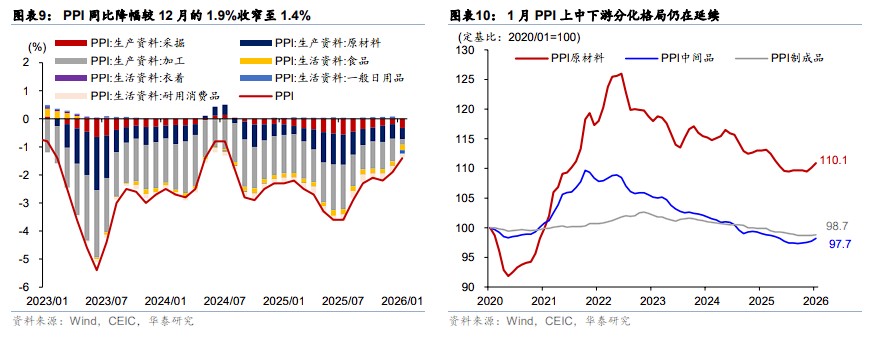
In January, the year-on-year decline of PPI narrowed from 1.9% in December to 1.4%, and the month-on-month growth rate increased from 0.2% in December to 0.4%. Among them, the prices of upstream products such as black and non-ferrous metals improved year-on-year, while the decline in international oil prices continued to weigh on domestic oil and coal-related industry prices. The differentiation among industries continues—PPI in non-ferrous metals, computer communications, and other industries improved significantly month-on-month, while the price decline in some industries continued to narrow under the marketization of "anti-involution." Specifically,

  • In January, the year-on-year decline of PPI narrowed for six consecutive months, with prices of non-ferrous and black metals rebounding year-on-year, while the decline in international oil prices continued to suppress domestic oil-related industry prices—the year-on-year decline of PPI narrowed from 1.9% in December to 1.4%, with the year-on-year decline of production materials narrowing from 2.1% in December to 1.3%, while the year-on-year decline of living materials widened from 1.3% in December to 1.7%. The decline in domestic energy prices continued to widen due to the drop in international oil prices, with the year-on-year decline in oil and gas extraction/processing widening from 11.5%/7.9% in December to 16.7%/11.5%, and the year-on-year decline in coal mining widening from 8.9% in December to 9.8%; the year-on-year decline in non-ferrous mining also fell from 24.0% in December to 22.7%, while the year-on-year growth rate of black mining rebounded from 1.8% in December to 3.0%. The year-on-year price changes in the midstream remained relatively stable, with the year-on-year decline in general equipment slightly narrowing from 1.7% in December to 1.3%, and the year-on-year decline in transportation equipment remaining flat at 0.3% in December. Domestic demand continued to recover moderately, and under the marketization of "anti-involution," prices in some industries rose, such as the manufacturing of cultural, educational, and sports goods, which increased by 21.2%, and the year-on-year decline in computer manufacturing narrowed from 2.2% in December to 1.6%.
  • In January, PPI increased by 0.2% month-on-month, with increased demand in some industries and the marketization of anti-involution driving PPI to record positive growth for four consecutive months, while the price trends in non-ferrous metals and oil-related industries showed differentiation—the month-on-month growth rate of PPI increased from 0.2% in December to 0.4%, with the month-on-month growth rate of production materials rising from 0.3% in December to 0.5%, and the month-on-month growth rate of living materials also rising from 0% in December to 0.1% In the upstream industry, the decline in international crude oil prices has dragged down the oil and gas extraction and processing sectors in January, further falling from -1.3% and -0.6% in December to -2.2% and -2.5%, respectively. In contrast, the non-ferrous selection/processing rose from 3.7%/2.8% in December to 5.7%/5.2%. Under the market-oriented promotion of the "anti-involution" policy, the prices of cement and lithium battery manufacturing both increased by 0.1% month-on-month, while photovoltaic equipment and chemical raw materials turned positive from -0.2%/-0.1% in December to +1.9%/+0.7%. In the downstream industry, the month-on-month growth rate of automobile prices rebounded from -0.1% in December to 0%, while the decline in pharmaceutical prices widened from 0.2% in December to 0.9%.

Risk Warning and Disclaimer

The market has risks, and investment requires caution. This article does not constitute personal investment advice and does not take into account the specific investment goals, financial conditions, or needs of individual users. Users should consider whether any opinions, views, or conclusions in this article are suitable for their specific circumstances. Investment based on this is at one's own risk