


The profits of US tech giants' "hegemony" coming to an end? Earnings growth is spreading across the entire industry

Financial report data shows that nearly half of the companies in the S&P 500 achieved double-digit growth rates, with a median growth rate close to 10%, setting a new high in four years. Analysts believe that the U.S. stock market is undergoing a clear style rotation, which is not driven by the decline of tech giants, but rather by cyclical factors that have improved the earnings of other sectors in the market. The previously rare era of profit concentration in the U.S. stock market may have come to an end
As the fourth quarter earnings season for U.S. stocks approaches its end, a fundamental shift is occurring in the dominance of profits by a few tech giants.
Since mid-December last year, the performance of the Russell 1000 Value Index has significantly outpaced that of its growth counterparts. The latest earnings reports show that the number of sectors in the S&P 500 achieving positive growth has increased from 6 in the third quarter to 8 (out of a total of 11 sectors), with nearly half of the companies achieving double-digit growth rates and a median growth rate close to 10%, reaching a four-year high.
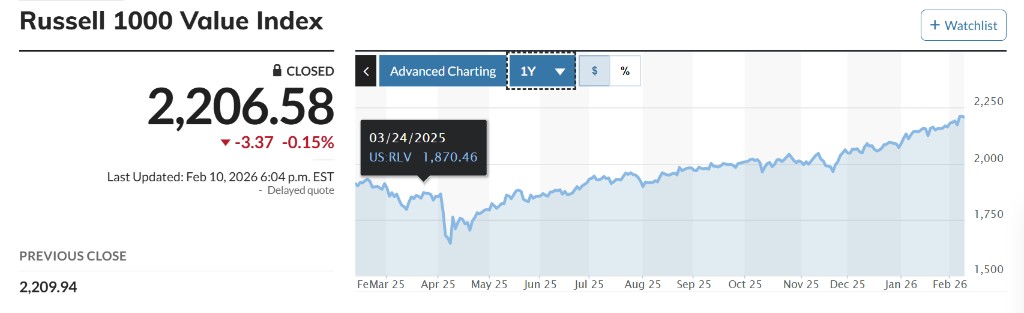
Bankim Chadha of Deutsche Bank pointed out that growth has begun to spread beyond the giant tech stocks. The overall earnings growth rate of the S&P 500 has slightly risen to a four-year high of 14.5%.
Bloomberg columnist John Authers analyzed that the market is undergoing a clear style rotation, which is not driven by the decline of tech giants but rather by cyclical factors that have improved earnings in other sectors of the market. The previously rare concentration of profits in U.S. stocks may have come to an end.
Although the story of artificial intelligence (AI) still dominates, the cooling job market and cyclical tailwinds are reshaping investor expectations. The decline in U.S. Treasury yields and changes in inflation data are providing a macro backdrop for this capital rotation from the "new economy" to the "old economy," a process that bears many similarities to the style switch from 2000 to 2003.
Value Reversion and Cyclical Recovery
The core issue of market concentration lies in the imbalance of earnings growth.
Since the end of 2022, the largest 10 companies in the S&P 500 have contributed about two-thirds of the index's earnings per share (EPS) growth, a proportion that was only one-quarter during the internet bubble period.
However, research models by ClearBridge's Jeffrey Schulze and Josh Jamner indicate that the U.S. economy is currently in a phase of "robust broad expansion," which typically benefits widespread corporate profits. The earnings reports disclosed by S&P 500 constituents confirm this trend.
Andrew Lapthorne of Société Générale believes it is somewhat ironic that the AI wave may be most destructive to those light-asset industries that previously enjoyed high valuations, as they are now forced to spend aggressively to avoid falling behind.
In contrast, last week saw a massive rotation towards "AI-immune" sectors, including utilities, food, mining, construction, and telecommunications. This shift of funds from "new" to "old" reflects the market's re-evaluation of capital-intensive and traditional industry valuations.
Exchange Rate Factors and the "NVIDIA Effect"
The weakness of the dollar has also had a significant impact on corporate earnings. FactSet's John Butters noted that S&P 500 export-oriented companies, which derive a significant portion of their revenue from outside the U.S., have seen both earnings and revenue growth exceed those of companies primarily focused on domestic business However, Butters also emphasized that the advantage of this "international risk exposure" largely still depends on Nvidia Corp. As the largest contributor to profits and revenue among S&P 500 companies with significant international business exposure, if Nvidia is excluded, the blended profit growth rate would drop from 17.7% to 12.0%, and the revenue growth rate would slow from 11.9% to 9.9%.
Thomas Mathews from Capital Economics warned that the current rally is still quite reliant on the business models of a few companies. In this case, any specific development or "expected misstep" in AI competition from any one company could drag down the entire market. However, the recent divergence among mega-cap stocks has not prevented the overall market from maintaining high levels, indicating that broad profit improvements driven by cyclical factors are supporting the market
