


AI panic "infection": New tools scare wealth management stocks, Charles Schwab drops over 9% during trading

Altruist launched an AI tool for tax strategy formulation on Tuesday, directly targeting the core business of traditional wealth management firms. Insurance brokerage stocks experienced a similar sharp decline on Monday after Insurify launched a new tool, with the S&P 500 Insurance Index falling nearly 4%, marking the largest drop since October last year. Last week, the tool released by Anthropic triggered a sell-off in software stocks, with Thomson Reuters experiencing a 20% drop for the first time in its history in a week
The threat of artificial intelligence (AI) to traditional business models is spreading in the stock market, expanding from software companies to more industries. Wealth management stocks have become the latest "victims."
On Tuesday, Eastern Time on the 10th, financial software provider Altruist Corp. launched an AI tool for tax strategy formulation, which can help financial advisors create personalized strategies for clients and generate payrolls, account statements, and other documents. This feature directly targets the core business of traditional wealth management firms.
The tool released by Altruist immediately raised concerns in the market about the business prospects of traditional wealth management companies. During Tuesday's trading, Charles Schwab (SCHW) fell as much as 9.5%, closing down 7.4%. Raymond James Financial Inc. (RJF) and LPL Financial Holdings Inc. (LPLA) saw intraday declines of over 9% and 11%, respectively, closing down nearly 9% and over 8%. Stifel Financial Corp. (SF) dropped more than 7% during the day, closing down 3.8%.
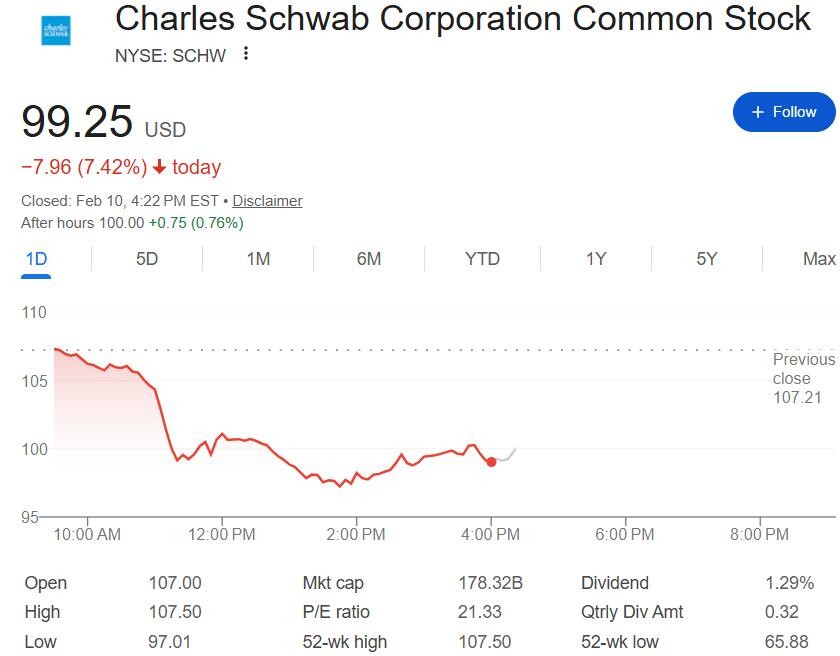
Neil Sipes, an analyst at Bloomberg Industry Research, stated, "This sell-off seems to be related to market concerns about AI disrupting the financial advisory and wealth management models." Investors may primarily worry about the erosion of efficiency gains due to competition, long-term fee compression, and potential market share shifts.
Sipes pointed out that current investor focus is on the competitive pressure brought by efficiency improvements, as well as the potential long-term fee compression and market share shifts that may result. This concern reflects a reassessment by the market of AI tools' ability to replace human services.
The day before the plunge in wealth management stocks, insurance brokerage stocks had just experienced a similar setback. Last week, a new tool released by AI startup Anthropic triggered a massive sell-off in software stocks, exposing the market's deep anxiety about AI disrupting traditional industries.
Insurance Brokerage Stocks Hit Hard on Monday
The day before the plunge in wealth management stocks, insurance brokerage stocks had just felt the impact of AI tools. The S&P 500 Insurance Index closed down 3.9% on Monday, marking the largest single-day decline since October 2025.
Willis Towers Watson PLC saw a decline of 12% that day, the largest drop since November 2008. Arthur J Gallagher & Co. fell 9.9%, and Aon PLC dropped 9.3%.
Matthew Palazola, an insurance industry analyst at Bloomberg Industry Research, stated that the sell-off may be related to the new AI tools launched by the private online insurance shopping platform Insurify and Anthropic's new tool. Insurify's application uses ChatGPT to compare auto insurance rates, allowing users to input vehicle information, customer credit history, driving records, and other details to complete the comparison. The application was launched on February 3rd Palazola pointed out, "These applications may pose a threat to some consulting businesses of insurance brokers, but we believe they are more like efficiency amplifiers rather than existential threats."
Anthropic Triggers Software Stock Sell-off
Concerns about AI applications disrupting multiple industries surged into the stock market last week, ignited by the new tools released by AI startup Anthropic. These tools are designed to automate work tasks across various fields, from legal services and data services to financial research.
Following the announcement, investors sold off large amounts of stock, with companies ranging from Expedia Group Inc. to Salesforce Inc. and the London Stock Exchange Group not escaping the fallout. Before a rebound in stock prices last Friday as bottom-fishing funds entered the market, the widely watched software ETF iShares Expanded Tech-Software Sector ETF (IGV) had cumulatively dropped about 12% over the first four trading days of last week.
Shares of Thomson Reuters, listed in Canada, plummeted 20% last week, marking the largest single-week decline since the company went public in the 1990s. Financial research firm Morningstar Inc. experienced its worst week since 2009. Software developers HubSpot Inc., Atlassian Corp., and Zscaler Inc. all saw declines exceeding 16%.
Media statistics show that the combined market value of 164 stocks in the software, financial services, and asset management sectors evaporated by $611 billion last week.
Disruption Threat Becomes a New Market Reality
Daniel Newman, CEO of Futurum Group, commented last weekend: "The situation is evolving every week, every day. The range of companies potentially affected by AI is expanding daily."
Since the launch of OpenAI's ChatGPT at the end of 2022, the disruptive potential of AI has been a hot topic. However, until last week, market attention was primarily focused on the beneficiaries. With hundreds of billions invested in computing power, investors have been enthusiastic about stocks of chip manufacturers, networking equipment companies, energy suppliers, and material producers seen as beneficiaries.
This strategy has yielded substantial returns. Since the end of 2022, indices tracking semiconductor-related stocks have more than doubled, while IGV has risen 61% and the S&P 500 has increased by 81%.
However, companies like Anthropic, OpenAI, and Google have rapidly pushed new tools to market, making the long-theoretical disruption feel more imminent. In just the past month, Google has impacted video game stocks with a tool that creates immersive digital worlds through simple images or text prompts. Meanwhile, the work assistant based on Claude coding services released by Anthropic has triggered a plunge in software stocks.
KeyBanc software analyst Jackson Ader stated, "If your performance and guidance do not meet expectations, it raises questions: What confidence can we have in the entire sector?" Traditional software manufacturers have been hit particularly hard. Salesforce has fallen 48% from its historical peak in December 2024, and ServiceNow has dropped 57% since reaching its peak in January 2025.
According to data from Goldman Sachs' prime brokerage, software has been the category with the highest net selling among all sectors this year. As of February 3rd, hedge funds' net exposure to software has fallen to a historical low of less than 3%, compared to a peak of 18% in 2023.
However, data compiled by Bloomberg Industry Research shows that Wall Street analysts' views on profit prospects are actually improving. Analysts expect that the earnings of S&P 500 software and services constituents will grow by 19% in 2026, up from a forecasted increase of 16% a few months ago.
Michael Mullaney, Global Market Research Director at Boston Partners, stated, "Everyone is assuming that operating metrics will bottom out. I am skeptical about this. Even if there is disruption, profits and profit margins may ultimately remain strong. If I were a growth fund manager, I would buy on the dips."
