Reviewing the price increase in the lithium battery industry chain: The current point in time is similar to Q4 2020, with both volume and profit expected to rise

Wallstreetcn
2026.02.10 07:25
portai
I'm PortAI, I can summarize articles.

The lithium battery industry chain is currently in a critical time window after experiencing three years of price decline. Dongxing Securities report points out that the current stage is similar to the fourth quarter of 2020, with demand exceeding expectations, price bottom testing, and low corporate profitability, leading to suppressed willingness to expand production. It is expected that the industry chain will enter a recovery channel of "dual increase in volume and profit." Looking back at 2020-2022, demand exceeding expectations drove systemic price increases, with significant rises in prices of electrolytes, lithium carbonate, etc., and the midstream's ability to transmit price increases to the upstream is strong

After experiencing three years of price decline and profit squeeze, the lithium battery industry chain is re-entering a critical time window.

Dongxing Securities Co., Ltd. pointed out in its latest in-depth industry report that through a systematic review of the complete price increase cycle of the lithium battery industry chain from 2020 to 2022: the current stage of the industry is highly similar to that of the fourth quarter of 2020—demand has exceeded expectations, prices are in a bottom-testing phase, and corporate profits are at historical lows, but the willingness to expand production is significantly suppressed.

Under this combination of conditions, the industry chain is expected to re-enter a "dual increase in volume and profit" recovery channel, rather than a simple emotional rebound.

Looking back at 2020-2022: A round of systematic price increases triggered by demand exceeding expectations

Reviewing the last round of lithium battery price increases, the core was not a supply shock of a single material, but rather demand exceeding market expectations for two consecutive years.

Since the second half of 2020, domestic new energy vehicle sales have rapidly recovered and accelerated, with penetration rates quickly rising from 4%-5% to nearly 10%. Leading battery manufacturers, represented by CATL, have repeatedly raised their production guidance, and the industry's shipments in 2021-2022 significantly exceeded initial forecasts. Against the backdrop of sustained demand exceeding expectations, the price system of the industry chain began to loosen from the bottom up.

From the perspective of the pace of price increases, the last cycle showed a clear transmission path:

Electrolyte (lithium hexafluorophosphate) started first → Lithium carbonate rebounded slightly → Processing fees for positive and negative electrodes increased → Lithium carbonate entered a main upward wave → Comprehensive price increases for batteries and complete vehicles.

Among them, the price of lithium hexafluorophosphate started from a bottom of 70,000 yuan/ton in the third quarter of 2020, reaching a peak of 580,000 yuan/ton in early 2022; lithium carbonate, under the mismatch of supply and demand and restocking behavior in the second half of 2021, saw price increases far exceeding market expectations, once soaring to 600,000 yuan/ton.

More importantly, during the strong demand phase, the midstream has a strong transmission ability for upstream price increases:

  • The profits of electrolytes and battery ends have significantly expanded;
  • Positive electrode material companies, under the "m-1 pricing" mechanism, amplified profit elasticity through inventory gains;
  • Complete vehicle manufacturers, during the rapid sales growth phase, were also able to smoothly pass cost pressures onto end consumers.

Why does it say "now is more like Q4 2020"?

Dongxing Securities Co., Ltd. believes that the current position of the industry is highly similar to that of the fourth quarter of 2020 in several key dimensions.

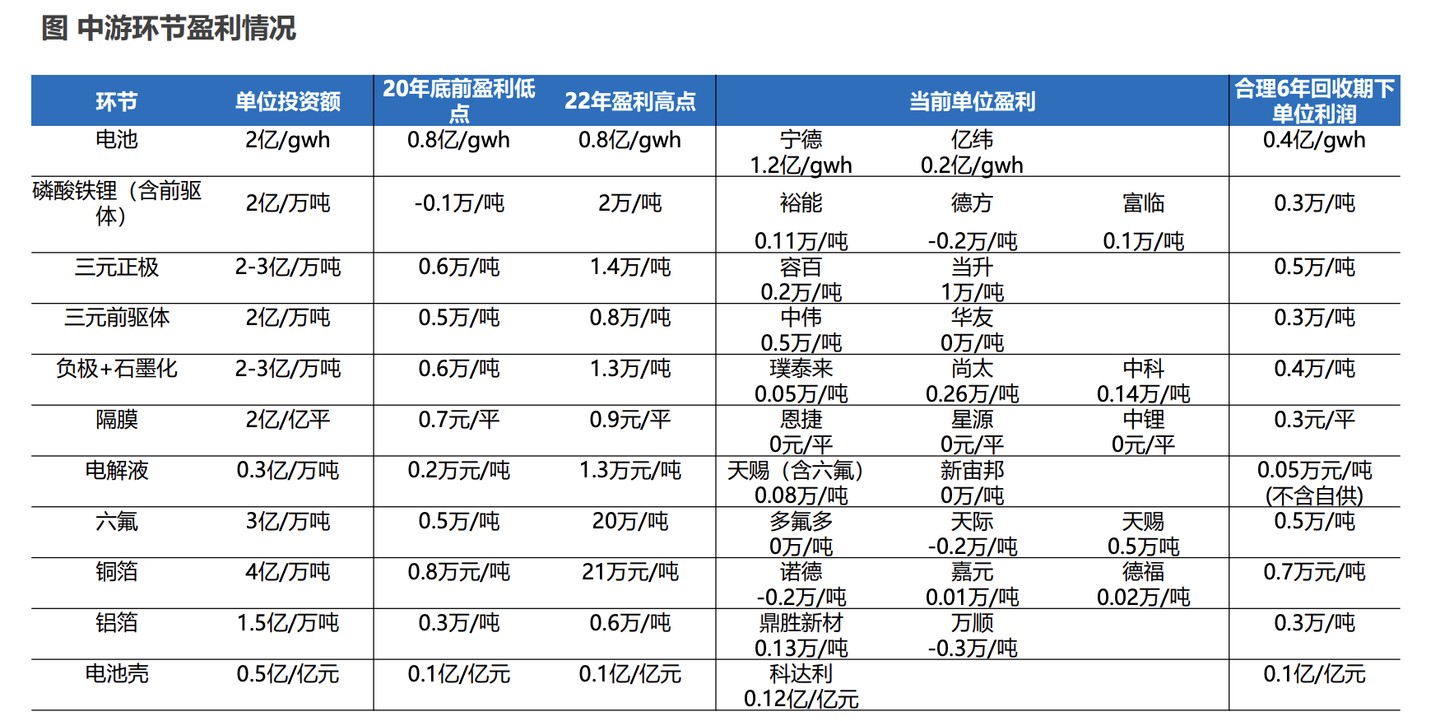
First, the position of prices and profits is lower. Whether it is lithium hexafluorophosphate, processing fees for positive electrodes, or lithium carbonate prices, they are all significantly lower than the levels before the last cycle started, and industry profits have been at low levels for nearly three years, with corporate price increase demands clearly stronger than in 2020.

Second, the willingness to expand production is significantly weaker than in 2021. Unlike the last cycle of "raising prices while expanding production on a large scale," this round of the industry has experienced overcapacity and a contraction in capital expenditures, leading to a noticeable slowdown in the release of new supply Dongxing Securities Co., Ltd. estimates that the supply-demand tightness in key areas will be around 80%-90% in 2026. Although this is not as extreme as the shortages in 2021, it is sufficient to support price elasticity.

Third, the "unexpected" demand is replaying, but the structure has changed. The core of this round of demand increase is not solely driven by new energy vehicles, but more from the continuous expansion of energy storage. Energy storage is more sensitive to prices, but under the current cost structure, even if battery prices rise by 4-5 cents/Wh, the impact on project IRR is relatively limited, providing realistic space for price recovery in the midstream materials and battery sectors.

It is important to emphasize that this round of increase is more likely to be a "moderate recovery," rather than the explosive growth seen in 2021-2022. The convergence of supply-demand gaps and the increased sensitivity of end prices will constrain the slope of price increases, but will not change the direction of the profit bottom rising.

Not a replay of history, but a rhyme

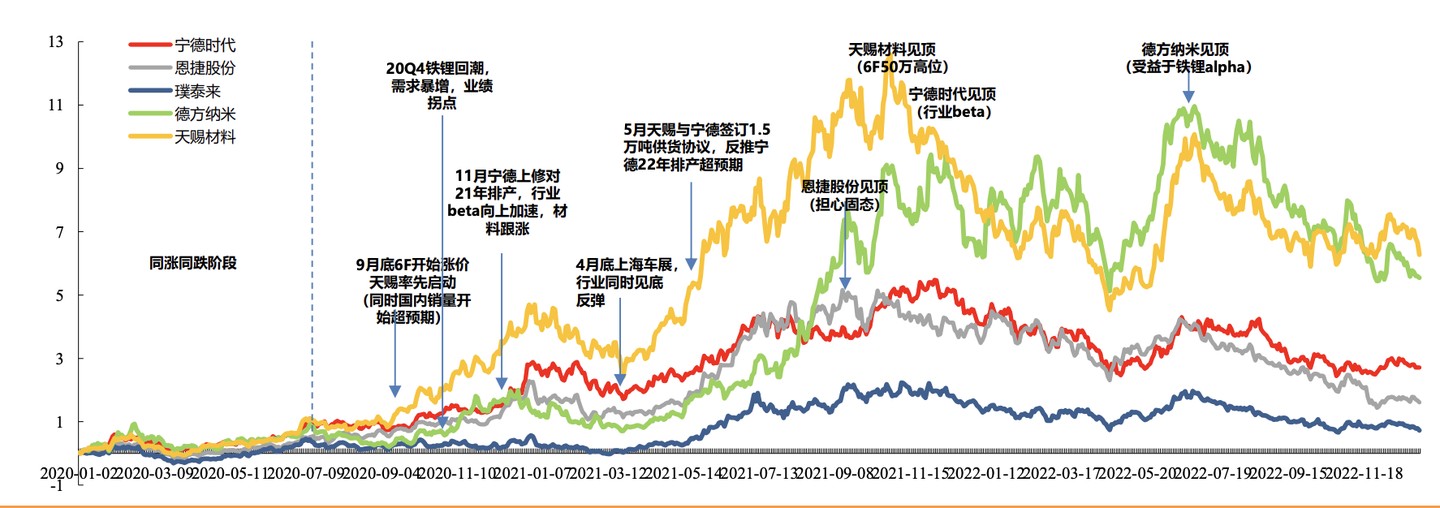
In terms of stock prices, the lithium battery sector has gone through a complete process from "dual increase in profits and valuations" to "double kill" from 2020 to 2023. Currently, most leading companies are generally valued below 20 times, assuming that profits will only recover to a relatively reasonable level in 2026; while the industry still has about 20% growth potential in 2027.

Compared to mid-2021, when profits peaked and valuations switched to forward high growth with pricing often exceeding 30 times, the current lithium battery sector is closer to a combination state of "profit bottom + valuation bottom." This is also an important reason why Dongxing Securities believes that it is more appropriate to re-examine lithium battery assets from an industrial cycle perspective rather than a short-term speculative perspective.

History will not simply replay, but cycles often rhyme.

Considering the four dimensions of demand, supply, price, and valuation, the current lithium battery industry chain resembles that of the fourth quarter of 2020:

  • Demand is starting to exceed expectations;
  • Prices are in a tentative recovery phase;
  • Corporate profits have been fully cleared at low levels;
  • A new round of capital expenditures has not yet been launched on a large scale.

In this context, the lithium battery industry chain is not heading towards an emotional rebound, but rather entering a mid-term upward window dominated by "volume and profit recovery." For investors, what is truly worth paying attention to may not be whether prices can replicate the heights of the previous round, but whether the profit curve has confirmed an upward turning point.

Risk warning and disclaimer

The market has risks, and investment requires caution. This article does not constitute personal investment advice and does not take into account the specific investment goals, financial conditions, or needs of individual users. Users should consider whether any opinions, views, or conclusions in this article are consistent with their specific circumstances. Investment based on this is at one's own risk