SpaceX's major shift! Musk changes his tune: Mars is too far, the Moon is faster, aiming to build a "lunar city" within ten years

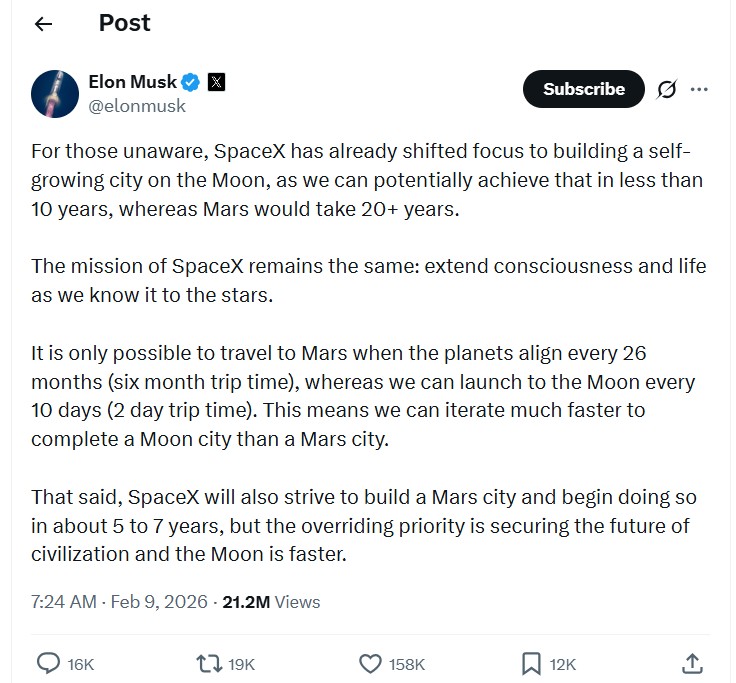
From "directly heading to Mars" to a sudden shift towards landing on the Moon in 2027, Musk's strategic turnaround. This man, who once claimed that "the Moon is a distraction," has finally shifted from romanticism to pragmatic business. He admitted that SpaceX has shifted its focus to building cities on the Moon, which is expected to be achieved within the next 10 years, while traveling to Mars will take more than 20 years
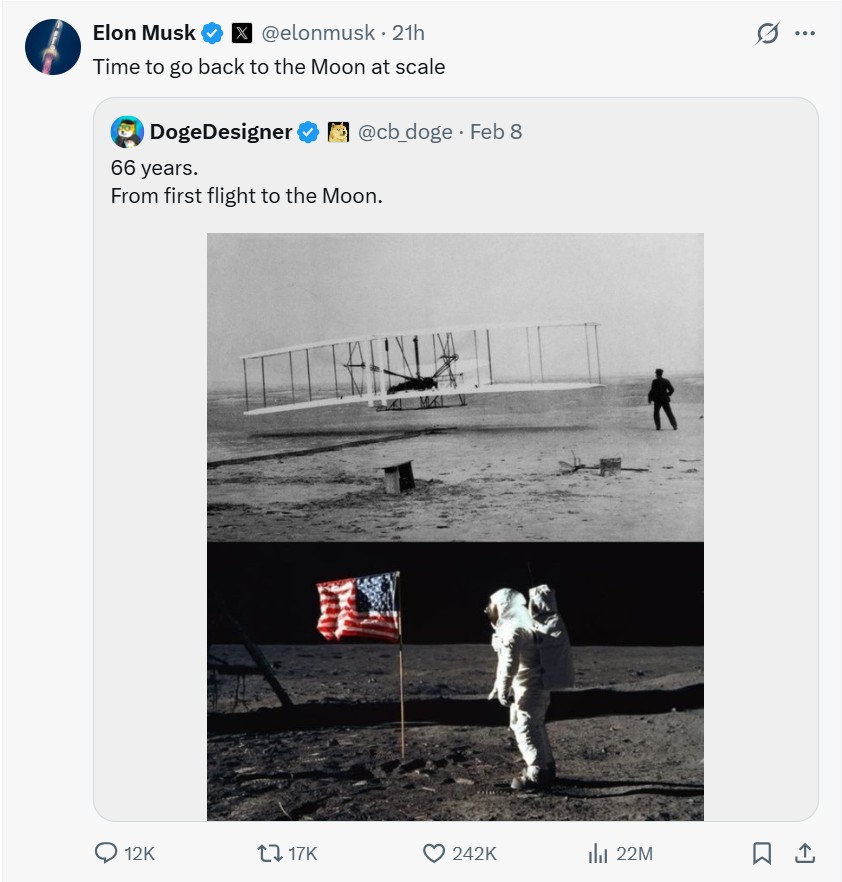
"Time to go back to the Moon at scale."

Just this past weekend, Musk announced this statement on the X platform, heralding the arrival of a new era in space exploration.
This tech mogul, who has repeatedly shouted "Mars first," suddenly made a 180-degree turn. According to an exclusive report from The Wall Street Journal, SpaceX has officially shifted its strategic focus, temporarily shelving the Mars plan to fully sprint towards the lunar mission scheduled for March 2027.
From Mars Dreams to Lunar Pragmatism
This shift is quite dramatic.
For over a decade, Musk has regarded Mars colonization as SpaceX's ultimate mission. He has repeatedly emphasized in numerous occasions: "The Moon is a distraction; we must head straight for Mars."
But reality has ultimately triumphed over romance. Musk admitted on social media:
SpaceX has shifted its focus to building a self-expanding city on the Moon, as we expect to achieve this goal within 10 years, while reaching Mars will take over 20 years.

The reality of the time window has become a key factor: the opportunity to go to Mars is limited to every 26 months during planetary alignments (with a travel time of 6 months), while the lunar launch cycle can be shortened to every 10 days (with a travel time of 2 days). This means that the construction iteration speed of the lunar base will far exceed that of Mars.
Of course, Musk emphasized that this does not mean giving up on Mars:
SpaceX will still be committed to building a Martian city, with plans to initiate related work within 5 to 7 years.
The Birth of a Trillion-Dollar Behemoth: The New Blueprint for a Space Empire
Behind this strategic shift is an epic integration of capital and technology.
SpaceX has officially acquired xAI, and the merged valuation has soared to $1.25 trillion, making it the most valuable private company in the world. Meanwhile, market rumors suggest that SpaceX may launch an IPO later this year, with fundraising potentially reaching $50 billion.
Even more shocking is the new vision for space commerce that Musk has outlined: a space AI data center. In a 3-hour in-depth interview last week, Musk elaborated on this crazy idea—
"Space is always sunny, with no day-night cycle, cloud cover, or atmospheric interference. The efficiency of solar panels is five times that on the ground, and there is no need for battery storage." Elon Musk asserts that within 36 months, space will become the cheapest place to deploy AI, costing only one-tenth of that on Earth.
Space Computing Power: Surpassing Earth's Total in Five Years
In that marathon interview, Musk made a more radical prediction:
In five years, I expect the AI computing power we launch and operate in space each year will exceed the total AI computing power on Earth.
This is not just talk. According to the plan, SpaceX needs to launch about 100 gigawatts of solar energy and computing power payloads into orbit each year, equivalent to 10,000 Starship launch missions—almost once every hour.
"The output of chips is growing exponentially, but the power output is flat. So how do you plan to power the chips? With magic energy?" Musk bluntly stated that the power bottleneck on Earth will become the ceiling for AI development, and space is the only solution.
AI + Robotics: The Only Opportunity to Enhance American Manufacturing
Behind the strategic shift lies deeper industrial concerns.
In the interview, Musk rarely warned about the decline of American manufacturing. His solution is: Optimus humanoid robot + xAI digital human.
Musk referred to Optimus as an "infinite money printer," emphasizing that "digital intelligence, AI chip capabilities, and electromechanical dexterity are all growing exponentially, and their product is the capability of robots."
xAI aims at the trillion-dollar "digital employee" market. "By the end of this year, if digital human simulation has not been solved, I would be surprised," Musk predicted, stating this would be the limit of what AI can do before physical robots exist.
Real Resistance and Time Urgency
Idealism is rich, but reality is stark.
NASA's "Artemis 2" rehearsal has just been postponed to March due to a liquid hydrogen leak, ringing alarm bells for SpaceX. To meet the lunar landing schedule in March 2027, the company needs to frequently launch Starships and prove its capability for in-orbit refueling—technologies that have yet to be fully conquered.
Meanwhile, Bezos's Blue Origin is attempting to get ahead with a simplified system. In January, Blue Origin announced it would suspend its space tourism business to fully focus on its lunar landing plans.
Musk is acutely aware of the urgency of time:
We just need enough time to build AI and robots so that we can finish before the (nation) goes bankrupt.
From Mars fantasies to lunar landings, from ground computing power to space data centers, this tech visionary once again pushes the boundaries of human imagination.
As he said at the end of the interview:
If you want to climb the Kardashev civilization scale, the only way is to go to space and harness the energy of the sun.
This time, he chooses to start with the moon