After ten years of effort, "all efforts were in vain," Glencore and Rio Tinto's "mining century merger" ultimately did not succeed

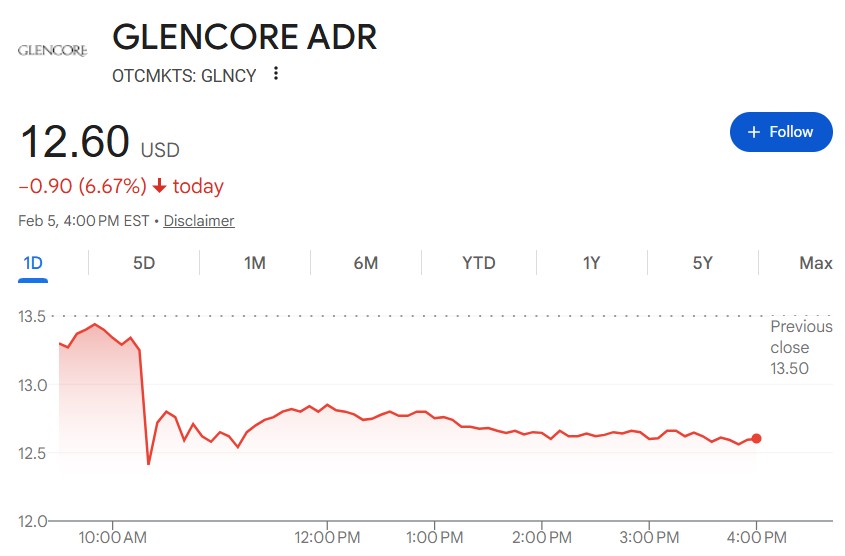
According to Bloomberg, on February 5th local time, Glencore and Rio Tinto's negotiations completely broke down. Glencore insisted on holding a 40% stake in the merged company, while Rio Tinto executives ultimately realized that prolonging the negotiations would be a waste of time and decided to terminate the deal. After the deal fell through, Glencore's ADR stock price plummeted over 6% that day, and investors began to question its ability to independently develop its copper business
Glencore and Rio Tinto's decade-long dream of a mining merger has ultimately shattered.
According to Bloomberg, on February 5 local time, negotiations between Glencore and Rio Tinto completely broke down. Glencore insisted on holding a 40% stake in the merged company, while Rio Tinto executives ultimately realized that prolonging negotiations would be a waste of time and decided to terminate the deal.
The failure of this transaction represents a significant setback for both parties. Glencore's copper production has declined by more than 40% over the past decade and is struggling to convince investors that its business has transformed. Meanwhile, Rio Tinto had hoped to use this deal to reduce its excessive reliance on the iron ore market.
After the deal fell through, Glencore's ADR stock price plummeted over 6% on the same day, as investors began to question its ability to independently develop its copper business.

The Collapse in the Last 24 Hours
According to Bloomberg, Rio Tinto hired Evercore, led by seasoned British dealmaker Simon Robey, as well as JP Morgan and Macquarie Group as advisors.
The report noted that Glencore brought in seasoned dealmaker Michael Klein, who had previously worked with them during the failed acquisition of Teck Resources in 2023.
Klein's core task was to convey the value of Glencore's business to Rio Tinto executives, while Glencore founder Glasenberg, as the largest shareholder, became more actively involved as the deadline approached, partly to alleviate Rio Tinto's concerns about his reluctance to reach a deal.
However, 24 hours before the deadline, the situation suddenly deteriorated. Rio Tinto internally became increasingly aware that Glencore and Glasenberg would not make significant concessions on the 40% stake demand.
On Glencore's side, they were frustrated that Rio Tinto linked the offer to the stock price on the day the deal was made public. Glencore believed that this arbitrary ratio did not reflect the past and future performance of both companies.
According to more than six insiders interviewed by Bloomberg, as negotiations continued on Thursday morning, Rio Tinto still hoped that Glencore would show a willingness to lower its asking price. Glencore CEO Nagle and Rio Tinto CEO Trott had two calls in an attempt to break the deadlock.
But as the deadline approached, it became clear that postponing would be meaningless. During their last call, Nagle and Trott discussed how to announce the deal's collapse to investors.
Under UK rules, unless a competitive bidder emerges or Glencore formally requests to restart negotiations, the two parties cannot negotiate again for at least six months.
Negotiation Process and Points of Disagreement
Glencore CEO Gary Nagle laid the groundwork for negotiations last summer.
He informally reached out to seasoned executive Simon Trott, who had just taken over as CEO of Rio Tinto. After Trott became familiar with his new role, the two sides officially launched negotiations in December, with Rio Tinto Chairman Dom Barton also playing a leading role The secret negotiations concluded in early January, when the Financial Times first reported that talks were underway. This initiated a countdown: According to UK takeover rules, Rio Tinto must make an offer, withdraw, or seek an extension by 5 PM London time on February 5.
In the early stages, the heads of both companies were largely kept out of the loop, as Rio Tinto's deal team and advisors made multiple trips to Glencore's headquarters in Switzerland for due diligence. This was a daunting task, as Glencore's operations are extremely complex, encompassing mines, smelters, refineries, and a vast trading and logistics business.
As due diligence progressed, both sides believed that given the substantial workload, the possibility of an extension was high. No red flags were found during due diligence, with the key issue being the price Rio Tinto needed to pay. The goal set by both parties was to make a takeover offer before announcing results in mid-February.
For mining billionaire Ivan Glasenberg, the merger of Glencore and Rio Tinto is the deal he has longed to achieve for over a decade. The founder who transformed Glencore from a commodity trader into a mining giant has made several attempts to facilitate this union.
In the past month, this dream seemed within reach. The two sides initiated merger talks for at least the fourth time, with nearly all participants believing this was the most serious attempt ever. But within less than 24 hours, everything suddenly collapsed.
Strategically Significant Deal
This deal holds significant strategic value for both parties.
Glencore's copper production has declined by over 40% in the past decade, and it is striving to prove to investors that its business has turned a corner, coinciding with a surge in the price of this key industrial metal.
Rio Tinto sees itself as one of the industry's most astute operators, hoping to unlock the growth potential of Glencore's copper asset portfolio through this deal. Without this transaction, Rio Tinto's profit outlook would continue to be tied to the iron ore market, which is facing dual pressures of increased supply and weak demand.
The merger of the two companies would allow Rio Tinto to surpass BHP and become the world's largest mining company. Glencore's vast coal and copper operations, along with its commodity trading division, would be integrated with Rio Tinto's massive iron ore business. For Rio Tinto, the key is that copper production would double, potentially establishing it as the world's largest copper miner and adding 1 million tons of future capacity.
Despite previous attempts to integrate Glencore's aggressive mining and trading operations into Rio Tinto's conservative corporate culture quickly falling apart, the risk of inaction is rising as competitors are also seeking significant copper mine acquisitions, making the opportunity hard to ignore.
Market Impact and Future Speculation
Glencore's stock price dropped 7%, highlighting the impact of the failed deal on company executives and investors, with analysts beginning to question whether the company can develop its copper business independently.
For Rio Tinto, the continued decline in iron ore prices serves as a reminder of the risks associated with withdrawing from the industry's largest-ever deal, and the industry quickly shifted focus to whether competitive bidders would emerge.
RBC Capital Markets analyst Ben Davis stated in an email report:
We have always believed that BHP is the most likely to get involved. Now BHP has the opportunity to take action, but the challenge lies in how to explain to value-focused Australian investors how they can see the value in Glencore that Rio Tinto cannot