The center of the "Software-PE" death spiral, the three giants of American PE continue to plummet, KKR and Blue Owl acknowledge financial challenges in conference calls

Affected by concerns over AI disrupting the software industry, American private equity giants are facing multiple challenges including a slowdown in financing, delayed exits, and redemption pressures. KKR warned that delaying asset sales will impact earnings in 2026, while Blue Owl's fee growth expectations plummeted from 20% to a "moderate" level. The core reason lies in the collapse of the "bond-like" stability logic of SaaS assets and the rising risk of bad loans
Amid concerns that AI is disrupting the software industry, American private equity giants are facing multiple challenges, including a slowdown in financing, delays in asset exits, and rising redemption pressures. For the past decade, software assets have been a core area of private equity investment, but this foundation is now shaking, threatening the industry's growth logic and profit model.
On February 5th, KKR and Blue Owl issued warnings about their financial outlook for 2026 during their earnings call. KKR's Chief Financial Officer Robert Lewin stated that if the market environment worsens, the company may delay some asset sales this year, which would reduce cash flow and lead to a decline in earnings for 2026.
Blue Owl disclosed that its redemption requests for credit funds have increased, causing the company to fail to meet its long-term growth targets. It expects that the growth of expenses in 2026 will only be at a "moderate" level, significantly slowing from the approximately 20% growth in assets and expenses in 2025.
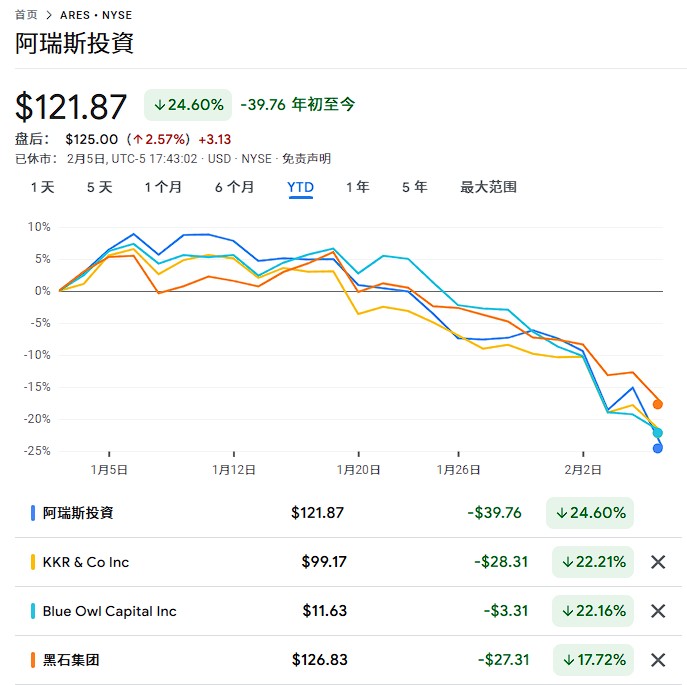
On Thursday, the stock prices of the three major U.S. private equity firms fell across the board. Ares plummeted over 11% to $121.87, KKR dropped 5.5% to $99.19, and Blue Owl fell 3.8% to $11.65. So far this year, the stock prices of these three companies, along with their private equity peers including Blackstone, have all declined by over 15%, as investors reassess their growth prospects.

The core of this sell-off is a fundamental shift in market logic. Over the past decade, the Software as a Service (SaaS) industry has become the most favored asset class in private credit due to its stable recurring revenue (ARR).
However, as the risk of AI replacing coding and data analysis capabilities rises, the stability logic of this "bond-like" asset is collapsing. According to an article mentioned by Wall Street News, Bloomberg Intelligence data shows that over $17.7 billion in loans to tech companies have fallen into bad status in the past four weeks.
Analysis indicates that this volatility is prompting private equity firms to consider delaying asset sales—this will affect their ability to generate substantial performance fees, while overall asset growth is also slowing due to investors withdrawing from certain funds or delaying new investments.
Delayed Asset Exits and Intensified Redemption Pressures
Market volatility is directly impacting the core business model of private equity firms. Delays in asset sales mean that performance fee income is postponed, while redemption pressures threaten the continued growth of assets under management.
Robert Lewin stated during the conference call that if the environment does worsen, delays in asset sales will lead to profits being realized in subsequent years, but he emphasized that KKR feels "very favorable" about the future.
Blue Owl's Chief Financial Officer Alan Kirshenbaum stated that in the face of rising redemption requests, this technology-focused private equity firm will only achieve "moderate" expense growth in 2026 Analysis suggests that this cautious guidance marks a significant slowdown, as the company had set ambitious goals last year, planning to manage over $500 billion in assets by 2029, with annual fee-related earnings exceeding $3.1 billion.
Despite facing challenges, the performance of the three institutions in the fourth quarter was mixed, but asset scale saw substantial growth. Ares recorded a record $34.4 billion in capital inflows during the three months ending last December, pushing its managed assets to a new high of $623 billion.
KKR's assets grew by 17% year-on-year to $744 billion, with fee-related earnings increasing by 15%, in line with expectations, but adjusted net income was $1.12 per share. Performance was dragged down by two factors: the group refunded over $200 million in performance fees to clients of its 2013 Japan fund, and asset sale gains fell short of analyst expectations.
Blue Owl raised $12 billion in capital commitments, along with an additional $5.3 billion in fund leverage, bringing total managed assets to $307 billion. Its $417 million in fee-related earnings grew by 22% year-on-year, exceeding Wall Street expectations, but the $187 billion in fee-paying assets was slightly below analyst forecasts from Bloomberg.
Software Exposure Becomes a Focus, Executives Seek to Assure
During the earnings call, analysts intensely questioned KKR, Ares, and Blue Owl executives about their loan exposure to software companies, and whether AI would lead to increased default rates and significant losses.
Blue Owl CEO Marc Lipschultz took a firm stance, calling the notion of software companies being massively outdated "absurd," and stated that the group's loan portfolio "mathematically cannot" experience a surge in defaults.
"We are not seeing significant losses. We are not seeing portfolio deterioration," he said, estimating that companies borrowing from Blue Owl saw a 14% profit increase last quarter.
KKR Co-CEO Scott Nuttall stated that its deal team has been preparing for AI-related disruptions for years, having sold off companies deemed vulnerable. "Our level of anxiety is quite low because we have been thinking about this issue for the past few years," Nuttall said, predicting that recent "dislocations have created many important opportunities for us."
Ares also attempted to clarify its total software exposure on Thursday. The company disclosed that software accounts for 9% of its private credit managed assets, including its real estate and infrastructure debt businesses. CEO Mike Arougheti stated during the call that the level of bad loans in its software portfolio is "close to zero," and that Ares's growth outlook "has not changed" due to AI risks.
Private Credit Faces Dual Unwinding
According to a previous article from Wall Street View, this crisis is rapidly transmitting from the stock market to the private credit sector. The private credit market is undergoing two simultaneous "unwinding" processes
- First, the logic of lending to software companies has collapsed. Annual Recurring Revenue (ARR) was once seen as providing stable, bond-like cash flows, and this predictable payment stream justified lending even when free cash flow was negative. However, when the business model suddenly faces obsolescence risk, the "stable annuity" turns into a binary bet.
- Second, the appeal of private credit itself is waning. As public market yields continue to catch up, the promised "liquidity premium" no longer seems as attractive. The so-called isolation effect—no daily mark-to-market and limited volatility—becomes harder to sell when defaults are now seen as a real risk.
Jeffrey Favuzza from Jefferies' equity trading department describes the current situation as the "SaaS apocalypse," pointing out that the current trading style is entirely panic selling of the "get me out at any cost" variety, with no signs of stabilization in sight.
Analysis indicates that as software equity valuations plummet, private credit institutions face pressure to reassess their balance sheets, which may lead to tighter credit conditions. This, in turn, will further squeeze the growth space of software companies already facing existential crises, creating a dangerous negative feedback loop.