Breakfast | All asset classes fell across the board! U.S. stocks, gold and silver, cryptocurrencies, and crude oil were all affected

Wallstreetcn
2026.02.06 00:20
portai
I'm PortAI, I can summarize articles.

All types of assets fell across the board! The three major indices all dropped over 1%, spot gold fell 4%, silver plummeted 19%, and cryptocurrencies faced a "bloodbath," with Bitcoin crashing 12% to below $63,000, and Ethereum plummeting 11% to below $1,900

Market Overview

Weak U.S. employment data combined with AI panic led to a decline in U.S. stocks, a plunge in cryptocurrencies and silver, and investors flocking to U.S. Treasuries for safety.

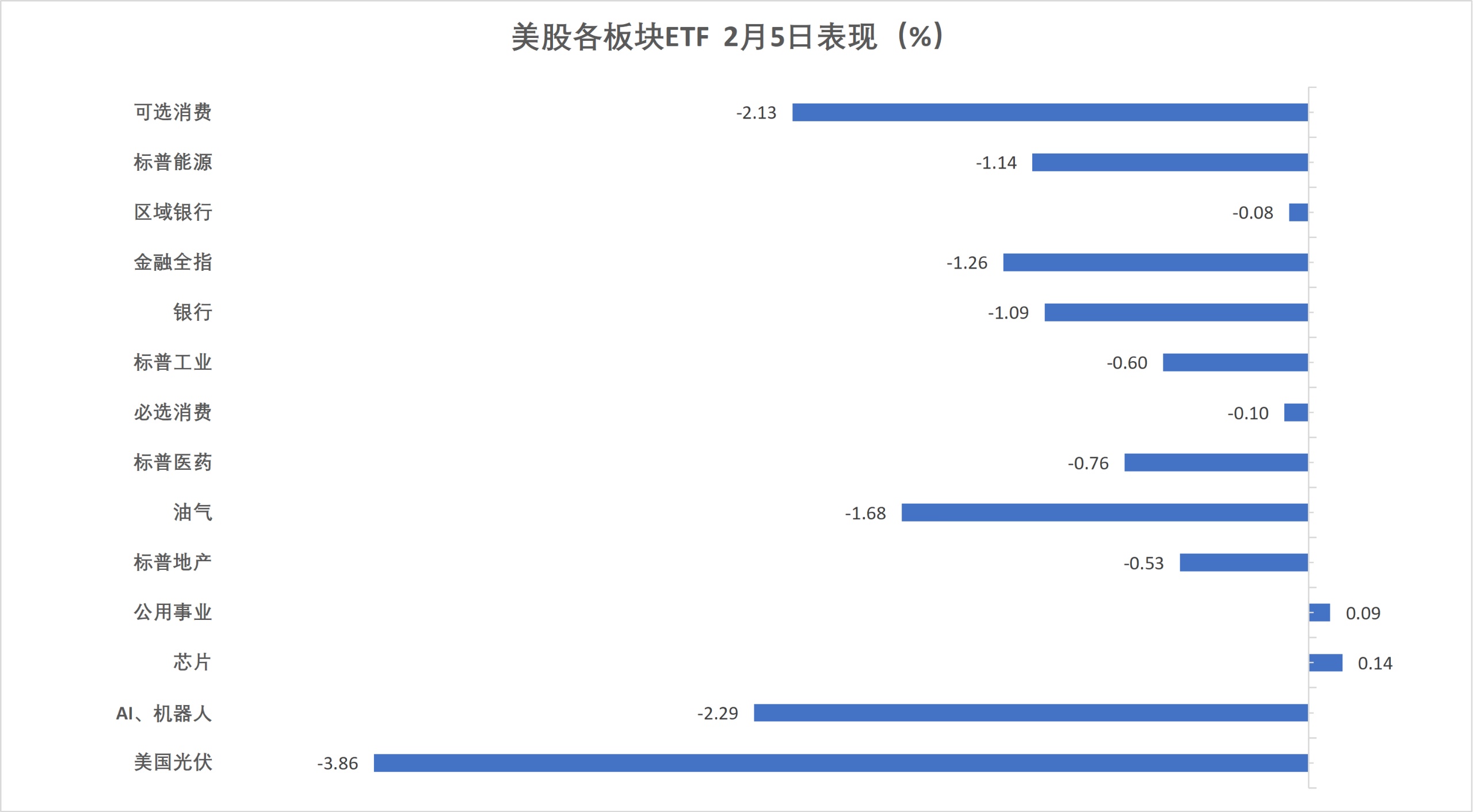
All three major U.S. stock indices fell over 1%, with small-cap stocks leading the decline, as the Russell 2000 dropped 1.8%. Among the 11 major sectors of the S&P, 9 declined, with software stock ETFs falling 5%. Oracle dropped nearly 7%, and Microsoft fell nearly 5%. Amazon plummeted 10% after earnings. The China concept stock index rose against the trend, with Baidu up 0.73%, Meituan rising over 2%, and Dingdong Maicai down 15%.

Risk aversion drove U.S. Treasury yields significantly lower. The yield on the 10-year U.S. Treasury fell 9 basis points to 4.19%, and the 2-year yield dropped 9 basis points to 3.46%, marking the lowest level in nearly a month.

Risk aversion pushed the dollar up 0.3%. The Bank of England's dovish rate decision caused the pound to drop 0.9%.

Spot gold fell 4%, while silver plummeted 19%, nearing the $70 mark.

Cryptocurrencies faced a "bloodbath," with Bitcoin crashing 12% to below $63,000, nearly halving since last October, and recording the largest single-day drop since the FTX collapse. Ethereum plummeted 11%, falling below $1,900. Crude oil dropped about 2%, with Iran confirming negotiations with the U.S. on Friday.

During the Asian session, all three major A-share indices fell, with space photovoltaic and precious metals experiencing a wave of limit-downs. Kweichow Moutai rose for the fourth consecutive day, the Hang Seng Index turned positive at the close, and tech stocks generally rebounded, while silver in Shanghai fell over 10%.

Key News

China

Chinese leaders are expected to visit the U.S. at the end of this year? The Ministry of Foreign Affairs responds.

Strong demand for AI, Foxconn's January sales reached NT$730.4 billion, a year-on-year increase of 35.5%.

Meituan acquires Dingdong Maicai.

Overseas

U.S. December JOLTS job openings hit a more than five-year low, far below expectations. U.S. Challenger companies announced layoffs of 108,000 in January, the highest for the same period since 2009, surging 205% month-on-month.

Amid election uncertainty, Japan's 30-year government bond auction "stabilizes the market."

European Central Bank President Christine Lagarde: Inflation is harder to predict than usual, with the euro strengthening under tariff shadows, the ECB held rates steady for the fifth consecutive time.

The Bank of England held rates steady at 3.75%, with a 5-4 voting result signaling a strong indication for rate cuts.

Bitcoin faced a bloodbath! Plummeting 12% to $63,000, over 400,000 people were liquidated, plunging the market into a "crisis of confidence."

Spending on AI surpasses Google, Amazon's spending guidance for this year unexpectedly soared to $200 billion, dropping over 10% in after-hours trading.

Due to a shortage of storage chips, NVIDIA will delay the release of new gaming chips.

Anthropic released Claude Opus 4.6, with Reuters dropping over 8.5%, and FactSet once falling 10%. OpenAI launched GPT-5.3-Codex, claiming it to be the strongest programming agent to date OpenAI launches Frontier, targeting enterprise-level agent automation.

Market Report

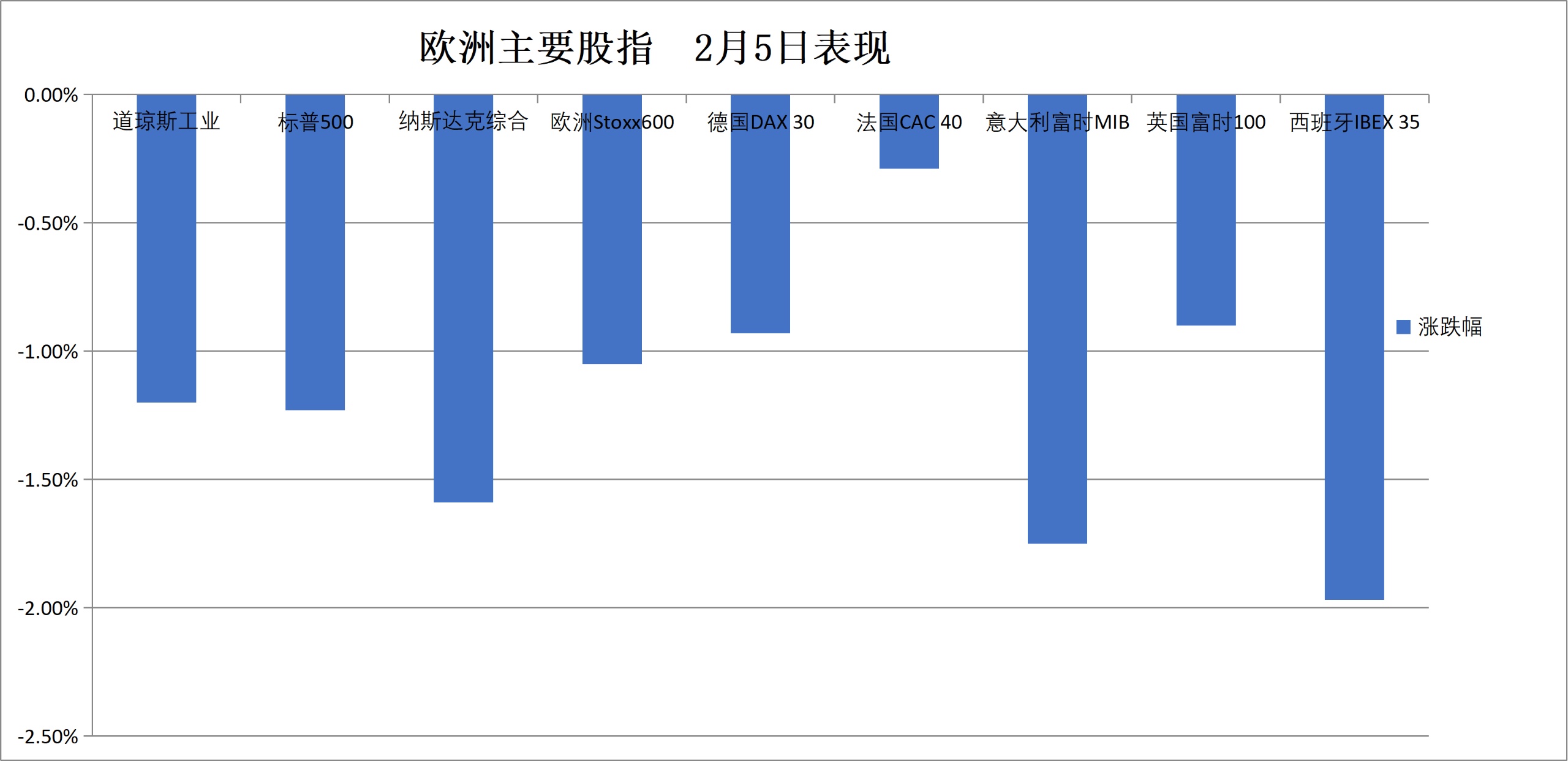
US and European Stock Markets: The S&P 500 fell 1.23%, closing at 6798.40 points. The Dow Jones fell 1.20%, closing at 48908.72 points. The Nasdaq fell 1.59%, closing at 22540.586 points. The European STOXX 600 index closed down 1.05%, at 611.65 points.

A-shares: The Shanghai Composite Index closed at 4075.92 points, down 0.64%. The Shenzhen Component Index closed at 13952.71 points, down 1.44%. The ChiNext Index closed at 3260.28 points, down 1.55%.

Bond Market: The yield on the US 10-year Treasury bond fell by 7.56 basis points, hitting a daily low of 4.1979%. The yield on the 2-year US Treasury bond fell by 8.43 basis points, hitting a daily low of 3.4669%.

Commodities: Spot gold fell by 4% during the day, priced at $4763.2 per ounce. Spot silver fell by 19.5% during the day, priced at $70.84 per ounce. WTI March crude oil futures fell by $1.85, a decrease of 2.84%, closing at $63.29 per barrel.

News Details

Global Highlights

China

Chinese leaders to visit the US by the end of this year? Foreign Ministry responds. “The leaders of China and the US maintain communication and interaction. Regarding the specific issue you mentioned, I currently have no information to provide,” said Foreign Ministry spokesperson Lin Jian.

Strong demand for AI, Hon Hai's January sales reached NT$730.04 billion, a year-on-year increase of 35.5%. Hon Hai Precision's January revenue reached NT$730 billion, a significant increase of 35.5% year-on-year, demonstrating strong resilience in AI infrastructure demand. As a core partner of NVIDIA, its substantial growth directly reflects the robust purchasing power of global data center servers, with expectations of a 28% increase in sales for the first quarter.

Meituan acquires Dingdong Maicai.

Overseas

US December JOLTS job openings hit a more than five-year low, far below expectations. US job openings fell to their lowest level in more than five years in December, significantly below expectations, and the previous month's data was also revised down, reflecting a softening labor market in the US by the end of 2025 Other indicators from the JOLTS report show that although the U.S. labor market has cooled, it has not collapsed.

U.S. Challenger Companies Announce Layoffs of 108,000 in January, the Highest for the Same Period Since 2009, Surging 205% Month-on-Month. The U.S. job market has seen the most severe start since the financial crisis: in January, companies announced layoffs of 108,435, a year-on-year increase of 118%, marking the highest record for layoffs in January since 2009. Companies only announced plans to add 5,306 positions, the lowest January figure since this data has been tracked by the agency since 2009.

Amid Election Uncertainty, Japan's 30-Year Government Bond Auction "Stabilizes the Market". Demand for Japan's 30-year government bond auction has warmed, with a bid-to-cover ratio of 3.64, pushing the 30-year yield down by 5 basis points to 3.585%. This result temporarily alleviated market concerns about long-term debt, indicating that the current high interest rate levels have attracted long-term investors such as insurance companies, but the long-term direction of the bond market still depends on fiscal policy and central bank actions after the election.

Will Waller Be Sued If Rate Cuts Are Ineffective? Bessent Hearing Leaves Uncertainty: Whether to Sue Depends on Trump. During the Senate Banking Committee's review of the Federal Reserve Chair nominee, Senator Warren demanded that Bessent assure that Waller would not be sued or investigated for not setting rates according to presidential wishes. Bessent refused to make such a commitment, stating that Trump's previous comments about suing Waller were a "joke," and that Waller is "very qualified." Bessent shifted the blame for inflation onto Biden, claiming that the media attributed the affordability crisis to the Trump administration, while in fact, it was the previous Biden administration that destroyed people's purchasing power, leading to inflation during Biden's term.

ECB President Lagarde: Inflation Is Harder to Predict Than Usual, Euro Strength and Tariff Shadows, ECB Holds Steady for the Fifth Consecutive Time. The European Central Bank decided on Thursday to keep the deposit rate unchanged at 2%, marking the fifth consecutive pause in rate cuts since last June. Officials are closely monitoring the impact of euro appreciation on export competitiveness and inflation prospects. With tariff risks resurfacing, the uncertainty in the external environment is increasing, which may exert dual pressure on economic growth and prices.

Bank of England Holds Steady, Maintains Rate at 3.75%, 5 to 4 Vote Result Signals Strong Rate Cut Signal. The Bank of England kept the rate unchanged at 3.75%, but the internal vote was close to a rate cut at 5:4, sending a strong dovish signal. Governor Bailey stated that "there should be further room for rate cuts this year," and predicted that inflation would fall to 2% by April. Following the decision, the pound fell by 0.8%, and short-term bond yields declined Despite the current high inflation, the focus of decision-making has clearly shifted from anti-inflation to addressing economic weakness and demand downside risks, paving the way for the start of an interest rate cut cycle within the year.

Bitcoin suffers a bloodbath! Plummeting 12% to $63,000, over 400,000 people face liquidation! The market is plunged into a "crisis of confidence". Bitcoin fell 12% on Thursday, hitting a 16-month low, as a global sell-off of risk assets pushed the world's largest cryptocurrency into a new downward channel. According to Coinglass data, the liquidation scale of long positions across various tokens reached $1.703 billion in the past 24 hours, with 400,000 people facing liquidation globally. Some market observers believe that with the loss of the $70,000 threshold, a larger-scale sell-off may be triggered in the short term, even falling back to the lows after the initial rebound in early 2024.

Spending big on AI surpasses Google, Amazon's spending guidance for this year unexpectedly skyrockets to $200 billion, plunging over 10% after hours. Amazon's Q4 revenue increased by 14% year-on-year, with cloud business AWS revenue exceeding expectations with a 24% surge, marking the highest growth rate in over three years. Free cash flow shrank by over 70% in a year, and property and equipment expenditures surged nearly 59% for the year; the annualized revenue from chips Trainium and Graviton exceeded $10 billion; capital expenditures are expected to increase by 50% annually by 2026, nearly 40% higher than analysts' expectations and 11% higher than Google's median guidance, reflecting investments in AI, chips, robotics, and low-orbit satellites; Q1 revenue is expected to grow by up to 15%, with operating profit expected to grow by nearly 17% at best and decline by 10% at worst, partly due to a $1 billion increase in low-orbit satellite costs.

Due to a shortage of storage chips, Nvidia will delay the release of new gaming chips. Affected by the shortage of storage chips triggered by the global AI boom, Nvidia announced it would delay the release of new gaming graphics cards, marking the first time in nearly thirty years that it will not launch new gaming chips in a year. The company has prioritized the allocation of scarce storage chip capacity to its more profitable AI business, resulting in a significant reduction in gaming GPU production.

Anthropic releases Claude Opus 4.6, Reuters drops over 8.5%, FactSet once fell 10%. On Thursday, Anthropic launched the AI model Claude Opus 4.6, which excels in financial research, capable of quickly analyzing company data, regulatory documents, and market information, with significant upgrades in programming and multitasking execution. Following the model's release, the stock prices of financial information service providers plummeted, with FactSet dropping as much as 10% at one point, and Thomson Reuters falling over 8.5%, hitting an intraday low not seen since March 2020, as market concerns about traditional software being replaced by AI intensified OpenAI launches GPT-5.3-Codex, calling it the strongest programming agent to date, with the release scheduled almost simultaneously with Anthropic's flagship upgraded model Claude Opus 4.6. The new model significantly outperforms in multiple benchmark tests and participates in its own training and deployment for the first time. Industry insiders believe this marks the official start of the AI programming battle surrounding enterprise-level software development.

OpenAI launches Frontier, targeting enterprise-level agent automation. On Thursday, OpenAI released the enterprise-level AI agent platform Frontier, which helps companies more easily build, deploy, and manage AI agents, integrating multi-source data to perform tasks such as document processing and code execution. The platform supports collaboration with AI agents from competitors like Anthropic and Microsoft, positioning itself not to replace existing software but as the infrastructure for enterprises to distribute and run AI agents. OpenAI executives stated that by the end of this year, a significant amount of digital work in leading companies will be commanded by humans and executed by AI agents. Meanwhile, competitor Anthropic released a financial research AI model on the same day, raising market concerns about traditional software being replaced by AI once again.

Once associated with OpenAI, it loses its appeal, Wall Street begins to "liquidate" OpenAI concept stocks, with Google soaring 36% as the winner. Wall Street's attitude towards OpenAI has shifted from enthusiasm to concern, with its losses and performance capabilities being questioned, leading to a sharp decline in the stock prices of deeply tied Microsoft and Oracle. Meanwhile, Google stands out with financial returns driven by Gemini 3 and a 48% revenue growth in its cloud business, supporting an index boom with a market value of $4 trillion, potentially becoming the winner in the second half of the AI competition.

  • Why are tech giants pouring huge sums into OpenAI? Nvidia, Amazon, and others have successively participated in OpenAI's $100 billion financing. Analysts believe that OpenAI has become the lifeline for tech giants' valuations; if continuous funding is not provided, it may trigger a collapse of AI logic, and tech giants could face a 50%-80% reduction in market value. "If OpenAI reduces its commitment spending to hyperscale cloud vendors, they would lose $1 trillion in market value, so what does $10 billion mean among friends?"

Research Report Highlights

Panic spreads, selling is triggering more selling. Anxiety in tech stocks has led to a chain reaction of sell-offs, with the market's narrative on AI shifting from optimism to caution Software and chip stocks plummeted (AMD fell 17%) and affected global assets, creating a negative feedback loop. The core of the market sentiment shift lies in the perception that AI is seen as a threat to business models rather than merely a growth driver, leading to a nearly $1 trillion evaporation in market value for the software sector within a week; at the same time, Alphabet's capital expenditure plan doubled to about $180 billion, exacerbating concerns about whether high investments can yield returns.

The historical peaks of silver have never been "expensive". The moment when a peak is truly confirmed often comes from changes in rules: for example, in 1980, silver prices peaked when the COMEX exchange implemented "clearing only," prohibiting new positions on the same day; in 2011, the handling was relatively mild, with prices peaking when CME announced a second margin increase. History seems to be repeating itself; in this round of silver market, CME has raised margins five times in just one month.

Did the market misunderstand? Walsh's true benchmark: Greenspan. Walsh believes that the current wave of AI is "the wave that can enhance productivity the most in a lifetime, past, present, and future," which can create significant room for the Federal Reserve to cut interest rates without raising inflation. His ideas are seen as an attempt to replicate the monetary policy legend of Greenspan. Bessen supports Walsh, stating that "we are currently in the early stages of a productivity boom similar to the 1990s, and the economy can operate under low interest rates."

Walmart's turnaround is not about becoming the second Amazon. Walmart has integrated online and offline, becoming a better version of itself.

Domestic Companies

Baidu announces a $5 billion share repurchase plan and adopts a dividend policy for the first time. Baidu announced that the new repurchase plan allows the company to repurchase up to $5 billion of its shares, valid until December 31, 2028. The board approved the company's first adoption of a dividend policy for common stock, which may include regular and special dividend distributions, with the first dividend expected to be announced in 2026.

Nio's U.S. stock pre-market rose over 11%, closing up 5.8%, as the company achieved its first quarterly profit, with operating profit expected to reach 700 million to 1.2 billion yuan in Q4 2025. Nio expects to achieve its first quarterly operating profit in Q4 2025, adjusted to 700 million to 1.2 billion yuan. Even under stricter accounting standards, profits are expected to be 200 million to 700 million yuan, indicating that its profit improvement stems from operational optimization. Compared to a loss of over 5.5 billion yuan in the same period last year, this quarter's sequential improvement is about 6.2 billion to 6.7 billion yuan. The company stated that growth is driven by increased sales, optimized product structure, and comprehensive cost reduction and efficiency enhancement. Following the announcement, Nio's U.S. stock surged over 11% in pre-market trading Elon Musk's team visits China to secretly meet with photovoltaic companies, what are they focusing on? This visit by Musk's team covers the entire photovoltaic industry chain, including equipment, silicon wafers, battery components, and cutting-edge technology directions, with particular attention to next-generation high-efficiency technologies such as heterojunction (HJT) and perovskite. These two technological routes are considered to have advantages in theoretical efficiency and long-term cost reduction potential.

Overseas Macro

Trump: India will no longer buy Russian oil, Russia: No, India never said that. Analysts believe that considering the potential economic impact of completely stopping the purchase of Russian oil, India is unlikely to fully turn away. Although India has reduced its purchases of crude oil from Russia in recent months, it is unlikely to stop all purchases immediately, which could disrupt India's economic growth.

Overseas Companies

Apple plans to launch a "budget version" MacBook, using iPhone chips for the first time, priced below $799. Although the "budget version" MacBook has lower memory configurations, its operating smoothness is unlikely to be significantly affected, and it will support Apple Intelligence, expected to remain competitive in the entry-level product segment. Industry insiders reveal that Apple expects annual shipments of this product to reach 5 to 8 million units, accounting for about 20% to 30% of last year's Mac sales.

Google earnings call: $185 billion in spending "must be spent," confirms partnership with Apple, Gemini is not the "terminator" of SaaS. Google announced that its capital expenditures in 2026 will reach $175 billion to $185 billion, mainly for servers and data centers, fully investing in the AI arms race. It officially confirmed its partnership with Apple to develop the next-generation foundational model based on Gemini. In response to market fears about "AI disrupting SaaS," the CEO stated that Gemini is its "engine" rather than a terminator, with 95% of leading SaaS companies already adopting it. Additionally, Gemini App's monthly active users have surpassed 750 million, as Google moves towards an "agent commerce" era.

  • Wall Street comments on Google's earnings report: "Explosive" capital expenditure guidance raises concerns about profit margins. Major Wall Street investment banks pointed out that Google's latest capital expenditure guidance is "explosive," nearly double previous market expectations, accounting for more than one-third of the total capital expenditures of major global tech giants' data centers in 2023. This will significantly squeeze its short-term profitability and cash flow. Although search and cloud business growth in Q4 is strong due to AI, market focus has shifted from revenue growth to the sustainability of capital returns, with massive investments expected to lead to a sharp decline in free cash flow over the next two years "Giant in Optical Modules" Coherent Conference Call: CPO Secures Major Orders, Indium Phosphide Chip Mass Production Breakthrough, 1.6T Optical Modules Enter Explosive Growth Phase. Optical module giant Coherent reported record revenue of $1.689 billion for the second fiscal quarter, a year-on-year increase of 17%. Benefiting from the leap in demand for artificial intelligence data center construction, the order shipment ratio for the data center business exceeded 4 times, with visibility extending to 2027. In terms of 6-inch indium phosphide wafer production, the company has achieved 80% of its capacity target. Despite strong performance, the stock price fell 2.36% in after-hours trading. Analysts believe that high market expectations led to profit-taking.

Over 200 Billion Mining Giant "Fails": Rio Tinto Abandons Merger Talks, Glencore Drops Over 10% Intraday. This marks the third failed attempt at a merger between the two companies in over a decade; if the deal had been reached, it would have created the largest mining company and the largest copper producer. Glencore stated that the key terms proposed by Rio Tinto "seriously undervalued Glencore's potential relative value contribution," particularly regarding its copper business and growth pipeline. Media reports indicate that Glencore sought to have its investors hold 40% of the merged company's shares after a stock swap, which Rio Tinto could not accept due to the premium proposed by Glencore.

European Stock Market "Black Thursday": Maersk's Profits Halved, Volvo Plummets 14%, Vodafone's Revenue Falls Short of Expectations. The European stock market faced a "Black Thursday": Maersk warned that the expected recovery of the Red Sea route would lead to a decline in freight rates, predicting that annual profits could be halved, with the stock price plunging 7% at one point; Volvo's profit margins dropped 14% due to tariffs and price wars, while Vodafone's sluggish growth in its core German market also weighed on its stock price. The concentration of pessimistic corporate earnings reports highlights geopolitical and industry pressures.

Today's News Preview

U.S. February Michigan Consumer Confidence and Inflation Expectations.

Federal Reserve Vice Chairman Jefferson's speech.

The 2026 Winter Olympics will be held from February 6 to 22.

Mudan Food's Hong Kong IPO, with shares expected to trade on February 6