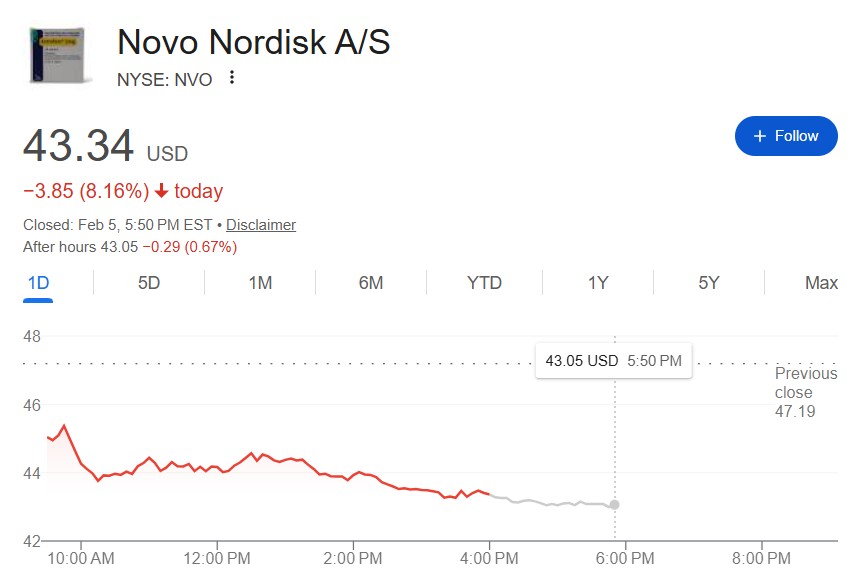
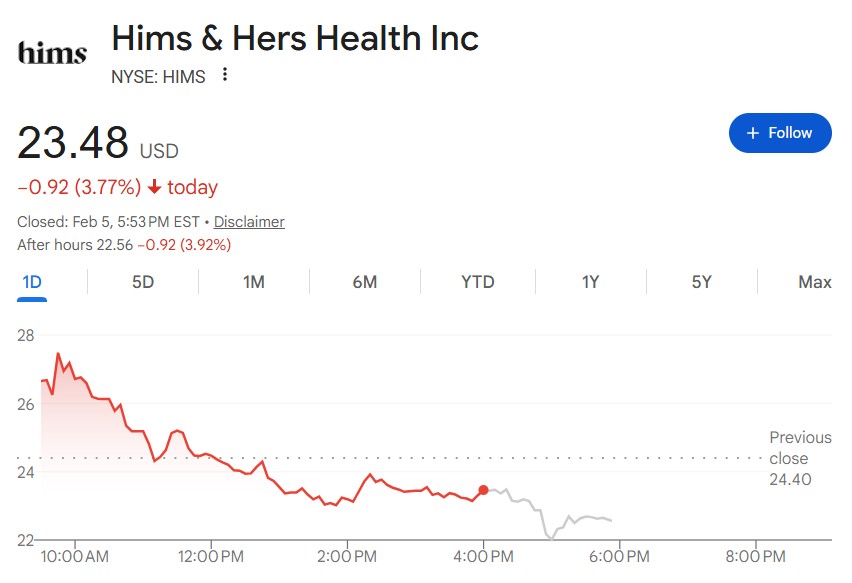
Novo Nordisk plummeted 8%, as the new weight loss pill faced "knockoffs" right after its launch, with telemedicine company Hims introducing a $49 generic version

Telemedicine company Hims launched a generic version, priced at $99 per month, significantly lower than the brand-name drug at $149. Novo Nordisk accused it of "illegal compounding" and threatened to sue, claiming the generic lacks proprietary protection technology and cannot be effectively absorbed. Hims argued that it uses a different formula. As a result, Novo Nordisk's stock price plummeted over 8%
Novo Nordisk's newly launched weight loss pill has faced an unexpected market challenge before it could establish itself.
On Thursday, February 5th, Novo Nordisk's stock price plummeted after telemedicine company Hims & Hers Health launched a generic version of Novo Nordisk's weight loss drug Wegovy, priced at just $49 for the first month and $99 thereafter, significantly lower than Novo Nordisk's brand drug starting at $149 per month.
Novo Nordisk had hoped to turn the tide with its new product, but the low-priced generic version introduced by the telemedicine company quickly disrupted the market landscape, sparking intense debates about drug patent protection and regulatory frameworks.
Novo Nordisk issued a statement claiming that Hims' actions constitute "illegal large-scale compounding, posing significant risks to patients." The company stated that it would take legal and regulatory action to protect patients, its intellectual property, and the integrity of the U.S. drug approval framework.
In response to this news, Novo Nordisk's ADR stock price fell over 8% on Thursday, while competitor Eli Lilly also dropped 7.1%.

Telemedicine Companies Targeting the Low-Price Market
Hims' generic pills pose a threat to Novo Nordisk's products.
According to Reuters, this generic version uses "different formulations and delivery systems," with Hims spokesperson Abby Reisinger stating:
The compounded semaglutide tablets offered today are not a true copy of Wegovy.
Hims defended its product on social media platform X, stating that this is not the first time pharmaceutical companies have criticized their business as "dangerous, illegal, or harmful to the market." The company stated:
This narrative is both predictable and outdated, and it is false.
Hims' stock price surged 14% in early trading on Thursday but then continued to decline, closing down 3.7%. The company had previously seized the opportunity to sell low-cost generic versions during the widespread shortages of Eli Lilly and Novo Nordisk's weight loss injections.

Although the supply shortages have ended, telemedicine companies should have stopped selling generics, but they have adjusted dosages or added ingredients to make their products sufficiently different from the brand drugs.
Core Technical Dispute Becomes the Focus
The core disagreement between the two parties lies in the drug formulation technology.
Novo Nordisk's pills use proprietary technology to protect the active ingredient semaglutide from gastric acid erosion to aid absorption. Novo Nordisk CEO Mike Doustdar stated during Thursday's analyst call that without this protective technology, "it simply won't work, it just won't work."
Doustdar said:
If consumers turn to alternatives, in my view, it's a waste of $49 because your intestinal enzymes will basically clear it out; it won't enter the bloodstream Hims claims that its tablets also use a formula that protects active ingredients from being destroyed during digestion.
The two companies previously had a brief collaboration. Last year, Hims partnered with Novo Nordisk to offer a discounted version of a weight loss injection, but less than two months later, Novo Nordisk abruptly terminated the partnership, accusing Hims of using "deceptive marketing" to sell a generic version of Wegovy.
New Product Launch Affected Growth Expectations
This controversy has cast a shadow over Novo Nordisk's originally strong product launch.
According to Mizuho Bank healthcare expert Jared Holz, the tablet is expected to generate $1.3 billion to $1.35 billion in revenue in its first year.
Novo Nordisk stated that within four weeks of its launch in January, over 170,000 patients had started taking the drug. Analysts had hailed it as one of the most successful drug launches in recent times.
Novo Nordisk is gradually losing its edge in the highly competitive obesity market, facing not only competition from Eli Lilly but also remote healthcare companies like Hims that sell generic drugs.
Analysts expect that other new weight loss products will also become targets for generics, including a tablet that Eli Lilly is developing, which the company stated could receive regulatory approval as early as April.
Novo Nordisk's stock price this week is set to record its largest weekly decline since August of last year, and this sudden challenge from generics has undoubtedly intensified investors' concerns about its market position