


Wall Street comments on Google's financial report: Under the "unbelievable" capital expenditure guidance, profit margins become the biggest concern

Major investment banks on Wall Street pointed out that Google's latest capital expenditure guidance is "explosive," nearly double the market's previous expectations, accounting for more than one-third of the total spending on data centers by major global tech giants in 2023. This will significantly squeeze its short-term profitability and cash flow. Although search and cloud business growth in the fourth quarter is strong due to AI, the market's focus has shifted from revenue growth to the sustainability of capital returns, with massive investments expected to lead to a sharp decline in free cash flow over the next two years
Major investment banks on Wall Street generally believe that Google's recently announced "explosive" capital expenditure plan will significantly squeeze its short-term profit structure and free cash flow, shifting the market's focus from revenue growth to the sustainability of capital returns.
According to the Wind Trading Desk, a Morgan Stanley report pointed out that Alphabet, Google's parent company, performed strongly in the latest quarterly results, with revenue and profit exceeding expectations. However, the company simultaneously announced a capital expenditure guidance of $175 billion to $185 billion for 2026, nearly double the market's previous expectations, accounting for more than 30% of the total capital expenditure of major global tech giants in 2023. This aggressive expansion plan immediately raised deep concerns among investors about its profit sustainability.
Despite the revitalization of the search business, high growth in the cloud business, and a significant increase in profit margins providing a financial foundation for strategic investments, the massive capital expenditure has begun to squeeze profit margins. According to Morgan Stanley's estimates, the company's free cash flow per share is expected to plummet by approximately 58% and 80% in the fiscal years 2026 and 2027, respectively.
The current core disagreement lies in whether the market is willing to pay for this "long-term check" in the absence of clarity on the AI investment return cycle, and whether such a scale of capital expenditure can ultimately translate into a substantial capital return rate. Google is at a critical turning point, betting on redefining its growth trajectory and financial balance.
AI-Driven Core Business Accelerates Growth
Alphabet's performance in the fourth quarter of 2023 was strong, with total revenue reaching $113.8 billion, a year-on-year increase of 17% at constant exchange rates, exceeding market expectations by about 2 percentage points. The growth was primarily driven by the dual engines of search and cloud businesses.
The search business demonstrated unexpected growth resilience, with revenue reaching $63.1 billion, a year-on-year increase of 15.6% at constant exchange rates, marking the highest growth rate since the second quarter of 2022. Notably, achieving this growth rate against a revenue base that is 35% higher than at that time adds quality significance.
The growth momentum stems from the comprehensive penetration of AI technology. This quarter, the volume of AI model search queries doubled, and the average query length reached three times that of traditional searches, with nearly one-sixth adopting non-text formats such as voice or images. The company launched over 250 AI search feature updates during the quarter and plans to maintain a pace of about 100 updates each quarter.
Meanwhile, the Gemini ecosystem is showing signs of accelerated expansion, with monthly active users increasing by 15% quarter-on-quarter to 750 million, and user engagement continuing to deepen. Its API processes 10 billion tokens per minute, significantly higher than comparable industry data, demonstrating a technological adoption advantage in the developer ecosystem.
Cloud Business Achieves Growth in Volume and Price
Google Cloud exhibited unexpected growth momentum and profit quality this quarter. Cloud business revenue reached $17.7 billion, a year-on-year increase of 47.8%, with growth significantly improving compared to the previous quarter, exceeding market expectations by about 9 percentage points. More importantly, its operating profit margin increased significantly by 6 percentage points quarter-on-quarter to 30.1%, well above the market's previous expectation of 22.7%, demonstrating strong scale effects and pricing power. **
The growth momentum is showing structural deepening. As the core GCP platform's growth rate surpasses the overall cloud business, it mainly benefits from the comprehensive demand increase in infrastructure, cybersecurity, data analytics, and enterprise AI solutions. Notably, the number of billion-dollar contracts signed in 2025 has exceeded the total of the previous three years, and nearly 75% of existing cloud customers are using AI products, with the average number of products used being 1.8 times that of non-AI users, indicating a deep expansion of customer value driven by AI.
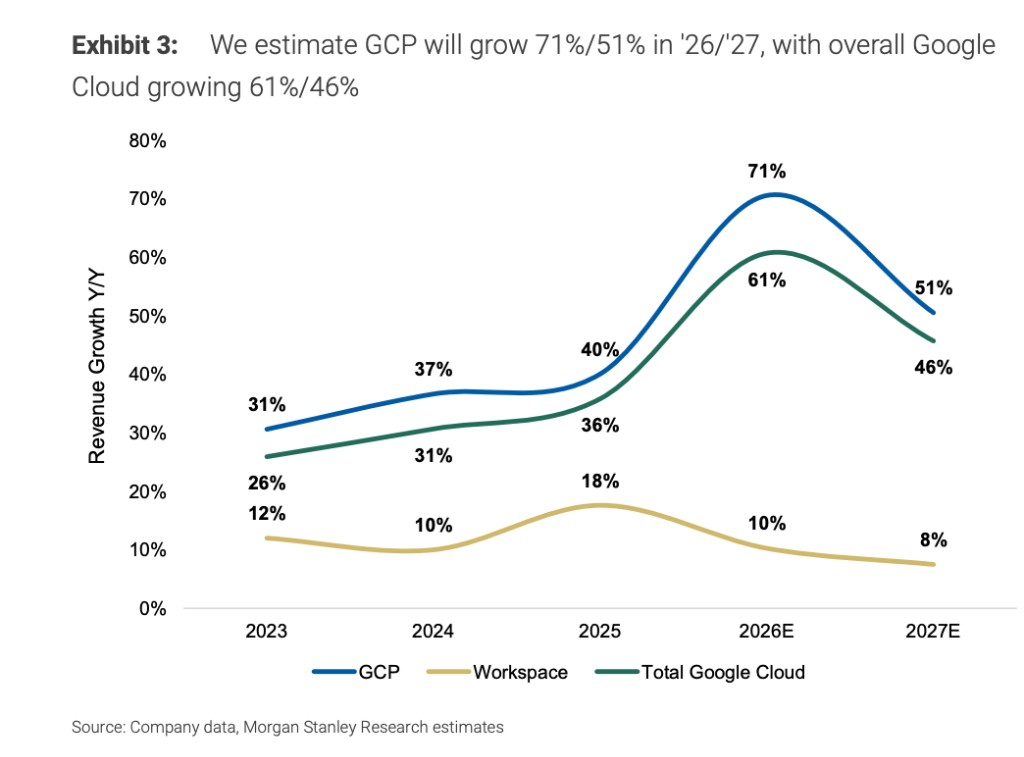
The visibility of the business has further improved. As of the fourth quarter, the backlog of cloud business orders increased by 55% quarter-on-quarter to approximately $240 billion, doubling year-on-year. Accordingly, Morgan Stanley predicts that GCP will achieve growth rates of 71% and 51% in the fiscal years 2026 and 2027, respectively.
The commercialization process of enterprise AI products is rapid. Gemini Enterprise has gained over 8 million paid seats from more than 2,800 enterprise customers just four months after its launch, with the volume of customer interactions processed in the fourth quarter increasing by 65% year-on-year to over 5 billion. Meanwhile, the revenue from products built on generative AI models has increased by nearly 400% year-on-year, with growth rates continuing to accelerate.
Capital Expenditure Guidance Significantly Raised
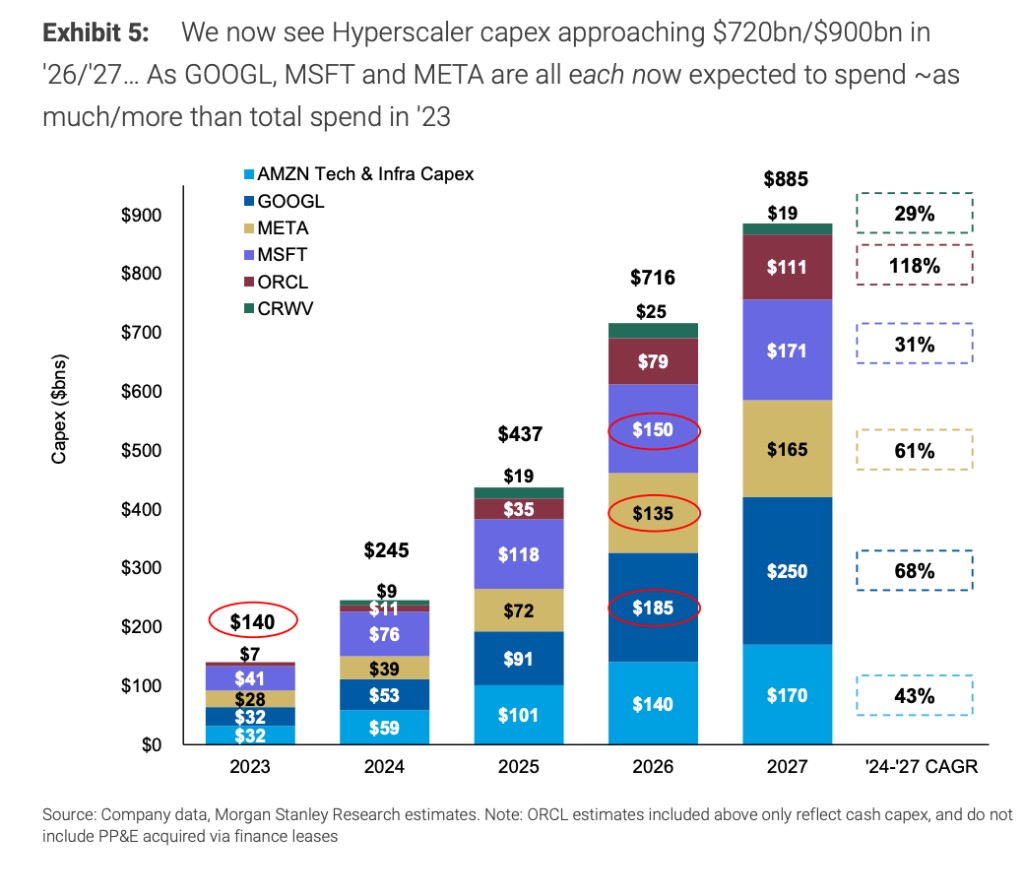
Alphabet's latest capital expenditure guidance for 2026 significantly exceeds market expectations, with a median investment scale of $175 billion to $185 billion, representing an approximate 97% increase compared to the expected 2025 figure, far surpassing the previous market consensus of about $129 billion. This level of investment is leading among major global cloud service providers.
It is noteworthy that, according to Morgan Stanley's calculations, the guidance amount has exceeded 32% of the total spending on data centers by the six major global cloud service providers in 2023. Compared to Meta's recently announced $135 billion investment plan, Alphabet's investment scale is even more prominent, as the latter is only about 4% lower than the total industry spending in 2023.
The company's management has clearly stated that the related capital will be primarily invested in the technology infrastructure sector, with approximately 60% allocated to server deployment and the remaining 40% distributed to data center construction and network equipment upgrades. The core challenge currently faced by the company is how to "expand capacity quickly enough" to meet the "extraordinary demand growth" in the market.
In terms of execution pace, the capital expenditure for the fourth quarter alone reached $27.9 billion, an increase of $3.9 billion quarter-on-quarter. The total capital expenditure for the year 2025 is expected to reach $91.5 billion, a significant leap from $52.5 billion in 2024, reflecting a systematic increase in investment intensity
Free Cash Flow Under Pressure
Aggressive capital expenditure plans are having a substantial impact on Alphabet's cash flow structure. According to Morgan Stanley's estimates, the company's free cash flow per share for the fiscal years 2026 and 2027 is expected to drop to $2.15 and $1.48, respectively, a downward adjustment of 58% and 80% from previous expectations. Although the company's free cash flow for the fourth quarter still reached $24.6 billion, totaling $73.3 billion for the year, Bernstein predicts that as capital expenditure intensity increases, the annual free cash flow for fiscal years 2026 and 2027 may contract to $14.4 billion and $26.4 billion, with corresponding free cash flow yields falling below 1%.
At the same time, the rise in depreciation expenses will further squeeze profit margins. Management has repeatedly indicated that the growth rate of depreciation will accelerate significantly starting in the first quarter of 2026, showing "significant growth" throughout the year. In the fourth quarter, depreciation expenses reached $6 billion, an 8% quarter-over-quarter increase, reflecting the accelerating accounting impact of prior capital investments.
Against this backdrop, the company has maintained continuity in shareholder returns, but there are signs of a shift towards strategic investments. The stock repurchase scale in the fourth quarter was $5.5 billion, lower than historical levels for the same period; dividend payments during the same period amounted to $2.5 billion. This change in distribution structure suggests that the company is allocating more cash resources to long-term capability building related to AI.
Operating Profit Margin Slightly Under Pressure
Alphabet's operating profit for the fourth quarter was $35.9 billion, with an operating profit margin of 31.6%, slightly below market expectations. Excluding one-time employee compensation expenses related to Waymo of approximately $2.1 billion, the adjusted operating profit margin was about 33%, slightly narrowing from the average level of 34% in the previous three quarters.
From a business structure perspective, the operating profit margin of the Google Services segment increased to 41.9%, expanding by 280 basis points year-over-year; Google Cloud showed significant improvement in profitability, with an operating profit margin reaching 30.1%, an increase of 1260 basis points year-over-year and 640 basis points quarter-over-quarter, demonstrating strong economies of scale.
Total operating expenses for the period grew by 29% year-over-year to $32.1 billion. Among them, R&D expenses increased by 42%, primarily driven by payroll expenses (especially related to Waymo) and increased depreciation; sales and marketing expenses grew by 12% year-over-year, while general and administrative expenses increased by 21%.
In terms of workforce size, the total number of employees increased by approximately 700 quarter-over-quarter, up 4% year-over-year. Management has clearly stated that it will continue to conduct selective hiring in strategic focus areas such as AI and cloud infrastructure to support long-term technological investments and business expansion.
Institutional Ratings Divergence: Balancing Growth Momentum and Capital Expenditure
Morgan Stanley maintains an "Overweight" rating on Alphabet, with its valuation primarily based on a 24x price-to-earnings ratio for 2027 earnings per share, while providing a bull market scenario valuation corresponding to a 28x price-to-earnings ratio. The implied upside potential of this target price is relatively limited, reflecting the market's cautious expectations regarding its short-term profit pressures Citigroup reiterated its "Buy" rating and raised its valuation multiple, pricing it at approximately 27 times the expected 2027 earnings per share. The bank believes that the rebound in Google Cloud revenue growth, strong demand for TPU and Gemini, and the continued resilience of the search business collectively form the core support for the company's deserved valuation premium.
Bernstein, on the other hand, maintains a "Market Perform" rating, with its valuation framework combining the revised enterprise value/EBITDA multiple for 2027 and a discounted cash flow model, assuming a weighted average cost of capital of 10% and a perpetual growth rate of 3.5%, with equal weighting for both. This adjustment reflects the bank's recognition of the company's growth momentum while maintaining a relatively cautious stance on the upside potential for valuation.
Overall, although major investment banks have generally raised their revenue expectations for Alphabet's search and cloud businesses, the significant increase in capital expenditures has led to a substantial downward adjustment in free cash flow expectations, keeping the earnings per share forecast stable overall. While institutions affirm the long-term growth logic, they are also digesting the structural pressure that high capital investments exert on short-term profitability and cash flow.
Market Becomes Cautious
Investors are showing increasing caution towards the aggressive capital expenditure plans of tech giants. In 2026, the combined capital expenditures of Meta, Alphabet, Microsoft, and Amazon are expected to rise to the range of $700 billion to $900 billion. To achieve substantial returns on this nearly trillion-dollar investment, the potential market size corresponding to new AI-driven products and enhanced features must reach several times the investment amount in the short term, which poses high demands on the commercialization capabilities of the entire industry.
At the same time, the competitive landscape is evolving rapidly. OpenAI's continuous innovation poses a long-term challenge, while Meta, xAI, Anthropic, and even Amazon are actively competing for enterprise and consumer user behavior through their own AI agent solutions. Each participant clearly identifies achieving a return on their investments as a core goal, and industry competition has entered a new phase focused on commercial monetization.
Morgan Stanley analysis points out that the key for Alphabet lies in continuously executing its strategy and effectively converting its vast user base and data resources into monetizable products and services. Although the bank believes that, with its ecosystem and technological reserves, Alphabet remains more likely to succeed than most competitors, and has once again demonstrated this strength in its latest quarterly report, the market is also clearly aware that all growth comes at a cost, and the current massive investments must translate into commensurate financial returns in the future
