


New Normal for US Stocks? In just a few weeks of 2026, there have already been 5 instances of "sharp declines followed by V-shaped reversals."

In the U.S. stock market, 2026 has seen frequent "fake falls": the S&P 500 has experienced 5 instances of rapid rebounds after intraday crashes, each accompanied by geopolitical turmoil, tariff fears, or AI competition, yet each time it has turned danger into safety. Deutsche Bank believes that the key to determining whether the stock market will enter a genuine sustained decline lies in whether macro expectations undergo a "structural downgrade."
Just over a month into 2026, the U.S. stock market has repeatedly witnessed the same scenario: sharp intraday declines, loss of control over emotions, but a rapid recovery before the close, even returning to high levels.
According to the Chase Wind Trading Desk, Deutsche Bank pointed out in its latest report that since January, the S&P 500 index has experienced at least five typical cases of "rapid decline - quick rebound."
These fluctuations are often accompanied by geopolitical tensions, tariff threats, panic in tech stocks, or narratives about AI competition, but have almost never caused substantial, lasting damage to the market.
In Deutsche Bank's view, this is not coincidental, but may represent a "new normal" currently forming in the U.S. stock market.
Five "Fake Falls": Frequent Risk Events, But the Market Refuses to Drop Deeply
Deutsche Bank macro strategist Henry Allen summarized several representative rapid pullbacks since the beginning of 2026:
- Mid-January Geopolitical Risk Escalation: After the S&P 500 reached a new high on January 12, concerns about potential U.S. intervention in the Iran situation, coupled with political statements regarding Greenland, caused the index to drop over 1% intraday. However, panic quickly dissipated, and the decline narrowed significantly by the end of the day, followed by a rebound in the next two days.
- Late January Tariff Threats Trigger Sell-off: The possibility of the U.S. imposing tariffs on certain European countries led to a single-day drop of over 2% in the S&P 500. However, as a negotiation framework emerged, the index rebounded for two consecutive trading days, almost completely recovering its losses.
- End of January Tech Stock Capex Concerns: Microsoft's earnings report showed capital expenditures above expectations, raising market concerns about the AI investment return cycle, leading to a sharp decline in the software sector, dragging the market down over 1.5% intraday. However, by the close, the index was only slightly lower, and panic did not spread.
- Early February Precious Metals Plunge Impacting Risk Assets: A significant correction in the precious metals market temporarily dragged S&P futures down nearly 1.5%, but after the U.S. stock market opened, it quickly rebounded, ultimately not only turning positive but also coming within a step of historical highs.
- Latest Instance of Software and AI Competition Resurfacing: Influenced by Anthropic's new AI tools, software stocks faced collective pressure, with the S&P 500 experiencing a maximum intraday drop of 1.64%. However, similar to previous instances, a significant recovery occurred at the end of the trading session, with the final decline being less than 1%.
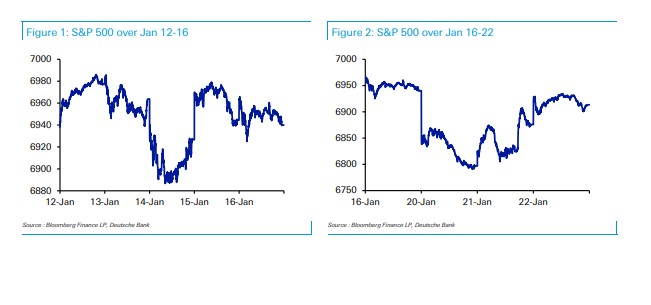
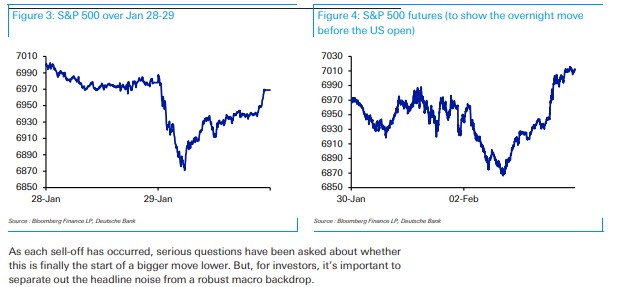
Deutsche Bank emphasizes that during each decline, the market quickly generates narratives questioning whether this is the beginning of a major adjustment, but the results repeatedly prove: high emotional noise, little trend disruption.
Why Can't It Drop? The Key Is Not the News, But the Macro
**In Deutsche Bank's view, determining whether the stock market will enter a genuine sustained decline is not primarily about the short-term shocks themselves, but rather whether macro expectations undergo a "structural downgrade." **
Historical experience shows that both the bear market of 2022 and the earlier burst of the internet bubble corresponded to a systematic deterioration in growth, policy, or financial conditions. However, the current environment is quite the opposite:
- The U.S. economy continues to maintain high growth, with an annualized growth rate of 4.4% in the third quarter, and the Atlanta Fed's GDPNow forecast for the fourth quarter remains above 4%;
- The ISM manufacturing index in January rose to its highest level since 2022;
- The Eurozone's economic growth in the fourth quarter exceeded expectations, with the PMI remaining in the expansion zone for a year;
- Germany's fiscal stimulus policy provides additional support for the European economy through 2026.
In this context, a single risk event is unlikely to trigger a systemic risk repricing. Deutsche Bank bluntly stated that as long as the macro fundamentals do not deteriorate significantly, the market is more inclined to view sharp declines as "buyable volatility" rather than signals of a trend reversal.
An Emerging Market Behavior: Data Over Narrative
Deutsche Bank presented an intriguing conclusion in its report: The current market's weighting of "real data" is significantly higher than that of "news narratives."
The fact that almost all major asset classes recorded gains in January itself indicates that risk appetite has not been damaged. Each sharp decline is quickly followed by a recovery, which reinforces investors' path dependence—buying the dip is continuously validated as an effective strategy.
This also explains why the frequency of market volatility is increasing, but the amplitude of trend fluctuations is firmly suppressed.
Deutsche Bank does not deny the existence of risks but reminds investors to distinguish between "noise" and "signals." Only when growth expectations, policy paths, or financial conditions experience a substantial reversal will U.S. stocks face a truly meaningful trend decline. Until then, the "sharp decline—rebound" pattern that has repeatedly appeared in 2026 may be the most accurate depiction of U.S. stock performance during this phase. At least for now, this seems more like a new normal rather than the calm before the storm
