


Qualcomm conference call: AI data centers "sucking dry" DRAM capacity, memory shortages will determine this year's smartphone market size

Qualcomm issued a stern warning for Q2, stating that the competition for HBM capacity in AI data centers has severely impacted traditional DRAM, leading to a significant shortage and forcing smartphone manufacturers to cut orders. The Q2 smartphone chip revenue guidance has been lowered to $6 billion. CEO Cristiano Amon emphasized that the total annual smartphone market size will directly depend on memory supply capacity
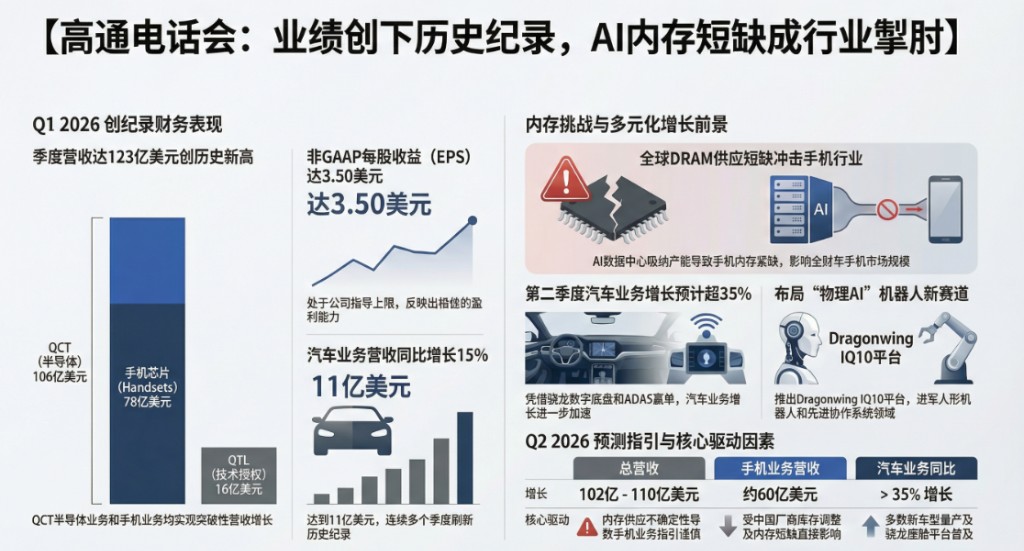
On February 4th, Eastern Time, Qualcomm held a conference call to discuss its financial results for the first quarter of fiscal year 2026.
Wallstreetcn mentioned that Qualcomm achieved record performance, with revenue reaching $12.3 billion and non-GAAP earnings per share of $3.50. Among them, QCT (chip business) revenue set a record of $10.6 billion, and automotive business revenue grew by 15% year-on-year to $1.1 billion, also setting a historical high.
However, due to the shortage of memory chips (DRAM), Qualcomm's guidance for the second fiscal quarter indicates that mobile chip revenue is expected to decline to about $6 billion, reflecting the direct suppression of shipment volumes by supply chain bottlenecks.
Memory Crisis: “HBM Crowding Out DRAM, All Caused by Memory”
During the earnings call, the biggest "black swan" came from the supply chain. Qualcomm CEO Cristiano Amon candidly pointed out that although end demand is strong, the mobile phone industry is facing a severe memory shortage.
The root of this shortage lies in the explosion of AI data centers. Amon explained:
As memory suppliers redirect manufacturing capacity towards HBM (High Bandwidth Memory) to meet the demands of AI data centers, the resulting industry-wide memory shortage and price increases may define the overall scale of the mobile phone industry for the entire fiscal year.
Qualcomm CFO Akash Palkhiwala added that given the current environment, several mobile OEM manufacturers are taking a cautious approach, reducing chip inventory to align with the scaled-back production plans.
In the Q&A session, Amon further emphasized the root of the problem:
This is 100% related to memory. In fact, macroeconomic indicators have been very strong, and we see strong demand for mobile phones... but unfortunately, the situation we saw in Q1 and the guidance for Q2 are completely constrained by the availability of memory.
He even made a conclusion:
The scale of the mobile phone market for the entire fiscal year will be determined by the availability of memory.
Mobile Business: Samsung's Share Remains Stable, AI Phones Become New Battleground
Despite facing supply headwinds, Qualcomm's position in the high-end market remains solid.
Regarding Samsung's upcoming flagship devices (Galaxy S26 series), Qualcomm confirmed that it expects to maintain about 75% market share, consistent with previous expectations.
Additionally, Amon specifically mentioned the AI smartphone launched by ByteDance, stating that this is an important milestone in the transition to "AI-native smartphones."
Amon stated that demand in the high-end and ultra-high-end markets has exceeded expectations, and this segment has proven to be more elastic to price increases. He said:
OEM manufacturers are likely to prioritize high-end and high-tier products as they have in the past, which means that in the context of memory constraints, manufacturers will tend to favor high-margin models
Diversification Highlights: Automotive Business Accelerates, Q2 Growth Estimated to Exceed 35%
Cristiano Amon announced at the conference a letter of intent for a long-term supply agreement signed with the Volkswagen Group, with Qualcomm becoming its main technology provider, covering brands such as Audi and Porsche.
In addition, Toyota's best-selling global model, the RAV4, is also equipped with the Snapdragon cockpit platform. Amon stated:
We feel good about our revenue scale forecast for the automotive business, and the targets for fiscal year 2029 are moving in the right direction. As new models go into mass production and release, the large design win funnel we established earlier is continuously converting into actual revenue.
PC and Robotics: Building the Future of "Physical AI"
In the PC sector, Qualcomm continues to advance the ecosystem of Windows on ARM.
Amon revealed that the Snapdragon X2 Plus platform, equipped with the third-generation Oryon CPU, has been launched, with 18 new PCs featuring Snapdragon showcased at CES, and it is expected that 150 PCs featuring the Snapdragon X series will be put into commercial use this year.
Notably, Qualcomm is making significant strides into the robotics field. The company has launched the Dragonwing IQ10 series chips aimed at accelerating the commercialization of home, industrial, and humanoid robots.
Amon defined this as the next frontier of "Physical AI" and stated that Qualcomm has partnered with leading robotics companies such as Figure and Kuka.
Data Center: Targeting the Inference Market, Results Expected by 2027
Regarding the highly anticipated data center business, Qualcomm reiterated its ambitions in this field, specifically to provide dedicated inference chips for "disaggregated data centers."
Amon disclosed that the company is executing a dual-line strategy: one based on Oryon CPUs and the other based on RISC-V architecture CPUs, strengthened by the acquisition of Ventana Microsystems. He stated:
Recent industry developments validate Qualcomm's view that as inference becomes a key driver of growth in data centers, specialized and energy-efficient AI platforms are crucial.
Qualcomm expects that the data center business will begin to generate substantial revenue by 2027.
The full translation of Qualcomm's earnings call is as follows:
Meeting Date: February 4, 2026
Company Name: Qualcomm Incorporated
Meeting Type: Fiscal Year 2026 First Quarter Earnings Call
Host Opening
Ladies and gentlemen, thank you for your patience. Welcome to Qualcomm's fiscal year 2026 first quarter earnings call. All participants are currently in listen-only mode. We will conduct a question-and-answer session later. A reminder, this conference is being recorded, and the recording date is February 4, 2026. The replay number for today's call is 877-660-6853, and international callers should dial 201-612-7415, with the replay reservation number being 137-58-127
Now I will turn the call over to Mr. Mauricio Lopez-Hodoyan, Vice President of Investor Relations. Mr. Lopez-Hodoyan, please go ahead.
Mauricio Lopez-Hodoyan (Vice President of Investor Relations)
Thank you, and good afternoon, everyone. Today's conference call will include prepared remarks from Cristiano Amon and Akash Palkhiwala. Additionally, Alex Rogers will participate in the Q&A session. You can access our earnings release and accompanying slide presentation on our Investor Relations website.
Furthermore, this conference call is being webcast on qualcomm.com, and a replay will be available on our website later today. In today's conference call, we will be using non-GAAP financial measures as defined in the G regulations. You can find the relevant reconciliations to GAAP on our website.
We will also be making forward-looking statements, including forecasts and estimates regarding future events, business or industry trends, or business or financial results. Actual events or results may differ materially from those projected in our forward-looking statements. Please refer to the documents we have filed with the U.S. Securities and Exchange Commission, including our most recent 10-K report, which contains important factors that could cause actual results to differ materially from our forward-looking statements.
Now, I would like to turn the floor over to Cristiano Amon, President and CEO of Qualcomm.
Cristiano Amon (CEO)
Thank you, Mauricio, and good afternoon, everyone. Thank you for joining us today.
In the first quarter of fiscal year 2026, we achieved record revenue of $12.3 billion and a non-GAAP earnings per share of $3.50. In the QCT business, record revenue of $10.6 billion was primarily driven by strong performance in flagship smartphones. We also saw record revenue in our automotive business, and our IoT business showed positive momentum in industrial, edge networking applications, and smart glasses.
Licensing revenue was $1.6 billion. Global consumer demand for smartphones, particularly for high-end and premium devices, exceeded our expectations, with healthy sales observed throughout the first fiscal quarter and in the early weeks of 2026.
In the coming quarters, the smartphone industry will be constrained by memory availability and pricing, particularly for DRAM. The shift in manufacturing capacity by memory suppliers towards HBM to meet AI data center demand may lead to an industry-wide memory shortage and price increases that could determine the overall size of the smartphone industry for this fiscal year.
Given the current environment, several smartphone original equipment manufacturers (OEMs), particularly those in China, are taking a cautious approach and reducing their chipset inventories. This is reflected in our guidance for the next quarter. We will continue to work closely with our customers and suppliers to make adjustments as the situation evolves. Akash will share more details about the impact of memory in his prepared remarks
Now let's introduce some key highlights of the business. We are pleased with the continued expansion in the high-end and premium smartphone market, as well as the appeal of the Snapdragon platform, including the widespread adoption of the dual flagship product strategy by original equipment manufacturers. For Samsung's upcoming high-end device series, we expect a share of about 75%, consistent with previous expectations.
Notably, in this quarter, ByteDance launched its first AI smartphone powered by Snapdragon 8 Elite. This is an important milestone in the transition to AI-native smartphones and a pioneer in shaping the agent experience of the mobile future. As agents evolve and AI becomes the new user interface, smart wearable devices are evolving into personal AI companions and quickly becoming the next category of mobile computing.
Our early investments in this area, including powerful and energy-efficient chipsets, advanced connectivity (including low-power WiFi), and environmental perception and sensing technologies, have made Snapdragon XR wearables and audio the preferred platform in the industry. We are excited to collaborate with seven of the world's top nine cloud companies, with over 40 personal AI devices currently in production or development.
In the PC space, we launched the Snapdragon X2 Plus, which is an extension of our second-generation platform designed specifically for enterprise and commercial markets. The X2 Plus is powered by the third-generation Qualcomm Orion CPU, with single-core performance improved by up to 35% and multi-core performance improved by up to 3.5 times compared to competitors and previous generations. Our Hexagon NPU has inference speeds that are 5.7 times and 3.4 times faster than competitors' NPUs and GPUs, respectively.
At CES, ASUS, HP, Lenovo, and Microsoft launched 18 Snapdragon-powered PCs. The ASUS Zenbook A16 is one of the standout models, featuring the Snapdragon X2 Elite Xtreme, which is the fastest Snapdragon-powered laptop to date. It is equipped with our 18-core third-generation Orion CPU and an 80 TOPS Hexagon NPU for AI workloads, as well as an Adreno GPU, achieving up to 2.3 times the performance per watt compared to the previous generation. The X2 Elite Xtreme delivers desktop-level performance, advanced graphics processing, and over 21 hours of battery life in an ultra-light 16-inch form factor. We still plan to commercialize 150 Snapdragon X-powered PCs this year.
Demand for our Snapdragon digital chassis solutions remains very strong, and we announced multiple collaborations with top automotive manufacturers, original equipment manufacturers, and service providers this quarter. We signed a letter of intent for a long-term supply agreement with the Volkswagen Group, covering multiple brands, including Audi and Porsche.
Under this letter of intent, we will provide advanced infotainment and connectivity features powered by our digital chassis across multiple vehicle segments, price tiers, and markets. We will also serve as the primary technology provider for the group's software-defined vehicle architecture developed through a joint venture with Rivian Automotive. Additionally, we are collaborating with the group's autonomous driving alliance, composed of CARIAD and Bosch, to accelerate the development of highly automated driving systems
We are very proud to see that the newly launched RAV4—Toyota's best-selling model globally and one of the best-selling cars in the world—is powered by our Snapdragon cockpit platform, providing a high-end AI-driven in-car experience. We also announced new and expanded partnerships with Hyundai, Leapmotor, Li Auto, ZEEKR, Great Wall Motors, Nio, and Chery, bringing our total design wins for the Snapdragon platform to 10 projects.
In the industrial Internet of Things sector, we continue to expand our portfolio of advanced computing, connectivity, and AI solutions for an increasing number of vertical industries. Through recent acquisitions, we have enhanced our Dragonwing Vision product portfolio and Qualcomm Insight platform with its AI-based low-power image signal processing solutions.
At CES, we also launched two new Dragonwing processors, providing device-side intelligence for security drones, smart cameras, industrial vision, AI TVs, media centers, and video collaboration systems. Additionally, the launch of our new Dragonwing IQX series marks our entry into the industrial PC space, offering best-in-class computing performance and efficient edge AI for PLCs, advanced human-machine interfaces, edge control, and panel and box PCs.
This quarter, we officially announced our expansion into the advanced robotics field and launched a complete suite of robotic technologies and solutions, including the Dragonwing IQ 10 series. Our universal robotic architecture supports advanced perception and motion planning using models such as VLA and VLM, enabling robots to perceive, reason, adapt, and act in real-world environments.
As part of a complete hardware-to-software stack, IQ10 is designed to accelerate the commercialization of home, industrial, and humanoid robots. It combines heterogeneous edge computing, security-grade SOC, and end-to-end AI. In a short time, we have collaborated with companies such as Advantech, Applause, Auto Core, Booster, Figure, KUKA Robotics, and RoboTech AI to help define the computing architecture for their robotic and humanoid platforms.
The field of physical AI and robotics is experiencing rapid growth driven by advancements in edge AI and sensor fusion, and Qualcomm is one of the most capable companies to realize the next frontier of AI. We aim to achieve this by leveraging our strengths in high-performance, energy-efficient computing, connectivity, and edge intelligence, as well as our expertise in ADAS and autonomous driving, industrial and security-grade silicon, and perception and sensing technologies. Many of the leadership drivers in the automotive sector apply to advanced robotics.
Finally, we continue to develop data center solutions and engage with leading hyperscale enterprises, cloud service providers, sovereign AI projects, and other global partners. We remain encouraged by the positive feedback received on our CPUs and the innovative AI processing and memory architectures for next-generation inference data centers. Furthermore, the latest developments in the industry validate Qualcomm's view on the importance of specialized and energy-efficient AI platforms, as inference is becoming a key driver of growth in data centers
In the first quarter of fiscal year 2026, we completed the acquisition of AlphaWave Semi, enhancing our platform with high-speed wired connectivity technology. We also acquired Ventana Microsystems, solidifying our leadership position and committing to expanding the RISC-V standard and ecosystem, as well as developing our high-performance RISC-V CPUs for data center workloads.
We look forward to providing more information at the next investor event, including updates on our roadmap. We will also share our progress in robotics, automotive and next-generation autonomous driving, industrial IoT, and 6G.
Now I will turn the call over to Akash.
Akash Palkhiwala (Chief Financial Officer)
Thank you, Cristiano, and good afternoon, everyone. Let me start with our strong first-quarter performance.
Total revenue of $12.3 billion and non-GAAP earnings per share of $3.50 both set records, with non-GAAP earnings per share at the high end of our guidance. QTL revenue was $1.6 billion, with an EBITDA margin of 77%, also at the high end of our guidance, driven by higher shipments and a favorable product mix.
We achieved record revenue of $10.6 billion in QCT, including strong year-over-year growth in automotive and IoT businesses. QCT mobile revenue reached a record $7.8 billion, reflecting the benefits from recently launched flagship smartphones. QCT IoT revenue was $1.7 billion, up 9% year-over-year, primarily driven by demand for consumer and networking products.
In the QCT automotive business, we achieved another record quarter, with revenue growing to $1.1 billion, a 15% increase compared to the same period last year, driven by increased demand for our Snapdragon digital chassis platform. QCT EBT margin was 31%, in line with expectations and exceeding our long-term target of 30%.
Finally, we returned $3.6 billion to shareholders, including $2.6 billion in stock repurchases and $949 million in dividends.
Before turning to guidance, I want to discuss the impact of dynamics in the memory industry on our financial outlook. The fundamentals of our mobile business remain favorable, with a stable global economic environment, and total mobile shipments in the December quarter exceeding expectations, particularly in the high-end and premium markets, with a strong pipeline of design orders for our Snapdragon chipsets.
However, the increased demand for memory solutions in AI data centers is creating near-term uncertainty for mobile OEMs regarding memory supply and pricing. As a result, mobile OEMs are taking a cautious approach in planning their businesses. We have seen several OEMs, particularly manufacturers in China, take action to reduce their mobile production plans and channel inventories.
Our guidance for the next quarter reflects the latest signals from these customers, including a reduction in chipset orders consistent with their scaled-back production plans. We expect that as these situations normalize, QCT mobile revenue will return to our previous run rates and growth trajectories
Now turning to guidance. For the second fiscal quarter, we forecast revenue of $10.2 billion to $11 billion, with non-GAAP earnings per share of $2.45 to $2.65.
In terms of QTL, we expect revenue of $1.2 billion to $1.4 billion, with an EBT margin of 68% to 72%, reflecting normal seasonal trends. For QCT, we expect revenue of $8.8 billion to $9.4 billion, with an EBT margin of 26% to 28%.
Due to the memory constraints I just outlined, we forecast QCT mobile revenue to be approximately $6 billion. We expect QCT IoT revenue to grow at a low double-digit percentage compared to the same period last year, driven by growth in industrial and consumer products. In QCT automotive business, after another record quarter, we expect year-over-year revenue growth to accelerate to over 35% in the second fiscal quarter.
Finally, we expect non-GAAP operating expenses for this quarter to be approximately $2.6 billion. The sequential increase is driven by typical calendar year resets of certain employee-related costs and our completion of the acquisition of AlphaWave to further enhance our platform for next-generation AI data centers.
In summary, we are pleased with our strong first-quarter performance, achieving record results in the following metrics: total company revenue, non-GAAP earnings per share, QCT revenue, QCT mobile revenue, and QCT automotive revenue. While the recent QCT mobile guidance has been impacted by dynamics in the memory industry, the fundamentals around consumer demand for mobile phones and the leadership of Snapdragon products remain strong.
Our second-quarter guidance reflects the continued revenue acceleration in automotive and IoT businesses, with their combined growth exceeding the run rate needed to achieve our long-term revenue targets. Our product launches at CES 2026 and strong customer engagement further demonstrate our momentum across multiple growth directions.
In the automotive space, we have solidified our technological leadership with 10 design wins for Snapdragon Ride Elite and Cockpit Elite, 8 global projects for Snapdragon Ride Flex, and continued success in building the autonomous driving stack ecosystem for our customers.
In the robotics field, we announced a full suite of technologies, including the industry-leading Dragonwing IQ10 chipset platform, and collaborations with multiple players in the ecosystem to drive the commercialization of our products. In the industrial sector, we showcased our ability to serve a wide range of customers, from global enterprises to local developers, through an expanded product portfolio that offers advanced edge computing and AI solutions across various industry verticals.
That concludes our prepared remarks. Back to you, Mauricio.
Mauricio Lopez-Hodoyan (Vice President of Investor Relations)
Thank you, Akash. Operator, we are now ready to take questions.
Q&A Session
Operator: The first question comes from Joshua Buchalter of TD Cowen. Please go ahead with your question.
Questioner: Hello, thank you for taking my question. I want to start with the mobile outlook. Aside from memory pricing, are there other factors contributing to the weakness? It's great to hear about the reaffirmed Samsung share. But I think the most important thing is, how should we view the overall market size for the year? Do you think this inventory adjustment is the last issue you saw in the March quarter? Thank you.
Cristiano Amon: Thank you for the question, Joshua. I'll start, and then I'll let Akash add more details. This is 100% related to memory. In fact, I would say that macroeconomic indicators have been very strong. We see that mobile demand has been very strong. I think due to our licensing business, we have a good understanding of overall demand. We see that sales data is also very strong.
But unfortunately, I think what we saw in the first quarter, in our guidance for the second quarter, is 100% determined by the availability of memory. As you know, all signs indicate that the availability of DRAM for consumer electronics, especially mobile phones, has actually decreased year-on-year because data centers prioritize HBM. I think the market size will be determined by this.
I think we see customers reacting immediately, adjusting their production plans to fit the memory they have available. Akash, do you want to add more details?
Akash Palkhiwala: No, I think that covers it.
Questioner: Okay, thank you, Cristiano. I think the follow-up question is, I mean, just based on your guidance for QCT, the automotive digital implies quite a significant acceleration quarter-over-quarter. Is this a reflection of some of the ADAS orders you mentioned earlier? Perhaps you could talk about the drivers and the persistence of this higher level you are guiding to? Thank you.
Cristiano Amon: Thank you very much. As we have always said, I think the pipeline we are building in the automotive space continues to translate into revenue, especially as new vehicles go into mass production and new vehicles are launched. I think that's why we continue to see record revenue in the automotive business.
We know we are not moving with the industry. You primarily move with our share growth. I think we are very excited about the trajectory. I would say we feel good about all the revenue scale forecasts, and when you look at our targets for fiscal year 2029, everything is heading in the right direction.
We continue to win more design orders. I think our position in the industry is getting stronger. I think through this platform, we see Flex gaining traction, able to bring ADAS and digital cockpit across other tiers within the same chip set. We are now seeing some major, I think, mass production drivers coming to fruition. We have indeed announced a very broad partnership with the Volkswagen Group
Regarding your comment, that is correct. Once the original equipment manufacturers can see the stack we launched with BMW, it becomes an option for them, and we gain more traction in ADAS. We have seen interest, and things are progressing very well.
Operator: The next question comes from Samik Chatterjee of JP Morgan. Please go ahead with your question.
Questioner: Hi, thank you for taking my question. I have one question about data centers and one about smartphones. Perhaps on the data center side, Cristiano, could you provide an update on your progress with customers in this area? Given the volatility we are seeing in memory, is this more disruptive to your progress with customers, or has it somewhat accelerated discussions due to the heightened focus on the bill of materials? I have a follow-up question as well. Thank you.
Cristiano Amon: Thank you very much, Samik. Let me start with data centers. Look, I think everything is going according to our plan. The only customer publicly announced today is (inaudible), and things are progressing well; we have started shipping. We have been working with them on third-party workloads with ISVs.
We are encouraged by the progress our team is making on the roadmap. We continue to receive very positive feedback, and I think, from a broad outreach, you can imagine that a company of our scale will be in conversations with some of the largest hyperscalers and cloud service providers in the industry.
We have something very unique. We have always said we have a platform dedicated to disaggregating data centers. We are doing very, very well in certain workloads, such as decoding, using our different compute and memory approaches. If anything, I think this deal somewhat validates that when you consider disaggregating data centers, you have dedicated hardware rather than a GPU doing everything, and we are gaining good traction.
What we are really focused on now is execution. I think we have identified some milestones. We are executing on two fronts. One is CPU. In addition to the Arm-compatible Orion, we are now adding RISC-V CPUs to the roadmap, and we are executing on AI 250 and our new memory architecture.
We will provide details of the roadmap at investor events. But so far, everything is on track. We still reiterate that we expect to start showing revenue in 2027. We feel good. We just need to continue executing. Before I talk about memory, Akash, do you want to add anything?
Akash Palkhiwala: No, I think the only thing I would add about data centers is that we previously mentioned we expect this to become a multi-billion dollar revenue opportunity in the coming years. So everything Cristiano outlined reaffirms this opportunity for us
Cristiano Amon: Okay, regarding memory, look, I think we will see how this develops. I will give you some dynamic information. When we take a step back and look at the business, we are very, very satisfied with everything in the business. We just wish there was more memory.
Given its scale and cycle time, mobile phones are hit the hardest. So we expect the impact on other businesses to be more moderate. For example, the automotive sector is slightly less sensitive to rising memory prices, as you pointed out, the impact on mobile phones extends beyond bonds.
That said, when we look back at what we have seen in the past, I think the best reference is what happened during the pandemic. High-end and premium have proven to be more resilient to price increases. We think this could be a factor at play, but the most important thing is not just the price. The issue is availability.
So I think memory availability will determine the overall size of the mobile phone market. OEMs are likely to prioritize high-end and premium, just as they have in the past. This may be less affected, and we will see how consumers respond to the price increases of finished products.
I do stand by what I said. I believe the scale of mobile phones for the entire fiscal year will be determined by memory availability, and we will only monitor this on a quarterly basis as phones are repriced, and the tiers shift towards high-end and premium, and we will see what happens in the market.
Questioner: Understood. If I could quickly follow up, Cristiano, regarding OEMs prioritizing high-end, I mean, within that high-end, do you expect them to adjust the tiering of chipsets or SOCs just to be able to manage their overall costs relative to what they need to pass on to consumers? That's all. Thank you.
Cristiano Amon: As a general trend, I want to emphasize what we saw this quarter. Yes, there is a memory shortage, but when there is memory, the results we see are very good. Consumer demand is very strong. What we have seen has continued for years, and the high-end tier continues to expand.
In a relatively stable market, namely the mobile phone market, we see growth as the high-end tier expands. So I think this is a factor that may drive OEMs to continue focusing on the high-end tier.
I did mention in my prepared remarks that we have adopted a dual flagship strategy, which has also been well received in the market. When you think about different OEMs, you may see how they have Ultra or different categories, and they have multiple tiers in the high-end segment. I expect this to work.
But overall, we hope the high-end tier will be more resilient. Of course, available memory is just available memory.
Operator: The next question comes from Ross Seymore of Deutsche Bank. Please go ahead with your question.
Questioner: Hi, thanks for taking my question. You mentioned several different things regarding mobile phones as my first question. But I guess at the end of the day, how much percentage of your mobile business do you think is in China, considering you mentioned they have been particularly hard hit? Do you think normal seasonality might emerge after the decline in the March quarter, or is it too difficult to judge?
Cristiano Amon: Yes, I think regarding your first question, Ross, we don't really break it down by region. But if you consider the percentage of sales driven by Chinese original equipment manufacturers and then adjust down based on the tier they are in, our exposure will be lower than what you see just based on unit numbers.
Questioner: What about seasonality?
Akash Palkhiwala: Regarding seasonality in mobile phones, I think you should consider that consumer demand seasonality will be consistent with what we've seen in the past. I believe consumers will wait for the high-end tier launches, and when that happens, there will be a significant amount of purchases.
I think, as Cristiano mentioned earlier, the real question is how supply aligns with demand. We don't have a demand issue, as we've said earlier, demand remains strong. Our design order pipeline continues to be strong, and then it's just a matter of supply aligning with it in the coming months.
Questioner: Then I think my follow-up question on operating expenses is that you gave a good explanation of why there was a slight increase in the March quarter. After that, given what you said about memory, is there any adjustment, or are you investing to get through this period?
Akash Palkhiwala: I think the way we guided the March quarter is a reasonable way to consider the remainder of the year. I think our focus, as we've said before, is on the following framework for operating expenses, really reducing investment in mature businesses and using that to fund diversification priorities.
Then we have these acquisitions, including AlphaWave, which drove incremental costs and investments in data centers. But it's really just focusing on these things. As we've been very disciplined over the past few years, the growth of operating expenses has clearly lagged behind revenue and gross profit, and this framework will not change for our future operating plans.
Questioner: Thank you.
Operator: The next question comes from Stacy Rasgon of Bernstein Research. Please go ahead with your question.
Questioner: Hi, thank you for taking my question. For the first question, I want to ask the seasonality question in a different way. I think it really is about discussing June. Typically just seasonally, I know your revenue declines in June. So you guided $6 billion on mobile phones. You guided $6 billion for the March quarter, which is a year-over-year decline of about 13%.
Given what you're seeing in the memory market now, do you expect to see a similar year-over-year growth in June, or do you think that $6 billion figure, given that it is somewhat supply constrained, is a good number considering the current supply until things normalize? In the context of the memory situation, how do we think about the relationship between June and March, considering the decline in March?
Akash Palkhiwala: Yes, Stacy, given the uncertainty in the market, we clearly won't be providing guidance beyond the second quarter. But as Cristiano mentioned earlier, when you consider the demand fundamentals, they are strong, and the real question is how supply aligns with that. We expect supply to really define the financial forecast for the remainder of this fiscal year.
Specifically between quarters, you should view March as a reasonable way to model June, really similar to the seasonal characteristics you've seen in other years.
Questioner: Got it. Thank you. For my follow-up question, I want to ask about QTL. Again, it sounds like there is demand, but we just don't know how many phones can be built. In this case, how do you view the typical QTL run rate for the year across quarters? Do you think they are similar to what we've seen in the past? I think your guidance might be consistent with or slightly below the levels we typically see in March, Stacy. What do you think?
Akash Palkhiwala: Yes, Stacy, I'm Akash. Let me try to address it in a few ways. I think first is the strong performance in the December quarter. We saw phone units above expectations for this quarter. I think as you enter the next quarter, our guidance for QTL is slightly below last year's levels. So it is very much in line with the trend.
But of course, it depends on supply considerations. When you think about the year as a whole, at this point, considering supply, we have a negative bias on units, but we really have to see how it develops in the coming months.
Questioner: Got it. So maybe slightly below what we saw in March, but given what we know now, that seems reasonable.
Akash Palkhiwala: I think that's the framework I've outlined, and that's how we consider it.
Questioner: Okay, thank you.
Operator: The next question comes from Timothy Arcuri of UBS. Please go ahead with your question.
Questioner: Thank you very much. Akash, I want to ask about the guidance for QCT's operating margin. The pass-through rate is over 100%. I mean, the decline in margins isn't surprising, but it seems to be declining very quickly, faster than I expected. Is there something else going on?
I know wafer costs are rising, and they mentioned on the call that they are still gaining share in the high end. Is there something that caused the top-line pass-through rate in March to exceed 100%?
Akash Palkhiwala: No, Tim. I think we expect gross margins to be roughly flat with the December quarter. So it's just the pass-through of revenue scale and the operating expense guidance we provided.
Cristiano Amon: Sorry, Tim. I just want to add one thing. Look, I think we see the same perspective on how other companies report, which is very consistent with what we've seen sequentially this quarter The smartphone market has already adapted to the new construction reality. So we actually don't see anything beyond that.
Just a reminder, regardless of this memory issue, we always have seasonality, with many high-end launches around the Lunar New Year. So you typically see some continuous decline in the Chinese market because they are just building for high-end launches.
Questioner: Okay, thank you. Do you have any updates on the Huawei license? I know we are still waiting for it. Maybe where is the crux of the issue? Is there a risk if you don't sign the license with Huawei? We have discussed this before, but is there a risk and precedent for major clients? Thank you.
Alex Rogers: Thank you. I'm Alex. There really isn't any update on the Huawei discussion. The discussions are ongoing. As for the crux, I really can't delve into confidential discussions. I think these two sets of negotiations are quite different and are operating on significantly different paths.
As you know, for another company, whenever we see a renewal date approaching, we start discussions in advance. So that is ongoing, and we have no updates on that.
Questioner: Okay, thank you.
Operator: The next question comes from C.J. Muse of Cantor Fitzgerald. Please go ahead with your question.
Questioner: Yes, good afternoon. Thank you for taking my question. I was wondering, obviously, DRAM manufacturers have been talking about only being able to meet 50% to 70% of demand, and they emphasize that the shortage will last until 2028. So I'm curious how you are planning for this potentially prolonged situation?
Are your Chinese customers looking to design CXMT, and can you get certified in that? I think your business with Samsung will be strong since they have internal supply of DRAM, and your wafer commitments to TSMC in the supply chain. Given all this significant uncertainty, how do you manage all of this?
Cristiano Amon: Look, very good question. I know this is obvious, but just in case, I will take this opportunity to clarify. For smartphones, we do not purchase memory. I think there is some memory to be stacked on the modem, but most of the memory is purchased directly by our customers.
Given our scale, you should expect that we might be one of the first companies to get certified by every memory provider. Every memory you can think of, CXMT and other smaller companies, we have already been certified. And compared to some other companies, we also have flexibility, and if you really dig deep, you will find that we have flexibility in using both new versions of memory and older versions of memory on our platform. We have multi-generation memory controllers.
So from a platform perspective, we will use anything available. I think this has always been our approach during shortages. So the second part of the question, this is a bigger issue. Look, I think the growth trend in data centers is still continuing. This is very obvious
I believe memory suppliers have prioritized the construction of HBM. Some of the data you just provided is what we are seeing. As I mentioned earlier, there are very clear signs that, as of today, the availability of memory for consumer electronics is lower than demand year-on-year, and we have seen this in enhancements. You are starting to see comments about gaming consoles and other consumer electronic devices.
We really cannot predict whether this will continue in 2027 or 2028. I think there are capacity construction plans. It also depends on the extent to which data center trends continue to accelerate. At this point, it is fair to assume that for this fiscal year, the size of the mobile phone market, which is likely the market most affected in our business, will be defined by the availability of DRAM.
Akash Palkhiwala: CJ, regarding the second part of your question about leading node wafers, as you know, leading nodes are also constrained in terms of wafers, but we have good relationships with suppliers. So we are confident that we will have enough wafers to meet demand.
Questioner: Thank you. I want to ask a follow-up question, curious if we do see Snapdragon hybrids higher but unit sales lower. How should we consider the impact on your QCT EVT margins?
Akash Palkhiwala: Yes, I mean, as you are well aware, CJ, we are doing very well in the high-end and premium segments. So as sales shift upwards, this is usually favorable for us.
Operator: The next question comes from Ben Reitzes of Melius Research. Please go ahead with your question.
Questioner: Yes, hey everyone. I want to continue talking about memory. When we look at Apple and its tendency for double-digit growth, possibly even for the year, it seems they will continue to gain a disproportionate share of available DRAM. Is that possible? How do you cope with all your partners?
I think the question is whether a supplier gaining this disproportionate unit growth and obviously the allocation they are receiving will increase some uncertainty that may persist into the next fiscal year.
Cristiano Amon: Look, it's hard to make predictions, but I might also remind you that we have another major customer that also has a memory division. So I think in general terms, I believe larger original equipment manufacturers may have a better ability to have enough memory, and they will make prioritization decisions rather than smaller original equipment manufacturers, which may be the case.
But I think this issue may be industry-wide. I don't think any original equipment manufacturer can escape it. Generally speaking, I think the statements we are widely seeing in the industry are not about demand issues, but about supply constraints?
Questioner: Okay. Well, look, there have been a lot of questions about this. My next question, I just want to delve into data centers. I know you were asked whether there will be memory available for this. But regarding the recently validated events, I believe it is about the decoding aspect of your solutions
I would like to know if you can provide some recent information about what has happened since the discussion between NVIDIA and Howard about transcending humanization, overall trends, and your ability to participate? Thank you.
Cristiano Amon: Look, oh, this is what I can say, and not to jump the gun before our investor activities. First of all, I think we are—I would describe it this way. I think many companies now recognize Qualcomm's technology and technical capabilities. I think you know our track record in technical execution has been very successful.
I think we also understand some dynamics in computing and memory, and considering the breadth of our IP roadmap, we might be one of the few companies that range from below 5 watts to now 500 watts.
We have said in the past that when we enter this market, we need to intercept the direction of market development, and we will be very focused on inference, especially decomposed. I think you pointed that out correctly. For example, in decoding applications, we believe we are very competitive, not only in terms of power consumption but also in overall TCO, compute density, and memory density.
We are really focused on execution. We have received very positive feedback from many large companies in terms of technology and products. Now the ball is in our court to execute, have available hardware, and show results, and we will just continue to do that.
Operator: Thank you. The Q&A session for today has concluded. Mr. Amon, do you have anything to add before we end the call?
Cristiano Amon: Yes, the only thing I want to add is, look, unfortunately, I think the entire industry is affected by memory, but we are still very encouraged by the foundation that the company is laying to remain relevant across many industries. So we are on track to fulfill the company's commitment to diversified revenue for fiscal year 2029.
We have gained very good traction in future opportunities in robotics and physical AI in robotics in record time, which is the best example of edge AI I can provide aside from autonomous driving. We believe we are creating a completely different company that is relevant in many, many markets.
We will continue to execute our roadmap. I want to thank all our partners and suppliers who have dealt with us during this memory shortage, as well as our employees, and we look forward to talking to you next quarter.
Operator: Ladies and gentlemen, the conference call for today has concluded. You may now disconnect
