Apple Xcode finally introduces AI, "Agentic Coding" invades the "Apple ecosystem" developer stronghold

Wallstreetcn
2026.02.04 08:16
portai
I'm PortAI, I can summarize articles.

Apple Inc. released Xcode version 26.3 on February 3, 2026, officially introducing AI features that support "agent programming." Developers can invoke AI agents such as Claude Agent from Anthropic and Codex from OpenAI within Xcode to perform complex tasks. New features include browsing project structures, file operations, and automatically fetching developer documentation. Although Apple lags behind competitors in AI integration, this move may promote the popularity of "Vibe Coding."

As OpenAI also begins to strive to catch up with the trend of Vibe Coding, after the launch of the CodeX MacOS desktop application, Apple's developer base—Apple Xcode—finally officially welcomes the addition of AI.

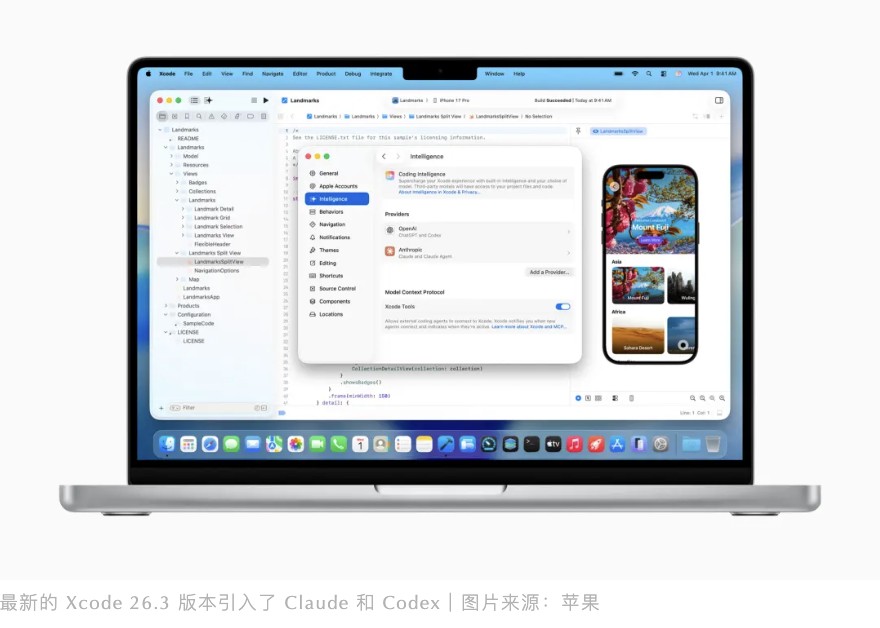
On February 3, 2026, local time, Apple officially released version 26.3 of Xcode, with the most notable feature being the introduction of "agent programming" support.

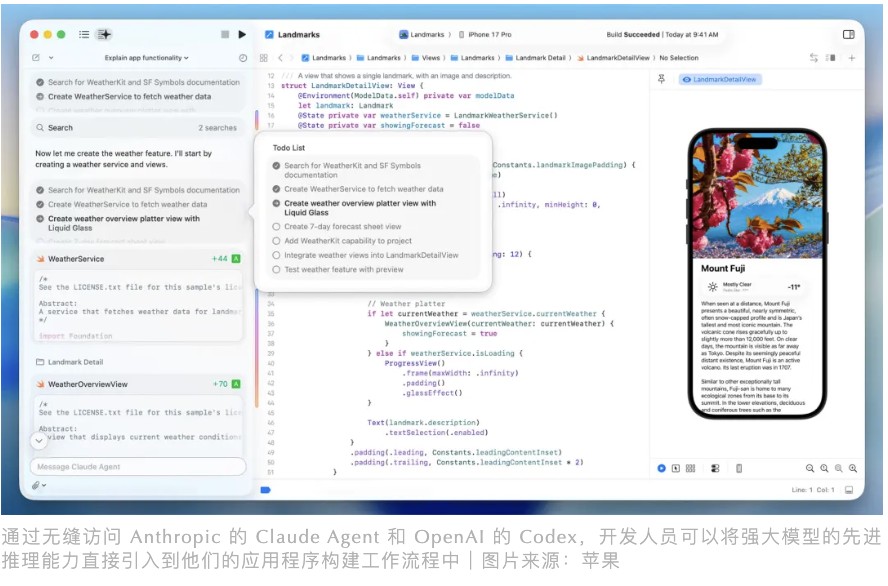
Developers can now directly call AI agents from Anthropic's Claude Agent and OpenAI's Codex within Apple's integrated development environment.

Unlike previous simple code completion suggestions, these agents are deeply integrated with Xcode through model context protocols, allowing them to execute complex tasks with greater autonomy.

According to Apple's official introduction, the integrated AI agents can browse and search the entire Xcode project structure; read, write, edit, move, and delete files; build projects based on instructions; and even automatically fetch Apple's official developer documentation to solve problems.

As the base for Apple developers, will the introduction of AI in Xcode ignite the widespread adoption of "Vibe Coding"?

Powerful features, but also more "reckless"

In fact, Apple attempted to introduce AI features as early as the release of Xcode 16 in 2024. However, the explosion of large models was still pending at that time.

It wasn't until Vibe Coding became a trend, and Cursor and Claude Code became the default tools for programmers, that Apple finally caught up, introducing the so-called agentic coding feature in the latest version 26.3.

In other words, Apple was once again late to the game compared to competitors like Microsoft, fully integrating third-party Claude and ChatGPT into the IDE only after the fact.

According to the official introduction, the current Xcode can achieve predictive code completion, a feature that performs quite aggressively on Apple Silicon chips and the latest macOS Tahoe system, as it can infer the next entire logic segment based on your context.

The more advanced agentic coding allows users to give instructions directly in natural language, enabling the AI agent to automatically create files, consult Apple's official documentation, write unit tests, and even directly run builds.

If there are compilation errors, this AI agent can go through the Build Logs to find errors and attempt to fix them, a closed-loop capability that was unimaginable before

In addition, it has integrated support for the DocC specification, allowing users to automatically generate compliant documentation comments by selecting a piece of code, saving a lot of manual effort.

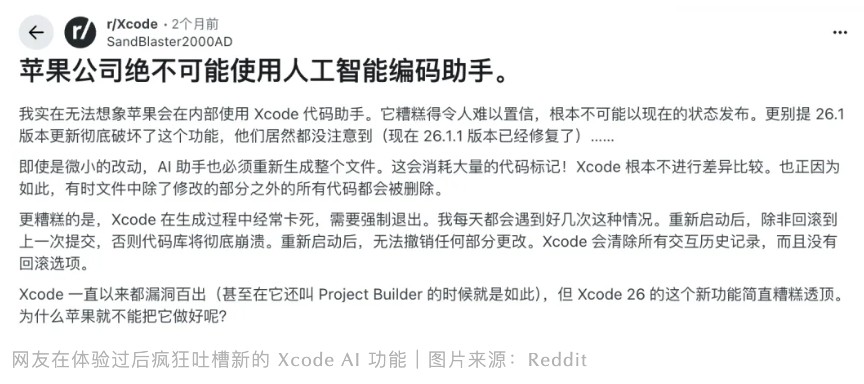
However, some early adopters have presented polarized conclusions after their experiences. In the discussion forums of MacRumors and Reddit, many professional developers have given rather harsh critiques of this feature.

Some users reported that Xcode often hangs when generating code, even requiring a forced exit.

Worse still, its Diff comparison mechanism is poorly executed; AI often regenerates the entire file when modifying a small feature, which not only consumes Token limits excessively but also occasionally deletes the original correct code, leaving only the modified parts, leading to a collapse of the codebase.

Notable developers like Thomas Ricouard have expressed that after trying it out, Codex "manages its own installation" in Xcode and integrates deeply with the IDE, providing a "very comfortable default experience."

To many seasoned developers, the current Xcode AI still resembles an apprentice that hasn't graduated; it does not perform as robustly as competitors like Cursor when handling complex cross-file refactoring.

Apple's "Supplement Ticket" Developer Ecosystem

Apple's introduction of AI in Xcode is far from a simple feature update; it is a well-considered strategic positioning in the ecosystem.

In the past year, editors like Cursor and Windsurf, which are centered around AI, have rapidly emerged, continuously eroding the market of traditional IDEs by offering disruptive code generation and understanding experiences.

Microsoft has also deeply penetrated the development process through GitHub Copilot. If Apple clings to tradition, it risks facing "voting with their feet" from developers, especially the new generation.

This time, Apple has directly collaborated with OpenAI and Anthropic, rather than relying entirely on self-developed models, demonstrating a pragmatic "borrowing approach" aimed at quickly addressing shortcomings and avoiding falling behind in the AI tool wave.

A clear trend for the industry is that all important productivity software will transition from "plugin-based" to "native integration" of AI capabilities. Whether it's Figma's design AI or Notion's writing AI, they will be deeply integrated into their data models and operational interfaces.

The opportunity window for independent AI tools is closing, and platform providers will reclaim dominance. Apple's demonstration on Xcode may force Google's Android Studio, Microsoft's Visual Studio, and others to respond more aggressively For individual developers, there may be both challenges and opportunities.

The challenge lies in the dilution of the value of basic coding skills, making continuous learning of AI collaborative workflows a necessity. The opportunity is that AI significantly lowers the barrier to turning ideas into prototypes and products, greatly expanding the capability boundaries of independent developers or small teams, potentially giving rise to a wave of "one-person army" style innovation. In the future, excellent developers may be those who are best at setting goals for AI entities, dividing responsibilities, and conducting final quality control as "AI team managers."

Of course, in the current explosion of OpenClaw and various Agent tools, ordinary developers may have already become accustomed to completing the entire development process in dialogue boxes.

This means that classic platforms like Xcode may have long been unable to keep up with the hearts of developers.

Risk Warning and Disclaimer

The market has risks, and investment requires caution. This article does not constitute personal investment advice and does not take into account the specific investment goals, financial situation, or needs of individual users. Users should consider whether any opinions, views, or conclusions in this article are suitable for their specific circumstances. Investment based on this is at one's own risk.