


Local Two Sessions Conclude: Signals Beyond GDP Targets

With the conclusion of the Shanghai Two Sessions, the policy direction of this year's local Two Sessions is gradually becoming clear. Key signals to focus on include: first, the "correct view of achievements" has become a local consensus, emphasizing pragmatism and concerns for people's livelihoods; second, major economic provinces will increase efforts in technological innovation to promote regional coordinated development; third, while "promoting consumption" is a priority, it is not an urgent matter. Overall, 2026 will place greater emphasis on medium- to long-term high-quality development
With the official conclusion of the Shanghai Two Sessions, the landscape of this year's local Two Sessions has become basically clear. From the opening of the Zhejiang Two Sessions to the near conclusion of the Shanghai Two Sessions, we can see the "forest" from the "trees," initially outlining the overall direction of future national policies. As the starting year of the 14th Five-Year Plan, the work deployment for 2026 will inevitably focus more on medium- and long-term high-quality development. Therefore, in addition to the highly anticipated GDP growth target, we believe there are several policy signals worth paying special attention to:
First, the "correct view of achievements" is being advocated from the top level and implemented as a local consensus. This year, some localities have begun to change their leadership, and the fifth plenary session of the Central Commission for Discipline Inspection pointed out the need to select "loyal, reliable, consistent in word and deed, and responsible good cadres." Under this guidance, this year's local Two Sessions have significantly strengthened the understanding and expression of the view of achievements, appearing more pragmatic, specific, and closer to people's livelihood concerns compared to last year.
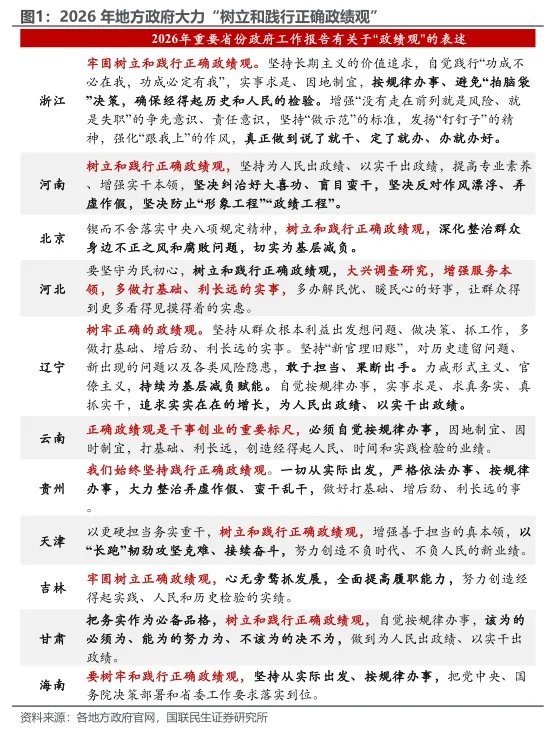
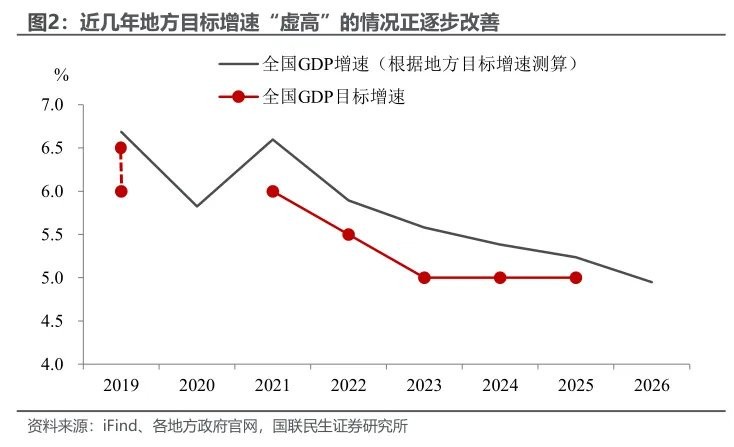
For example, Beijing proposed to "deepen the rectification of improper practices and corruption issues around the masses, and effectively reduce the burden on grassroots"; Zhejiang emphasized "avoiding 'knee-jerk' decision-making, ensuring it can withstand the test of history and the people," etc. This may also indirectly explain the reason for the weighted average reduction of economic growth targets in various provinces this year.
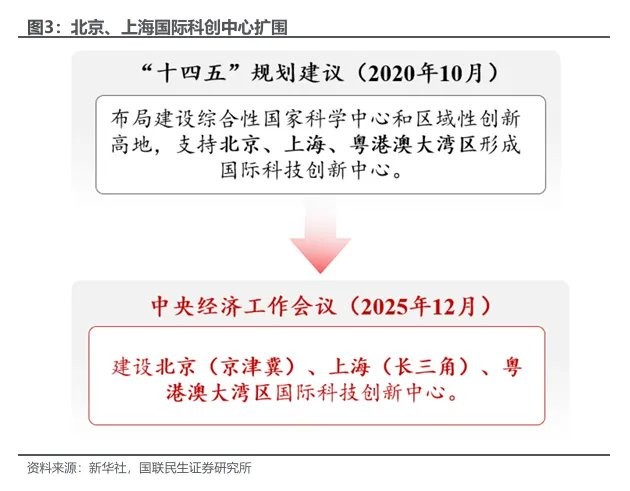
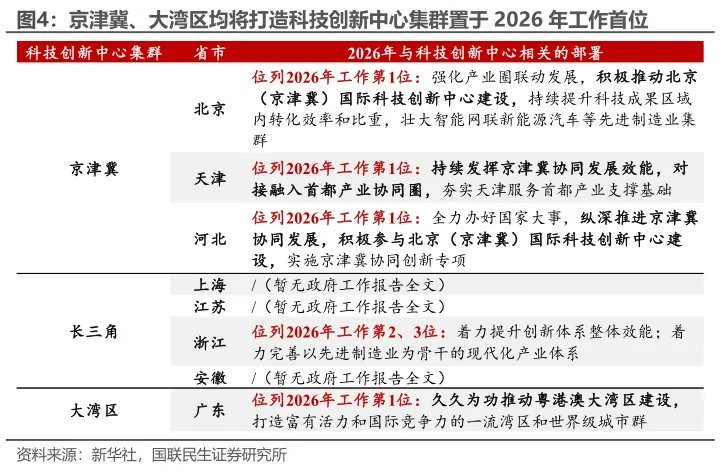
Second, major economic provinces will "put in full effort" to develop technology. With the Central Economic Work Conference expanding the layout of China's international science and technology innovation centers from Beijing, Shanghai, and the Greater Bay Area to the three major regions of Beijing-Tianjin-Hebei, the Yangtze River Delta, and the Greater Bay Area, in 2026, these regions have almost uniformly placed the creation of technology innovation center clusters at the forefront of their annual work reports, indicating that regional collaborative innovation has become a core strategy driving high-quality development.
Of course, while "putting in full effort" to develop technology, it is also necessary to calm down and "counter involution." Interestingly, these core regions responsible for building international science and technology innovation centers have almost all specifically deployed "counter involution" work in 2026, while many other provinces have not prioritized it. This highlights the important role of constructing a clear, efficient, and sustainable research and industrial ecosystem in innovation hubs.
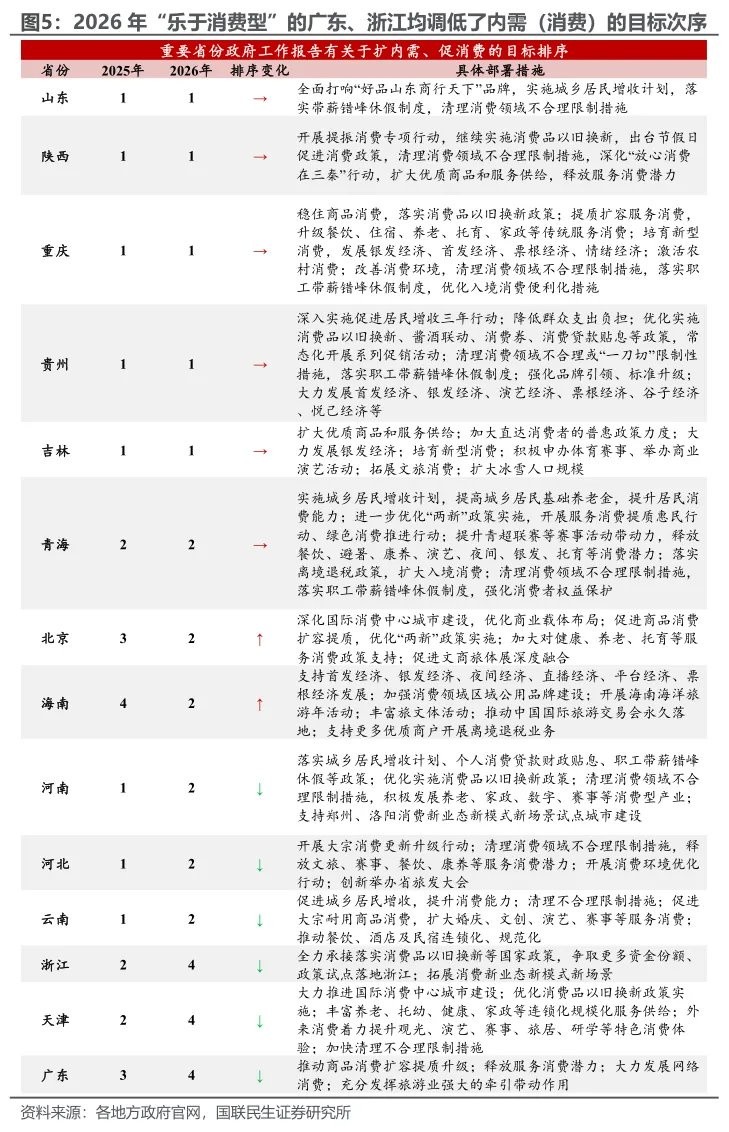
 Thirdly, local "consumption promotion" is a key work deployment, but it is not an urgent priority. Although various regions have made further arrangements to implement national-level policies such as replacing old consumer goods, clearing unreasonable restrictions in the consumption field, and enriching service consumption supply, compared to the 2025 local government work reports, this year, the order of tasks related to "expanding domestic demand and promoting consumption" in various regions has mostly remained stable or been postponed (including Guangdong and Zhejiang, which were mentioned in our previous report "Enhancing Consumption Rate: Four Types of Portraits of China" as "consumption-friendly," both of their 2026 work reports have downgraded the priority of domestic demand tasks).
In the 2026 work kickoff, local governments will still allocate limited policy resources and attention more towards tasks such as industrial upgrading and technological innovation. In contrast, the expansion of consumption is viewed as a systematic project that needs to be steadily advanced and continuously deepened in the medium to long-term dimension during the "14th Five-Year Plan" period.
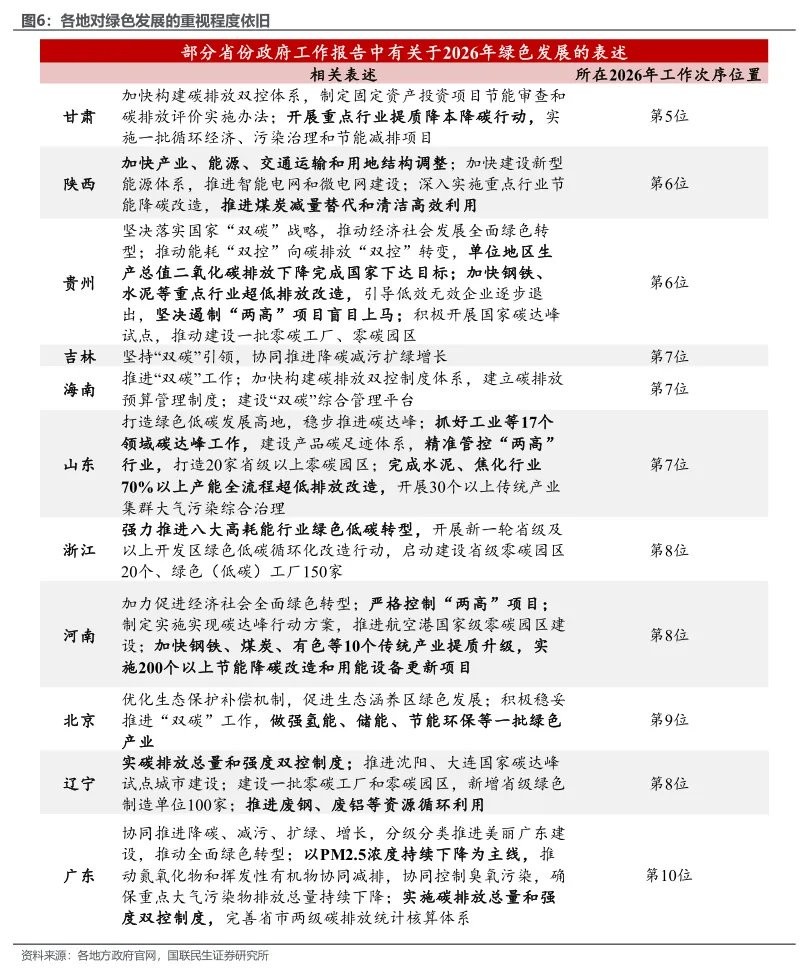
Fourthly, green development still holds a solid position. Although the ranking of green development among provinces in 2026 varies, most have made clear deployments for "dual carbon" work, with Zhejiang even holding a special meeting at the beginning of the year to promote "dual carbon" work deployment. High-energy-consuming industries such as steel, cement, coking, and non-ferrous metals, as well as "two high" projects, will become key targets for carbon emission monitoring and transformation. In addition, various regions generally regard the construction of "zero-carbon parks," "zero-carbon factories," and the establishment of a dual control system for carbon emissions as key measures to shift green work from goal-oriented to project-based and systematic implementation.
Risk Warning and Disclaimer
The market has risks, and investment should be cautious. This article does not constitute personal investment advice and does not take into account the specific investment goals, financial conditions, or needs of individual users. Users should consider whether any opinions, views, or conclusions in this article are suitable for their specific circumstances. Investment based on this is at one's own risk
