Why AI can't revolutionize game engines in the short term?

Google DeepMind's Project Genie has triggered market panic, but Bernstein's latest research report believes it is an overreaction. The core reason is that generative AI is a probabilistic tool, while games are deterministic systems. AI cannot replace core barriers such as IP, rule design, numerical balance, and long-term operations. The panic selling instead highlights the investment value of leading Asian gaming companies that actively embrace AI, possess top-tier IP, and have strong operational capabilities
Recently, Project Genie, an experimental prototype released by Google's DeepMind that allows creators to generate, edit, and explore 3D virtual worlds, has caused significant turbulence in the capital markets, leading to a sharp decline in the stock prices of several gaming companies in the U.S. However, a Bernstein research report pointed out that this panic is not only excessive but also exposes the market's superficial understanding of the essence of game development.
According to the Chasing Wind trading desk, Bernstein's report released on February 2 states that for investors, the core point is: Generative AI is currently only a probabilistic tool, while games are deterministic systems; the two are fundamentally different.
While AI can accelerate material production, it cannot replace game rule design, numerical balance, and the moat created by IP accumulation. The report clearly states that compared to the increasingly strong resistance to AI among Western developers, Asian gaming companies are in a more advantageous position in utilizing AI to enhance R&D efficiency. This irrational sell-off, on the contrary, highlights the investment value of leading Asian companies that possess top-tier IP, strong long-term operational capabilities, and actively embrace AI technology.
Technical Reality: The "Illusion" Generated by AI Cannot Replace Deterministic Game Rules
The market's fear of Project Genie stems from an impressive video demonstration, but the devil is in the details. The report points out that this technology is still in its very early stages: The generated virtual world sessions are limited to 60 seconds and cannot be saved for reuse.
A deeper logical contradiction lies in the differences in technical principles. Generative AI models are essentially "probabilistic"; they guess the next pixel or frame based on statistical patterns, while video games must be "deterministic," requiring rigorous rules to provide a consistent experience.
When you play an action game, what you need is precise feedback, not an AI-generated "surprise." Although the technology behind 3D world modeling will iterate rapidly, it currently only addresses one aspect of the many disciplines involved in game development—rendering, and is far from building a fully functional game system.
The Barrier of "Fun": More Than Just Piling Up 3D Models
The moat of game development is much deeper than simply generating a beautiful 3D scene. The report emphasizes that "fun" is an extremely complex concept. Relying solely on AI to generate visual materials cannot solve core issues such as whether the narrative is engaging, whether the impact feels precise, and whether the character growth curve is reasonable.
In multiplayer games, this complexity increases exponentially. Multiplayer games are places where players express deep desires for survival and conquest, which require extremely complex systems to support, including in-game balance (the dynamic game between developers and players seeking loopholes), anti-cheat systems, and matchmaking mechanisms. These are all "implicit variables" that generative AI currently cannot understand or replace. Therefore, the view that AI can quickly replace traditional game engines overlooks the complexity of games as a comprehensive interactive medium.
Content Supply and IP Moat: Quantity Does Not Equal Quality
AI has indeed lowered the threshold for game production, leading to a surge in market supply. Data shows that the number of new games launched on the Steam platform in 2025 will exceed 20,000, partly thanks to AI-assisted production. However, this "explosion of quantity" has not changed the "monopoly of quality."
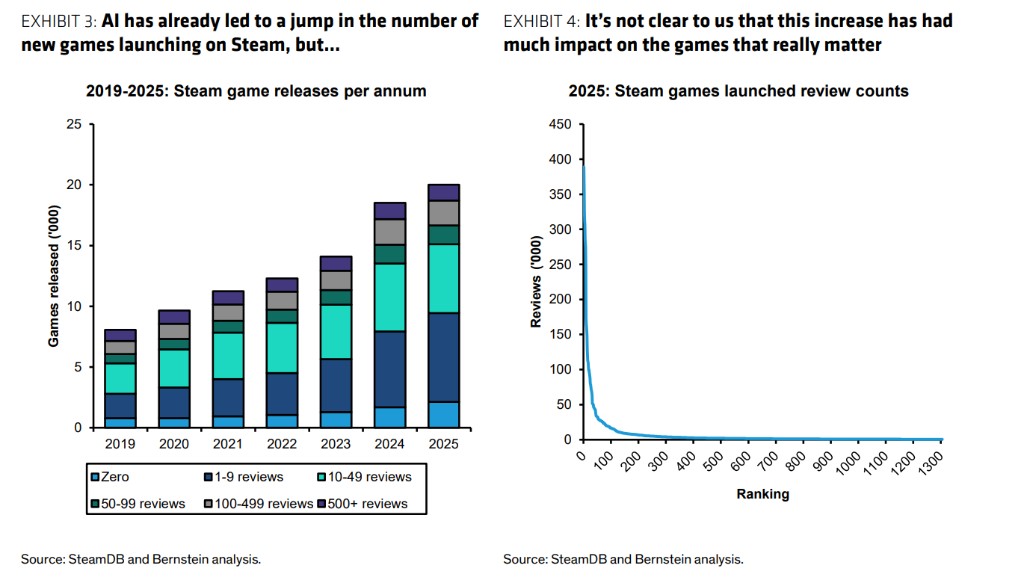
Research data indicates that among the vast number of games released in 2025, only about 1,300 games received more than 500 reviews; if the threshold is raised to 10,000 reviews, this number plummets to just 137. This indicates that while AI has increased the supply of relatively cheap and one-time experiences, it has not increased the supply of unique, differentiated content. The dopamine produced by the human brain in response to repetitive experiences diminishes, meaning that merely relying on AI to generate a large amount of homogenized content cannot achieve commercial success.
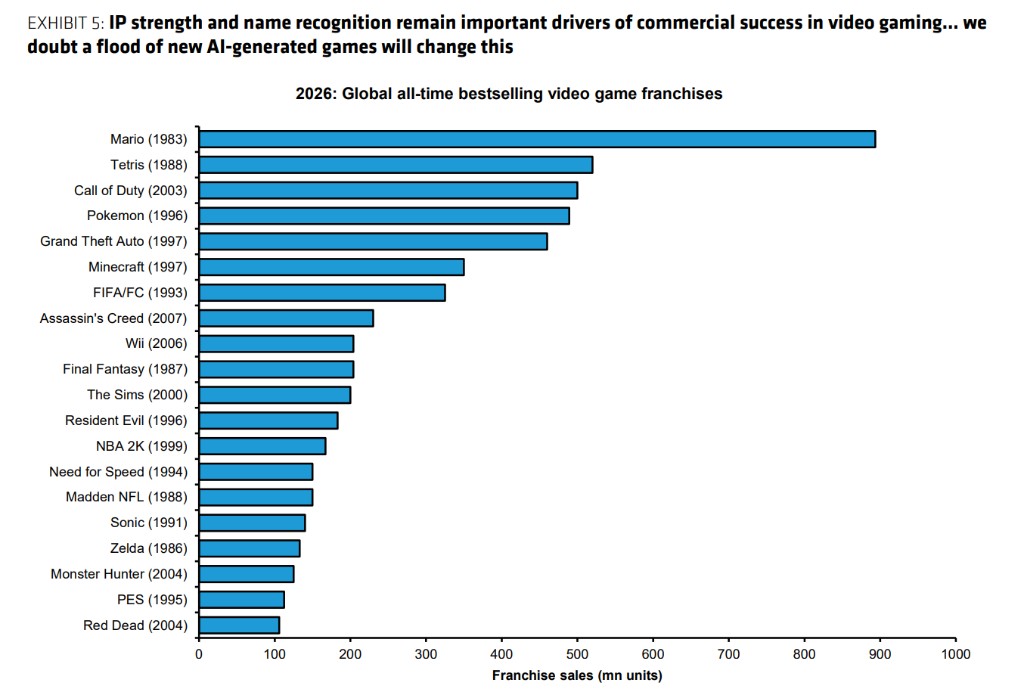
On the contrary, the strength of IP, brand recognition, and player sentiment remain key factors determining commercial success or failure. Whether it is Nintendo's classic IP or the GTA series, the emotional connections built over the long term cannot be replicated overnight by AI.
Challenges of Long-Term Operations: Dynamic Art Difficult for AI to Learn
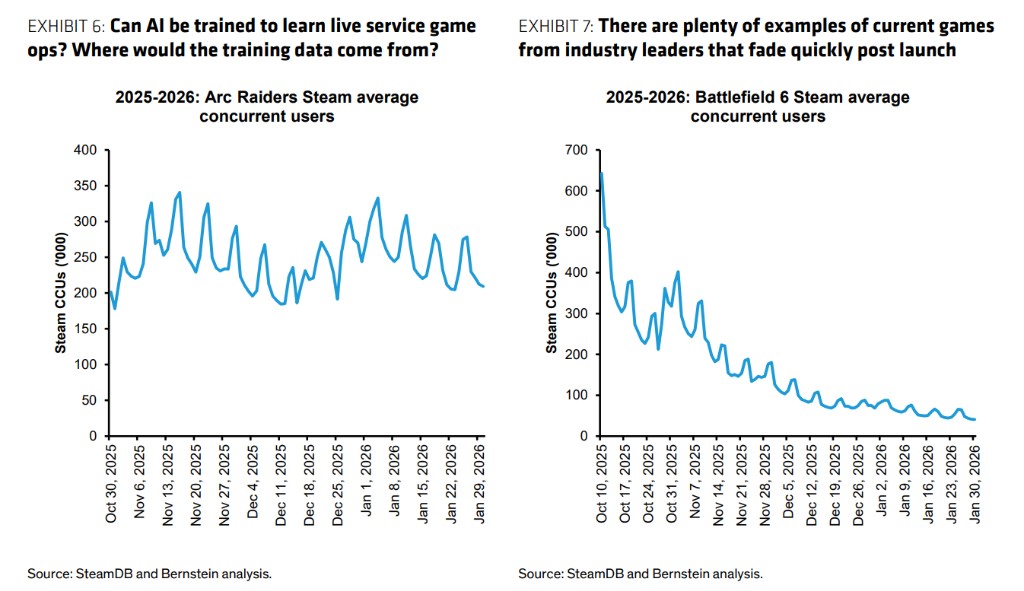
For currently mainstream service-oriented games, the ability of AI to replace human effort is even more questionable. The research report argues that there is no "one-size-fits-all" solution for long-term operations; even AI trained on vast amounts of human behavioral data is unlikely to perform better than top human teams in the industry.
Historical cases show that even seemingly similar games like Battlefield 6 and Arc Raiders exhibit significant differences in player retention rates after release. Maintaining the vitality of a game requires continuously adjusting content pacing and balance based on player feedback; this dynamic, context-specific decision-making ability currently lacks evidence that AI can fulfill. If even industry veterans struggle to ensure success in every operation, it is clearly unrealistic to expect AI to automatically manage a complex online community.
Future Outlook: AI as the Co-Pilot of the Engine, Not the Driver
Regarding the relationship between AI and game engines, the research report proposes a rational integration path: Generative AI will be subordinate to game engines. As Tim Sweeney of Epic Games stated, engines have advantages in stable world expression and physical simulation, while AI excels in handling diverse content. The future development model is likely to be: game engines are responsible for constructing the "skeleton" such as physical rules, lighting, and asset layout, while generative AI is used to fill in the "flesh" such as crowd behavior, random events, or assisting in generating UGC content.
Tencent's "Peace Elite" is a typical case, where its UGC content currently accounts for only a single-digit percentage of revenue, but the daily active user count (DAU) has increased by 25% year-on-year. This indicates that AI is more of an empowering tool, helping to expand the content ecosystem rather than completely overturning the existing development process.
Geopolitical Differences: Structural Advantages of Asian Firms
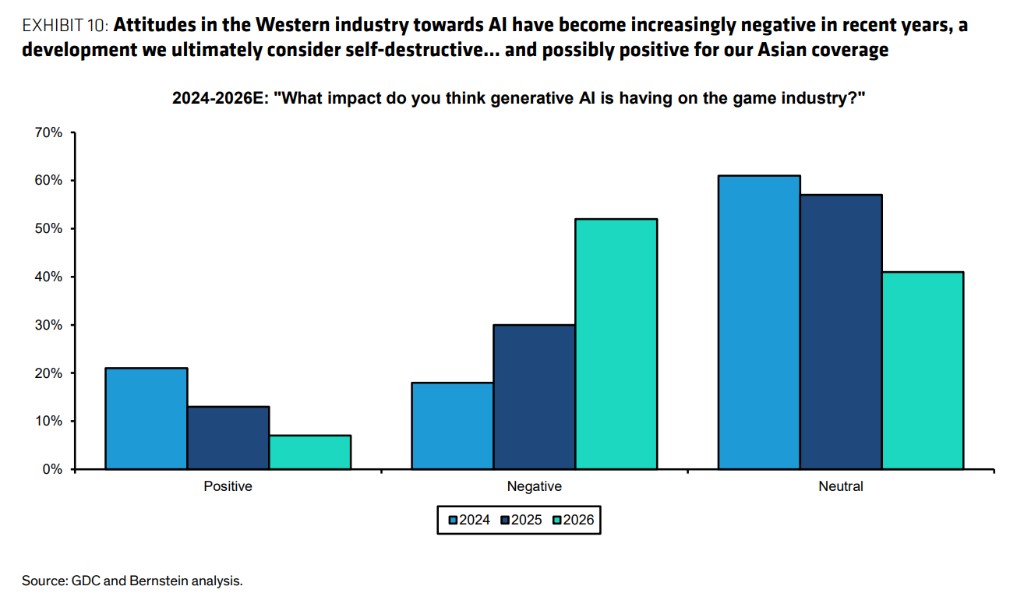
Finally, the research report presents an extremely important investment perspective: the global gaming industry's attitude towards AI shows a clear divergence. The 2026 GDC game industry report indicates that Western developers are increasingly hostile towards AI, even exhibiting "Luddite" tendencies, which may lead to self-destruction in technological iteration.
In contrast, Asian, particularly Chinese, gaming companies demonstrate greater adaptability. Tencent is considered one of the companies in the industry with the highest readiness for AI, being one of the few, aside from Google and OpenAI, to have released a 3D world model (HY-World v1.5).
Asian developers not only enjoy lower R&D costs but also show a more proactive attitude in embracing new technologies and utilizing AI to enhance productivity. In this wave of AI, Asian companies that can pragmatically integrate AI into workflows and convert it into commercial value will have a greater chance of winning compared to their Western counterparts, who are mired in ideological disputes.