The turmoil of "valuation adjustment" of China Investment UBS Silver LOF

The China Investment Securities UBS Silver LOF Fund has sparked controversy due to valuation adjustments. On February 3rd, the fund company announced it would revalue the fund's assets based on international silver futures market prices, leading to a 31.05% plunge in the unit net value on February 2nd. This move raised questions among holders regarding the fund management, particularly why the information was released only after the market closed. Silver prices have fluctuated significantly recently, and the fund's premium rate has soared to 110%
The most well-known silver fund in China—Guotou Ruijin Silver LOF—has fallen into a huge controversy after more than two months of intense trading.
The catalyst for the controversy was an announcement made by Guotou Ruijin Fund Company on February 3rd (actually on the evening of February 2nd).
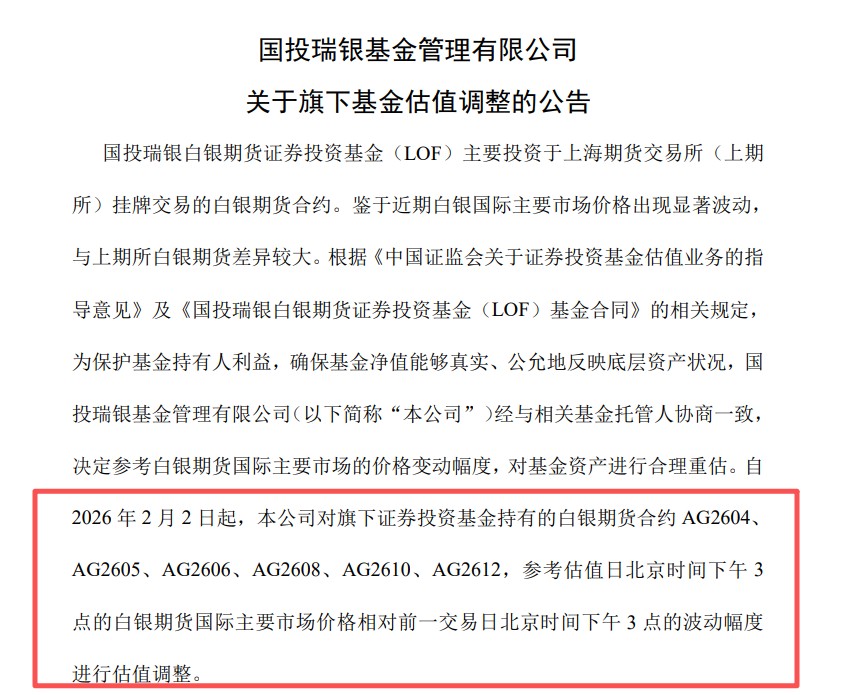
The announcement stated: In order to protect the interests of fund holders and ensure that the fund's net value can truly and fairly reflect the status of the underlying assets, Guotou Ruijin Fund Management Co., Ltd., after consultation with the relevant fund custodian, decided to reasonably reassess the fund assets by referencing the price fluctuations in the major international silver futures markets. The valuation method is: Starting from February 2, 2026, our company will adjust the valuation of the silver futures contracts AG2604, AG2605, AG2606, AG2608, AG2610, AG2612 held by the securities investment funds under its management, based on the price fluctuations of the major international silver futures markets at 3 PM Beijing time on the valuation date relative to the previous trading day's price at 3 PM Beijing time (see the chart below).

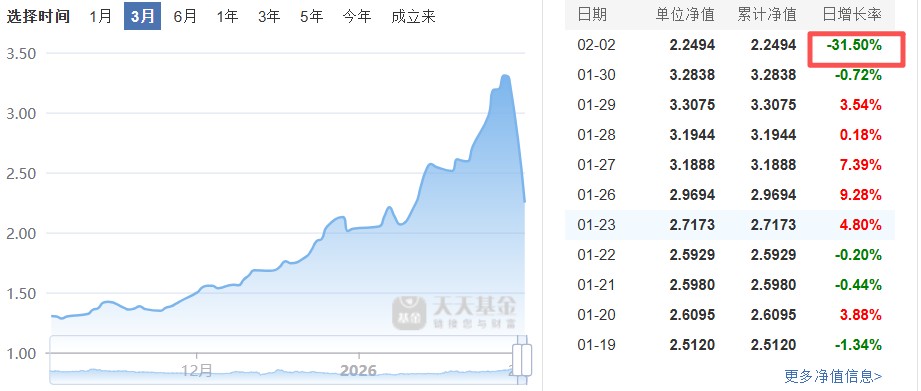
Once the announcement was made, the unit net value of Guotou Ruijin LOF on February 2nd plummeted by 31.05%, falling from 3.2838 yuan to 2.2494 yuan (see the chart below). The redemption price for holders who had submitted redemption applications that day would be based on the adjusted settlement price.
Equally "frustrated" are the holders of the listed shares of the silver LOF fund, as the high premium over the past few months saw the fund's secondary market transaction price reach as high as 5.247 yuan last week, and it has just begun to decline. After this adjustment, the premium rate for this product surged to 110% (calculated by dividing the closing price on February 2nd by the net value announced on February 2nd), making the subsequent trend even more uncertain.

Why did Guotou Ruijin Silver LOF make a temporary valuation adjustment?
Why was the relevant information released only after the market closed on February 2nd?
Has the interests of the product holders been considered in this approach?
A series of controversies quickly emerged among holders and the fund investment community...
Origin: The Booming Silver Trend
The origin of it all should first be attributed to the suddenly surging silver prices.
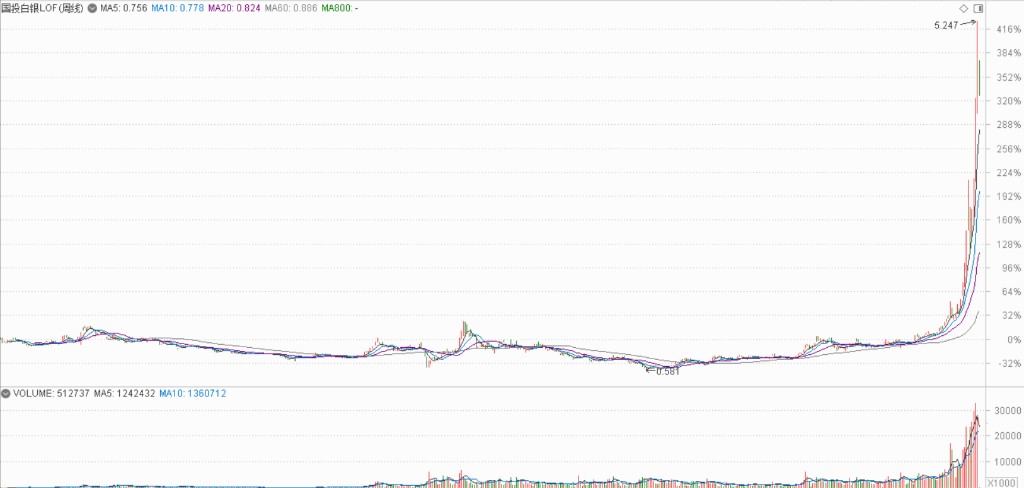
Looking back at the price trend of the silver LOF over the past eleven years (see the chart below), it can be observed that silver is experiencing one of the "most vigorous" rounds of price increases in over a decade.
Historically, silver prices have been relatively stable compared to the stock market, but this assessment will no longer hold true starting from the second half of 2025.
Strictly speaking, since early September 2025, the price of silver LOF has begun to reach its highest level in a decade and has rapidly surged upward, with increasingly fierce momentum.
Entering the last week of November, the vigorous trend began to "upgrade" into a frenzied rally. Taking the Guotou Ruijin Silver LOF as an example, the fund's price started to rise without looking back after breaking through the "historical highest price" of 1.48 yuan at the end of November.
— In just over a month, the silver LOF rose to a maximum of 5.247 yuan, an increase of over 240% (see chart below).
This increase is attributed to both the rise in silver futures contracts held by the fund and the premium uplift at the trading level, with the premium rate once reaching 50%.
The latter reflects the trading enthusiasm of secondary market investors: A premium rate of over 50% is historically very high for any listed fund.
"Taking Action": From "Unable to Keep Up" to "Overstepping"?
When a huge market movement or volatility occurs, and when significant profits are adjusted, the actions of every stakeholder are magnified.
Inevitably, the fund manager Guotou Ruijin Fund was quickly pushed to the forefront of the market, becoming a part of the market's windfall.
Perhaps due to the rapid market rise, or perhaps lacking sufficient experience to respond, Guotou Ruijin Fund's series of measures "took action" before and after the significant fluctuations in silver, leading to much controversy later on.
Initially, Guotou Ruijin's actions were relatively timely and "gentle."
Starting from early December, Guotou Ruijin Fund continuously issued "premium risk warnings" regarding the silver LOF, reminding investors that the trading price in the secondary market was significantly higher than the net asset value of the fund shares, and that investors blindly investing in high-premium fund shares might face substantial losses.
However, in the face of a major market trend, gentle reminders are often hard to see "immediate effects."
As the market progressed to mid-December, Guotou Ruijin's "role" became increasingly prominent, with "actions" becoming more significant.
On December 19, the company issued a "Guotou Ruijin Silver Futures Securities Investment Fund (LOF) Announcement on Adjusting Large Subscription (including Regular Investment) Business," lowering the subscription limit for the fund (including regular investment) to 500 yuan.
On December 26, the fund company again issued a "Announcement on Adjusting Large Subscription (including Regular Investment) Business," lowering the subscription limit for the fund to 100 yuan, and directly closing subscriptions for Class C.
On January 27, Guotou Ruijin Fund Company issued a "Announcement on Suspending Subscription (including Regular Investment) Business for Guotou Ruijin Silver Futures Securities Investment Fund (LOF)," completely closing the subscription channel for the fund. The sequential introduction of the above three measures has sparked much "heated discussion":
On one hand, lowering or even closing subscriptions when the product is in a high premium range seems to be a rational move to control the fund size and avoid investors "increasing their positions at high levels."
On the other hand, since the silver LOF also has listed varieties and the situation of heated speculation has already formed, the continuous lowering or closing of subscription channels means that on-site speculators are increasingly unconcerned about the "hedging" of external subscription funds, becoming more fearless, and pushing some subscribers towards the higher-priced secondary market.
Indeed, after completely closing the subscription channel on January 27, the secondary market price of the silver LOF surged sharply, ultimately making the subsequent peak market trend even more "acute."
Controversial "Suspension" Measures
In addition to limiting subscriptions, China Investment Securities UBS Silver LOF also implemented other market cooling measures, such as suspending trading—however, the latter's "controversy" is greater.
Starting from December 12, the silver LOF almost routinely suspended trading for one hour after the market opened to alert market risks and cool down. This measure was relatively mild and did not change the heated speculation pattern in the market.
During this period, the silver LOF also arranged for two full-day trading suspensions, on January 22 and January 30. This measure had a more significant cooling effect.
However, the suspension itself also limited normal trading circulation, its effect akin to "holding down" a "wild horse" on the prairie, and the resulting consequences are actually difficult to estimate.
Unfortunately for the silver LOF, the suspension on January 30 triggered a series of subsequent issues.
Because, very unfortunately, on January 30, the day the silver LOF was suspended, the silver price—hit its peak.
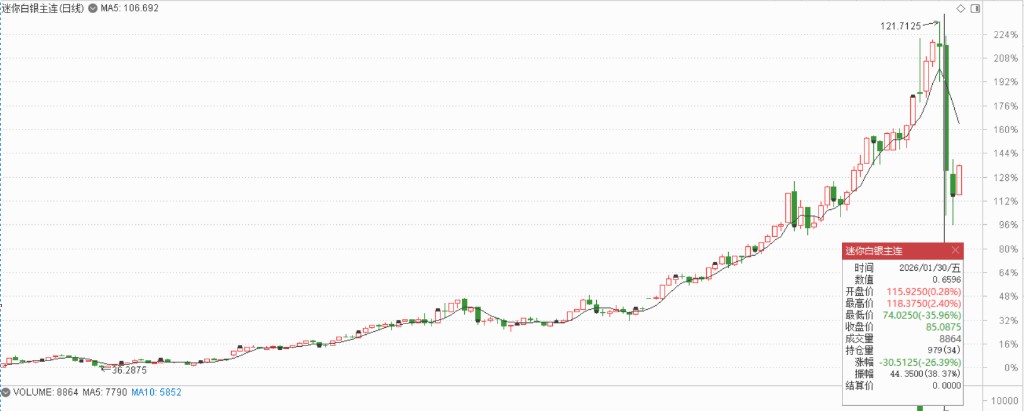
Taking the overseas silver trend on that day as an example, the mini silver contract on the New York Mercantile Exchange fell by over 30% (see chart below). The domestic silver futures main contract did not experience such an extreme trend but also showed a significant adjustment.

When the overseas silver price suddenly peaked, domestic silver LOF secondary market investors were stuck in suspension, watching the premium rate remain in the previous day's heated state, unable to "move" on the trading board.
At the same time, the silver LOF, which missed a day of adjustment opportunity, further "widened" the gap with the silver futures trend, and a day's suspension became the prelude to a series of subsequent "troubles."
The "Valuation Adjustment" That Sparked Huge Discussion
The unprecedented surge and plunge, along with the rare occurrence of the fund peaking during a trading suspension, must be said that the "luck" of the silver LOF in this regard was not very "good."
However, more measures were subsequently announced In response to the limit down of silver futures and silver LOF on Monday and Tuesday this week, an unexpected measure has emerged.
On February 3rd (actually announced on the evening of February 2nd), Guotou Ruijin Fund Company announced a "reasonable revaluation of the fund assets" for silver LOF. The valuation method is as follows: starting from February 2, 2026, the company will adjust the valuation of the silver futures contracts AG2604, AG2605, AG2606, AG2608, AG2610, AG2612 held by its securities investment funds based on the fluctuation of the international major market price of silver futures at 3 PM Beijing time relative to the previous trading day's price at 3 PM Beijing time (see the chart below).
This revaluation brought about two unexpected adjustments:
First, the fund announced the adjustment to the net asset value calculation method for February 2nd after the market closed on February 2nd (the announcement was signed on February 3rd). At that time, all redemption requests for February 2nd had already been submitted, meaning that these redeeming investors would directly bear the consequences of the net value adjustment—unexpectedly.
Second, this adjustment plan references the prices of silver futures in the international major markets to assess the value of domestic futures contracts, a practice that has rarely been seen in the industry before. For investors, this is the second layer of unexpectedness.
With these two unexpected factors, coupled with the previously accumulated high premiums, it is not surprising that some investors in the market have had "shifting thoughts."
Relevant "Parties" Have Something to Say
So why adjust the fund's net value calculation method at this moment? Guotou Ruijin also has its own explanation.
According to the explanation provided by Guotou Ruijin:
This adjustment in the valuation method stems from recent significant fluctuations in international silver prices, and given the current market's uniqueness, starting from February 2, 2026, the company will assess the silver futures contracts (AG2604, AG2605, AG2606, AG2608, AG2610, AG2612) held by the Guotou Ruijin Silver Futures Securities Investment Fund (LOF) based on the fluctuation of the international major market price of silver futures at 3 PM Beijing time relative to the previous trading day's price at 3 PM Beijing time.
The company also stated that under normal market conditions, the net asset value of silver LOF is typically estimated using the "settlement price of the contracts held on the valuation date" as a basis. This practice aligns with industry norms and facilitates understanding and tracking for investors.
However, it should be noted that the domestic futures market has a price limit system. Taking a certain silver futures contract on the Shanghai Futures Exchange as an example, the current price limit is ±17%. This means that even if the international market price experiences greater fluctuations, the domestic contract price can only reflect a maximum change of 17% within a single trading day. In simple terms, in extreme market conditions, conventional valuation methods may lead to overestimation or underestimation The company also stated that research from multiple futures companies indicates a very high correlation between the price fluctuations of silver futures on the Shanghai Futures Exchange and those in major international silver futures markets. In the absence of price limits, the fluctuations of both should be comparable. In recent extreme market conditions, the daily volatility of silver futures prices in major international markets far exceeded the price fluctuation limits of silver futures on the Shanghai Futures Exchange. At this time, if the settlement price of silver futures on the Shanghai Futures Exchange is still used for valuation, it may result in the fund's net asset value not being able to fully and timely reflect the true fair value of the underlying assets.
Therefore, to ensure that the fund's net asset value can truly and fairly reflect the status of the underlying assets, Guotou Ruijin has decided to reasonably reassess the fund's assets by referencing the price fluctuations in major international silver futures markets.
Guotou Ruijin also stated that the basis for this adjustment in valuation methods is the "Guiding Opinions on the Valuation Business of Securities Investment Funds" issued by the China Securities Regulatory Commission and the fund's contract. The fund contract clearly stipulates: "If there is conclusive evidence that the valuation according to the above methods cannot objectively reflect its fair value, the fund manager may, after consulting with the fund custodian based on specific circumstances, value at the price that best reflects fair value." Based on recent international market prices and liquidity factors, and after full consultation with the fund custodian, we believe that the current situation meets the applicable conditions of the above clause.
Guotou Ruijin also stated, "Our company will comprehensively consider various relevant influencing factors and negotiate with the fund custodian. Once the above contract transactions reflect the characteristics of an active market, we will restore the valuation method based on the settlement price." This adjustment in the valuation method does not change the fund's investment objectives, investment scope, or risk-return characteristics, but is only to ensure that the net asset value can truly and fairly reflect the asset value.
In summary, Guotou Ruijin's explanation mainly includes four aspects: first, the valuation adjustment arises from the inability of the daily scheme to accurately value the fund's assets under extreme market conditions; second, the adjustment plan references the opinions of futures experts and uses overseas silver futures prices without price limits as a reference; third, this adjustment complies with regulatory requirements and the fund contract; fourth, the conventional valuation scheme will be restored in a timely manner once domestic futures contract trading becomes active again.
Of course, from another perspective, a vibrant, stable, and healthy listed fund relies on a sound system, experienced "regulation," and a more balanced and systematic mechanism design for its safe, stable, and active operation. This mechanism should be able to adequately cope with various shocks, rather than temporarily adopting one measure after another to rebalance the entire system. The latter easily undermines investors' trading confidence and can also trigger unknown "butterfly effects." This may be the most important insight from this incident.
Risk Warning and Disclaimer
The market has risks, and investment requires caution. This article does not constitute personal investment advice and does not take into account the specific investment objectives, financial conditions, or needs of individual users. Users should consider whether any opinions, views, or conclusions in this article align with their specific circumstances. Investment based on this is at their own risk.