"Those who don't want to use ours don't have to": Palantir secures $4.3 billion in orders in Q4, CEO calls the company's performance a "landmark moment" in corporate history

Wallstreetcn
2026.02.03 09:35
portai
I'm PortAI, I can summarize articles.

The enterprise-level AI market is paying a high premium for "certain delivery." Palantir CEO Alex Karp clearly stated that the company's 127% "Rule of 40" score and 93% growth in the U.S. stem from customers viewing AI as "critical to survival," rather than just a technological experiment. The company has restructured customer business processes to become their "operating system," achieving a 57% operating profit margin without significantly expanding the sales team, demonstrating its "product-driven" growth model and strong operational leverage

On February 3rd, the US stock market AI application leader Palantir Technologies (PLTR) shocked the market with its financial report for the fourth quarter of fiscal year 2025: core indicators such as revenue, profit margin, and cash flow all surged, with growth momentum far exceeding Wall Street's most optimistic expectations.

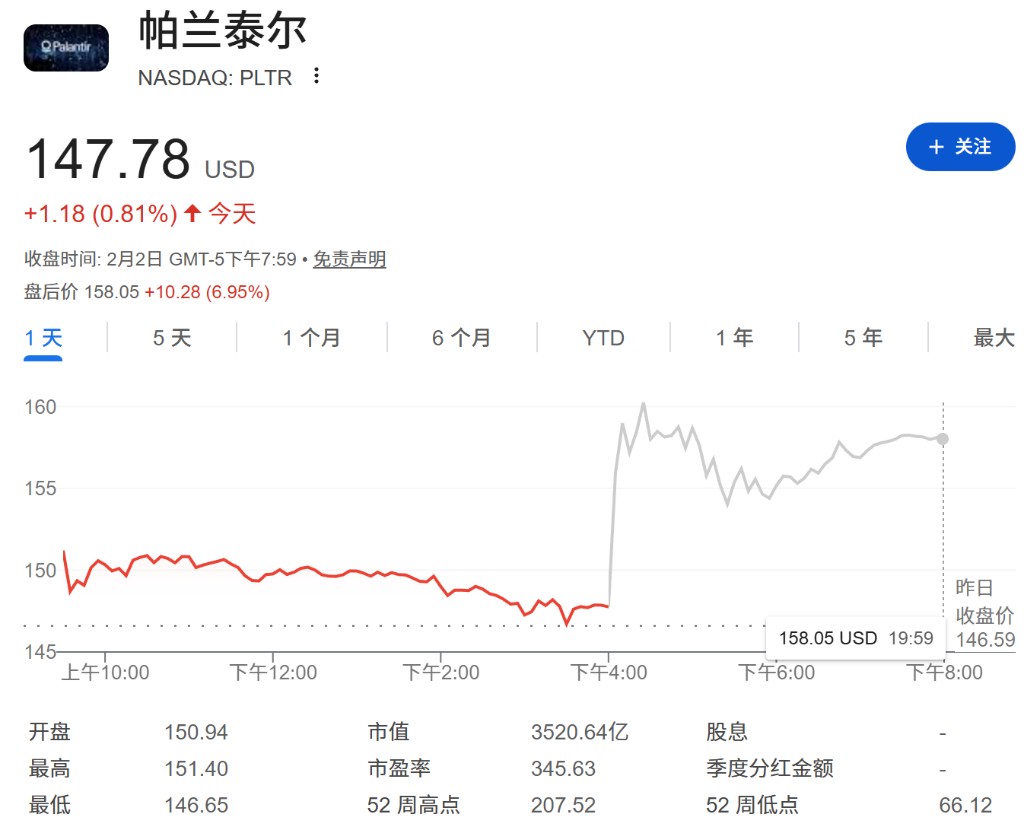
The subsequent conference call further pushed market sentiment to a boiling point, with the company's stock price soaring nearly 7% in after-hours trading. This meeting not only showcased a "historic" report card but also rarely provided a clear signal about the transition of AI in enterprises from "trial" to "scalable monetization." The management did not stop at reiterating the astonishing financial data but repeatedly emphasized a core logic: the market demand for AI has transcended mere model recognition and entered a new phase of extreme desire for "certain delivery" and "operational leverage."

CEO Alex Karp's statements were filled with confidence and aggression:

"The company's growth rate is simply incredible... Our revenue in the US grew by 93%, and total revenue grew by 70%."

"Our 'Rule of 40' score reached 127%... This is a number that no other company can match."

"Those customers who have crossed the chasm—AI-haves—are defining the future of industries, while those still on the other side—AI-have-nots—are fighting for survival."

For a software company that has long been questioned for its high valuation and complex business model, such statements are not just bragging but a key signal: enterprise-level AI is no longer just "the icing on the cake," but has become the "lifeline" that widens the competitive gap.

AI is "exponentially amplifying" enterprise efficiency

More importantly, management clearly linked this explosive growth to a qualitative change in the structure of AI applications.

Chief Revenue Officer Ryan Taylor pointed out that customers are no longer tentatively trying AI but are fully committed:

"Our top 20 customers have seen an average revenue growth of 45% year-over-year over the past 12 months, reaching $94 million per company."

"An executive from a construction industry client stated: 'We have gone all in, to the extent that any other software must prove its justification for existence... Foundry is our operating system.'"

On this basis, Palantir repeatedly emphasized a concept that is distinctly different from its competitors—AI is not just a chatbot, but a combination of "ontology" and "agent-based AI." Taylor explained:

"The rapid advancement of AI models is driving the commodification of cognition. The next step is for the market to distinguish who is providing this commodified cognition and who is leveraging this cognition for scalable leverage." This means that AI does not merely bring a one-time efficiency boost, but rather, by redefining data structures and business processes, it long-term increases enterprises' dependence on core software platforms.

It is against this backdrop that Palantir has provided a very clear positioning of its place in the industry chain:

"If you are just producing what everyone else is producing, then the value is obviously minimal."

"Palantir is an 'N=1' existence. That’s why we can achieve a '40 Rule' score of 127%."

The first key signal released during the call is already very clear: AI is not undermining software value, but is reshaping software pricing power through deep operations.

Not just "selling more software," profit structure is undergoing a systematic leap

One of the market's biggest concerns is whether Palantir can maintain profit quality while achieving high growth. The management's answer is very firm and points to a more important change—growth is no longer reliant on simple sales expansion, but comes from extremely high product leverage.

Palantir's growth logic no longer relies on "human wave tactics," but has shifted to "product-driven + unit profit structure improvement."

Karp clearly stated:

"No one thinks we can generate this scale of revenue with a weak or even shrinking sales team."

Specifically, it is reflected in:

"Adjusted operating profit for the fourth quarter reached $798 million, with a profit margin of 57%."

"Adjusted free cash flow for the year was $2.3 billion, with a profit margin of 51%."

Chief Financial Officer David Glazer further added that the company is achieving remarkable financial efficiency:

"This is not just growth; this is compounded acceleration."

"As we release our revenue and adjusted operating income guidance for 2026, we expect the full-year '40 Rule' score to reach 118%."

This is a typical structural improvement model: AIP platform accelerated deployment → shortened value realization time → customer self-service expansion → profit elasticity release. Rather than simply piling on sales personnel.

Warp Speed and Defense: Transforming from "back-end systems" to "production engines"

If in the past few years Palantir was more viewed as an intelligence analysis tool in the defense sector, during this call, it was described as delving into the core of physical manufacturing through the "Warp Speed" project.

Chief Technology Officer Shyam Sankar emphasized:

"ShipOS is the most important advancement in the fourth quarter, promoting Warp Speed to shipbuilders, shipyards, and key suppliers to accelerate submarine production and maintenance."

"At one shipyard, we reduced material review time from several weeks to less than one hour."

More critically, this technology not only brings efficiency improvements but is also reshaping the labor structure. Sankar bluntly stated:

"This is a practical application of the Jevons paradox. By reducing the time wasted on planning and ensuring material availability, our clients are able to increase the third shift, as there are now more 'shovels ready' jobs waiting to be completed."

This means: The real scarcity is not data, but the ability to convert data into physical world productivity.

The real scarcity is not AI models, but 'results-oriented delivery'

What was repeatedly hinted at during the conference call is not 'how advanced the technology is', but the 'delivery discipline' compared to peers.

Karp bluntly pointed out the chaos in the market: "If you want event planning and steak dinners, you can go find someone else. In fact, some companies will say, 'Okay, part of our company is not doing serious business, we will find those companies that do events and entertain to handle that part.' But we are (responsible for) the real part of the business."

This means the market has entered a new phase: from "who can tell the best AI story" to "who can really make AI run."

In this structure, pricing power naturally changes:

"People are starting to say, 'If I don't act now, I won't survive.'"

Taylor made it clear that for American business clients,

"Speed and scalable transformation are no longer optional, but a matter of life and death."

This is precisely the underlying logic that allows Palantir to maintain extremely high profit margins and accelerate growth.

Full translation of Palantir's Q4 2025 earnings call:

Q4 2025 Earnings Call

Company Participants

Alexander Karp

Anna Demanovich-Soro

David Glazer

Ryan Taylor

Shyam Sankar

Other Participants

Daniel Ives

Marianna Perez Mora

Opening Remarks

Anna Demanovich-Soro

Good afternoon. I am Anna Soro from Palantir's finance team, and welcome to our Q4 2025 earnings call. We will discuss the performance announced in the press release published after today's market close, which is also available on our investor relations website.

During this call, we will make statements about our business that may be considered forward-looking statements under applicable securities laws, including statements regarding our Q1 2026 and full fiscal year performance, management's expectations for future financial and operational performance, and other statements regarding our plans, prospects, and expectations. These statements are not commitments or guarantees and are subject to risks and uncertainties that may cause actual results to differ materially. Information about these risks can be found in the earnings press release published after today's market close and in the documents we have filed with the U.S. Securities and Exchange Commission (SEC) We are not obligated to update forward-looking statements unless required by law.

Additionally, during today's conference call, we will refer to certain adjusted financial metrics. These non-GAAP financial metrics should be viewed as a supplement to, and not a substitute for, GAAP metrics, and should not be considered in isolation. More information regarding these non-GAAP metrics, including reconciliation tables to comparable GAAP metrics, is included in the press release and investor presentation materials we provided today.

Our press release, investor presentation materials, and other performance materials are available on our investor relations website at investors.palantir.com. During the conference call, we will mention various growth rates when discussing the business. Unless otherwise noted, these rates reflect year-over-year comparisons.

Joining me on the conference call today are: CEO Alex Karp; CTO Shyam Sankar; CFO Dave Glazer; and Chief Revenue Officer and Chief Legal Officer Ryan Taylor.

Now, I will turn the meeting over to Ryan to begin.

Ryan Taylor

Our fourth-quarter performance is historic, capping off an extraordinary year for our company. In the fourth quarter, total revenue grew 70% year-over-year, marking our highest growth rate since going public. This strong growth is driven by the continued momentum of our U.S. business, which now accounts for 77% of total revenue, growing 93% year-over-year and 22% quarter-over-quarter. Our "Rule of 40" score reached a new high of 127%, up 46 points year-over-year and 13 points quarter-over-quarter. This demonstrates that hyper-growth and exceptional profitability are not mutually exclusive, but rather a natural result of Palantir's ability to deliver transformative impact at scale.

We achieved the highest total contract value (TCV) quarterly record ever, reaching $4.3 billion. In the fourth quarter, our top 20 customers' revenue over the past 12 months grew 45% year-over-year, averaging $94 million per customer, showcasing our customers' strong confidence in us. Our customers are not tentatively trying AI; they are investing heavily in it, driven by Palantir. The rapid evolution of AI models is continuously driving the commoditization of cognitive capabilities. The next step in the market will be to distinguish between two types of companies: those that merely provide cognitive commoditization tools and those that can leverage this commoditization for scalable effects. We are the only enterprise software company that consciously chooses to focus on the latter, creating real-world value for customers by maximizing the use of these models in production environments. Palantir is unique. This is why the "Rule of 127" is achievable. It also explains why those customers who partner with Palantir to bridge the gap—"AI owners"—are defining the future of their industries, while those still on the other side, "AI non-owners," are fighting for survival in the present

As Johnson Controls commented on our collaborative project: “It’s incredible to see AI transform a company with a 140-year history.” I have witnessed this transformation among our client base. We are transitioning clients from AI adopters to AI-native enterprises, turning execution into exponential advantage. A senior executive from Thomas Cavanagh Construction summarized it best: “We have gone all in, to the point where all other software must prove its worth. And so far, none have. 97% of our employees use Foundry every day. Foundry is our operating system.” He continued, “Ontology is the secret weapon. Unmatched. We are not only phasing out third-party software, but thanks to ontology, we have replaced their functionalities within a year and surpassed them in developing new features.”

Our U.S. commercial business grew by 137% year-over-year and 28% quarter-over-quarter, building on an astonishing growth rate of 121% year-over-year in Q3 and 93% year-over-year in Q2, disrupting the traditional enterprise software development pattern. This is not just growth; it is compounded acceleration. AIP continues to fundamentally change the speed at which clients realize value, significantly shortening the time from “initial contact” to “creating transformative impact.”

Lear shared their experience at our recent DevCon conference: starting with 100 users and 4 use cases, they grew to 16,000 users and 280 use cases. We see this effect across our entire client base. Existing clients are expanding at a faster and larger scale. For example, the annual contract value (ACV) of a utility company expanded from $7 million in Q1 2025 to $31 million by year-end; an energy company expanded from $4 million in Q1 2025 to over $20 million by year-end, all driven by value generated from new use cases. Additionally, new clients are starting collaborations with large-scale initial transactions. A healthcare company completed two boot camps with us last summer and signed a $96 million contract by year-end. An engineering services company signed an $80 million contract by year-end after watching a series of demonstrations in the fall.

Rapid deployment and achieving transformative scale are no longer optional; they are matters of survival. Palantir remains the only platform capable of delivering enterprise-level speed.

This revolution is not limited to companies but extends to the national level, with the United States leading the way. U.S. government business grew by 66% year-over-year and 17% quarter-over-quarter, thanks to our increasing influence within the U.S. Department of Defense and civilian agencies. The U.S. Navy awarded Palantir a contract worth up to $448 million aimed at modernizing the shipbuilding supply chain and accelerating the delivery of naval vessels. This collaboration exemplifies Palantir's supply chain expertise—honed in commercial and defense clients—now being applied to address some of the most strategically significant challenges facing our nation, including rebuilding its maritime industrial base

The strong performance of the U.S. government reflects a fundamental reality: in an era of escalating global threats and budget pressures, the government is turning to truly effective software, as speed, accuracy, and decision-making advantages are crucial. We are entering 2026 on an extremely solid foundation. Everything we have built over the past twenty years is converging at this moment, and as a company defining this era of enterprise software, we are stepping into the new year with unmatched confidence.

Now, I will hand the meeting over to Sham.

Sham Sankar

Thank you, Ryan. Our focus with AIP has always been on enterprise autonomy, which is our normative vision of the value of AI in enterprises. Hivemind now enables AI to develop novel solutions for emerging challenges and identify hidden opportunities. The rest of AIP allows you to turn these ideas into realized realities, forming a business closed-loop evolution driven by AI, made possible by AIP and ontology. The Hivemind framework is being applied to a broader set of problems. We previously used Hivemind to generate a customized AIP demonstration for a specific client based solely on their website and other publicly available information. The company's Chief Technology Officer was astonished by how well the demonstration aligned with their internal challenges, even though it was based solely on public domain information. Hivemind is that impressive. We will continue to invest to close the loop between Hivemind's outputs and the autonomous execution of these ideas at the client level.

AI FDE continues to surprise. AI FDE can now drive complex SAP ERP migrations from ECC to S/4. What used to take years of work can now be completed in as little as two weeks. We are expanding the capabilities of AI FDE to handle a broader set of problems for our clients. AI FDE and OSDK are unlocking the potential of specialized code builders within our platform. We handle over 1 billion API gateway requests weekly, coming from applications built by clients using OSDK on top of AIP.

AIP is becoming the default build platform for the U.S. Department of Defense. Active-duty military personnel, major contractors, federally funded R&D centers, and others are building (not just using) AI applications on platforms like Maven, Vantage, Envision, and Warp Core. We see the Army and Navy building their own clusters of intelligent agents to change the way they operate. Like any true revolution, innovation comes from the edges, not the project office. It is the E4 soldiers in Hawaii and the E8 sergeants in South Carolina who are exploring how AI can change joint forces with every code submission.

Gotham's new integration capability suite, "Platform Operations Foundry," is timely. Kairos for integration planning and synchronization matrices, Nexus for dynamic command relationships and unit task hierarchies, and Workbench for automating intelligence collection, fire strikes, and battle damage assessment. These are not three separate capabilities; they are three new dimensions of a prism that work together and enhance each other

Warp Speed continues to gain momentum in the U.S. industrial sector. ShipOS is the most significant advancement in the fourth quarter, promoting Warp Speed to shipyards, docks, and key suppliers to accelerate submarine production and maintenance. At one shipyard, we reduced the planning time from 160 hours to 10 minutes. At one dock, we cut the material review time from several weeks to less than an hour. But what excites me the most is that we have proven our long-held belief: AI will create jobs. This is the Jevons Paradox at work. By reducing the waste of planning time and ensuring material availability, one of our clients was able to add a third shift because there is now more ready and executable work waiting to be done.

We are impressed by the talent hidden within the submarine industry foundation, so we will launch a U.S. technology scholarship program specifically for them later this month. This will be an eight-week course designed to enhance the skills of suppliers and dock users, enabling them to build their own AI applications and unleash deep domain expertise to accelerate the delivery of one of our military's most critical capabilities.

Other success stories from Warp Speed: a client in full-speed production of a mature weapon system was able to increase the coverage of root cause analysis from less than 20% to over 99% in less than a week. On the other hand, another client producing a new weapon system that is still undergoing design changes saw a 40-fold increase in throughput of their production system, which was able to scale with the speed of design changes rather than crash because of them.

Next, I will hand the meeting over to Dave, who will take us deeper into the financial numbers.

David Glazer

Thank you, Sham. We had an outstanding performance in the fourth quarter, with our "40 Rule" score improving by 13 points quarter-over-quarter to 127%. In the fourth quarter, we achieved the highest reported revenue growth rate ever, with a year-over-year increase of 70%, exceeding the high end of our previous guidance by over 900 basis points, and improving by 3400 basis points compared to last year's fourth quarter growth rate. For the full year 2025, revenue is expected to grow by 56% year-over-year. Based on the strong performance in 2025, we are guiding a midpoint of $7.19 billion for full year 2026 revenue, which implies a year-over-year growth of 61%.

We achieved another $1 billion milestone this quarter: revenue from our U.S. business exceeded $1 billion for the first time. The market's demand for accelerated growth in AIP continues to drive our overall U.S. business's outperformance, with a year-over-year increase of 93% and a quarter-over-quarter increase of 22% in the fourth quarter. Our U.S. commercial business grew by 137% year-over-year and 28% quarter-over-quarter; our U.S. government business grew by 66% year-over-year and 17% quarter-over-quarter.

We achieved these outstanding revenue results while continuing to expand profitability. In the fourth quarter, we generated $798 million in adjusted operating income, with a margin of 57%, exceeding our previous guidance by 500 basis points. For the full year 2025, adjusted operating income is expected to be $2.3 billion, with a margin of 50%, expanding by 1100 basis points compared to 2024. We generated adjusted free cash flow of $2.3 billion for the year, with a margin of 51%, representing an 82% year-over-year increase

Let's take a look at our global revenue performance. Revenue in the fourth quarter increased by 70% year-on-year and 19% quarter-on-quarter, reaching $1.407 billion. Annual revenue grew by 56% year-on-year, totaling $4.475 billion. Revenue in the United States for the fourth quarter increased by 93% year-on-year and 22% quarter-on-quarter, reaching $1.076 billion. Annual revenue in the United States grew by 75%, reaching $3.320 billion. Excluding the impact of strategic commercial contract revenue, fourth-quarter revenue increased by 72% year-on-year and 19% quarter-on-quarter; annual revenue increased by 59% year-on-year. We set a record for the highest TCV contract amount in a single quarter, reaching $4.3 billion, a year-on-year increase of 138%. This surpassed the previous record of over $1.5 billion set in the last quarter. The number of customers increased by 34% year-on-year and 5% quarter-on-quarter, reaching 954 customers. Revenue from our largest customers continued to expand. In the fourth quarter, the revenue from our top 20 customers over the past 12 months increased by 45% year-on-year, averaging $94 million per customer.

Now, turning to our commercial segment. Fourth-quarter commercial revenue increased by 82% year-on-year and 23% quarter-on-quarter, reaching $677 million. Annual commercial revenue grew by 60% year-on-year, totaling $2.073 billion. Excluding the impact of strategic commercial contracts, fourth-quarter commercial revenue increased by 86% year-on-year and 24% quarter-on-quarter; annual commercial revenue increased by 65% year-on-year. In the fourth quarter, we signed commercial TCV contracts worth $2.6 billion, a year-on-year increase of 161% and a quarter-on-quarter increase of 83%. AIP continues to drive expansion among existing customers in the United States and conversion of new customers. Fourth-quarter commercial revenue in the United States increased by 137% year-on-year and 28% quarter-on-quarter, reaching $507 million. Annual commercial revenue in the United States grew by 109%, reaching $1.465 billion. Excluding strategic commercial contract revenue, fourth-quarter commercial revenue in the United States increased by 142% year-on-year and 28% quarter-on-quarter; annual commercial revenue increased by 113% year-on-year. In the fourth quarter, we signed U.S. commercial TCV contracts worth $1.3 billion, a year-on-year increase of 67%. For the full year of 2025, we signed U.S. commercial TCV contracts worth $4.3 billion, a 161% increase from last year, highlighting the accelerated growth in demand for AI use cases. The total remaining contract value (TRDV) of our U.S. commercial business increased by 145% year-on-year and 21% quarter-on-quarter. The number of our U.S. commercial customers grew to 571, a year-on-year increase of 49% and a quarter-on-quarter increase of 8%.

Fourth-quarter international commercial revenue increased by 8% year-on-year and 12% quarter-on-quarter, reaching $171 million. Annual international commercial revenue grew by 2% year-on-year, totaling $608 million. In the fourth quarter, we signed international commercial TCV contracts worth $1.3 billion, thanks to long-term renewals with several long-term international commercial customers. Strategic commercial contract revenue for this quarter was $2.1 million, accounting for 0.1% of total revenue. We expect that the revenue from these contracts in the first quarter of 2026 will be between $1 million and $3 million, compared to $5.1 million in the first quarter of 2025. We anticipate that the total revenue from these contracts in 2026 will be less than $7 million, or less than 0.1% of total annual revenue

Turning to our government segment. In the fourth quarter, government revenue increased by 60% year-over-year and 15% quarter-over-quarter, reaching $730 million. For the full year, government revenue grew by 53% year-over-year, totaling $2.402 billion. In the fourth quarter, U.S. government revenue rose by 66% year-over-year and 17% quarter-over-quarter, reaching $570 million. For the full year, U.S. government revenue increased by 55% year-over-year, totaling $1.855 billion. This growth is attributed to the continued execution of existing projects and the awarding of new contracts, reflecting the growing demand for AI in our government software products. In the fourth quarter, international government revenue increased by 43% year-over-year and 9% quarter-over-quarter, reaching $160 million, primarily due to our ongoing work in the UK. For the full year, international government revenue grew by 47%, totaling $547 million.

We signed the highest quarterly record for Total Contract Value (TCV) contracts ever, reaching $4.3 billion, a year-over-year increase of 138% and a quarter-over-quarter increase of 54%. On a dollar-weighted basis, TCV contracts increased by 166% year-over-year. The Net Dollar Retention (NDR) rate was 139%, up 500 basis points from the previous quarter. This increase came from both the expansion of existing customers and new customers acquired in the fourth quarter of last year, reflecting the impact of the AI revolution. Since the NDR does not include revenue from new customers acquired in the past 12 months, it has not fully reflected the acceleration and growth momentum of our U.S. business over the past year.

At the end of the fourth quarter, we had a Total Remaining Contract Value (TRDV) of $11.2 billion, a year-over-year increase of 105% and a quarter-over-quarter increase of 29%; Remaining Performance Obligations (RPO) of $4.2 billion, a year-over-year increase of 144% and a quarter-over-quarter increase of 62%. In the fourth quarter, we signed significant long-term renewals with several long-term international clients, which contributed to the growth of RPO. It is important to note that RPO is primarily composed of our commercial business, as it does not consider contracts with initial terms of less than 12 months and contracts with "any termination" clauses, both of which are common in our government business.

Turning to margins and expenses. The adjusted gross margin (excluding stock-based compensation expenses) for this quarter was 86%, and 84% for the full year. Adjusted operating income (excluding stock-based compensation expenses and related employer payroll taxes) for the fourth quarter was $798 million, with an adjusted operating margin of 57%. For the full year, adjusted operating income was $2.254 billion, with a margin of 50%. In the fourth quarter, adjusted expenses were $608 million, a quarter-over-quarter increase of 5% and a year-over-year increase of 34%, primarily driven by our continued investment in AIP and recruitment of elite technical talent. For the full year, adjusted expenses were $2.221 billion, a year-over-year increase of 28%. We expect expenses to continue to rise in 2026 as we commit to investing in product lines and attracting top technical talent while achieving sustained GAAP profitability.

Fourth quarter GAAP operating income was $575 million, with a margin of 41%. For the full year, GAAP operating income was $1.414 billion, with a margin of 32%. Fourth quarter GAAP net income was $609 million, with a margin of 43%. For the full year, GAAP net income was $1.625 billion, with a margin of 36% In the fourth quarter, equity incentive expenses amounted to $196 million, with employer payroll tax expenses related to equity totaling $27 million. For the entire year, equity incentive expenses reached $684 million, and employer payroll tax expenses related to equity were $156 million. The GAAP earnings per share (EPS) for the fourth quarter was $0.24, while the GAAP earnings per share for the entire year was $0.63. The adjusted earnings per share for the fourth quarter was $0.25, and for the entire year, it was $0.75.

Additionally, our comprehensive revenue growth rate and adjusted operating profit margin accelerated to 127% in the fourth quarter, increasing our "Rule of 40" score by 13 points compared to the previous quarter, marking the tenth consecutive quarter of expanding "Rule of 40" scores. Our annual "Rule of 40" score was 106%. Based on our guidance for revenue and adjusted operating income in 2026, we expect the annual "Rule of 40" score to reach 118%.

Now, turning to our cash flow. In the fourth quarter, we generated $777 million in cash from operations and $791 million in adjusted free cash flow, with margins of 55% and 56%, respectively. For the entire year, we generated $2.13 billion in cash from operations and $2.27 billion in adjusted free cash flow, with margins of 48% and 51%, respectively. At the end of the quarter, we had $7.2 billion in cash, cash equivalents, and short-term U.S. Treasury securities.

Now, turning to our performance outlook. For the first quarter of 2026, we expect revenue to be between $1.532 billion and $1.536 billion, with adjusted operating income between $870 million and $874 million. For the full year of 2026, we expect revenue to be between $7.182 billion and $7.198 billion; U.S. commercial revenue to exceed $3.144 billion, with a growth rate of at least 115%; adjusted operating income to be between $4.126 billion and $4.142 billion; adjusted free cash flow to be between $3.925 billion and $4.125 billion; and we expect to achieve GAAP operating income and net profit in every quarter this year.

Next, I will hand the meeting over to Alex for some concluding remarks, and then Anna will begin the Q&A session.

Alexander Karp

Welcome to our earnings call, celebrating one of the truly iconic performances in the company's or technology's history. I want to highlight some of the numbers that Glazer just read out—though he did so in a somewhat dry manner (which is not easy). This company grew by 93% in the U.S. Our overall growth rate is 70%, that's right, 70%. We achieved the "127 Rule," and our growth guidance for this year is 61%.

Such performance would be outstanding, extraordinary, and exceptional for a company in an earlier stage of development. But we have been operating at this level for quite some time, and you simply cannot expect a company like ours to reach such heights. At the beginning of last year, our guidance was around 30%—which would already be an outstanding performance for any company. By the end of the year, we nearly achieved close to 20% growth in just one quarter If you are a company located in continental Europe, Canada, or any similar country, achieving a 20% growth across the entire company while adhering to the Rule of 50 will make you one of the top companies in your country (if not on your continent). At the same time, we have supported some of the most interesting, complex, and unusual actions involving the U.S. government in key ways, many of which we cannot comment on, but they were highlights of last year and greatly inspired every employee at Palantir.

Therefore, this really raises a question: what do such astonishing numbers mean? Because if you grow a company like ours at a rate of 40%, you might say it has something to do with a broader, well-performing market category. However, with the Rule of 127, an overall growth of 70%, and a 93% growth in the U.S., you really have to examine this. These numbers clearly indicate that we are in a unique category, and what we are doing is something no other company has done. Of course, this has been confusing over the years: when we do FDE, they say we are a service company; they say our products are just software, when in fact, they are about implementing and orchestrating machines; no one believed we could generate such revenue while our sales team is not large and is still shrinking.

Clearly, this has significant implications for the world. So, what does this mean for the world? First, it means that the way we view value is clearly no longer applicable. The value at the bottom of the stack is diminishing, while at the top of the stack—where we empower the world through AI, ontology, FDE, and the domain knowledge reflected at this table—is where real value is created. This value is so immense and disproportionate that you can create a company that is experiencing explosive growth in both revenue and growth quality. It also means that the cracks we have been talking about for years—the chips and ontology—namely, purely investing in uncoordinated commoditized products (like LLMs), will not only harm the unit economics of the business but also provide the market with a very distorted view of value creation. Because clearly, if you have revenue but cannot be profitable due to high costs, then there is no value. Equally obvious is that if what you produce is the same as everyone else's, then the value is clearly minimal or non-existent.

Therefore, we have disrupted the traditional value stack. We have proven that investing in what we do, even at a small scale, can have a disproportionately large impact on revenue and profits. Unfortunately, we have also seen a real hesitation to adopt such products outside the U.S., and the situation we see in the U.S. is vastly different from elsewhere. Those non-adopters, the "AI non-owners," want to catch up, but these numbers represent breakthrough growth, meaning that with these numbers, we have broken into a whole new category. The broad category of "AI" has become meaningless. The real category is efficient value creation using the tools at our disposal (of which AI is crucial). The idea that great companies can be built without these is extremely dangerous. In the coming year, we will see companies that adopt truly effective tools succeed. We know that ontology, FDE, and orchestration are explosive and revolutionary Clearly, we cannot expect other companies to reach our level. This is indeed historic.

However, how to reach half of this level will become the real issue facing technology companies and countries. Can we create a company that can achieve in one year what we produce in a quarter? One thing the Western world needs to figure out is how we do this? This puts immense political pressure on our social institutions, as political leaders are clearly struggling with the question: How do I provide value to voters when the gap between the "owners" and the "non-owners" is so vast? In Palantir's model, the "owners" are the workers and those who know how to actually use these products. Even this basic reality is far from people's intuitive beliefs. It is not actually a capitalist versus worker scenario, but rather capitalists working hand in hand with workers. But this confuses political leaders and also confuses institutions and cultures that do not know how to adopt this technology or produce such products.

Equally important is that these numbers are extraordinary because they are completely organic. They are organic not only because we do not make acquisitions (we do not make acquisitions because we have a deep, tight culture that means you have to integrate, and now we have the perfect excuse not to make acquisitions because no one has such numbers, and acquisitions would pull down our growth numbers). They are also completely organic because we do not have intertwined economic interests with our clients. Palantir maintains direct relationships with U.S. defense, intelligence, and commercial clients. We do not co-invest. We do not invest in commoditized products. These numbers are pure, reflecting the purity and courage of the Palantir enterprise. In the U.S., the U.S. institutions and intelligence agencies essentially embody the spirit of the Fourth Amendment, which is fully represented by our streamlined processes and Foundry, injecting it into institutions so that every institution using our products operates within the bounds of U.S. laws and ethical standards (and hopefully logically extends globally). Thank you.

Q&A Session

Anna Demanovich Soro

Thank you, Alex. Before we open the floor for questions, let's first address the questions submitted in advance by shareholders. We received a question from Jeff J.: How do you view your international business? Do you expect to accelerate growth again soon? For example, due to the rearmament in Europe?

Alexander Karp

Sham and Ryan should comment on this. But one major difficulty outside the U.S. is, as these numbers show, the issue is not how much you spend, but who you partner with? So, currently—first, Palantir is in a unique position, and we really do not have the extra energy to deal with the complexities outside the U.S. And as the learning curve progresses, it becomes increasingly difficult to help people understand how to implement these things. Meanwhile, the demand in the U.S. is so immense.

But our core question will be whether they can reach a clear consensus: that they must purchase products that are far more advanced than their domestic products? This is complex for them. But if you look from a broader perspective: does the procurement system of this institution have the capacity to bear this? Is the procurement structure of a European country really allowed to take on the responsibility of purchasing the best products? Can they understand this performance gap and make decisions that may go against their own narrow economic interests? Unfortunately, what you see in the Arab and non-Arab Middle East (Arab countries and Israel) is adoption. In Canada, the Nordics, and across Europe, what you see is a lack of adoption.

However, the real difficulty facing the world is whether Palantir will bear a significant portion of this workload? We are expanding, and I mean Sham should talk about this, but the demand for our products from the U.S. government’s defense and civilian sectors is enormous. So how do you justify entering more complex and difficult markets? That is indeed a question. Again, but this question is ultimately more their problem than ours. I think in the Nordics, Canada, and elsewhere, you will see real pressure to go left and right (politically extreme), because when you don’t have answers to a problem, you come up with some meaningless ideology and try to implement it. That is the pressure they will face.

The pressure we will face as a company and a country is how do we meet the demand with the kind of unwavering quality level we require of ourselves? Palantir’s standard is not “we are the best,” but it must be magical. What we are engaged in is not providing the best products, but providing magical, game-changing projects at the front lines. Unfortunately, we cannot talk about some of those projects, but we have seen over the past year—those magical implementations have actually changed people’s perceptions of U.S. deterrence. Clearly, the main heroes here are the warriors, but the implementation and orchestration work that Sham and many Palantir employees put in day and night has actually changed people’s capabilities. If you have any doubts about this, you can take a look—if you speak French or read French, check out the French newspapers. One of the countries that understands this dilemma most clearly is France, but do they really know how to solve it? Because the solution involves purchasing American products, especially Palantir.

Sham Sankar

No further comments, well said.

Anna Demanovich Soro

Thank you, Alex. Our next question comes from Marianna at Bank of America. Marianna, please turn on your camera first, and then you will receive a prompt to unmute.

Marianna Perez Mora

Good afternoon, everyone. Can you hear me? Good. So, two questions, as usual. One on the business side and the other on defense. On the business side, the market has identified 2026 as the "show me" year for AI. Have you seen this mindset among your customers or software partners? You mentioned this... I think you referred to it as hesitation, but over time, you talked about some companies facing resistance when implementing AI in what you believe is the right way. Have you seen this dynamic change?

Another question is related to ShipOS. Shipbuilding is not the only area where the Pentagon struggles to increase capacity. The U.S. is undergoing a significant reindustrialization effort. So, is there a possibility for opportunities like "Ammunition OS" or "Missile OS"? In what other areas can the capabilities of ShipOS be applied?

Ryan Taylor

I want to say that our entire business market strategy is to demonstrate and deliver value impact directly to customers as quickly as possible. This is why we see stories of customers starting on a larger scale and expanding faster. In our overall business, we have signed 61 deals over $10 million. This is due to the impact we bring to customers, and the customers—I have spoken with many of these customers—they all agree—this is because we have shown them what we can do with software, demonstrating tangible impact. We are the only company that provides this leveraged impact within these organizations through ontology, FDE, and our products.

Alexander Karp

In the U.S. market, we have proactive inquiries; people have seen proof points of success at other companies, and not just one use case, such as the migration of this type of product, underwriting, and countless other use cases. Conversations two years ago were more like, "I've heard about your strange thing, maybe it can work." Overall, the conversation now is, "I've heard you made this work, I'm not quite sure where you fit in our architecture?" The reality of Palantir is that we are not a single-position company. So, if you want to look at us, what people know is: it will work, and it will work well, and it will work very quickly. Now many customers come to us with the idea of "I know it will work, what do I need to do to accelerate this process?" On the other end, it may not be as positive, perhaps "I'm not quite sure how this will work or why it will work?" But that has decreased significantly. Frankly, we are more capable than ever of choosing who to work with. What we are doing, frankly, is partly about choosing who to collaborate with. Because Ryan is involved in a deployment that is both technologically and commercially innovative, and the person responsible for this deployment is actually the CEO, and they are very deep into the details. They have reorganized their organization to absorb our products. We have never had this situation before; Sham, you also talked about this depth of collaboration at the Department of Defense, but this is indeed unprecedented.

Unfortunately, one unusual thing we cannot talk about is the extent to which we can help shape the operational framework behind the scenes, including how to best orchestrate certain things in the U.S. defense or civilian environment. Right now, we are not the final decision-makers, but this is the first time we have been able to help shape the framework of our execution in many cases. What we need to accomplish this year is to expand this depth of collaboration. This is more about the density of customer collaboration rather than the number of customers. We focus on transforming large institutions and then creating immense value from that. This is very counterintuitive. But because of this, they see a deep alignment of interests with us. When we say, "Yes, we know that approach won't work," they are willing to listen In the past, we had to prove through demonstrations that it wouldn't succeed. Now, many of our conversations are like: "We know this won't succeed. Everyone thinks it will succeed. This is just empty talk that certain companies tell you. It will never succeed. If you want event planning and steak dinners, you can go to them." Frankly, some companies will say, "Yes, part of our business is not so 'real.' We will use another company that specializes in event planning and steak dinners for that part. And Palantir will be the truly core and real part of our business."

Shyam Sankar

Regarding defense and re-industrialization, clearly, re-industrialization is something we've been talking about and pushing for the past two or three years. It is a major focus for us. It started with defense, but I think it extends to pharmaceuticals, to the chain reaction of helping build data centers, and so on. There are so many activities there, and we are in a unique position to seize these opportunities.

Alexander Karp

Shyam is too modest. Shyam's phone rings off the hook all day. What they want from him is: How can I do the same thing in various government departments? That is indeed what is happening.

Shyam Sankar

Indeed. Regarding ShipOS, of course, we started with the submarine fleet, but people are asking us to help with various different weapon systems: fighter jets, bombers, surface vessels, drones, the weapons themselves, ammunition, and so on. This is a vast area for us, covering not only the production of weapons but also the maintenance of their entire lifecycle. If you consider lethality and the ability to provide combat power, you need a comprehensive capability from the factory floor to the foxhole. Maven is a huge investment that has changed the way we operate on the foxhole side of joint forces; and ShipOS (powered by Warp Speed) is at the core of how we revitalize the factory floor and provide the Pentagon with a comprehensive view from production to deployment.

Anna Demanovich Soro

Thank you. Our next question comes from Dan at Wedbush. Dan, please turn on your camera first, and then you will receive a prompt to unmute.

Daniel Ives

Yes. Great to see you all again. My question is, do you feel that in business and government defense, as Palantir gets involved, the share of the budget you are receiving is becoming larger and larger? You go in to do X, and suddenly Y and Z are also handed over to you? Is that starting to happen now? Are you gaining an increasingly larger portion of these budgets as Palantir gets involved?

Alexander Karp

If you look closely at our numbers, you'll find that revenue growth is difficult to explain with linear logic, but the growth in the number of customers is not. The reason revenue growth is "difficult to explain" is that serious customers are handing us their most important and core issues in large quantities. Then, the value creation — we are the downstream beneficiaries of that — is so immense So, it's not just that you get more questions, but that you solve them in a way that is decisive for the business, and they pay you more because of it. And now there is a consensus (right or wrong) that other options outside of us are not ideal. Like, before every conference call, I get 50 texts saying, "Can you be a bit more humble?" That is indeed a problem, but we are all trying (to stay humble).

But the fact is, I think the real answer is: the clients we work with know that we know things that others do not. We have stuck to our unique approach for a long time. Now, AI has just poured gasoline on all the domain knowledge and expertise in our products, amplifying their power. I want to say—and we are actually better at this now... I won't say "humble," but we will express more clearly: you might be a client or country that is not ready to work with us yet, like Western Europe. I am very supportive of Western Europe. I have been telling Germany in German to "wake up" because I care about them, not for business reasons. But the reality is that most people there are not ready yet. So, we are now in a position to clearly say, "Yes, you understand what we can do, so... things should work this way." The best example is what Sham and others are doing in the government (which cannot be discussed). But the initial discussions often start with, "So, how would you plan this issue?"—this is exactly what people want to get from us, because as far as I know, our weapon software is involved in every combat situation I know of. Perhaps those with higher security clearances know things we are not involved in. So—people will say, "Well, this shouldn't have succeeded, but it did."

In business terms, I think investors are very interested in this, I mean, this is why we have the Rule of 127, this is why we grew 93% in the U.S., this is why our growth guidance is 61% (whereas it was about 31% or similar levels at the beginning of last year). So, this is because we have built very close, deep, and direct relationships with leaders in almost every industry sector.

Finally, one point related to your question is that these relationships are by no means simple buy-sell or cyclical payment relationships. We provide value. I used to tell others (though I don't mention it much now), imagine we are a Swiss company, but you have to pay us. We deliver high-value products, and we do not want to haggle over payment issues. We also will not make excuses for products not meeting expectations, or compensate with steak dinners or event planning. We deliver results, and then we get paid. And—last year we were well compensated, 127%, 70%, 93%, these are my favorite numbers.

Anna Demanovich Soro

Thank you. Alex, as always, there are many individual investors online, is there anything else you would like to say to them before we end the conference call?

Alexander Karp

When we think about everything we have built, we do so in collaboration with our internal culture, our U.S. defense customers, and partners, while fully considering those who have invested their personal funds into Palantir. The latter is just one of the important reasons why we continue to perform well and motivate many of us (including myself, of course). I hope that when you encounter those professional analysts who once thought we would never have positive free cash flow, never be profitable, and never achieve growth rates in the twenties, thirties, forties, or fifties, but now see overall growth reaching the seventies, and the "40 Rule" being some kind of unattainable category (even though 127% is indeed unattainable for everyone outside of us), you can enjoy the process. So, I hope you enjoy this journey. The market always has its ups and downs, and that goes for all of us. We have been doing this for a long time—but we are happy tonight (for this performance). I hope you are too. Yes, congratulations to everyone