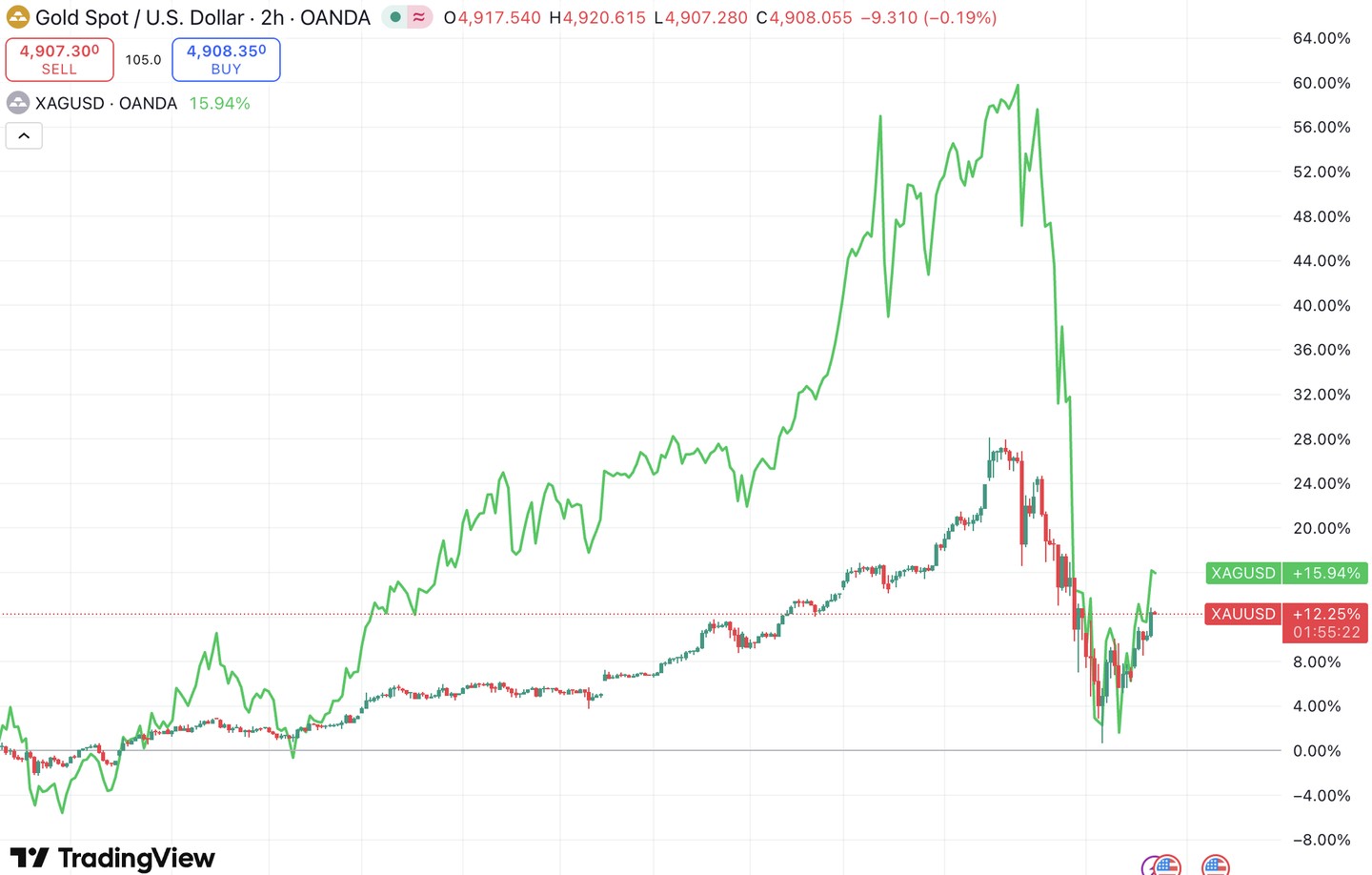
Global Top Traders' Comments: When Will Gold and Silver Rebound?

Traders unanimously believe that the underlying logic of gold prices remains unchanged, but short-term speculation and retail investors' high-position squeeze have triggered wild fluctuations. Goldman Sachs warns that gold prices may continue to test lows before volatility cools and retail long positions are cleared; however, based on the three assumptions of central bank gold purchases, Federal Reserve rate cuts, and the private sector no longer increasing allocations, it maintains a gold price of $5,400 in December 2026
Wall Street's view on the recent surge and plunge of gold is largely consistent: the underlying logic supporting gold prices remains—central banks are buying, de-dollarization/inflation expectations have not disappeared, and there is uncertainty in macro policies.
However, short-term funds have overdrawn the market. Goldman Sachs' judgment is that short-term speculative funds and retail physical demand have overly crowded the trades, and once volatility spikes, it triggers stop-losses and forced liquidations. Now traders are generally reducing positions and lowering leverage, focusing more on volatility rather than directional trades.
The divergence lies in how deep and how long this adjustment will last: Goldman Sachs' commodity research still sees gold reaching $5,400 by the end of 2026 and believes the probability of moving upwards is greater; Jay Hatfield from Infrastructure Capital directly states that this market has long deviated from fundamentals and is purely momentum trading.

Short-term: Volatility has not stabilized, a rebound may need to wash out positions first
Goldman Sachs' trading department believes that the most urgent issue now is the repricing of volatility and clearing of positions. Traders say the volatility market is misaligned, with the one-month implied volatility for gold still at a high level, which will raise trading costs. Once stop-losses are triggered, it creates a chain reaction. In this environment, "when the rebound happens" actually depends on "when volatility decreases and leverage and retail positions cool down."
Goldman Sachs traders also provided a more pragmatic observation: with pressure not fully released, gold prices may need to probe lower.
GUPTA from Goldman Sachs' precious metals trading department and GILLIARD from the commodities sales department said: We acknowledge the long-term bull market logic, but have reduced positions in the short term due to amplified volatility.
“We have reduced directional long positions, believing that the pressure in the volatility market (with one-month gold volatility reaching 40%) combined with the high concentration of retail long positions may lead gold prices to test $4,600 per ounce (as an example support level). This round of trading is similar to the October 2025 sell-off: we still recognize the structural bull market logic, but prices have risen too quickly in the short term, and the volatility shock has triggered stop-losses.”
Mid-term: Goldman Sachs still bets on gold prices reaching $5,400 by the end of 2026, with more upside risks
In the mid-term framework, Goldman Sachs' research department has not lowered its target due to short-term volatility, still predicting gold prices of $5,400 by December 2026. This prediction is based on three assumptions: central bank gold purchases maintain the high pace of the past 12 months (60 tons per month), the Federal Reserve cuts interest rates twice by 25 basis points in 2026, and the private sector's additional allocation to gold does not increase.
The research side also emphasizes that upside risks remain biased towards the positive, as the private sector continuing to allocate to gold is "very likely." The reason is that global macro policy uncertainty is unlikely to be fully resolved by 2026, and the proportion of gold in private investment portfolios is still relatively low.
STRUYVEN from Goldman Sachs' commodity research department: Based on the three assumptions of central bank gold purchases, Federal Reserve interest rate cuts, and no further allocation increases from the private sector, we maintain the gold price target of $5,400 by December 2026.
"We still maintain our forecast of gold prices at $5,400 by December 2026. This forecast is based on: 1) central bank gold purchases remaining at a high level over the past 12 months (60 tons per month); 2) the Federal Reserve cutting interest rates twice by 25 basis points each in 2026; 3) the private sector not further diversifying its allocation to gold (i.e., macro policy hedging demand remains stable). The risk to the forecast remains significantly skewed to the upside, as private sector allocation demand may continue: global macro policy uncertainty (such as fiscal sustainability in developed economies) is unlikely to be fully resolved by 2026; the allocation ratio to gold remains low (in the third quarter of 2025, gold ETFs accounted for only 0.2% of U.S. private investment portfolios). Long-term institutional investors and private wealth clients we have contacted have expressed interest in establishing/increasing gold allocations in their strategic portfolios."
Diverging Sentiment: On one hand, "buying up the shortage," on the other hand, believing it is already momentum trading
In contrast to the trading side's rhythm of "reducing risk and waiting for volatility to subside," sentiment on the physical side is much hotter. The trading head at Heraeus Precious Metals stated that he has never seen such a drastic market in his career, with some specifications of gold bars sold out weeks in advance, and consumers still lining up to buy. This strong physical demand supports the mid-term bullish narrative but also indicates that "price stability" is being challenged.
At the same time, some institutional investors have characterized the previous rise as momentum-driven, believing that the pullback is a typical outcome of high-level momentum trading.
Dominik Sperzel (Head of Trading at Heraeus Precious Metals): Crazy market, public buying sentiment is high.
"This is the craziest market I've seen in my career. Gold is supposed to be a symbol of stability, such volatility is certainly not a reflection of stability... Some specifications of gold bars have been sold out for weeks, and the public is still queuing for hours to buy."
Jay Hatfield (CIO at Infrastructure Capital Advisors): Precious metals have become momentum trading, waiting for an adjustment to occur.
"We determined three to four weeks ago that this has turned into momentum trading rather than fundamental trading. We are just going with the flow, waiting for the current type of adjustment to happen."
Trader Response: Reduce directional risk, focus on volatility curve and position size
Regarding "when the rebound will occur," Goldman Sachs' trading side provides executable clues that lean more towards technical and risk control: reduce directional exposure, pay attention to the pricing of the front end of the volatility curve being expensive, and participate with smaller positions, as both the nominal value and volatility of gold are much higher than in the past.
KIM from Goldman Sachs' commodity trading department: Significantly reduce directional exposure, mid-term recognition of the trading logic brought by central bank purchases, but speculative demand has pushed prices too high too early.
"We have significantly reduced our directional risk exposure. In the mid-term, we believe the structural trading logic brought by central bank purchases still exists, but speculative demand has pushed prices up too early and too fast, making it uncomfortable to hold large beta positions. There are some interesting opportunities in the volatility space—there is a misalignment in the volatility market, with significant premiums in the short-term volatility curve, which may be an area worth reversing in the process of market normalization." In addition, we need to completely change our approach to building position sizes: the nominal value and volatility of one ounce of gold are no longer what they used to be, so we are responding to the current market by reducing position sizes