Is the gold bull market still on? Wall Street remains bullish: Don't be scared off, Chinese buyers have become a strong pillar of the gold market!

Wallstreetcn
2026.02.03 03:02
portai
I'm PortAI, I can summarize articles.

Recently, the sharp decline in gold has been viewed by Wall Street as a "technical washout," and the bull market logic remains unshaken. Deutsche Bank maintains a bullish outlook of $6,000, emphasizing that Chinese buyers are frantically stocking up, with January gold ETF purchases increasing by 940,000 ounces, potentially reaching three times last year's buying intensity; UBS indicates that $4,500 is a strong support level. Barclays believes that under the conditions of fiat currency credit crisis and policy turmoil, gold premiums will persist in the long term

In the gold market at the beginning of 2026, a dramatic "nightmare" unfolded.

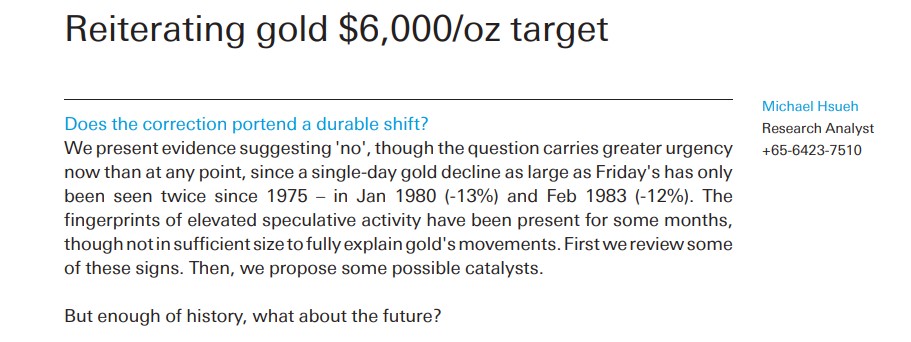
Within just a few weeks, the spot gold price skyrocketed from $4,300 to a historic peak of $5,600, only to plummet below $4,500 like a kite with a broken string. Such a double-digit drop in a single day has only occurred twice in gold's history—once in 1980 and again in 1983.

In the face of this "flash crash," doubts about a gold bubble bursting have been rampant in the market. However, Wall Street giants like Barclays, UBS, and Deutsche Bank maintained remarkable calm amid the turmoil.

In their view, this is not the end of a bull market, but a "healthy liquidation" after an extreme squeeze. Against the backdrop of an unchanged macro narrative, gold is undergoing a "technical adjustment" on the way to a $6,000 target.

Meanwhile, a key support is that Chinese buyers are going on a buying spree. A Deutsche Bank report indicates that the current buying intensity of gold ETFs by Chinese investors may be more than three times that of last year.

Consensus Among Major Banks: Technical Pullback After "Extreme Crowding"

The recent sharp adjustment in gold is viewed by Wall Street more as "technical" rather than "fundamental." UBS stated in its latest report:

Has the gold rally ended? In short, our answer is no.

The bank believes that the approximately 21% drop in gold prices from their highs is mainly attributed to a "cleaning out" of short-term speculative positions. The previous one-sided surge led to an overly crowded market, and when profit-taking occurred, the cascading effect was magnified. UBS strategist Joni Teves noted:

At present, a short-term consolidation is necessary, and we believe this pullback will be beneficial for the market in the long run. This period should provide investors with an opportunity to build long-term strategic positions at more attractive entry points. We expect support levels to emerge nearby.

Barclays' analysis corroborates this. Its model indicates that the fair value of gold is currently around $4,000. Although a premium still exists, after falling to $4,900, the premium has returned to a reasonable standard deviation.

The bank emphasized that, in the context of policy turmoil and the erosion of fiat currency credibility, the long-term deviation of gold prices from fair value is not a bubble, but rather a "forward pricing" of market risks.

Don't Panic, the Fundamentals Haven't Changed

Despite the price turbulence, major banks emphasize that the underlying fundamentals driving gold's long bull run have not changed significantly.

UBS wrote:

From a fundamental perspective, we believe the situation has not changed much. We expect demand from all parties, including retail, institutional, and official sectors, to fully recover. This will ultimately drive gold back into an upward trend and set new highs in the coming quarters The turbulence in the global macro environment remains the "fuel" for gold. Geopolitical tensions, tariff policies, ongoing fiscal expansion, and concerns over fiat currency devaluation are forcing investors to view gold as the "last line of defense" for risk aversion.

  • Dollar Devaluation Pressure under "Fiscal Dominance":

Barclays points out that the core policy of the Trump 2.0 era is "expansionary fiscal policy + tariff inflation." With the U.S. government debt levels high and no intention to constrain them, this "Fiscal Dominance" environment directly undermines the safe-haven attributes of U.S. Treasuries. The long-term fear of fiat currency devaluation has not only persisted but has intensified due to policy uncertainty.

  • Fed Leadership Change Won't Alter "Inflation Drift":

Although Kevin Warsh, nominated by Trump as the Federal Reserve Chairman, is seen as a symbol of institutional continuity, Barclays believes that the challenges brought about by policy volatility will not disappear quickly. The bank calculates that for every 1% increase in the U.S. CPI, gold prices have an endogenous upward momentum of 5%. Against a backdrop of 3% inflation expectations over the next year, gold prices have a guaranteed increase of 15% solely from "inflation drift."

  • Geopolitics and "Strategic Autonomy":

Deutsche Bank notes that the current global political and trade relationships are undergoing structural shifts. Following the freezing of Russian reserves, the demand for "strategic autonomy" among global central banks has reached unprecedented heights. As the only "non-sovereign credit asset," gold's position in reserves is shifting from "yield-driven" to "survival-driven."

"Mysterious Forces" Emerge: Chinese Buyers are Frenziedly Stocking Up

In this gold price game, Deutsche Bank has captured a crucial variable: Chinese investors are becoming the "key pillar" of the global precious metals market.

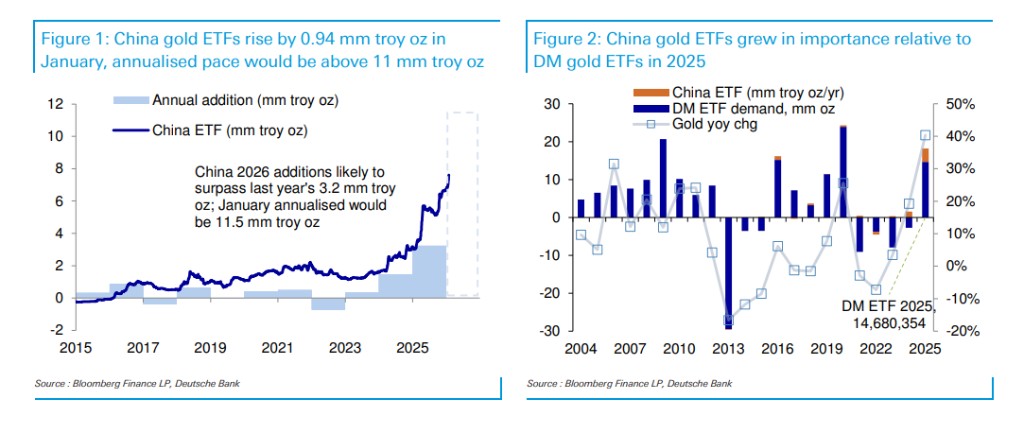
Data shows that in January 2026 alone, the increase in China's gold ETF holdings reached 940,000 ounces. Deutsche Bank analyst Michael Hsueh points out that if this pace continues, the annualized increase in China's gold ETF holdings could reach 11.5 million ounces by 2026.

What does this mean? In 2025, China's gold ETF set a historical record, but the total increase was only 3.24 million ounces. This means that the current buying intensity of Chinese investors is more than three times that of last year.

This demand is not only reflected in gold. Deutsche Bank has noted that due to limited domestic investment channels, a certain silver futures fund in China experienced an astonishing 62% premium last December. Despite the risks, the premium briefly fell in January before quickly soaring back to 59%, even triggering a trading halt According to Deutsche Bank, the rise of this "Eastern pricing power" has built a solid bottom line for global gold prices.

Chinese Investors "Buy More as Prices Rise"

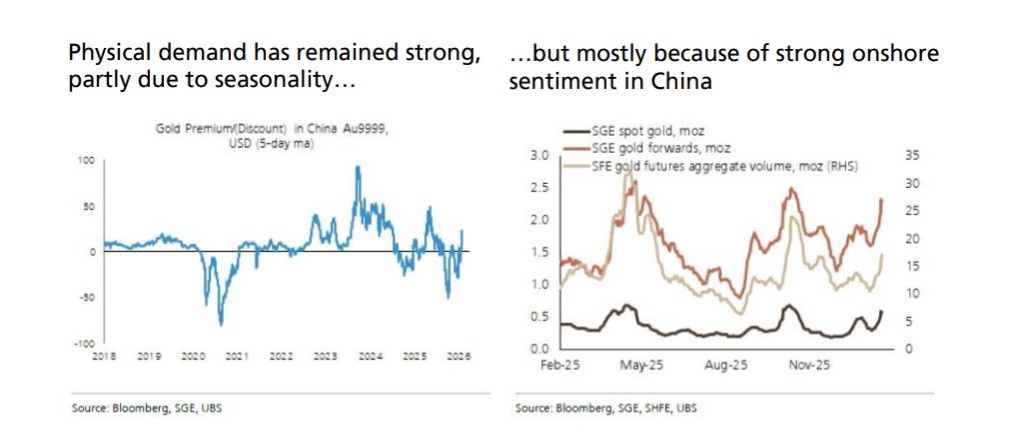
In a deep dive into the Chinese market, UBS captured a crucial structural change: high gold prices have suppressed jewelry consumption but have sparked a more intense demand for investment purchases.

UBS pointed out in its report that the "bullish sentiment" in the Chinese market is at a multi-year high. In the past, rising gold prices often scared off Chinese consumers, but this time, Chinese investors have shown a characteristic of "buying more as prices rise."

  • The seesaw of "jewelry to investment": UBS observed that although retail jewelry demand has seasonally slowed due to high gold prices, this gap has been completely filled by the surging demand for physical gold bars and coins.

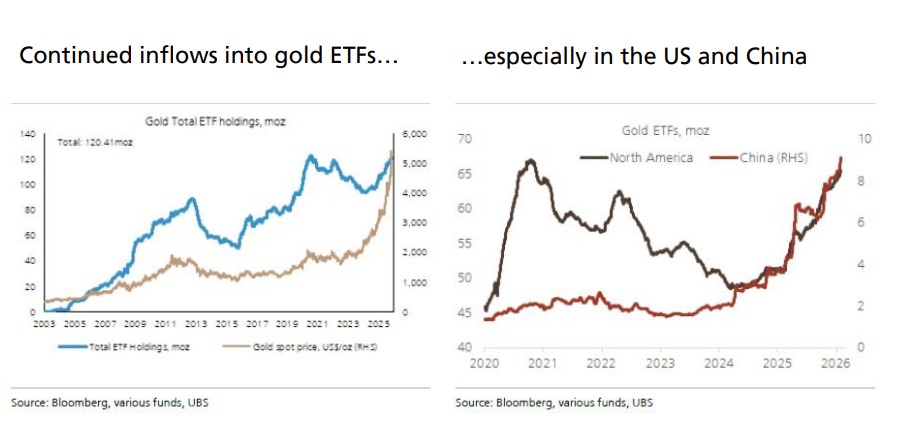
  • Offshore risk aversion sentiment: UBS analyzed that the strong demand for asset preservation in the onshore Chinese market has driven funds to flood into gold ETFs. UBS's data shows that China has become the strongest engine for net inflows into global gold ETFs, and this buying driven by "risk aversion + asset rotation" is more sustainable and has a larger scale effect than traditional gift consumption.

UBS: Positions Still Low, $4,500 is "Support"

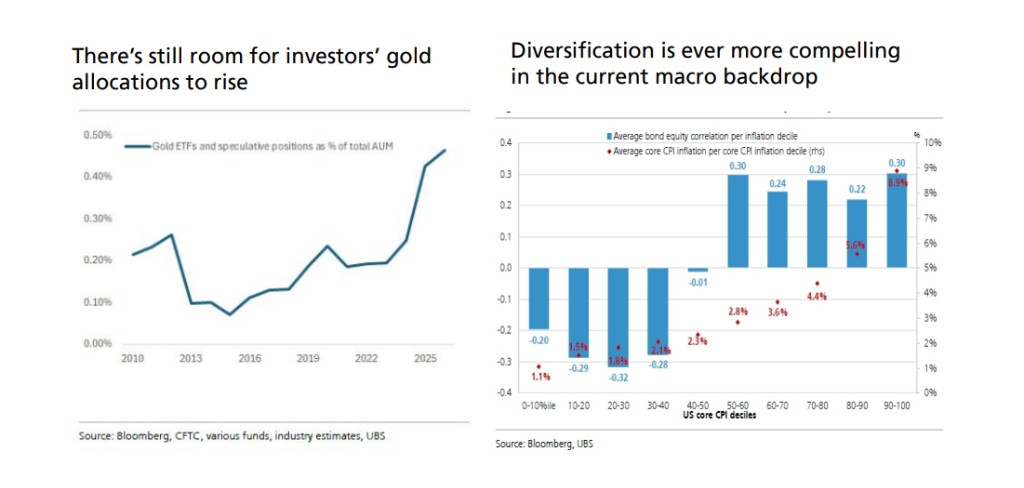
UBS strategist Joni Teves pointed out that despite significant fluctuations in gold prices, most long-term institutional investors' gold allocations remain at low levels. As gold prices retreat, these investors who have not yet built positions or are underweight will find a perfect entry point.

UBS predicts that around $4,500 will be a strong technical support level, and gold prices are expected to regain upward momentum in the coming quarters and reach new highs.

The long-term logic supporting this judgment includes:

  1. Continued De-dollarization: Central bank demand remains strong, with the Polish central bank approving a plan to increase gold reserves from 550 tons to 700 tons, even allowing gold's proportion in reserves to exceed 30%; the South Korean central bank has also indicated it is considering ending a decade-long wait-and-see period and re-accumulating gold. UBS pointed out that under the structural trend of de-dollarization and asset diversification, the central bank's "buying patch" will exist in the long term.

  2. Dulling of Real Yields: In recent months, gold has shown "immunity" to expectations of Federal Reserve interest rate hikes and rising real interest rates, indicating that the driving axis of gold prices has shifted from "interest rate speculation" to "credit risk hedging."

Deutsche Bank: $6,000 Target Unchanged, Pullbacks are Entry Points

For the outlook, Wall Street's views are highly consistent: short-term consolidation, medium to long-term still "shining."

Deutsche Bank firmly maintains its target price of $6,000 per ounce for gold, believing that the current adjustment is merely a minor hiccup in the larger trend.

Analyst Michael Hsueh wrote in a report on February 2 that the so-called thematic drivers of gold, including central bank buying, "remain positive, and we believe the reasons for investors to allocate to gold will not change." ”

Barclays: Gold Mining Stocks Remain Attractive

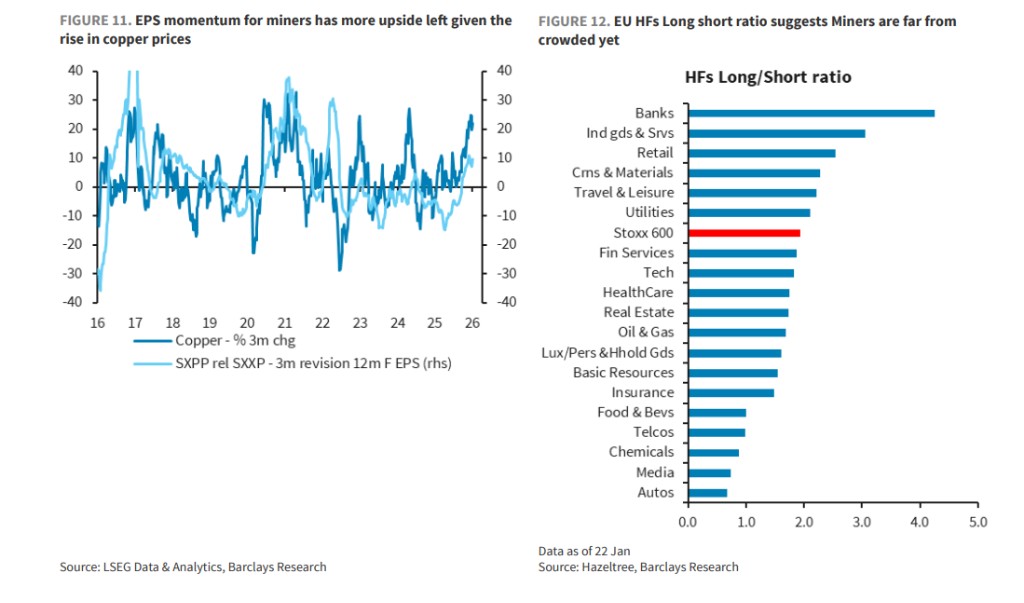
In addition to spot gold, Barclays has also presented a highly attractive arbitrage opportunity: gold mining stocks.

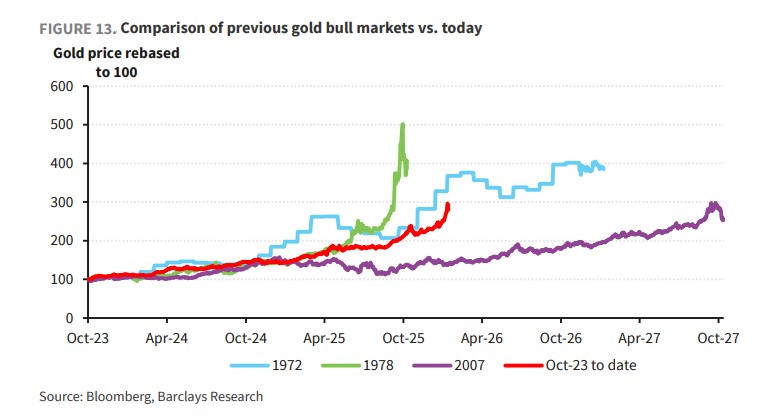
Historical experience shows that gold bull markets often last 2-4 years, with increases of 200%-400%. Since October 2023, the current bull market has only increased by 170%. More importantly, the EPS (earnings per share) momentum of mining companies has not yet been fully released.

Barclays believes that mining stocks are likely to experience a wave of strong retaliatory rebound after gold prices stabilize.

This round of "pause for thought" in the gold market may be preparing for a stronger push next time. As Wall Street analysts have summarized: in 2026, when fiat currency credibility is shaken and geopolitical situations are unpredictable, the allure of gold lies not only in its safe-haven status but also in the rare certainty it provides in a world full of uncertainties