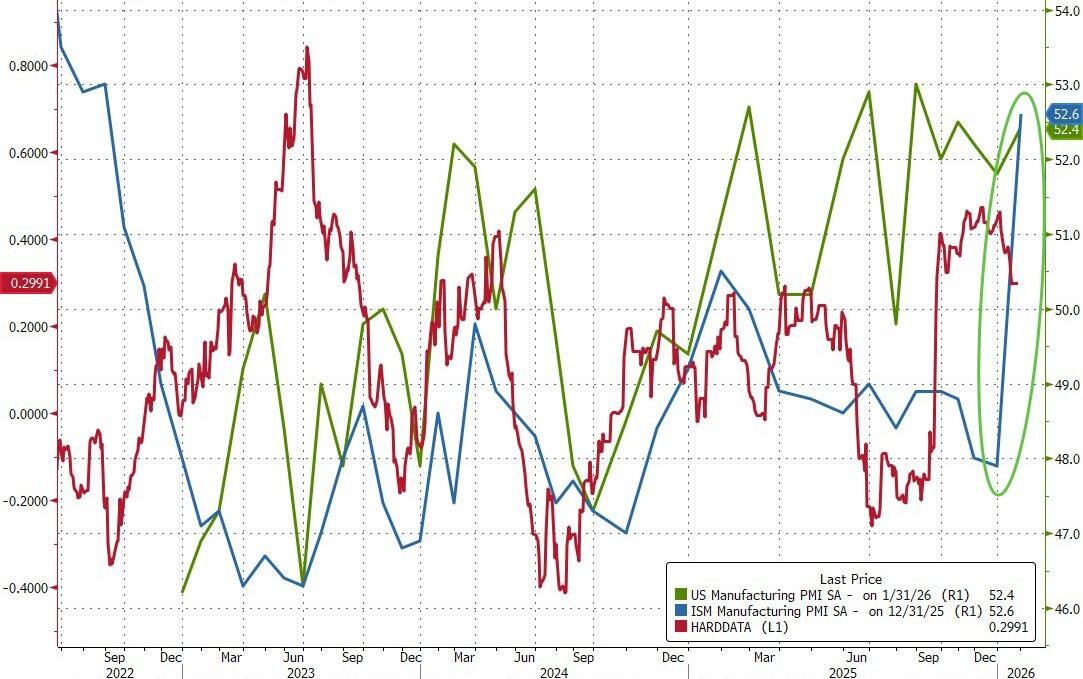
Far exceeding expectations! The U.S. January ISM Manufacturing PMI recorded the fastest growth since February 2022

Wallstreetcn
2026.02.02 15:00
portai
I'm PortAI, I can summarize articles.

The U.S. January ISM Manufacturing PMI index surged from 47.9 the previous month to 52.6, far exceeding the expected 48.5. This was mainly driven by robust growth in new orders and output. The employment index reached a one-year high but remains in the contraction zone. The prices paid index hit a four-month high

U.S. manufacturing activity unexpectedly expanded in January, with the growth rate reaching its fastest level since 2022, primarily boosted by robust increases in new orders and output.

According to data released on Monday, the Institute for Supply Management (ISM) manufacturing PMI index surged from 47.9 the previous month to 52.6, far exceeding the expected 48.5. A reading above 50 indicates expansion in economic activity, and the latest figure also surpassed all survey expectations from economists.

In terms of important sub-indices:

  • The new orders index was 57.1, up from 47.7, marking a significant increase of nearly 10 points, and the production index also strengthened significantly. Both indicate the fastest growth rate in nearly four years.

  • The employment index was 48.1, expected 46, previous value 44.9. The employment index reached a one-year high, indicating that manufacturing employment is still declining, but the rate of decline has slowed.

  • The prices paid index was 59, reaching a four-month high, expected 59.3, previous value 58.5, indicating that manufacturers have seen little relief from high input costs.

  • Backlogs of orders expanded for the first time since 2022.

  • Export orders also increased.

  • Strengthening demand is partially reflected in the decline of customer inventory indicators, which saw the largest contraction since mid-2022. Customer inventories are low, which is expected to further drive factory orders and production growth in the coming months. Producers continue to reduce inventory, but the pace has slowed compared to the previous month.

  • The supplier delivery performance index rose to its highest level since May, indicating that manufacturers are facing longer delivery times for the inputs needed for production.

Analysts state that the rebound in factory activity driven by demand, after nearly a year of contraction, is undoubtedly good news. If growth can be sustained, it will help bolster confidence that U.S. manufacturing is emerging from the sluggish state of the past three years.

Susan Spence, chair of the ISM Manufacturing Business Survey Committee, stated in a statement:

While these data bring positive signals at the beginning of the year, caution is also warranted. Some commentators noted that January is typically a month for post-holiday restocking, and additionally, due to ongoing tariff issues, some purchasing behavior may be aimed at preemptively addressing anticipated price increases.

In January, nine industries experienced growth, including apparel, metal products, transportation equipment, and machinery manufacturing; eight other industries saw contraction.

Earlier data released on the same day showed that the final value of the S&P Global manufacturing PMI for January was 52.4, expected 52, previous value 51.9.

Chris Williamson, chief business economist at S&P Global Market Intelligence, stated:

The news of factory output experiencing the largest increase since May 2022 is overshadowed by persistently sluggish sales growth. Therefore, at the beginning of the year, output growth is significantly outpacing new orders, leading to further accumulation of unsold warehouse inventory. Surveys over the past three months have shown that factory output typically remains higher than sales, a level of divergence not seen since the early days of the global financial crisis in 2009

This highly abnormal situation is clearly difficult to sustain. If demand does not significantly improve in the coming months, it will signal the risk of a production slowdown and may have a cascading effect on employment.

Weak growth in sales and order books is generally attributed to customers' resistance to high prices, which are often perceived to be related to tariffs, while also being affected by rising uncertainty in the economic outlook.

However, despite being slightly below long-term trends, businesses' expectations for growth in the coming year remain resilient. Companies expect demand to improve, partly due to falling interest rates, reduced import competition from tariffs, and increased government support.

Political uncertainty remains a key factor dragging down business confidence