Palantir's revenue surged 70% year-on-year, with full-year guidance far exceeding market expectations, and the stock price rose about 8% in after-hours trading | Earnings Report Insights

Palantir's fourth-quarter revenue surged 70% year-on-year, reaching $1.41 billion, with both government and commercial businesses exceeding expectations; the company also provided quarterly and annual revenue guidance significantly above market expectations, stimulating a post-market stock price increase of about 8%. However, controversies surrounding government contracts, collaboration with ICE, and high valuations continue to brew
Data analysis company Palantir announced its fourth-quarter results after the market closed on Monday, showing revenue that exceeded market expectations, with a year-on-year increase of 70%, reaching $1.41 billion. Meanwhile, the company's guidance for revenue in the next quarter also surpassed expectations, exceeding analysts' original forecasts by 15.3%. The strong performance stimulated the company's stock price to rise about 8% in after-hours trading on Monday.
Here are the key points from Palantir's financial report:
Key Financial Data:
Revenue: $1.41 billion, higher than analysts' expectations of $1.34 billion (year-on-year growth of 70%, exceeding expectations by 4.9%)
Government Procurement: Revenue from government procurement increased by 66% year-on-year, reaching $570 million, also surpassing analysts' expectations of $522 million for this segment.
Commercial Procurement: Increased by 137% year-on-year, reaching $507 million, higher than the market's expected $479 million; the total value of unfulfilled U.S. commercial contracts increased by 145% year-on-year, reaching $4.38 billion.
Adjusted Earnings Per Share (EPS): $0.25, higher than analysts' expectations of $0.23 (exceeding expectations by 8.6%)
Adjusted Operating Profit: $798.5 million, higher than analysts' expectations of $701.1 million (operating profit margin of 56.8%, exceeding expectations by 13.9%)
Number of Customers: The number of customers increased by 34% year-on-year and 5% quarter-on-quarter.
Performance Guidance:
First Quarter Revenue: Revenue is expected to be between $1.532 billion and $1.536 billion, with the midpoint exceeding analysts' expectations of $1.32 billion.
Full Year 2026 Revenue: The company expects full-year revenue to be between $7.182 billion and $7.198 billion, also higher than FactSet's expectation of $6.22 billion.
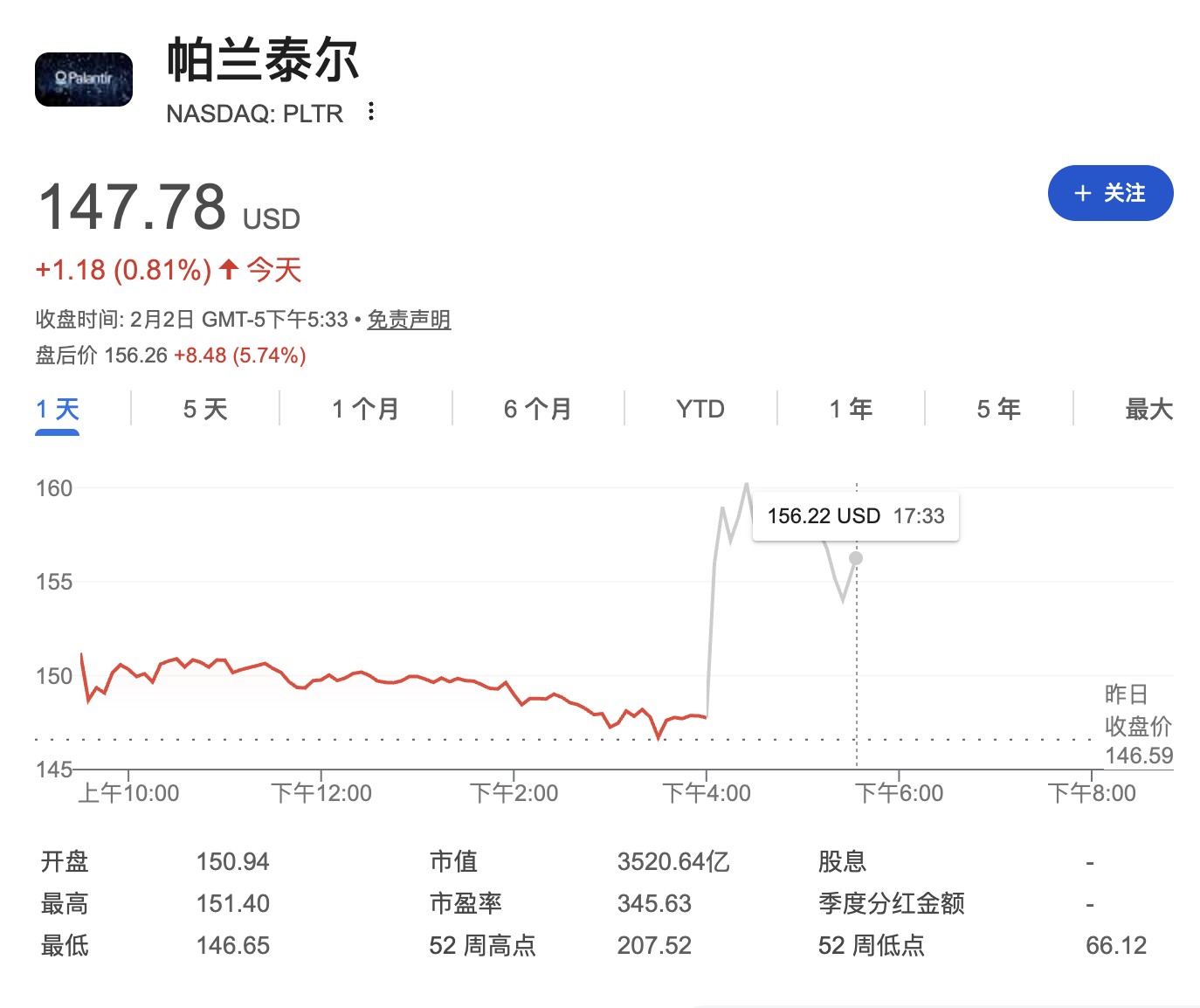
After the financial report was released, the stock rose about 8% in after-hours trading, with a previous closing price of $147.77. The stock has fallen 29% since its peak last November. As of the close, the stock price has dropped 17% year-to-date in 2026.

Surge in Government Business Demand, but Controversy Over ICE Enforcement
Palantir primarily provides software to clients for centralizing, managing, and analyzing vast amounts of data. With the overall artificial intelligence boom, the company's profitability continues to reach new heights. Over the past two years, the company's stock price has increased nearly 800%, and its market value has risen by nearly $315 billion.
Media reports indicate that Palantir's strong performance reflects robust demand from U.S. government and commercial clients for its artificial intelligence technology. Meanwhile, Palantir's role in assisting the Trump administration in advancing its immigration deportation agenda is facing increasing scrutiny. A large portion of Palantir's revenue in the United States comes from government contracts, with government users including the U.S. Immigration and Customs Enforcement (ICE), the Internal Revenue Service (IRS), and the Department of Defense. Palantir reported that revenue from U.S. government contracts last quarter was $570 million, a year-on-year increase of 66%. Sales from U.S. commercial customers amounted to $507 million, more than doubling from a year ago. Both figures exceeded analysts' expectations.
Last month, the company signed a $448 million contract with the U.S. Navy to provide better data support for the maintenance and upgrade of nuclear submarines.
However, in the past year, criticism from current and former employees, as well as elected officials regarding Palantir's collaboration with ICE, has cast a shadow over the company's strong stock performance. ICE has a contract with Palantir to use its technology to develop applications for locating and tracking immigrants designated for deportation by the agency.
These criticisms reached a peak following the escalation of immigration enforcement actions in Minneapolis last month, which resulted in the deaths of two U.S. citizens. Palantir has consistently defended its collaboration with ICE in public statements.
According to media analysis of government contract announcements, since January 2025, Palantir has received $81 million in contracts from ICE. This includes a $30 million contract signed last April to establish a system to streamline the "screening and apprehension of illegal immigrants."
Questioned Valuation
The company's CEO and co-founder Alexander Karp described the accelerated revenue growth as "a cosmic return" for the company's supporters in a letter to shareholders. He stated that the company's performance is "driven by a group of increasingly discerning enterprises and institutions in the U.S. that truly understand the value of artificial intelligence."
He told the media,
"What I know is that the last ten years have been the undisputed best performance in the tech industry."
"If you’re not spending money on this, then you’re not investing in things that can keep up with the momentum."
Despite a poor performance this year, the company's $350 billion market capitalization still makes it one of the higher-valued stocks in the S&P 500 index.
According to media analysis based on inflation-adjusted FactSet market data (dating back to 1984) conducted last November, no other company in the S&P 500 index has ever reached a "valuation relative to revenue scale" like Palantir's.
At the end of last year, hedge fund manager Michael Burry, who gained fame for shorting mortgages in the late 2000s and is known for the movie "The Big Short," disclosed his short position on Palantir. Burry also posted on social media platform X, broadly warning of the bubble risk in artificial intelligence. Subsequently, as investors turned to withdraw from AI stocks due to valuation concerns and fears of an AI bubble, the stock recorded its worst month in two years At that time, Karp described the operation as "simply crazy" during a media interview and accused it of "market manipulation."
In a letter to shareholders, Karp stated that despite increasing market pressure on AI companies to return to fundamentals, Palantir's profits remain "pure and not artificially manufactured."
He added that the company's commercial business segment benefits from the market demand for software that can provide structural support for large language models.
Karp wrote:
"Any company that lacks a fervent focus on the value created by these technological systems and lacks a true 'mouse-catching' ability will ultimately fade away and be forgotten."
William Blair analyst Louis DiPalma upgraded Palantir's stock rating from "market perform" to "outperform" on Monday, stating that the previous pullback has made the company's valuation "more reasonable."