


Forget about the January non-farm payroll! Annual employment may be revised down by 1 million, and U.S. employment is being systematically overestimated

On Friday, the U.S. January non-farm payroll report will be released. Barclays and Citigroup believe that the issue with U.S. employment is not about "how many jobs were added in January," but rather "how many have been overestimated over the past year." Barclays, based on the latest QCEW data, points out that the average monthly employment over the past year has been overestimated by 80,000 to 90,000 people; Citigroup indicates that the signals that truly reflect the downward trend are more likely to concentrate in the spring and summer stages
Regarding the upcoming January non-farm payroll report, Barclays and Citigroup have significant differences in their forecasts for new jobs added that month, but they have reached a strong consensus on a more critical issue—U.S. employment in 2025 is systematically overestimated, and the annual benchmark revision will expose this discrepancy all at once, with the market clearly underpricing the downside risks to employment.
Barclays' judgment is the most direct, based on the latest QCEW data, the non-farm employment level in March 2025 may be revised down by about 1 million, which means that the average monthly employment over the past year has been overestimated by 80,000 to 90,000.
Citigroup, on the other hand, warns from the perspective of data "quality" that even if the January non-farm figures appear strong on the surface, they are likely influenced by residual seasonality and model biases, and do not represent a stabilization in employment; the signals that truly reflect the downward trend are more likely to emerge in the spring and summer.
In other words, the market is still debating whether "January non-farm is good or bad," but what could truly reshape the employment narrative is a systematic reassessment of the employment level in 2025.
Apparent Discrepancy: January Non-Farm "Strong or Weak," Two Investment Banks Give Different Answers
In terms of specific predictions, the divergence between the two investment banks is quite noticeable:
Barclays predicts that only 50,000 new jobs will be added in January, with the private sector also increasing by about 50,000, government employment remaining basically flat, and the unemployment rate slightly falling to 4.3% due to rounding and supply-demand gaps.
Citigroup, however, expects an increase of 135,000 jobs, with about 140,000 new jobs in the private sector, significantly higher than the market consensus (about 70,000), and the unemployment rate remaining at 4.4%.
However, it is worth noting that both investment banks clearly state: the information content of the January employment data itself is relatively low.
Barclays emphasizes that the employment data for the fourth quarter of 2025 is significantly disturbed by the government's "delayed resignation plan," and short-term fluctuations do not represent trends; Citigroup points out that January is one of the most "favorable" months for seasonal adjustments throughout the year, historically showing a pattern of "initial strength followed by a decline."
Therefore, the divergence exists in the "numbers," but it does not affect the common judgment on the trend.
True Consensus: Employment "Stock" is Overestimated, Which is the Core Risk
Despite differing judgments for January, Barclays and Citigroup completely agree on one issue:
The U.S. employment problem is not about "how many new jobs are added this month," but about "how much has been cumulatively overestimated over the past year."
Barclays' core evidence comes from QCEW (Quarterly Census of Employment and Wages)—this is a "quasi-complete sample" employment data based on mandatory tax filings by businesses, regarded as the statistical measure closest to the true employment level.
Key findings include: from March 2024 to March 2025: the non-farm survey (CES) shows an accumulated increase of about 1.8 million jobs, while the QCEW measure only shows an increase of about 800,000, with a discrepancy of nearly 1 million.
This means that official non-farm payrolls have systematically overestimated new jobs over the past year, with an average monthly overestimation of about 80,000 to 90,000.
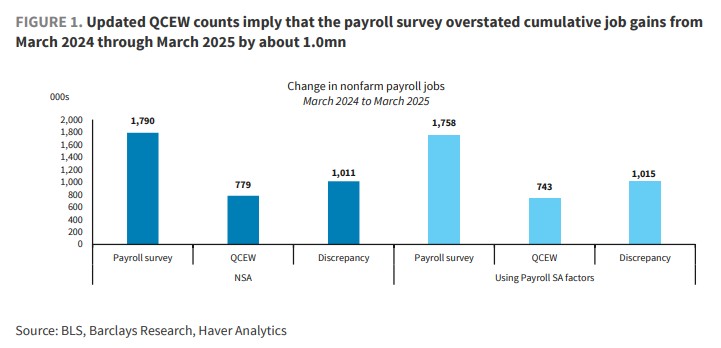 More critically, this deviation: significantly greater than the 2024 benchmark revision (-598,000) and the 2023 revision (-187,000), indicates a persistent disturbance to the model caused by changes in the birth-death structure of enterprises post-pandemic.
Citigroup's Additional Perspective: Strong Seasonal Adjustment, Weak Fundamentals
Citigroup does not deny that January employment may be stronger, but its logic is highly "counterintuitive."
Citigroup emphasizes three sets of detailed signals:
- Recruitment has not warmed up: The JOLTS hiring rate continues to decline to around 3.2%; temporary workers, retail, transportation, and other "cyclical sensitive industries" are still contracting;
- Signals from the consumer side are deteriorating: The proportion of "hard-to-find jobs" in the Conference Board rose seasonally in January;
- Employment in the second half of 2025 has clearly been distorted: For example, in October 2025, the private sector added only 1,000 jobs, but in the following months, it was significantly "elevated" by seasonal adjustment;
Citigroup's conclusion is very clear:
If January is strong, there is a lot of room for interpretation; but if January weakens, it can almost only point to fundamental issues. The real pressure in the job market is more likely to manifest in the spring and summer after the seasonal adjustment advantage fades.
Why Does the Market Still Underestimate Employment Downside Risks?
The key reason lies in the misalignment of the pricing framework.
The current market is more focused on whether the monthly non-farm payrolls "beat/miss" and whether the unemployment rate holds at 4.5%.
Yet it overlooks three points:
- Employment stock revisions will change historical paths: it is not "growing a little slower," but rather "growth over the past year was not as much";
- The explanatory framework for wages, consumption, and GDP will be rewritten;
- The Federal Reserve's "employment safety net" may not exist.
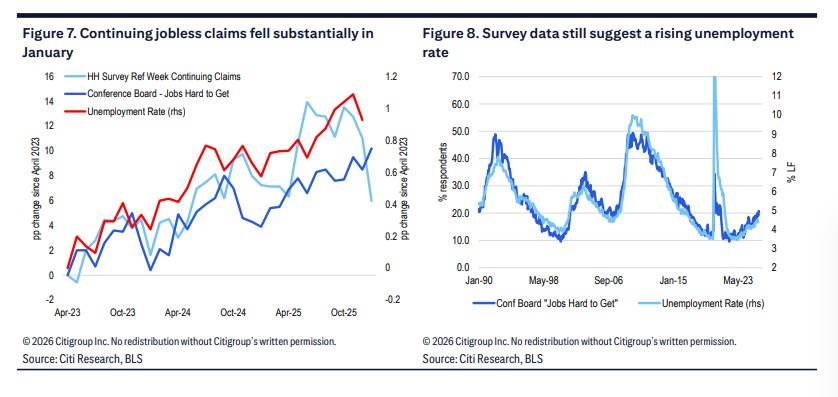
Once it is confirmed that employment in 2025 is revised down by 700,000 to 1,000,000:
- The intensity of labor demand corresponding to the current unemployment rate will be reassessed;
- The distance to the "turning point" in employment is closer than the market imagines.
What Really Matters Is Not January Non-Farm Payrolls, But the "Post-Revision Employment World"
Combining the judgments of Barclays and Citigroup, the conclusions are actually highly consistent:
January non-farm payrolls are noise; the annual benchmark revision is the trend confirmation.
If employment is revised down close to 1 million:
- The "employment resilience" in 2025 will prove to be more of a statistical illusion;
- Employment in the U.S. in 2026 will not be "stabilized again," but will continue to slow down from a lower starting point.
And this risk has not yet been fully priced in by the market
