


How does this round of "gold rush" differ from 2013?

Guosen Securities believes that 2013 was a "bottom-fishing" behavior after the sharp decline in gold prices, leading to a serious overdraft of demand; while the current round of demand is built against the backdrop of continuously rising gold prices, with the driving force shifting from speculation to long-term pursuits of asset allocation and wealth preservation. Market resilience is more established on product craftsmanship, brand narrative, and diversification of consumption scenarios, with consumers beginning to pay for "craftsmanship" and "culture." The core of industry growth has shifted from channel expansion to product-driven, with high value-added products effectively offsetting the impact of gold price fluctuations
Under the severe fluctuations in gold prices, the retail market for gold and jewelry is experiencing a change that is both similar to and different from the "gold rush" of 2013.
On February 2, Guosen Securities stated in its latest research report that this round of market activity is fundamentally different from that of 2013. In 2013, it was a "bottom-fishing" behavior following a sharp decline in gold prices, which led to a serious overdraft of subsequent demand; while this round (2026) is based on the backdrop of continuously rising gold prices, with the driving force shifting from pure speculation to "asset allocation" and "product narrative."
Recently, gold prices have experienced severe fluctuations, with COMEX gold futures rising by 12.28% from the beginning of 2026 to January 29, but dropping by as much as 8.35% in a single day on January 30.
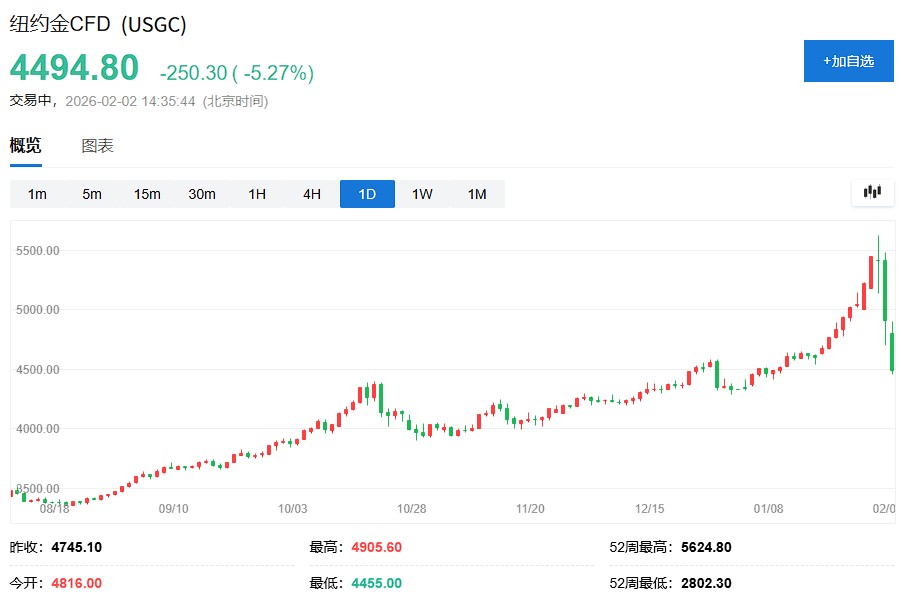
Guosen Securities analyzes the current gold price fluctuations by referencing the "gold rush" of 2013, noting that the cyclical commonality exists—gold prices have corrected after several years of continuous upward movement, reinforcing residents' recognition of gold as a long-term store of value and appreciation, and a concentrated consumption enthusiasm is expected to emerge in the early stages of the decline.
However, the structural differences are more significant. Guosen Securities points out that the core driving force behind this round of gold purchasing frenzy is not short-term bottom-fishing for profit, but rather the pursuit of optimizing asset allocation, wealth preservation, and inheritance, which is a more long-term behavior.
From the perspective of consumption attributes, market resilience is built on product craftsmanship, brand narrative, and diversification of consumption scenarios. Since last year, several companies represented by old gold shops have achieved high double-digit to triple-digit same-store growth in fixed-price products, providing evidence for this.
2013 "Gold Rush": Stimulus Effect Lasting for Months
Guosen Securities defines the "gold rush" of April 2013 as: a phenomenon of relatively concentrated and large-scale purchases of gold products in the domestic market against the backdrop of a rapid decline in gold prices after a bull market lasting over a decade.
After the Shanghai Gold Exchange officially started operations in October 2002, the Chinese gold market entered a bull market lasting over a decade. By October 30, 2012, the closing price of Shanghai gold AU9999 was 344.29 yuan/gram, with an increase of 312.22% over the period. Starting in November 2012, gold prices began to fluctuate and weaken, with Shanghai gold recording significant declines of 7.03% and 5.22% on April 15 and 16, 2013, respectively.
This round of declines stimulated residents' purchasing enthusiasm in the short term. According to data from the National Bureau of Statistics, the year-on-year growth rate of retail sales of gold and silver jewelry in April 2013 was 72.16%, significantly up from 26.3% in March. The growth lasted for at least several months, contrary to market concerns of being fleeting. The annual growth rate of retail sales of gold and silver jewelry in 2013 was 25.8%, accelerating by 9.8 percentage points from the 16% growth in 2012.
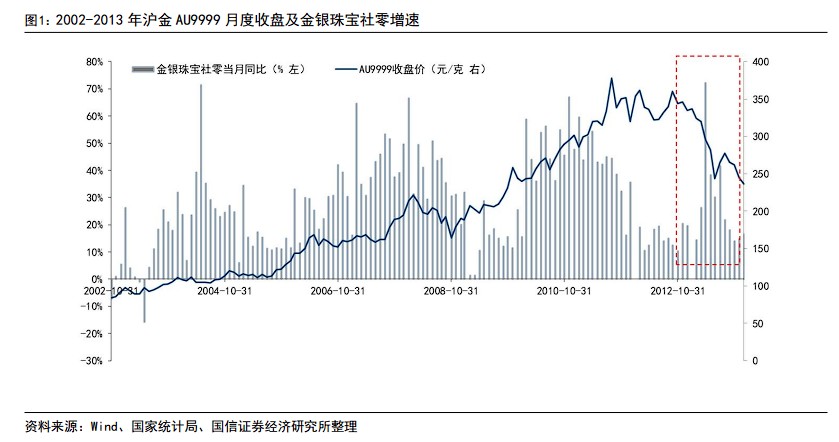 The annual gold consumption reached 1,176.4 tons, an increase of 41.4%, with China surpassing India for the first time to become the world's largest gold consumer. According to statistics from the Hong Kong Special Administrative Region government, in 2013, the mainland's gold imports and exports from Hong Kong were 1,108 tons and 474 tons, respectively, both hitting historical highs.
Significant Boost in Corporate Performance but Overdraft Effect Emerges
The "gold rush" significantly boosted the annual performance of related companies.
Research reports indicate that from April 2013 to March 2014, the revenue of Chow Tai Fook Jewelry Group was HKD 19.215 billion, a year-on-year increase of 43.3%, with a net profit attributable to shareholders of HKD 1.865 billion, a year-on-year increase of 50%, setting a historical high.
The company stated in its financial report that "the sharp decline in gold prices in April and June 2013 triggered a gold rush, leading to a surge in demand for gold products. With gold prices remaining at relatively low levels, the sales volume of gold was able to maintain a good increase for several months after the gold rush."
During the same fiscal year, Chow Tai Fook's revenue was HKD 77.407 billion, a year-on-year increase of 34.8%, with a net profit attributable to shareholders of HKD 7.272 billion, a year-on-year increase of 32.1%.
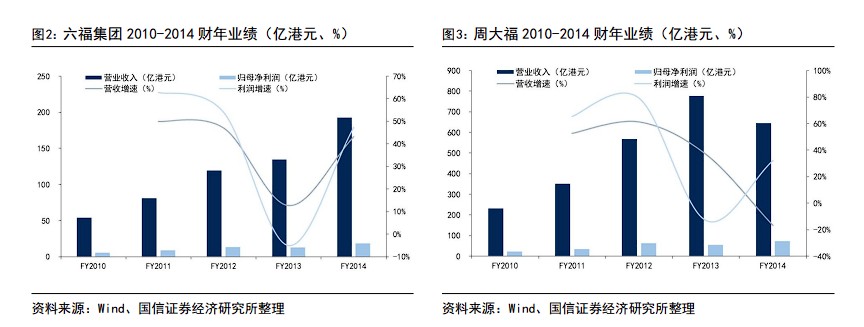
However, the subsequent continuous decline in gold prices led to an overdraft in demand. From 2013 to 2015, the Shanghai gold AU9999 prices fell by 29%, rose by 1.19%, and then fell by 7.3% year-on-year, respectively. In the absence of a timely rebound in gold prices, the "gold rush" somewhat overdrew consumer demand.
In 2014, the retail sales of gold, silver, and jewelry only grew by 0.4% year-on-year, the lowest growth rate in the past decade, with negative growth observed from March to July. However, consumption rebounded in 2015, with a year-on-year growth of 11.1% for that year.
Commonalities and Differences in This Cycle
Guotai Junan Securities pointed out that the fluctuations in gold prices in 2026 share two major commonalities with those in 2013:
First, gold prices also experienced several years of upward movement before the decline, reinforcing residents' recognition of the long-term value preservation and appreciation of gold products;
Second, if gold prices undergo sustained consolidation and decline, it is expected that the consumption demand, which is heavily investment-oriented, will decline, affecting industry growth rates.
However, Guotai Junan Securities believes that the current gold price is only a short-term adjustment over a few days, and further observation is needed.
The structural differences are more critical. From the perspective of investment demand, the triggering logic is different. The current gold buying frenzy has actually been gradually occurring against the backdrop of continuously rising gold prices.
Taking Cai Bai Co., Ltd., which has a high proportion of investment gold business, as an example, the revenue for the first three quarters of 2024 and 2025 is expected to grow by 22.24% and 33.41% year-on-year, respectively, with the precious metals investment business growing even faster. The net profit attributable to shareholders for the entire year of 2025 is expected to reach HKD 1.06-1.23 billion, a year-on-year increase of 47.43%-71.07%.
According to data from the World Gold Council, the demand for gold bars and coins in the domestic market is expected to increase by 61% quarter-on-quarter and 42% year-on-year in the fourth quarter of 2025. The total purchase of gold bars for the entire year of 2025 is projected to reach 432 tons, a year-on-year increase of 28%, setting a new annual record.
Guosen Securities believes that this reflects consumers' core driving force is the long-term pursuit of asset allocation optimization, wealth preservation, and inheritance, rather than short-term profit-taking.
Product Strength Drives New Growth Logic
According to research reports, another significant structural change in this cycle is that consumers are beginning to pay for "craftsmanship" and "culture," rather than merely focusing on the weight of gold and fluctuations in gold prices.
From the perspective of consumer demand, market resilience is primarily built on product craftsmanship, brand narrative, and diversification of consumption scenarios. Companies that layout with differentiated brands or product positioning and establish brand awareness have achieved higher growth against the backdrop of high gold prices.
Lao Pu Gold achieved revenue of 12.354 billion yuan in the first half of 2025, a year-on-year increase of 251%, with a net profit attributable to the parent company of 2.268 billion yuan, a year-on-year increase of 286%, thanks to its high-end Eastern traditional gold positioning and exquisite craftsmanship.
Chow Tai Fook is expected to achieve a net profit attributable to the parent company of 436-533 million yuan for the entire year of 2025, a year-on-year increase of 125%-175%, thanks to its young and fashionable product design and intangible cultural heritage craftsmanship.
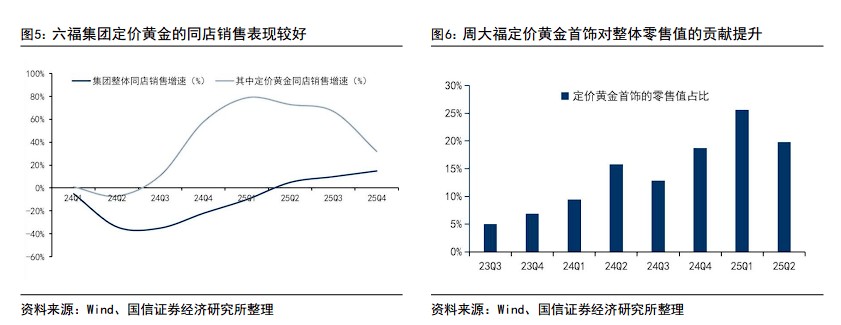
At the same time, the fixed-price gold products themselves have high processing fees and brand premiums, but they are growing rapidly. The same-store sales of fixed-price gold products of Luk Fook Holdings from October to December 2025 increased by 32% against a high base, with the gold-inlaid diamond series growing by 66%. This reflects that consumers are willing to pay for product design or cultural recognition.
Guosen Securities believes that the short-term fluctuations in gold prices have relatively little impact on the demand for gold consumption. A high price correction may further stimulate the release of pent-up demand.
A typical case is the price correction that began on October 20, 2025, which stabilized at a low point by the end of December, while the demand for gold jewelry in the fourth quarter showed resilience, totaling 77.8 billion yuan, a year-on-year increase of 19%. Chow Tai Fook's retail value of jewelry priced in mainland China from October to December 2025 increased by 59.6% year-on-year, accelerating by 35.4 percentage points compared to July-September.
Guosen Securities stated that the core of industry growth has shifted from channel expansion to product-driven. Products with high craftsmanship value can effectively offset the impact of gold price fluctuations on consumer willingness, generating "α returns" independent of gold prices
