


Gold valuation has reached extreme levels! The decline of risk aversion in the second half of the year will become the biggest bearish factor

Citigroup warns that gold valuations have reached extreme levels, with global gold expenditure as a percentage of GDP soaring to 0.7%, the highest in 55 years. If the allocation ratio of gold returns to the historical norm of 0.35%-0.4%, gold prices will face the risk of being "halved." As a potential agreement in the Russia-Ukraine conflict is expected in the second half of 2026, along with an upward trend in the U.S. economy and confirmation of the Federal Reserve's independence, the collective retreat of risk aversion will remove the last pillar supporting gold prices
In the context of tightening global liquidity and a collective decline in Bitcoin and commodities, gold, which had been soaring, is now facing a severe revaluation of its value.
According to news from the Chase Trading Desk, Citigroup Research pointed out in its latest commodity report on January 30 that the current gold price has severely overdrawn future uncertainties.
Maximilian Layton, the global commodities head at Citigroup, believes that while there may still be potential for gold prices to rise in the short term, its valuation has reached "extreme levels." As risk aversion sentiment collectively fades in the second half of 2026, the "pillars" supporting gold prices may face structural collapse.
Multiple Historical Indicators Sound the Valuation "Red Alarm"
In the report, Citigroup demonstrates the bubble characteristics of the current gold price through multidimensional modeling.
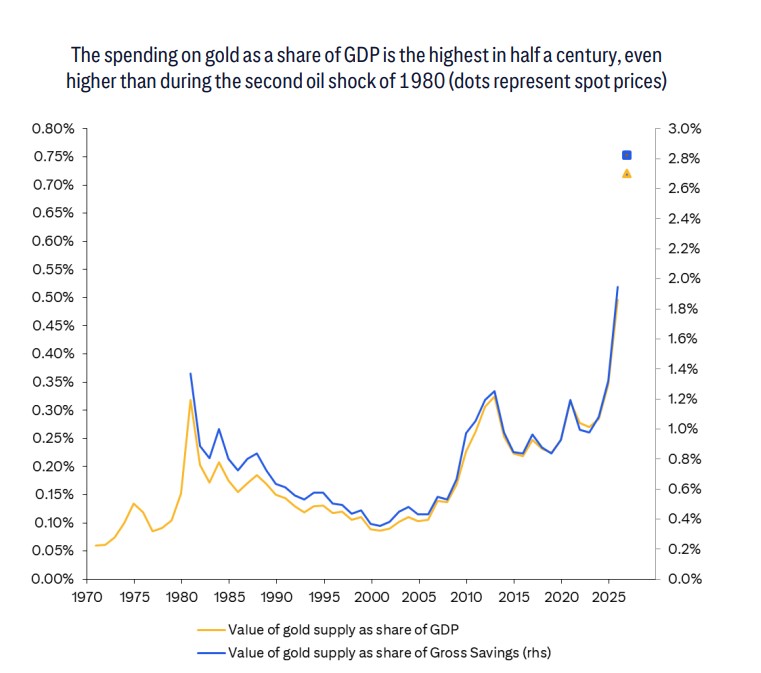
First is the decoupling from the real economy: Currently, global annual spending on gold as a percentage of GDP has surged to 0.7%, the highest level in the past 55 years, far exceeding the levels during the 1980 oil crisis.
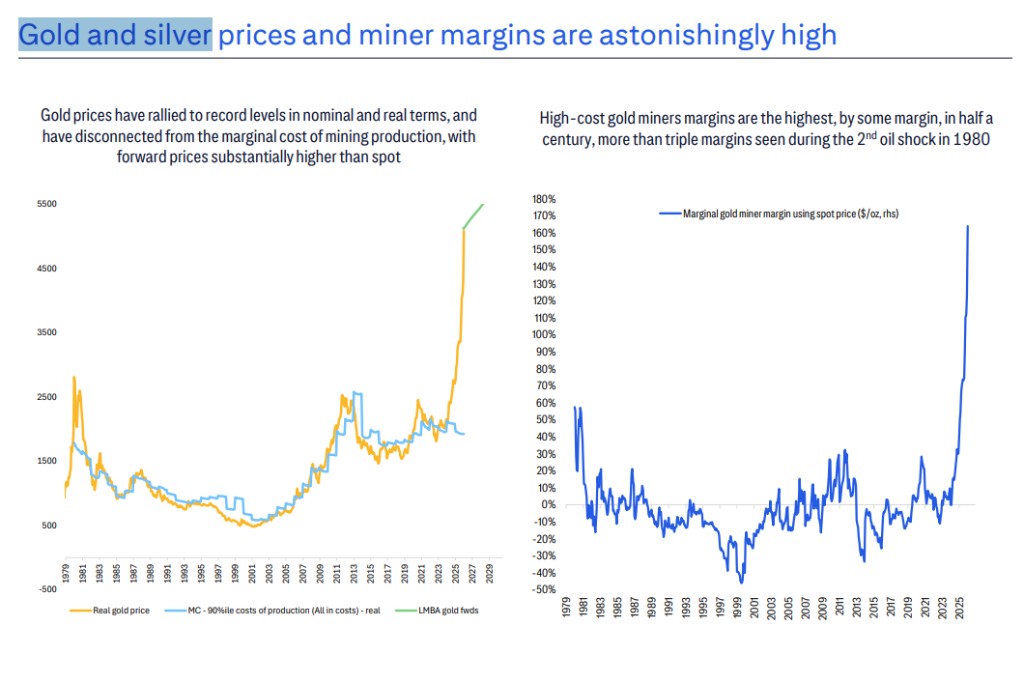
At the same time, the current gold price has completely detached from the marginal production costs of the mining industry. The report shows that the profit margins of high-cost gold miners are at their highest level in 50 years.
Even in the context of extreme inflation expectations, the ratio of gold to global broad money supply has risen to 16%, even higher than the peak during the first oil crisis in the early 1970s.
Citigroup emphasizes that once the transfer of wealth distribution is completed, gold will return to equilibrium pricing based on savings distribution.
"If the allocation ratio of gold merely returns to the historical norm of GDP proportion (0.35%-0.4%), under unchanged conditions, the gold price will nearly halve from its current level, falling to $2,500-$3,000 per ounce."
Although Citigroup's benchmark price target for 2026 is $4,600, its downside risk is increasing with the bubble in valuation.
Outlook for the Second Half of 2026: The Erosion of Risk Aversion is the Biggest Threat
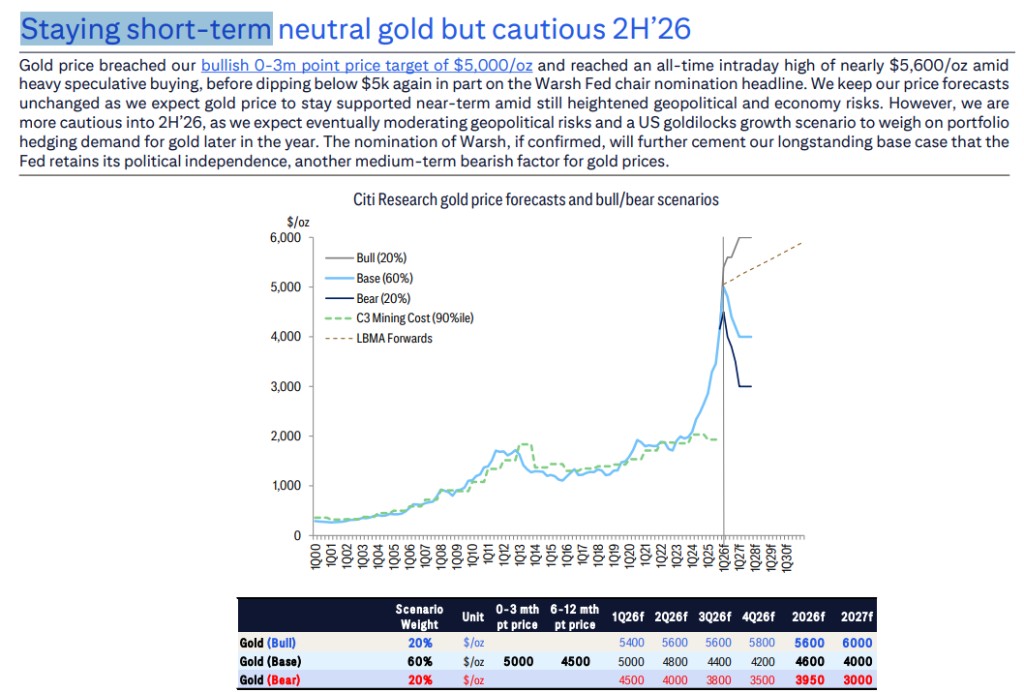
Despite maintaining a supportive view on gold prices in the short term (0-3 months), with a target price of $5,400-$5,600 per ounce due to high geopolitical and economic risks, Citigroup's attitude turns distinctly "cautious" for the second half of 2026.
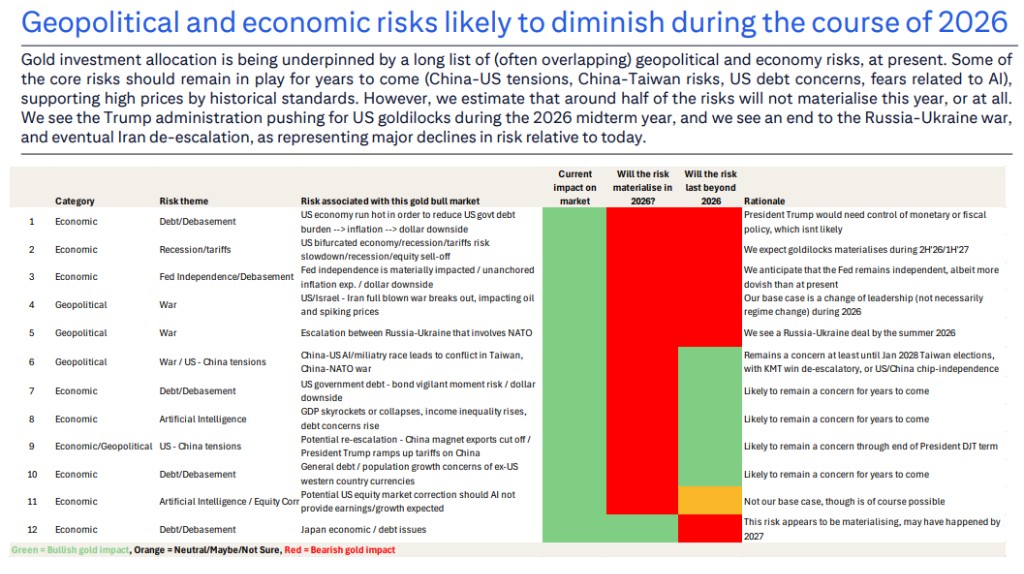
Citigroup expects that a series of risk factors supporting the current high gold prices will fade later this year. Specifically:
-
Geopolitical De-escalation: In the baseline scenario, Citigroup anticipates that the Russia-Ukraine conflict may reach some form of agreement before the summer of 2026, while the situation in Iran will show signs of de-escalation. The alleviation of these two major risks will significantly weaken investors' hedging motives
-
The "Goldilocks" Economy in the U.S.: The Trump administration is pushing the U.S. economy into a "Goldilocks" state (high growth, low inflation) in the year of the 2026 midterm elections, which will weaken the hedging demand for gold in investment portfolios.
-
Independence of the Federal Reserve: Despite political pressure, Citigroup expects the Federal Reserve to maintain its independence, which is also a medium-term bearish factor for gold prices. If Waller is confirmed as the next Federal Reserve Chairman, it will strengthen market confidence in the independence of monetary policy.
Based on this, Citigroup predicts that gold prices will begin to decline in the second half of 2026 and further drop in 2027. In its baseline scenario, gold prices will fall to $4,000 per ounce in 2027; while in a bear market scenario (20% probability), gold prices could plummet to $3,000 per ounce.
The above exciting content comes from [Chasing Wind Trading Platform](https://mp.weixin.qq.com/s/uua05g5qk-N2J7h91pyqxQ).
For more detailed interpretations, including real-time analysis and frontline research, please join the【 [Chasing Wind Trading Platform ▪ Annual Membership](https://wallstreetcn.com/shop/item/1000309)】
[](https://wallstreetcn.com/shop/item/1000309)