


Four restaurant companies apply for IPO in the nine heavens. How much longer is the window period for Hong Kong stocks?

In just nine days, four catering companies have applied for listing on the Hong Kong Stock Exchange, marking the return of the mainland catering industry to the capital market after three years of hiatus. Companies including COMMUNE, Yuanji Food, and Big Pizza have submitted applications, indicating that the relatively relaxed listing conditions of the Hong Kong stock market have attracted numerous enterprises. Although market enthusiasm for the listing of catering companies is high, analysts point out that the Hong Kong stock market may face tightening trends, and companies need to seize the window of opportunity to avoid missing out. After going public, market value management will be a long-term challenge
After a three-year hiatus from going public, mainland catering companies are flocking to Hong Kong to queue up for listings.
In the first half of January 2026, four catering companies have already submitted listing applications to the Hong Kong Stock Exchange. On January 9, the restaurant and bar brand COMMUNE's parent company, Extreme Thinking Limited, submitted its application; on January 12, it was Yuanji Food Group Co., Ltd., the parent company of Yuanji Cloud Dumplings; on January 16, Big Pizza followed closely, becoming the first Western casual dining company to submit a listing application in 2026. Laoxiangji, which has already initiated the listing process, also updated its prospectus for the third time on January 8, further advancing its listing work on the main board of the Hong Kong Stock Exchange.
In the past year, the bell of the Hong Kong Stock Exchange has rung for several mainland catering and consumer companies: "the second stock of new tea drinks" Guming, "cost-effective milk tea" Mixue Ice City, "regional tea drink giant" Hu Shang Ayi, "chain Chinese dining" Green Tea Restaurant, and "Sichuan-Chongqing flavor noodle shop" Yujian Xiaomian have all successfully gone public.
In recent years, with the capital frenzy in the new consumption sector, a number of previously funded catering companies are now concentrating on their exit phase. The Hong Kong stock market, with its relatively relaxed listing conditions and ability to connect with global capital, has become an important channel for these companies to seek listings and achieve capital exits. Shen Meng, director of Chanson Capital, told Caijing that while global stock markets and capital are focusing on major technology themes, the Hong Kong stock market still has a certain survival space for traditional consumption.
This wave of catering companies going public in Hong Kong has continued from 2025 to the present. Many investors and catering professionals repeatedly mention that the Hong Kong stock market is still in a "window period"—with openings in the Hong Kong stock market and relaxed mainland regulations. However, catering industry analyst and founder of Restaurant Bible, Wang Hongdong, has noticed a trend of "tightening" in the Hong Kong stock market, with many companies worried that "if they don't submit their applications soon, they will miss this wave of listings."
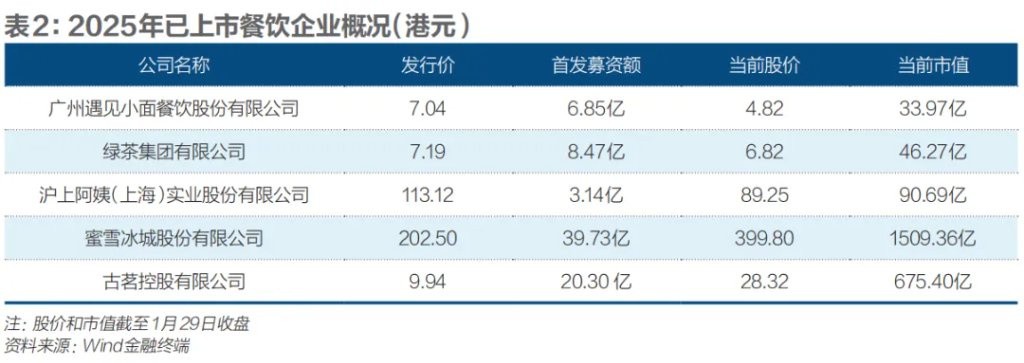
However, even if they successfully go public during this window period, market value management remains a long-term issue for these listed companies. Market data reveals the "ice and fire" behind the listing frenzy. Wind data shows that Guming, Green Tea Group, and Yujian Xiaomian, which went public in 2025, all experienced a drop in share price immediately after listing. Hu Shang Ayi did not drop on its first day but fell below the issue price five months after listing. Furthermore, the divergence in stock price trends of these catering companies after going public continues to widen, with some experiencing a counter-trend rise while others fall into prolonged stagnation.
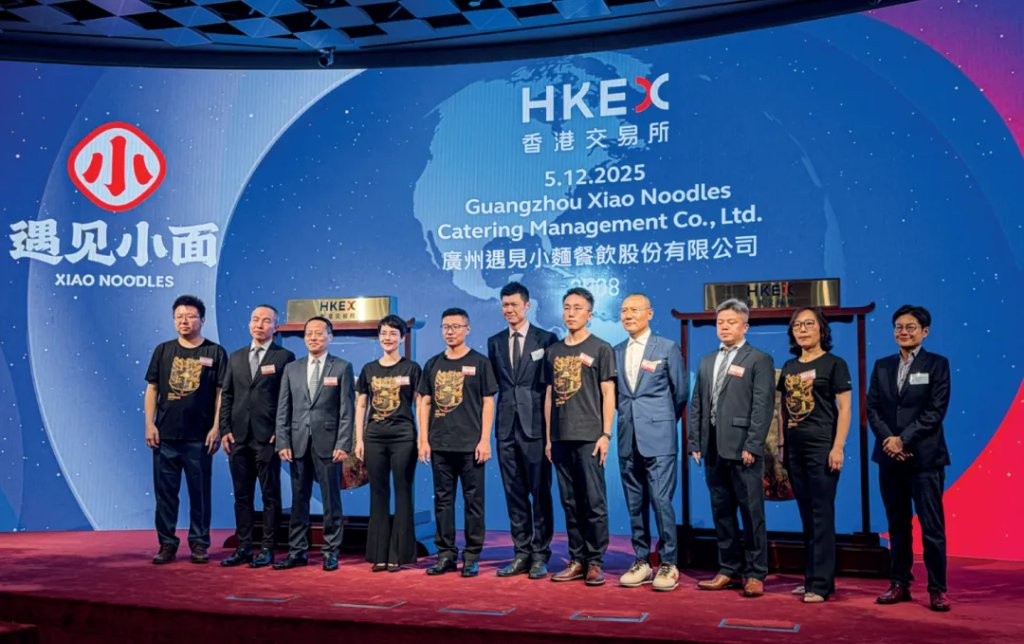
On December 5, 2025, Yujian Xiaomian was listed on the main board of the Hong Kong Stock Exchange. Photo/Visual China
Amid the wave of listings in Hong Kong, the catering industry is navigating a challenging cycle. Data from the National Bureau of Statistics shows that in 2025, national catering revenue reached 57,982 billion yuan, a year-on-year increase of 3.2%, which is lower than the GDP growth rate. Catering revenue accounted for 11.6% of total retail sales of consumer goods, only up 0.2 percentage points from the previous year. The growth rate of catering revenue has significantly slowed compared to previous years For many years, facing the capital market, the catering industry has fallen into a rigid dilemma of homogenized competition, with keywords like franchising, standardization, and chain operations repeatedly appearing, while new stories that excite investor enthusiasm are rare. Against the backdrop of overall consumption growth slowing and intensified industry competition, the IPO (Initial Public Offering) represents a severe test of survival capability and growth quality.
Listing in Hong Kong is not a multiple-choice question
From the perspective of industry distribution, the current wave of catering IPOs since 2025 has a wide coverage and significant diversification. In the casual fast food and formal dining sectors, there are brands like Lao Xiang Ji, Yu Jian Xiao Mian, Green Tea Group, and Ba Nu Mao Du Hot Pot; in the tea beverage sector, there are Gu Ming, Mi Xue Bing Cheng, and Hu Shang A Yi; in Western dining and composite formats, there are Big Pizza and COMMUNE.
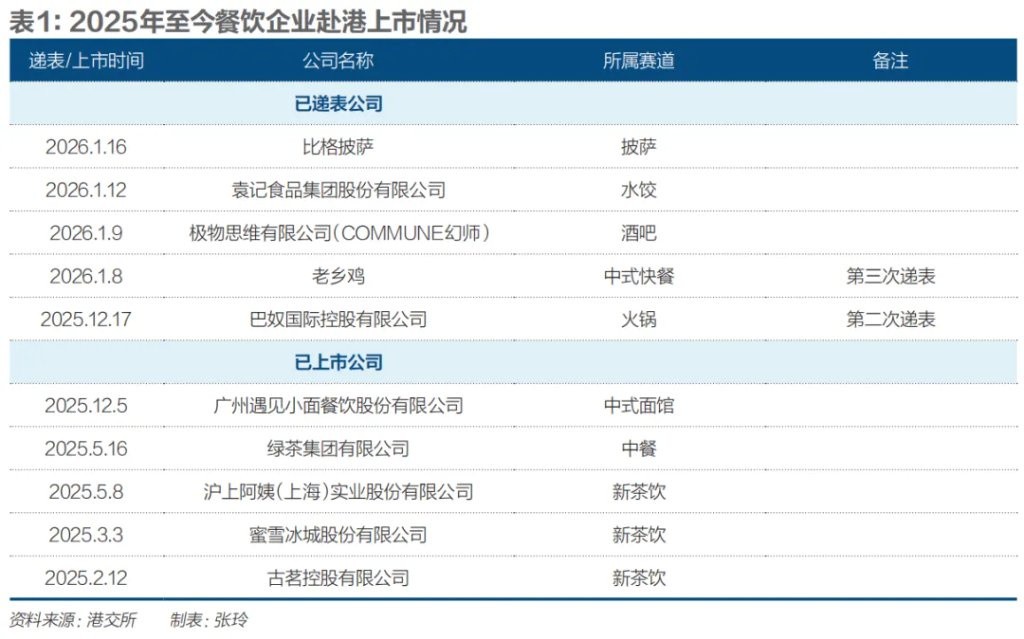
Among them, the tea beverage category stands out in 2025, as they possess both revenue and store scale, along with brand recognition, attracting most of the capital market's attention in the consumer sector. The companies that have already submitted their applications for 2026 are leading players in their respective segments, with a certain scale of stores and market share, forming the basis for their push into the Hong Kong stock market.
According to the prospectus, from 2022 to 2024, based on operating revenue, COMMUNE has ranked first among Chinese restaurant and bar brands for three consecutive years. By 2024, its market share reached 7.8%, equivalent to twice the combined market share of the second and third largest competitors.
Yuan Ji Yun Jiao had 4,266 stores as of September 30, 2025, covering 32 provincial-level administrative regions in China and Southeast Asian countries.
As a representative of local pizza brands, Big Pizza, according to data from ZhiShi Consulting, ranked first among local pizza restaurants in China based on GMV for the first nine months of 2025, first among buffet restaurants, and first among Western casual dining restaurants. As of September 30, 2025, it had a total of 342 stores, covering 28 provinces and 105 cities in China.
The companies applying for listing also show certain competitiveness in financial performance. COMMUNE maintains a high gross margin of over 65% due to its all-day operation model of "Japanese cuisine by day, bar by night" and a high proportion of beverage sales. Big Pizza's revenue for the first three quarters of 2025 was 1.389 billion yuan, a year-on-year increase of 66.6%, far exceeding the total revenue for 2024.
Expanding store scale and building supply chains are the core fundraising purposes for these companies seeking to go public. Big Pizza has clearly planned to open 610 to 790 new stores from 2026 to 2028, further enhancing its national market coverage; Yuan Ji Food also mentioned in its prospectus that part of the raised funds will be used for expanding its store network, extending into lower-tier cities and overseas markets According to Shen Meng's observation, consumers are now more inclined towards cost-effective dining options, and the restaurant industry as a whole is facing downward pressure on consumption. However, due to rising fixed costs such as rent, utilities, and labor, restaurant businesses are squeezed from both the cost and revenue sides, putting pressure on their overall capital turnover ability. In this context, the demand for public financing has become more urgent.
Especially for companies that have already reached a certain scale, wanting to continue developing in the tightening financing environment in mainland China, it is easier to hope for a listing in Hong Kong. Additionally, investors also need to exit, which will drive companies to seek listing.
Since the comprehensive registration system reform was officially implemented in 2023, particularly based on the "Administrative Measures for the Registration of Initial Public Offerings" disclosed in February of that year, the A-share main board encourages leading enterprises in mature business models and stable operating performance, while the Sci-Tech Innovation Board and the Growth Enterprise Market support high-quality enterprises that deeply integrate new technologies and new industries. Objectively, consumer enterprises are not included in the basic framework encouraged for listing.
The Hong Kong Stock Exchange's optimized listing rules in August 2024 further lowered the listing threshold for restaurant and consumer enterprises. The new regulations adopt flexible standards for the initial public shareholding requirements of "A+H" issuers, reducing it to 10% or a market value of HKD 3 billion, which allows more small and medium-sized restaurant brands to meet the listing conditions.
A senior lawyer serving overseas listings told Caijing that for mainland enterprises, listing in Hong Kong is more certain. He explained that the Hong Kong stock market emphasizes disclosure, and under the financial indicators that meet the listing rules of Article 8.05, the overall review process is transparent and controllable, usually taking about four to six months.
In addition, the Hong Kong stock market also offers more flexibility in corporate structure, such as supporting dual-class shares and VIE (Variable Interest Entity)/Red Chip structures, especially suitable for new economy and industries with foreign investment restrictions. After listing, companies can continue to finance very flexibly, such as through accelerated placements, connecting with a rich resource of global institutional investors without complex approvals.
The Hong Kong stock market's attribute of connecting global capital aligns more closely with the globalization demands of restaurant enterprises. Huang Simin, President of the Tourism and Hospitality Industry at the Hong Kong Investment Promotion Agency, pointed out that Hong Kong's global network and mature professional services can provide the best function for mainland food and beverage enterprises as a multinational supply chain management center. The Investment Promotion Agency has already assisted over 50 restaurant and hospitality enterprises in entering Hong Kong, more than 30 of which are from mainland China.
From the capital side, the pressure for venture capital exits also needs to be released urgently. In recent years, the new consumption sector has seen an investment boom, with a large amount of capital flowing into new tea drinks, dining, trendy toys, and other fields. Now these investment projects are entering the exit period. Against the backdrop of relatively limited exit paths in the A-share market, the Hong Kong stock market has become an important channel for investment institutions to achieve exits.
For example, Yujian Xiaomian, which is set to go public by the end of 2025, is facing such a situation. Its prospectus disclosed that the company signed a redemption agreement in March 2021, stipulating that if it fails to complete the listing by the seventh anniversary (March 2028) or before, Yujian Xiaomian needs to repurchase at the original issue price plus a 7% annual return rate plus the total of unpaid dividends, or 150% of the original issue price plus the total of unpaid dividends Gu Ming's listing in February 2025 also carries the urgency of capital exit. The preferred stock agreements held by institutions such as Sequoia China and Kotu Capital stipulate that if it is not listed by 2027, Gu Ming must repurchase shares at an annual interest rate of 8%.
Wang Hongdong mentioned that many restaurant companies queuing to enter the secondary market are driven by capital, most of which raised funds in the primary market around 2020 and 2021.
According to data from Hongcan Network, in 2021, the investment enthusiasm in the restaurant sector peaked, with a total of 347 financing events throughout the year, a 60% increase compared to 2020. In 2022, there were 238 financing events in the restaurant industry. Specifically for Chinese cuisine, data from IT Juzi shows that from 2011 to 2019, there were a total of 114 financing events in the Chinese restaurant sector, averaging less than 13 events per year.
The restaurant industry has new companies, but few new stories
On December 5, 2025, Yujian Xiaomian rang the bell on the Hong Kong Stock Exchange, marking the last listing from mainland restaurants for the previous year, but soon faced a dismal debut with a 27.84% drop on the first day, a shocking scene for many consumer companies.
In the past year, only Mixue Bingcheng performed relatively well in the capital market, with a first-day increase of over 43% upon its listing in March 2025, and its stock price has since fluctuated upward, currently maintaining a high price range of around HKD 400.
As a traditional service industry, the restaurant sector has characteristics such as relatively fixed gross margins, significant influence from macroeconomic conditions and consumer demand, high standardization difficulty, and rising management costs with scale expansion. These characteristics determine that the performance growth of restaurant companies is relatively stable but lacks explosiveness, making it difficult to bring high growth expectations to the capital market like the technology and new energy sectors.
Wind data shows that the average price-to-sales ratio of the Hong Kong restaurant sector is only 1.84 (as of January 26, 2026), far below the technology sector's 11.84 and the pharmaceutical sector's 21.04. A low price-to-sales ratio essentially means that the market value of the company relative to its revenue scale is small, which also indicates that the restaurant industry finds it hard to achieve high valuations. The sluggish stock prices of companies like Nayuki and Helen's after their listings also confirm the difficulty of storytelling for restaurant companies.
A person engaged in asset management in Hong Kong told Caijing that historically, the restaurant industry in the Hong Kong capital market has had few positive returns and a high rate of first-day losses. They hold a cautious attitude towards such sectors unless there are excellent investment opportunities.
For many years, restaurant companies have rarely told "new stories" to the capital market. The homogenization of competition in the mainland restaurant industry has become increasingly severe, with highly similar business models across various segments. The "franchise + fresh-made" model in the tea beverage sector, the "direct operation + standardization" model in the fast food sector, and the "self-developed base material + chain expansion" model in the hot pot sector are all well-known to the capital market, lacking unique core competitiveness However, Wang Hongdong believes that whether catering companies can successfully go public mainly depends on data, scale, and future potential. "The catering business is not that complicated; it's all about opening stores, and it still depends on the future's imagination space."
According to this logic, among the companies that have recently submitted their applications, he is relatively optimistic about Yuanji Yunjiao—its model is light, more flexible, and has low store opening costs, similar to milk tea shops. According to the company's prospectus, its business model involves factories producing fillings, dough, and other foods, which are sold to franchise stores, where they are hand-wrapped on-site. The company mainly provides brand, supply chain, digital, and operational support, operating only a small number of franchise stores. Data shows that Yuanji Yunjiao's franchise store rate exceeds 99%.
"In the past two years, the trend has been to be small, light, and flexible," Wang Hongdong said.
The aforementioned lawyer also mentioned that the Hong Kong stock market is still more focused on corporate performance and investor feedback during the roadshow. "The Hong Kong Stock Exchange's review standards for catering companies have not changed significantly; even for Green Tea, after a long period of multiple submissions, it eventually went public successfully," he said.
However, in Shen Meng's view, the recently submitted companies do not have concepts that can be hyped or products that can become blockbuster hits, making it difficult to see star consumer stocks like Mixue Ice City or Pop Mart emerging again. The secondary market needs speculation driven by rising stock prices, such as LABUBU, which can trigger a consumption craze, or old gold shops that continue to rise under the influence of international gold prices. This is the consumption story the secondary market hopes to see. "We need to see if there are themes and whether more people are willing to pass the baton," he said.
In terms of industry ecology, the catering sector also faces significant challenges. According to data from the National Bureau of Statistics, by 2025, national catering revenue growth will be lower than GDP growth. In terms of per capita catering consumption expenditure, it is projected to be 4,127 yuan in 2025, accounting for 14% of per capita household consumption expenditure, remaining basically flat compared to 2024.
Hongcan Network points out that due to intensified competition and sluggish consumption, the lifecycle of catering stores is shortening, having decreased from 2.1 years in 2015 to 16.9 months in 2024. Its co-founder and vice president Fan Ning predicts that the average lifespan of catering stores may further shorten to around 15 months by 2025.
Hong Kong Stock Attitude Amid Active Fundraising
Although catering companies face an overall valuation slump in the Hong Kong stock market, it is undeniable that the fundraising activity in the Hong Kong stock market has continued to rise in recent years, becoming an important battleground for the capitalization of mainland consumer enterprises.
According to statistics from PwC, there were 119 IPOs in Hong Kong throughout 2025, an increase of 68% compared to 2024, with a fundraising amount reaching HKD 285.8 billion, a significant increase of 225%, ranking first in the world. Among the 113 main board companies, the retail, consumer goods, and services sectors accounted for 28%, becoming an important force in Hong Kong IPOs. In terms of fundraising amounts, the retail, consumer goods, and services sectors accounted for 27%.
However, according to Shen Meng's observations, the Hong Kong Stock Exchange has extended the review period for consumer enterprises to six months or even longer. "Which is more willing to trade, a medium-sized catering company or a large technology company?" "Which of these two targets is more attractive to the Hong Kong Stock Exchange?" Shen Meng stated that the answer is obvious.
In addition, the 2025 public fund quarterly report shows that among the top ten heavy positions of active equity funds, technology and new energy stocks occupy nine seats, with only Kweichow Moutai representing traditional consumption. Traditional consumption is fading from the top ten heavy positions of public funds, while new consumption fields such as figurines, the millet economy, and medical beauty have become key investment directions for the new generation of fund managers.
In December 2025, the Hong Kong Stock Exchange and the Hong Kong Securities and Futures Commission jointly issued a letter to sponsors regarding listing application matters, pointing out a series of quality decline issues and some non-compliance behaviors in the listing applications, including poor drafting quality of listing documents, selective presentation of industry data exaggerating market position, sponsors failing to effectively respond to regulatory inquiries, and some institutions even lacking understanding of the basic facts of the projects.
Wang Hongdong's view is that the window for Hong Kong stocks is narrowing.
Gao Guolei, chairman of Shanghai Zhanghe Investment, previously told Caijing that the current market for Hong Kong stocks has lasted over a year, with many quality IPO projects having completed their listings, including quality A-share companies achieving A+H listings and quality entrepreneurial projects choosing Hong Kong for their first IPO. "The overall quality of subsequent projects has declined, coupled with the continuous rise of the Hong Kong stock index leading to market sentiment divergence, which may be the main reason for recent IPOs in Hong Kong breaking below issue price."
He also mentioned, "In the future, the Securities and Futures Commission's filing process will only become stricter, not more lenient; it is uncertain how long this round of Hong Kong IPOs can last. Therefore, the prospects for projects currently queuing for listing and those planning to queue for filing with the China Securities Regulatory Commission have certain uncertainties."
Currently, over 350 companies (including those with secret filings) are queuing for listing in Hong Kong—this is the number disclosed by HKEX CEO (Chief Executive Officer) Charles Li during the World Economic Forum in Davos, Switzerland, in January 2026. She mentioned that the quality of IPOs must be "non-negotiable," which is the basis for maintaining market trust, ensuring that the quality of each listing application and due diligence is in place. Recent warnings issued regarding some poorly qualified IPO applications serve as a reminder that professionals must balance speed with quality.
Many of these repeatedly mentioned issues are common among restaurant and consumer enterprises that rely on store networks and scale. The requirements of the Hong Kong Stock Exchange also, to some extent, compel restaurant enterprises to improve their internal control systems and business models before going public.
The aforementioned Hong Kong asset management personnel mentioned that the Hong Kong stock market is different from the A-share market, with the former primarily consisting of institutional investors and having a short-selling mechanism, which requires companies to be more rational and cautious when seeking to list in Hong Kong. Many restaurant and consumer enterprises that previously encountered price breaks mostly had high pricing, leading to certain valuation bubbles. "One should not hold the purpose of raising funds; instead, it should emphasize the actual returns to shareholders, making subsequent financing and issuance easier," he stated.
According to his understanding of the Hong Kong stock market, restaurant enterprises with reasonable valuation pricing, even considered cheap, with national network penetration capabilities, products with certain cost-effectiveness, and stable store profit models, if they have strong cornerstone investors with cornerstone investment accounting for over 50%-60%, will still be welcomed by the Hong Kong stock market, with Mixue Ice City being a positive example However, when the sound of the gong fades, the core competitiveness of catering enterprises ultimately needs to return to the products and services themselves.
Risk Warning and Disclaimer
The market has risks, and investment requires caution. This article does not constitute personal investment advice and does not take into account the specific investment goals, financial situation, or needs of individual users. Users should consider whether any opinions, views, or conclusions in this article are suitable for their specific circumstances. Investment based on this is at one's own risk.
