


China AI Trading: Uncertainty over "Who is the Ultimate Winner," Betting on the Beneficiaries of the "AI Application War"

JP Morgan defines 2026 as the "activation year" for consumer-grade AI. Due to the application layer's moat not being solidified yet, the report suggests that investors avoid betting on single application winners and instead focus on the "second-order beneficiaries" such as the surge in token consumption, the marketing battle for user acquisition bonuses, and AI's compression of content production cycles, mentioning Alibaba, Tencent, Baidu, NetEase, and Kuaishou among others
Author: Long Yue
Source: Hard AI
As the "AI application war" fully unfolds, JP Morgan chooses to avoid betting on a single winner and instead focuses on earlier realizations and more visible second-order beneficiary areas.
On January 30, JP Morgan's China Securities Research team released a research report on the Chinese internet industry titled "2026 Outlook: Trading AI Second-Order Beneficiaries." The report explores various directions such as consumer AI, enterprise AI, agent commerce, and gaming, with the core judgment not being "who will win," but rather "which segments will benefit first and are easier to trade in the market."
Not in a hurry to judge "application winners," the market is not yet ready for pricing
JP Morgan clearly states in the report:
"It is still too early to trade on 'AI application winners and losers' in the Chinese chatbot market, as the market is still brewing, and short-term share fluctuations reflect the rhythm of distribution and product iteration, rather than a solid moat."
In their view, early user metrics and market share changes are insufficient to support judgments on structural outcomes. The report emphasizes:
"In our view, a viable investment approach at this stage is to avoid black-and-white bets on application-level winners, but to target beneficiaries in the industry advancing the AI interaction process, whose upside potential depends more on the breadth of adoption rather than the market share of a single application."
2026 may become the "activation year," chatbots entering a high-frequency usage phase
At the consumer AI level, the report defines 2026 as a critical juncture:
"We believe that 2026 may become the 'activation year' for consumer AI in China, as chatbots transition from novelty to habit and begin to reshape how users discover information, evaluate options, and initiate actions."
JP Morgan cites specific data indicating that the user scale of ByteDance's Doubao is of landmark significance:
"The daily active users of ByteDance's Doubao have reached approximately 100 million, which is milestone-worthy as it indicates that general chat interaction has crossed the 'good enough' threshold for mass market applications."
The report also places this trend in a global context, citing Reuters:
"ChatGPT's weekly active users have reached 800 million, which prominently indicates how fast the compound growth rate of consumer AI can be once product usability and distribution align. "
JP Morgan judges that chatbots are evolving into "high-frequency traffic portals positioned upstream of many AI use cases," which will directly change the competitive dynamics between platforms.

Second-order trading logic: token, marketing, and productivity
Without betting on the ultimate winner, JP Morgan clearly anchors the trading logic in second-order exposure:
"On the contrary, we anchor our operational recommendations to second-order exposure: 1) AI infrastructure and cloud vendors, which can capture the rising inference workload; 2) Advertising platforms, which can benefit from increased industry sales and marketing intensity."
Specifically:
-
In terms of AI infrastructure (Overweight: Alibaba, Baidu): The report believes that "the growth of daily multi-turn chatbot conversations will directly benefit inference demand and token throughput." As agents expand from conversation to execution, token consumption will show compound growth, and the value chain will reward scalable infrastructure and ecosystem integrators.
-
In terms of online advertising platforms (Overweight: Kuaishou Technology): Major platforms will increase customer acquisition spending to compete for AI mindshare. JP Morgan expects that "performance-oriented channels will occupy a significant share of the budget," and Kuaishou, even if not the ultimate chatbot winner, will benefit from the overall increase in industry marketing intensity.
"We expect that large platforms will increase spending on customer acquisition and repeat interactions in the competition for chatbot mindshare."
-
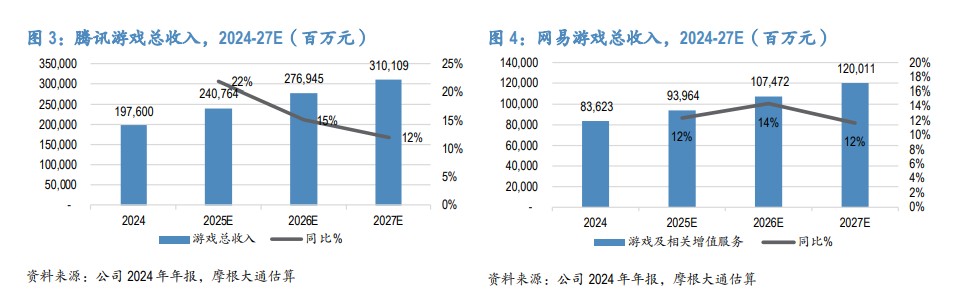
In the online gaming industry (Overweight: Tencent, NetEase): AI compresses the "creative to market" cycle, improving R&D ROI. Tencent has released an open-source 3D generation model that quickly transforms text/images into high-quality 3D visual effects, a structural benefit of content supply that the market has underestimated.
-
JP Morgan also points out that performance-oriented channels will become the main beneficiaries.
Enterprise AI: From "Experiment" to "Measurable Returns"
In terms of enterprise AI, the report emphasizes that the turning point is measurable returns in high-stakes workflows:
"We believe that the turning point for enterprise AI adoption occurs when the value proposition becomes measurable in high-stakes workflows."
JP Morgan cites several public disclosures as examples, including:
"More than a quarter of Google's new code is generated by AI before being reviewed and accepted by engineers."
"Developers using GitHub Copilot complete standardized coding tasks 55.8% faster than the control group."
In the Chinese market, the report cites Tencent's disclosure:
"Its AI coding tool CodeBuddy reduced coding time by 40% and improved R&D efficiency by 16%."
JP Morgan also reminds to be cautious about corporate disclosure data but believes this is an important signal:
"Indicating that vendors are currently actively promoting the AI value proposition in operational language (saving time, improving efficiency), which is often a prelude to broader procurement and adoption."
Agent Commerce: The Conversion Layer from "Dialogue to Execution"
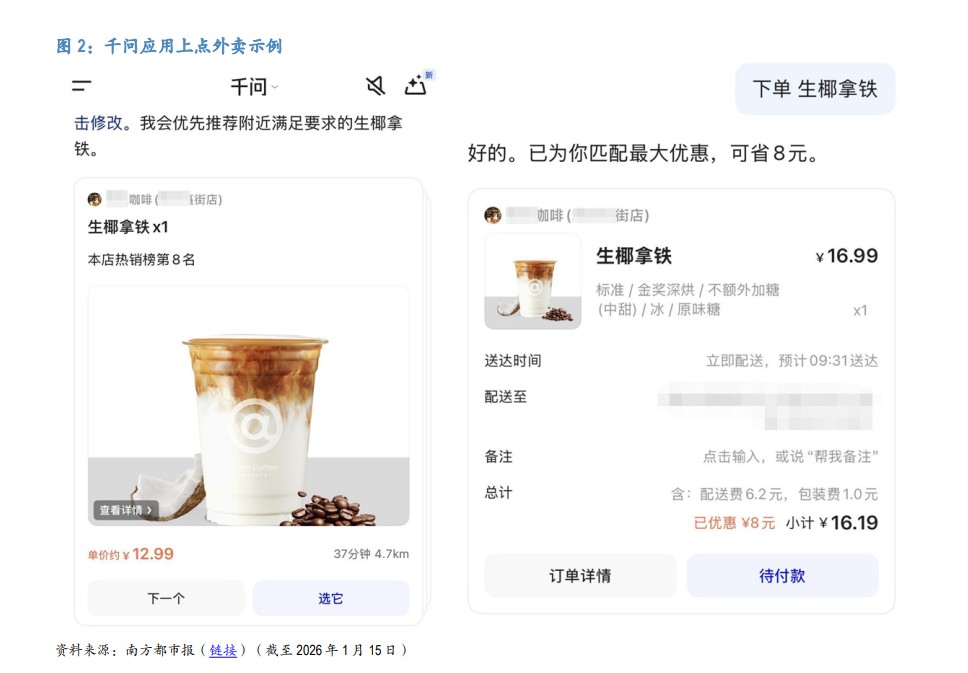
JP Morgan views agents as the next core transformation layer. Alibaba has integrated food delivery, travel booking, and payment through the "Qianwen" application in the chat interface.
The report states: "Conversational interfaces can reduce friction between discovery, comparison, and checkout."
However, JP Morgan's attitude is equally cautious:
“Given that we are still in the early stages and disclosures are limited, we avoid drawing premature conclusions about ‘who wins and who loses.’”
The report believes that short-term opportunities are more reflected in:
“Funnel efficiency, rather than immediate disruption of market share.”
Although it is difficult to immediately disrupt market share in the short term, the first-order advantage lies in increasing the value of each incremental user conversation. For vertical leaders like Trip.com, the risk lies in the upward shift of traffic entry points, but they can protect high-frequency use cases by embedding the agent layer within their own app.
Valuation Restructuring: Discounted Relative to Global Peers
Looking back to 2025, Chinese internet stocks are primarily driven by "narrative changes" rather than profit forecast adjustments.
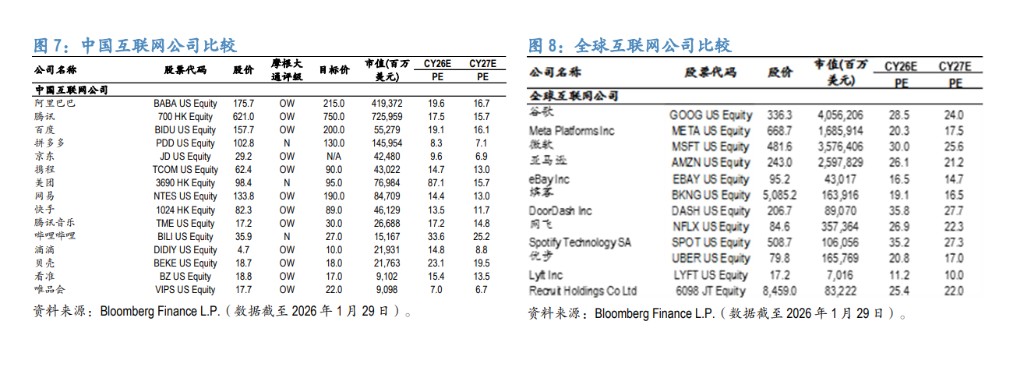
The report points out that even with a recent rebound, the dynamic price-to-earnings ratio of Chinese leaders still shows a significant discount compared to global peers.
-
Valuation Comparison: Alibaba (2026 calendar year expected PE of 20 times) compared to Google (29 times) and Amazon (26 times); Pinduoduo (8 times) compared to eBay (17 times).
-
Core Viewpoint: JP Morgan believes that as AI narratives converge, "individually narrowing valuation gaps seems achievable." This benefits companies with high credibility in long-term narratives that have indeed reached execution milestones.
This article is from WeChat Official Account "Hard AI". For more cutting-edge AI news, please click here.
