


Japanese Ministry of Finance: No yen intervention operations were conducted in January

The Japanese government officially confirmed that there was no actual intervention in the foreign exchange market at the end of January, and the appreciation of the yen mainly relied on market expectations of a joint intervention by the U.S. and Japan. This move has bought time for the government ahead of the upcoming elections, but the strategy is dependent on cooperation from the United States, which makes it fragile. With the U.S. Treasury Secretary denying coordinated action and Japan potentially facing stronger intervention pressure after the elections, the future trend of the yen remains uncertain
The data released by the Japanese Ministry of Finance on Friday confirmed that the authorities did not directly intervene in the foreign exchange market for most of January. Although the yen significantly appreciated from near the 160 level to the 154 range during this period, its rebound was mainly driven by market concerns about a possible joint action between the U.S. and Japan, rather than actual intervention operations.
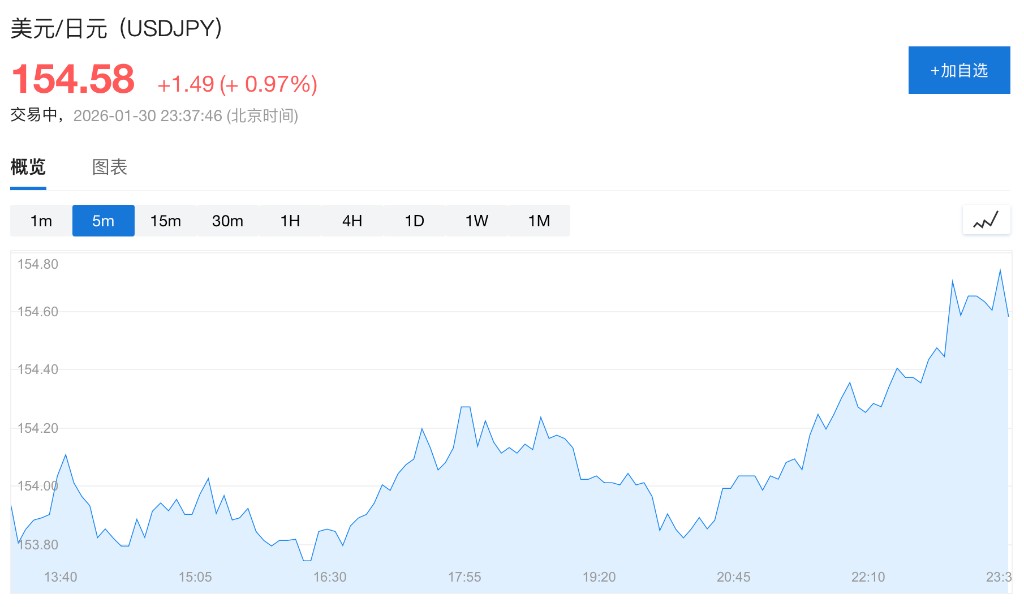
Data shows that from December 29 of last year to January 28 of this year, Japan did not use any funds for foreign exchange intervention. This stands in stark contrast to the situation in spring 2024, when Japan had invested nearly 10 trillion yen (about 65 billion USD) to achieve a similar magnitude of adjustment.
This strategy has provided valuable breathing room for the government of Sato Masami, which is facing an election test on February 8, as the inflation driven by the depreciation of the yen has been a major focus of voter dissatisfaction. However, analysts warn that this strategy, which relies on coordination with U.S. policies, has significant vulnerabilities and is difficult to sustain; should the yen approach 160 again, Japan may have to initiate a larger-scale actual intervention.
It is noteworthy that U.S. Treasury Secretary Yellen made it clear on Wednesday that the U.S. "absolutely did not" sell dollars against the yen in the currency market for intervention, further weakening the market's deterrent expectations for joint action.
Exchange Rate Checks as an Alternative to Actual Intervention
Market analysis generally believes that Japanese authorities conducted exchange rate checks before the yen's appreciation. This operation typically involves the central bank contacting major traders to inquire about real-time quotes; while it does not involve actual transactions, it is often implemented before formal interventions and can serve to warn the market and suppress speculation.
Traders reported that the inquiry operations of the New York Federal Reserve actually drove the yen stronger. Compared to Japan acting alone, the potential threat of a U.S.-Japan joint intervention has a stronger market impact, effectively guiding the exchange rate direction and suppressing speculative trading.
Japanese Finance Minister Kato Masami has recently cited the U.S.-Japan currency agreement from last September multiple times, emphasizing the possibility of coordinating actions with the U.S. After the yen further appreciated on Tuesday, she told reporters:
"We will continue to closely coordinate with U.S. authorities as necessary, in accordance with the spirit of the joint statement, to take appropriate responses to exchange rate fluctuations."
Tomio Kinoshita, a global market strategist at Invesco Asset Management Japan, pointed out:
"Japan is currently handling the yen issue quite effectively. While the statements from Trump and Yellen have affected market sentiment, the key is that the yen has significantly rebounded from the dangerous range around 160, and the Ministry of Finance has hardly used any funds in the process."
Confusion in U.S. Signals Weakens Deterrent Effect
Trump's remarks on Tuesday evening further fueled market speculation about joint foreign exchange intervention. He hinted that he could easily manipulate the dollar's movement, stating, "I can make it bounce up and down like a yo-yo." Trump's open attitude towards the depreciation of the dollar has sparked speculation that the dollar may enter a long-term downward phase, which has also boosted the strength of various currencies, including the yen However, Treasury Secretary Besant's statement weakened the deterrent effect of joint intervention. He reiterated that the U.S. maintains a "strong dollar" policy. The conflicting signals released between Trump and Besant may also raise doubts in the market about the actual strength of policy coordination.
Stronger Actions May Be Needed After the Election
The latest strategy from Japan's Ministry of Finance has provided the government of Prime Minister Kishi Sanae with some breathing room before the election. However, after the election, authorities may need to enter the market to implement large-scale interventions to release a stronger policy signal. Given that the Bank of Japan is not expected to raise interest rates until at least April, this move may become a necessary choice.
Tomio Kinoshita pointed out that if Kishi Sanae wins, it may put further pressure on the yen, as her aggressive fiscal policies have been viewed by global investors as one of the incentives to short the yen. He stated:
"Some market participants are still worried about a 'Japanese version of the Truss shock.' Concerns about fiscal sustainability have sown the seeds for a renewed weakening of the yen."
