


Is a recession still needed before commodities reach a "super bull market"?

The rapid rise in the commodity market has sparked imaginations of a super cycle in commodities, but Guolian Minsheng Securities points out that a true commodity bull market typically begins at the economic trough, not during a boom. Historical data shows that commodity bull markets last an average of 12 years, with the starting point often corresponding to a recovery after an economic crisis. The current rise resembles a precious metals market and has not yet entered a phase of comprehensive resonance expansion
In the past year, the rapid rise of commodities such as copper, gold, and silver has reignited the market's imagination of a "super cycle of commodities." But the question is: is this round of increase merely a structural market, or is it a prelude to a true commodity bull market?
Guolian Minsheng Securities, in its latest asset allocation report, systematically reviewed the conditions for the formation of commodity bull markets from a long-term perspective spanning over 170 years since 1850. The conclusion drawn is not aggressive, and even somewhat restrained—this round of commodity cycle has not yet "completed the necessary steps."
Guolian Minsheng Securities pointed out that historically, true commodity bull markets often do not begin in prosperity, but are born from economic troughs and ultimately complete pricing during economic overheating or even recession.
A Century of Review: True Commodity Bull Markets Last an Average of 12 Years, but Their Starting Points Are Very "Cold"
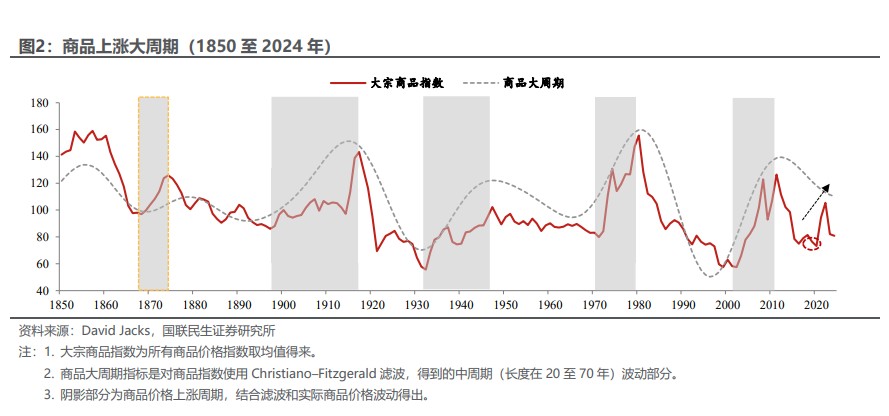
Based on David Jacks' actual commodity price index and combined with the Christiano–Fitzgerald filter, Guolian Minsheng Securities conducted a long-term decomposition of commodity prices since 1850, identifying five typical large cycles of commodity price increases.
These cycles share several highly consistent characteristics:
- Average duration of about 11.8 years
- After excluding inflation, the average real commodity price increased by about 79%, and if inflation is considered, the nominal increase is about 125%
- The rise is not linear but is repeatedly advanced alongside macro fluctuations
More critically, the starting point of each commodity super cycle almost corresponds to a phase of "clearing" after an economic trough or crisis:
- 1897: After long-term deflation and industrial adjustment
- 1932: Bottom of the Great Depression
- 1971: Collapse of the Bretton Woods system
- 2002: Global recovery after the burst of the internet bubble
- 2020: Global recession under the impact of the pandemic
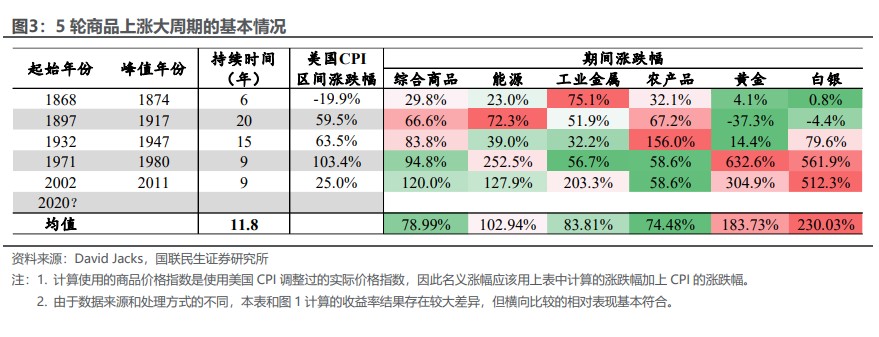
Guolian Minsheng Securities emphasizes: Commodity bull markets do not start at the "best" times, but rather after the "worst."
From this dimension, 2020 indeed possesses the macro characteristics of a "cycle starting point," but the question is—has the cycle entered a true expansion phase?
Structural Differentiation is Obvious: The Current Rise Resembles "Precious Metals Market," Rather Than a Comprehensive Resonance
When comparing the recognized commodity bull market from 2002 to 2011, the structural differences of this round of market are very apparent.
Guolian Minsheng Securities found that:
- In the previous commodity bull market, in most years, over 60% of commodities rose synchronously
- In the past three years, the breadth of commodity price increases has been noticeably insufficient.
- Precious metals have significantly outperformed, but energy, agricultural products, and some industrial metals have overall experienced "stagnation."
From a macro perspective, historically, the most "cyclical" categories are still:
- Energy and industrial metals: Highly correlated with technological revolutions, infrastructure expansion, and geopolitical conflicts.
- Agricultural products: Long-term trends lag behind inflation, only experiencing periodic surges during wars or extreme supply shocks.
- Precious metals: Only after moving away from the gold standard and the decline of monetary credit did they truly become the main players in the cycle.
Guolian Minsheng Securities believes that the current rise in commodities reflects more of a financial attribute-driven precious metals market, rather than a comprehensive commodity bull market led by physical demand.
This is also the core of market divergence: If there is a lack of resonance from physical demand, has the commodity truly entered a "super cycle"?
Three Major Medium to Long-term Variables: War, Technological Revolution, and Emerging Demand
To answer this question, Guolian Minsheng Securities starts from three structural factors that determine the long-term pricing of commodities.
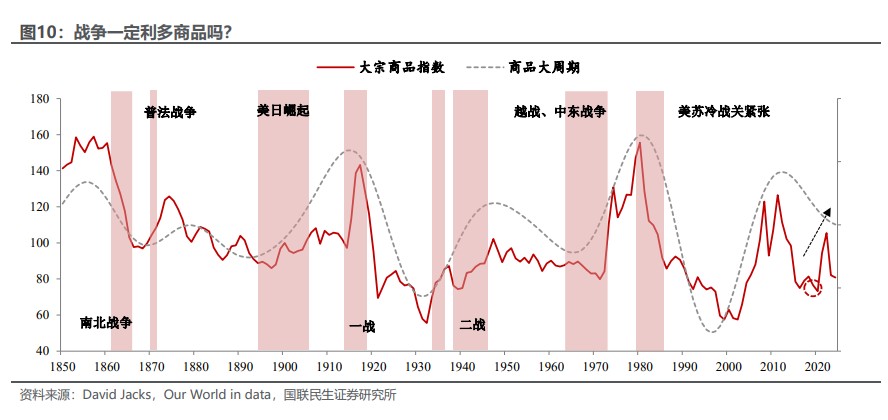
1. War: Not all conflicts are beneficial for commodities; it depends on whether "demand is destroyed."
The report clearly points out a commonly misunderstood fact: War does not necessarily drive up commodity prices and may even suppress them.
War will systematically benefit commodities only in two situations:
- World War-level conflicts that cause complete disruption of supply chains + large-scale military demand expansion.
- Conflicts that do not significantly damage the demand of core economies.
Conversely, prolonged civil wars or regional conflicts often drag down demand, thereby suppressing commodity prices. A typical example is the early 1980s when the Cold War between the U.S. and the Soviet Union intensified, but both economies weakened simultaneously, leading to a major bear market in commodities.
2. Technological Revolution: Commodity bull markets often occur during two "window periods."
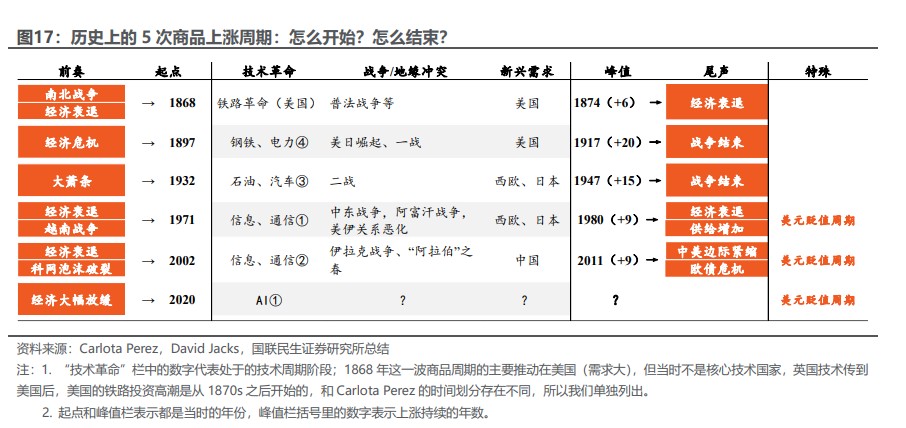
Guolian Minsheng Securities cites Carlota Perez's framework of technological revolutions, summarizing the relationship between commodity bull markets and technological cycles into two key phases:
- Technological explosion / early frenzy: New technologies spur waves of investment, rapidly increasing infrastructure and resource demand.
- Turning point / synergy phase after the bubble bursts: After the recession clears, technological diffusion brings real demand.
Historical experience shows that the phase low points of commodity prices often occur during the bursting of technological bubbles or economic recessions, after which they enter a sustained upward channel. Guolian Minsheng Securities judges that the current technological revolution represented by AI is still in its early stages and has not yet experienced a sufficient clearing of the "turning point."
3. Emerging Demand: Behind every round of commodity bull markets, there are "new buyers."
Whether in 19th century America, post-World War II Europe and Japan, or 2000s China, the rise of emerging demand has been an indispensable condition for major commodity bull markets The current issue is that the world has not yet seen a "demand-level leap" similar to China's accession to the WTO; the pull of AI on commodities is still more reflected in medium- to long-term imagination rather than an immediate magnitude impact.
The conclusion is very restrained, but also very clear: the commodity bull market may still lack "a test"
Based on historical reviews and current conditions, Guolian Minsheng Securities provides the following positioning:
- The starting point of this commodity cycle likely appeared in 2020
- The U.S. dollar entering a medium- to long-term depreciation cycle is an important favorable condition
- However, what is currently lacking includes: concentrated outbreaks of geopolitical conflicts, clear emerging demand exceeding expectations, and a true economic recession "verification"
Guolian Minsheng Securities bluntly states: "An economic recession may be an important touchstone for testing the quality of this commodity price increase cycle." In other words, without experiencing a recession to clear out excess, it is difficult for commodities to transition from a structural market to a full bull market.
Risk warning and disclaimer
The market has risks, and investment should be cautious. This article does not constitute personal investment advice and does not take into account the specific investment goals, financial situation, or needs of individual users. Users should consider whether any opinions, views, or conclusions in this article align with their specific circumstances. Investing based on this is at one's own risk.
