


Morgan Stanley lowers Tesla's target price: The "burning cash" model will impact short-term profits, and free cash flow is likely to turn negative

Tesla is transforming from an electric vehicle manufacturer to a leading company in physical AI. Capital expenditures for Tesla are expected to exceed $20 billion in 2026, far surpassing the market's previous expectation of $11 billion. The huge capital expenditures are worsening cash flow, with Morgan Stanley estimating that Tesla will consume $8.1 billion in cash in 2026 and $500 million in 2027, until it can return to positive cash flow in 2028. At the same time, Morgan Stanley has lowered Tesla's target price from $425 to $415
Tesla is transitioning from an electric vehicle manufacturer to a leader in physical AI, but this strategic shift requires massive capital expenditures. Tesla's capital expenditure is expected to exceed $20 billion in 2026, far surpassing the market's previous expectation of $11 billion. The enormous capital expenditure has worsened cash flow, impacting Tesla's current valuation.
According to Wind Information, Morgan Stanley released a report on January 29, lowering Tesla's target price from $425 to $415, maintaining a "hold" rating. This adjustment is driven by concerns over Tesla's significant future capital expenditures.
Morgan Stanley expects Tesla to face cash consumption of up to $8.1 billion in 2026, with adjusted EBITDA expectations declining by 5% for that year, and operating expenses as a percentage of sales rising from 13% to 14.5%.
The report also notes that the discontinuation of the Model X/S models, while symbolizing a strategic transformation, may lead to a deterioration in the product mix, as these high-priced models contribute higher gross margins.
In the short term, the expansion space for valuation is limited, but in the long term, investments in autonomous driving, robotics, and energy will solidify Tesla's leadership position.
Significant Adjustment in Financial Forecasts: Cash Flow Turning Negative Becomes the Biggest Concern
Morgan Stanley has adjusted its financial forecasts for Tesla in 2026. The capital expenditure expectation has been significantly raised from the previous $13 billion to $21 billion, with the company's capital expenditure guidance set at "over $20 billion," far exceeding the market consensus of $11 billion. This surge in capital expenditure is primarily aimed at supporting the infrastructure development and computing power expansion for the physical AI business.
The core issue is the free cash flow forecast. Morgan Stanley expects Tesla to consume $8.1 billion in cash in 2026, a significant deterioration compared to the previous forecast of $1.3 billion in cash consumption. Cash consumption is expected to continue into 2027, estimated at $500 million, and will not return to positive territory until 2028.
Regarding operating expenses, Morgan Stanley expects operating expenses to account for 14.5% of sales in 2026, up from 13% in 2025, an increase of 12.5%. This reflects Tesla's substantial investments to support growth prospects and AI projects.
In terms of revenue and EBITDA, Morgan Stanley expects 2026 revenue to be $96.7 billion, with adjusted EBITDA at $14.3 billion, a 5% decrease from previous expectations, and an EBITDA margin of 14.8%.
Accelerating Strategic Transformation: Comprehensive Layout from Electric Vehicles to Physical AI
Tesla CEO Elon Musk announced several major strategic decisions during the earnings call, the most notable being the plan to halt production of the Model X and S in the next quarter.
Morgan Stanley pointed out that although these two models together account for less than 2% of total sales in 2025, their higher price positioning contributes a larger proportion to gross profit.
Tesla plans to repurpose the dedicated space for Model X/S at the Fremont factory for the production of the Optimus humanoid robot, with an annual production capacity of up to 1 million units. The company reiterated its plan to launch the third-generation Optimus in the first quarter of 2026 In terms of autonomous driving taxis (Robotaxi), Tesla's progress aligns with Morgan Stanley's model expectations. The company confirmed that there are already over 500 Robotaxis operating on the roads between the San Francisco Bay Area and Austin, a scale much larger than the previously expected 200 vehicles.
At the same time, Tesla plans to launch Robotaxi services in seven cities, including Dallas, Houston, Phoenix, Miami, Orlando, Tampa, and Las Vegas, in the first half of 2026.
Huge Investment Supports AI Ambitions: xAI Invests $2 Billion
Tesla announced a $2 billion investment in xAI as part of its broader strategy to accelerate the progress of physical AI terminal markets and enhance efficiency. xAI's chatbot Grok has already been integrated into Tesla vehicles, with the potential to enhance Tesla's management capabilities for large autonomous fleets like the future Optimus and Robotaxi networks.
Management stated that this xAI investment has received shareholder support. Additionally, Musk emphasized that potential shortages in chip and memory production are the biggest bottlenecks for expanding Tesla's autonomous fleet and Optimus business. While this will not be a limiting factor in the next 3-4 years, supplier capacity will ultimately constrain Tesla's growth relative to its production expectations.
As a result, Tesla is exploring the possibility of building its own large-scale domestic chip manufacturing plant to integrate logic, memory, and packaging, reducing reliance on external suppliers.
Energy Business Cannot Be Ignored: Planning for 100 Gigawatt Solar Capacity
Management emphasized that the energy business has a promising outlook for 2026, driven by the deployment increase from the launch of Megapack 3 and Megablock. However, the profit margins of this business segment will face certain pressures, mainly due to higher tariff costs and competition from peers.
Musk particularly highlighted the undervalued energy opportunities, especially in the solar sector. He revealed preliminary plans to build approximately 100 gigawatts of solar manufacturing capacity annually, achieving complete integration from raw materials to finished panels. This demonstrates Tesla's long-term layout in the renewable energy field.
Valuation Adjustment: Target Price Downgrade Reflects Short-Term Pressure
Morgan Stanley has lowered Tesla's target price from $425 to $415, based on a sum-of-the-parts (SOTP) valuation method. The specific breakdown is: core automotive business $45/share, network services $145/share, Robotaxi network $125/share, energy business $40/share, humanoid robot $60/share (applying a 50% probability discount).
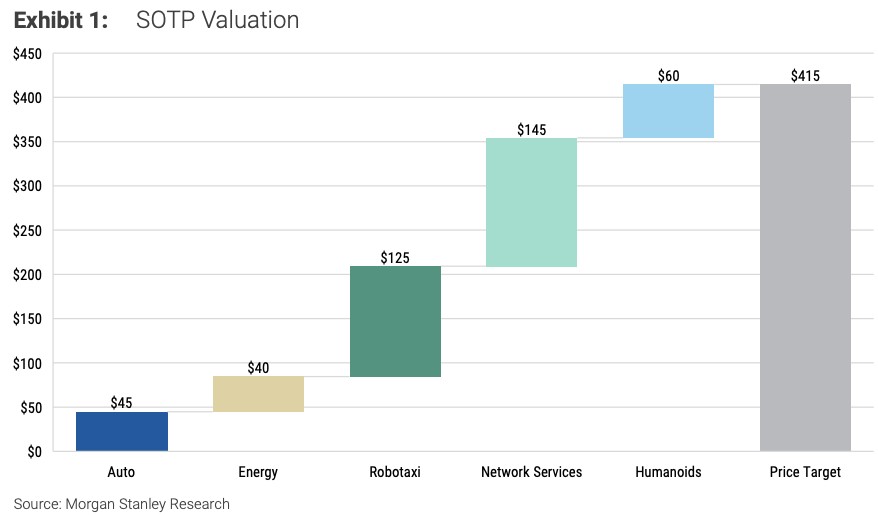
The target price downgrade reflects a 5% and 10% decrease in adjusted EBITDA expectations for 2026 and 2027, respectively, as well as increased cash consumption due to accelerated capital expenditures. Although the growth in capital expenditures supports Tesla's leadership in the physical AI field, the high level of cash consumption in the short term may limit the expansion of valuation multiples Morgan Stanley's base case target price of $415 implies a 50x valuation on 2030 EBITDA, consistent with previous models. The bull case target price has been lowered from $860 to $845, while the bear case scenario has been reduced from $145 to $135
