


Metal market "the darkest hour": LME delayed opening due to malfunction, copper prices fell sharply by 4% after hitting a historic high

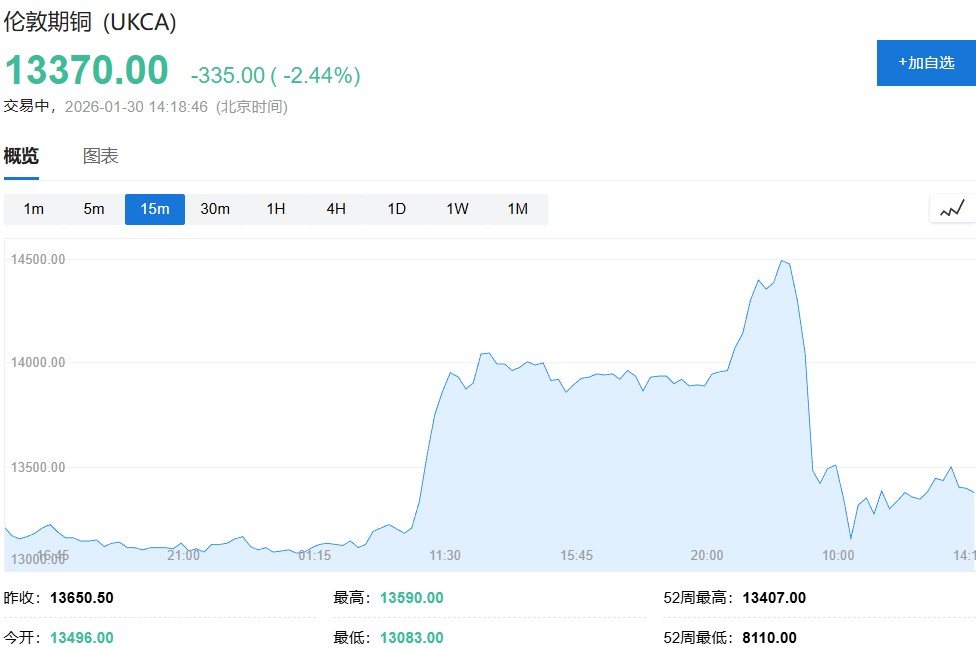
The technical failure of the LME coincided with a rare speculative frenzy in the metal market, with LME copper prices soaring 11% in a single day the previous day. On Friday, the London Metal Exchange delayed its opening by about an hour due to technical issues. After trading resumed, metal prices quickly fell back, with copper prices dropping by as much as 3.9%. This marks the second significant exchange failure incident in two months
On Friday, the London Metal Exchange delayed its opening by about an hour due to a technical failure, exacerbating the already volatile global metal market. The electronic trading system of the world's largest metal exchange did not start until 10 a.m., a full hour later than scheduled.
The timing of this failure is particularly sensitive. Just the day before, LME copper prices surged 11% in a single day, marking the largest increase since 2008, and reached a historic high of $14,500 per ton. Several traders indicated that before receiving the exchange's delay notice, the market was already speculating on who might face significant losses.
After trading resumed, metal prices quickly fell back. Copper prices dropped by as much as 3.9%, and other metals also declined across the board. By the afternoon, the LME benchmark copper contract was down 1.4%, aluminum fell 0.6%, and nickel dropped 2.0%. Earlier, the Shanghai Futures Exchange had already seen declines during that period.
This is the second major exchange failure in two months. Last November, the Chicago Mercantile Exchange experienced a trading interruption of over 10 hours due to overheating at its data center. For the LME, system reliability has been a regulatory focus since the nickel market crisis in 2022, when large-scale short squeezes led to some trades being declared invalid and triggered comprehensive regulatory reforms.
Technical Challenges Amid Extreme Volatility
The LME's technical failure coincided with a rare speculative frenzy in the metal market. Since the beginning of 2026, the global metal market has been unusually active. According to the Wall Street Journal, the trading volume of six base metals on the Shanghai Futures Exchange in January reached a historic high, and this fervor has transmitted to LME prices.
Several traders pointed out that during such a tense market moment, a system failure could trap traders hoping to close positions. If downtime extends, it would further exacerbate market chaos.
The LME's London office was unreachable during non-working hours, and a spokesperson for its parent company, Hong Kong Exchanges and Clearing Limited, did not immediately comment on the incident.
Multiple Factors Triggering Market Frenzy
The extreme volatility in the metal market this week has been triggered by multiple overlapping factors, including U.S. military action threats against Iran, the White House's renewed tariff threats against allies like South Korea and Canada, and the demand for physical assets driven by a weakening dollar, all of which ignited this buying frenzy.
The historic rise in copper prices on Thursday was particularly noteworthy. The LME three-month copper contract surged by 10% at one point during the session, ultimately closing up 11%, breaking through the $14,500 per ton mark, marking the largest single-day increase since the 2008 financial crisis.
Reliability Issues Back in Focus
Although global exchanges occasionally experience trading pauses or delays, this incident has brought the LME's system reliability issues back into the spotlight. Following the nickel market crisis in 2022, the LME underwent comprehensive regulatory reforms, with system stability becoming a key area of focus.
According to the Wall Street Journal, last November, the Chicago Mercantile Exchange experienced a trading halt of over 10 hours due to a data center failure, marking another significant technical incident at an exchange in recent times For traders facing extreme market volatility, the technical stability of the exchange is particularly important. An hour's delay, while not causing more severe consequences, is enough to trigger unease in a highly tense market environment
