


Microsoft's earnings report triggers a sell-off: intraday decline reaches 12%, market value evaporates by $430 billion at one point

After Microsoft disclosed a significant surge in spending on data centers and AI infrastructure, it triggered a sharp market sell-off. The stock fell more than 12% at one point during the trading session, marking the largest intraday drop since March 2020, with a market value evaporating by approximately $430 billion in a single day, becoming the second-largest single-day market value loss on record for U.S. stocks. This plunge reignited concerns in the market about the return prospects of Silicon Valley's massive AI investments and dragged down the overall technology stocks
Microsoft disclosed in its latest financial report that the company's data center spending has surged significantly, leading to a drop of over 12% in its stock price on the following trading day, resulting in a market value evaporation of $430 billion, marking the second-largest single-day market value loss on record. This news has reignited market concerns about Silicon Valley's massive investments in AI infrastructure, dragging down Wall Street overall.
Microsoft's stock price fell over 12% during intraday trading on Wednesday, marking the largest intraday drop since March 2020, and dragging the broader market lower. Ultimately, Microsoft closed down 9.99% on Wednesday, at $433.50. Moreover, before the market closed on Wednesday, it had barely moved since the beginning of 2026.
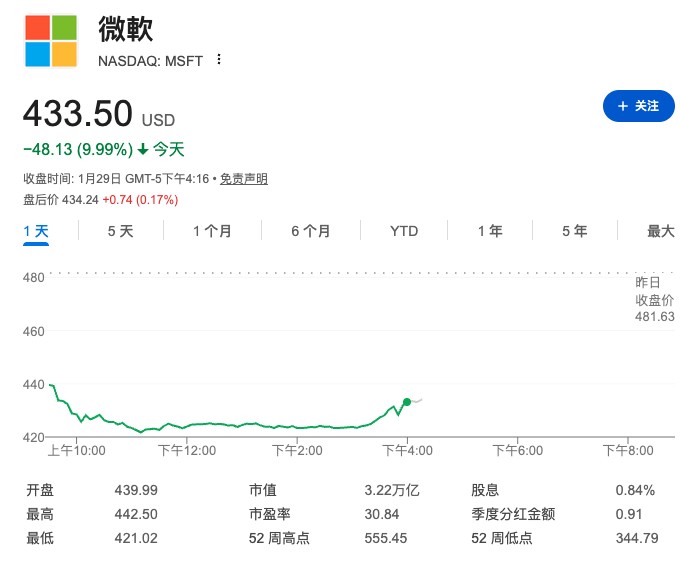
Previously, the company revealed that data center spending increased by 66% year-over-year, bringing its capital expenditures for the three months ending in December to $37.5 billion. Microsoft also reported that cloud business growth fell short of market expectations; however, adjusted net profit and revenue both exceeded analyst predictions.
In the history of U.S. stocks, the only instance of a single-day market value loss exceeding Microsoft's was last year when NVIDIA experienced a market value drop of $593 billion following the launch of its low-cost AI model, DeepSeek. According to data compiled by the media, the scale of Microsoft's market value shrinkage exceeds that of approximately 96% of the components in the S&P 500 index and is greater than the total market value of entire stock markets in countries like Finland, Vietnam, and Poland.
The approximately 12% drop in Microsoft's stock price ranks among the most severe declines in its history. Since its IPO in 1986, Microsoft's stock price has only seen larger declines on a few trading days, including "Black Monday" in 1987, during the dot-com bubble, and during the peak of market panic triggered by the COVID-19 pandemic in 2020.
The chill has also spread to other tech companies. Peers, including Alphabet and NVIDIA, also saw their market values evaporate by over $100 billion at one point on Thursday.
Excessive Spending
This sell-off occurred amid growing investor skepticism about whether the thousands of billions of dollars invested by large tech companies in artificial intelligence will ultimately yield returns. Microsoft's financial report showed that its capital expenditures in the most recent quarter increased by 66% year-over-year, reaching a record $37.5 billion; meanwhile, the growth rate of its highly watched Azure cloud computing business slowed compared to the previous quarter.
Venu Krishna, Barclays' head of U.S. equity strategy, stated:
"With spending at such a scale, the market will naturally focus on how these investments will be monetized."
Matthew Maley, chief market strategist at Miller Tabak + Co., remarked:
"As it becomes increasingly clear that Microsoft is unlikely to achieve strong returns on its massive AI investments, its stock price needs to be repriced down to a level that aligns more closely with its historical reasonable valuation." Morgan Stanley's Keith Weiss stated during the earnings call:
"One of the core issues weighing on investors' minds is that the growth rate of capital expenditures is faster than we expected, while Azure's growth may be slightly slower than we originally anticipated."
Chief Financial Officer Amy Hood responded by saying that a significant portion of the new cloud computing capacity is being used to support internal teams, which is driving the development of products like Copilot. She indicated that if all the new capacity were allocated to Azure, the corresponding growth rate would be significantly higher.
She told investors that the limited supply of artificial intelligence hardware is affecting the expansion speed of Microsoft's cloud business and constraining the growth potential of Azure's revenue. She noted that Azure's growth rate may further slow in the current quarter, but demand for cloud computing remains higher than supply.
Overreliance on OpenAI
Investors have also expressed concerns about Microsoft's overreliance on OpenAI. The earnings report released on Wednesday showed that 45% of Microsoft's $625 billion future cloud service contracts come from OpenAI, the developer of ChatGPT.
Manish Kabria, head of U.S. equity strategy at Societe Generale, stated:
"The market is closely watching Microsoft's exposure risk to OpenAI."
Media reports previously indicated that OpenAI is negotiating a new round of financing, planning to raise nearly $40 billion, with potential investors including NVIDIA, Microsoft, and Amazon—three companies that are also among its largest infrastructure providers. This news has reignited market concerns about the "circular financing" in the AI industry.
Still Seeking Optimal Pricing Strategy
Some analysts have pointed out that the relationship between Microsoft and OpenAI has gradually cooled. Microsoft has now invested in Anthropic and is trying to integrate its capabilities into its own products. Meanwhile, OpenAI, which is in desperate need of computing power, has turned to Oracle, Google, and Amazon for support. Analysts suggest that this "AI polyamory" allows Microsoft not to put all its eggs in one basket, but it also highlights that Microsoft's first-mover advantage is gradually diminishing.
Microsoft is pushing for broader applications of its Copilot AI chatbot, but the product currently lags behind leading competitors like Google and OpenAI. Microsoft had primarily relied on OpenAI models to support several Copilot tools, but has recently begun diversifying its approach by introducing Anthropic's models into programming tools and Microsoft 365 office products.
Last November, Microsoft announced it would invest up to $5 billion in Anthropic, while the startup promised to purchase $30 billion worth of cloud computing services from Microsoft Azure.
Stifel's Ribak stated:
"It's not just Microsoft; all companies are trying to find the optimal pricing strategy for new AI features."
In contrast, Meta's stock rose 9.5% after reporting better-than-expected earnings, highlighting the increasing divergence among Silicon Valley tech giants Krishna pointed out that the correlation among large tech stocks "has fallen to historic lows." He added:
"We have entered a new phase of the AI narrative, where the market is shifting from the logic of 'a rising tide lifts all boats' to a phase of 'winners and losers,' trying to determine which business model is more advantageous."
