


Memory prices surge by 400%, raising gross profit alarms; Apple's Q1 financial report faces a cost challenge

Memory chip prices have surged dramatically under the demand driven by AI, creating unprecedented cost pressures on Apple. DRAM spot prices have skyrocketed since the end of last year, eroding profit margins and raising market concerns. Meanwhile, Apple's supplier Qorvo warned in its latest financial report that limited memory pricing and supply have affected customer production plans, posing a more severe cost challenge for Apple's financial report set to be released after the U.S. stock market closes on Thursday
Apple Inc.'s stock price is facing its most severe test since 2024, as soaring memory chip prices are eroding its profit margins. The iPhone manufacturer will announce its earnings report after the U.S. stock market closes on Thursday, and investors will look for the real impact of cost pressures.
Since peaking on December 2, Apple's stock price has fallen more than 10%, making it the worst-performing company among the "Mag7" tech stocks and the biggest drag on the S&P 500 index during the same period. The stock has declined for eight consecutive weeks, marking its longest losing streak since 1993.
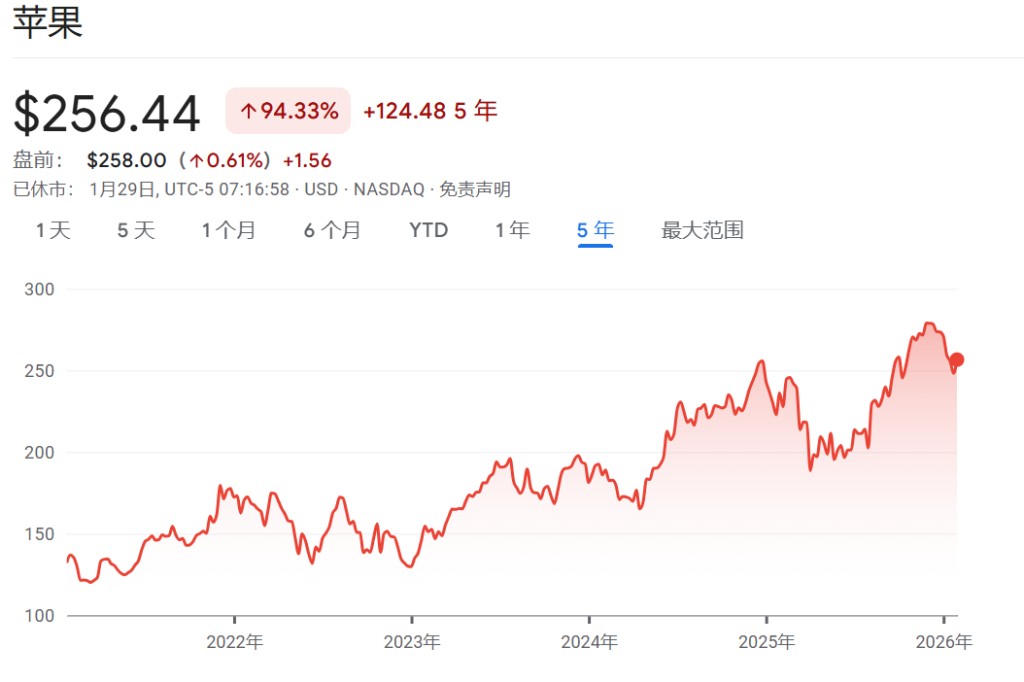
This round of selling is at least partially driven by market concerns over the skyrocketing costs of memory chips. As a key component in smartphones and tablets, the surge in memory prices is expected to suppress Apple's profit margins and profitability. This issue has overshadowed positive news regarding its artificial intelligence plans and is expected to become more pronounced after supply contracts expire in the second half of 2026.
Since the end of September, the spot price index for dynamic random-access memory (DRAM) chips has surged nearly 400%, reflecting a spike in demand driven by AI data center construction. On Tuesday, Apple's supplier Qorvo Inc. provided a performance outlook that fell far short of expectations and mentioned in a conference call that "memory pricing and supply constraints are affecting customers' production plans."
Cost Pressures Exceed Historical Levels
"We have seen Apple face memory price pressures before, but never at such an unprecedented pace," said Shaon Baqui, a senior technology research analyst at Janus Henderson, which holds a significant stake in Apple. "The market is clearly uncertain and worried that we will see more bad news regarding memory."
According to data from technology research firm IDC, memory accounts for 10% to 20% of smartphone manufacturing costs. IDC has referred to the rise in memory prices as a "crisis" for hardware companies. Memory prices are expected to remain high for the foreseeable future.
Apple's scale means it has significant leverage over suppliers and some ability to pass higher costs onto consumers, especially given the continued strong demand for high-end models. However, the steep rise in memory prices leaves it with limited options. "Apple can alleviate some pressure, but the leverage it can pull is limited," Baqui said. "Pulling pricing levers could lead to demand destruction. Clearly defining the impact on margins will be crucial."
Wall Street Takes a Wait-and-See Approach
Currently, Wall Street is taking a wait-and-see stance. According to data compiled by Bloomberg, consensus expectations for Apple's net profit in 2026 have changed little over the past month, and revenue and gross margin expectations are similarly stable. If these assumptions decline due to memory costs, it means that despite the stock being at a premium relative to major indices and its own history, the actual valuation is becoming more expensive.
As memory issues arise, investor sentiment towards this tech giant is mixed. The company's last earnings report provided an optimistic forecast, but sales in the Chinese market unexpectedly declined. However, after reaching a multi-year agreement with Alphabet Inc.'s Google, which will support Apple's AI technologies (including Siri), Wall Street has turned positive on its AI position This news is seen as a validation of Apple's strategy of not investing aggressively in AI like other giants.
"I like Apple's approach to spending," said David Wagner, portfolio manager at Aptus Capital Advisors, which holds Apple stock. "Everyone is focused on its positioning in AI, but this shows it is not falling behind."
Valuation Premium Coexists with Slowing Growth
Apple's stock price is currently about 30 times expected earnings, higher than its 10-year average of 22 times, and also higher than the multiples of the Nasdaq 100 index and the "Mag7."
Revenue for Apple in fiscal year 2026 (ending September) is expected to grow by 8.7%, which will be the fastest growth rate since 2021, but is expected to slow year by year over the next three fiscal years. According to Bloomberg Industry Research, the overall tech industry is expected to see revenue growth of about 19% in 2026, while the tech hardware and equipment sub-industry is expected to grow by 11%.
Nevertheless, even with the company's stock valuation being high and growth relatively moderate, many investors still view the stock as a relative safe haven among tech stocks. Its healthy balance sheet, enduring profitability, and strong cash flow make it a stable holding in portfolios.
"Clearly, the valuation multiples are high, but relative to the other 'Mag7', Apple looks like a very resilient company," said Baqui from Janus Henderson. "It has a large user base and recurring revenue from services, all of which supports free cash flow. I don't know if we will see a growth inflection point soon, but during volatile times, it still feels like a warm blanket."
