


Why has NVIDIA recently underperformed the market, and what are investors worried about?

NVIDIA's recent stock price has underperformed the market, not due to a weakening of its fundamentals, but because the market is shifting from high performance expectations to concerns about the financing capabilities of AI customers, the sustainability of capital expenditures, and intensified competition. Morgan Stanley believes these concerns are exaggerated, maintaining an "Overweight" rating with a target price of $250. The key increment lies in the next-generation chip Vera Rubin, which achieves a qualitative leap in manufacturing efficiency, significantly shortens system assembly time, and greatly enhances the certainty of mass production and delivery in 2026, likely solidifying NVIDIA's dominant position in the next phase of AI computing architecture
NVIDIA's recent stock price performance has shown a rare divergence from its fundamentals: on one hand, the market has extremely high expectations for its short-term performance, while on the other hand, the stock price continues to underperform the broader market. This weakness is not due to a performance disaster, but rather a "wall of worry" facing investors. The market is no longer simply buying the story of supply exceeding demand, but is instead becoming entangled in concerns about customers' financing capabilities, the rise of competitors, and the sustainability of AI investment returns.
According to the Wind Trading Desk, Morgan Stanley analyst Joseph Moore pointed out in a recent research report that while these concerns have put pressure on the stock price, they are actually exaggerated. The firm believes that NVIDIA's upcoming next-generation chip "Vera Rubin" will be a key catalyst to break the deadlock, alleviating market anxiety about market share loss and establishing the company's dominance in the next phase of computing architecture. Morgan Stanley maintains an "overweight" rating on NVIDIA, setting a target price of $250.
The current market sentiment is starkly different from the pullbacks seen during the AI boom over the past three years. Previous sell-offs (such as at the end of 2024 or 2025) were typically accompanied by specific negative news, such as the technical route disputes triggered by DeepSeek or rumors of supply chain inventory backlogs. Now, despite extremely strong demand feedback from the supply chain—investors are even discussing the possibility of this year's earnings per share exceeding $9, far surpassing the market consensus of $7.75—the stock price has reacted tepidly.
The core of this disconnect lies in the shift of investor focus from "who can produce chips" to "who can afford to pay for these expensive chips." As the list of AI beneficiaries expands, other segments of the semiconductor ecosystem (such as storage and equipment) are diverting funds, while the market has deep doubts about the sustainability of capital expenditures for cutting-edge model developers.
Concerns About Customers' "Wallets" and NVIDIA's Role
The market's concerns about the financing capabilities of NVIDIA's major customers are becoming more tangible. Recently, stocks closely tied to OpenAI (such as Microsoft and Oracle) have significantly underperformed, with the core logic being the market's skepticism about whether OpenAI's cash burn rate can match its infrastructure development.
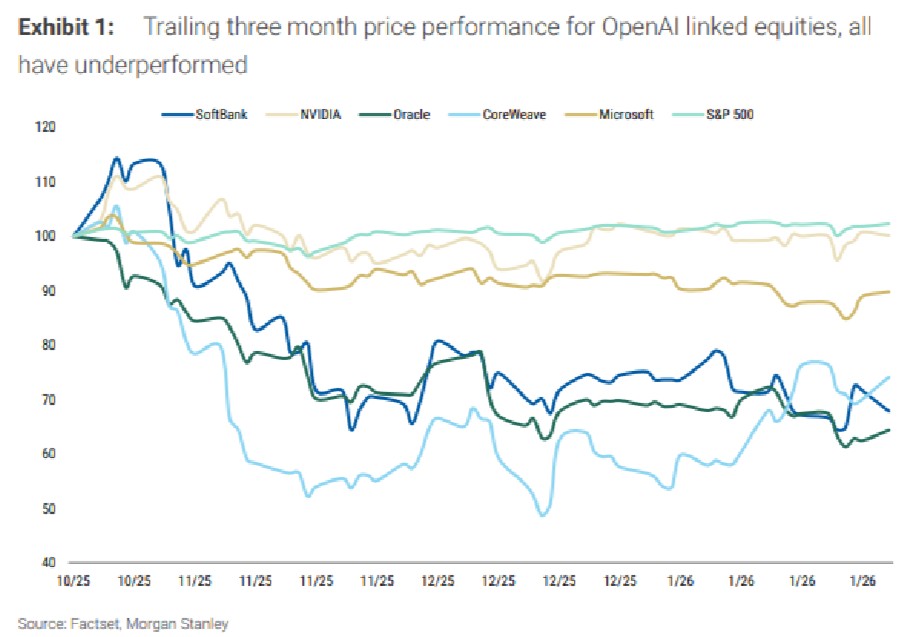
Taking Oracle as an example, the need to support massive IT capital expenditures (most of which are related to OpenAI) requires bearing incremental interest expenses and lease liabilities, leading analysts to significantly lower their future earnings per share expectations. If investors doubt that Oracle can fulfill backlogged orders or question whether OpenAI can afford to pay, this sentiment will inevitably translate into NVIDIA's valuation.
Even more sensitive is the role NVIDIA plays in this scenario. NVIDIA is "reinvesting" in its customers and partners, including OpenAI, CoreWeave, and even Intel, through equity investments. This practice has raised market questions about "circular financing."
In this regard, Jensen Huang's remarks at CES were quite candid, as he admitted that if he could turn back time, he would make different investment choices regarding Anthropic—missing the opportunity at that time due to insufficient funds, which led Anthropic to lean more towards Amazon and Google's ASIC solutions in its early stages
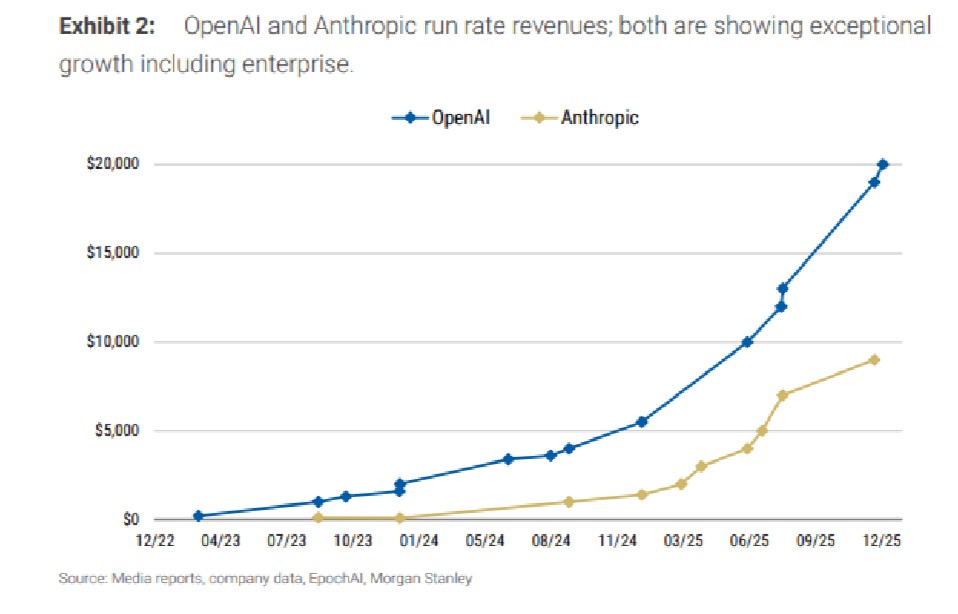
NVIDIA clearly does not want to repeat past mistakes. Morgan Stanley has pointed out after verification that NVIDIA's current investments are mostly equity-based rather than debt-based.
Taking this week's investment in CoreWeave as an example, it is purely an equity injection, without any credit arrangements involved. Although the company may retain some credit risk exposure in the future through leasing and other forms, this is more about maintaining dominance in the ecosystem rather than forcing a "financial game" to inflate revenue figures.
Not just computing power, but a dimensional reduction in manufacturing efficiency
Regarding competition, the market is generally concerned that ASICs (Application-Specific Integrated Circuits) and AMD will erode NVIDIA's market share. Indeed, when the entire industry is growing at over 75%, every competitor feels they have "won." Total Cost of Ownership (TCO) studies often show that alternatives are cheaper, but such calculations based on paper parameters often distort in actual large-scale deployments.
Morgan Stanley expects NVIDIA to maintain about 85% of revenue share this year, with its quarterly revenue increment even exceeding the total revenue of the second competitor. The real trump card lies in the next-generation architecture "Vera Rubin." Supply chain checks indicate that the transition from Blackwell to Rubin may happen faster than expected.
One overlooked key detail is the leap in manufacturing efficiency: information from CES shows that the board-level assembly time for the Vera Rubin system is only about 5 minutes, while Blackwell takes about 2 hours.
This significant advantage in manufacturing processes, combined with full-rack-level connectivity speeds and optimizations at the silicon level, will make Rubin's mass production ramp-up in 2026 much smoother than its competitors. For developers urgently needing large-scale clusters, this is not just a performance issue, but also a matter of delivery certainty.
A more crowded track and valuation regression
By 2026, the AI semiconductor ecosystem will indeed have changed. As capacity bottlenecks are resolved, the AI dividend begins to spill over, with segments like storage and wafer foundry attracting some funds seeking higher elasticity due to their higher operational leverage. Morgan Stanley has previously adjusted its preferred stocks from NVIDIA to companies like Micron based on this logic.
However, this does not mean NVIDIA has lost its appeal. Currently, NVIDIA's price-to-earnings ratio is lower than that of most growth or cyclical stocks within its coverage.
The market has become desensitized to the recent strong earnings expectations, and only when the GTC conference in mid-March occurs, when more details about Vera Rubin and the product pipeline become transparent, especially as the capital market mechanisms surrounding AI spending become more robust, will the valuation shackles suppressing the stock price be broken. Until then, those seemingly aggressive customer spending plans actually form the cornerstone of NVIDIA's bull market
