


Where is the focus of the Federal Reserve's interest rate cuts this year?

The January FOMC meeting decided to pause interest rate cuts, maintaining the rate at 3.5%-3.75%. The statement shifted to an optimistic tone regarding the economy and employment, with signs of stabilization in the unemployment rate. Powell pointed out that inflation and employment risks have weakened, and future decisions are not predetermined. The focus on interest rate cuts is on the trend of employment recovery; if new job additions stabilize above 100,000 per month, the Federal Reserve may no longer cut rates. Inflation should not restrict rate cuts, but rather be a response to the economy
January FOMC Meeting: Pause on Rate Cuts, In Line with Expectations
-
The pause on rate cuts keeps the interest rate at 3.5%-3.75%, which aligns with market expectations. Among the 12 FOMC voting members, 2 voted against, with governors Milan and Waller advocating for a 25 basis point cut.
-
Consistent with the pause on rate cuts, the statement from this meeting shows a marginally more optimistic tone regarding the economy and employment. The description of economic growth changed from "moderate expansion" to "robust expansion." Although "employment growth remains low," the unemployment rate shifted from "rising" to "showing signs of stabilization." The statement on inflation removed the phrase "has risen since 2025," but noted that it "remains high."
-
At the press conference, Powell stated that the risks of rising inflation and declining employment have somewhat diminished, and future decisions are not predetermined, with rate hikes not being the baseline assumption. Media focus was on "Federal Reserve personnel" and "financial market volatility" (fluctuations in the dollar exchange rate and rising precious metal prices), which Powell directly avoided commenting on.
What is the focus of the Fed's rate cuts this year?
Regarding the pace and magnitude of rate cuts this year, from an economic perspective, the focus is on the trend of employment recovery rather than inflation constraints. From a non-economic perspective, the emphasis is on potential fiscal stimulus under electoral pressure rather than changes in Federal Reserve personnel.
From an economic standpoint, the focus is on the trend of employment recovery rather than inflation constraints.
Regarding employment, 100,000 may be a watershed. Since 2025, the job market has weakened due to tightening immigration, government layoffs, and structural impacts of AI, as well as restrictive monetary policy and marginal fiscal contraction, along with the general decline in employment demand caused by trade policy "uncertainty." This year, the central tendency of new non-farm employment is 100,000/month (which means that, disregarding structural factors, employment growth will be flat with 2024), which may be a watershed for the Fed's rate cuts. If new employment steadily approaches 100,000/month in the coming months, the Fed can pause rate cuts and maintain observation; if new employment rapidly recovers and stabilizes at 100,000/month or above, the Fed may find no further need for rate cuts (refer to "100K! Or the Employment Watershed for U.S. Rate Cuts").
Regarding inflation: it should not be a precondition for the Fed's rate cuts, but rather a retrospective feedback from the economy. Tariff shocks may have peaked, and without additional trade policy disturbances, core goods inflation is unlikely to rise significantly. The probability of a rebound in food and energy inflation is low. Currently, the job market has not shown a clear trend of recovery, and super core services and housing inflation are still gradually declining. Under baseline conditions, the risks of rising inflation are relatively weak (refer to "Fiscal May Be More Important Than Tariffs - Analysis of U.S. Inflation Risks in 2026").
From a non-economic perspective, the focus is on potential fiscal stimulus under electoral pressure (which may lead to a failure of rate cut expectations in the second half of the year), rather than changes in Federal Reserve personnel.
Changes in Federal Reserve personnel, under baseline conditions, may not lead to a significant shift from the current wait-and-see stance to an unexpectedly dovish rate cut. Firstly, based on Powell's neutral stance and firm commitment to maintaining Fed independence, the so-called "shadow Fed chair" after the announcement of the new chair nomination may find it difficult to exert pressure before Waller's departure. Secondly, the currently popular candidates for chair, whether it be BlackRock's Riedel, former governor Warsh, or current governor Waller, all have dovish stances supporting rate cuts, but have expressed support for Fed independence, showing no inclination for unexpected rate cuts (the candidate with the highest probability, Riedel, supports two rate cuts this year, consistent with market expectations), but it cannot be ruled out that the views of these three candidates may change in the future Thirdly, the rotation of regional Federal Reserve Bank presidents among this year's FOMC voting members will not bring additional dovish influence (see "What is the Policy Orientation of Next Year's FOMC Voting Members?").
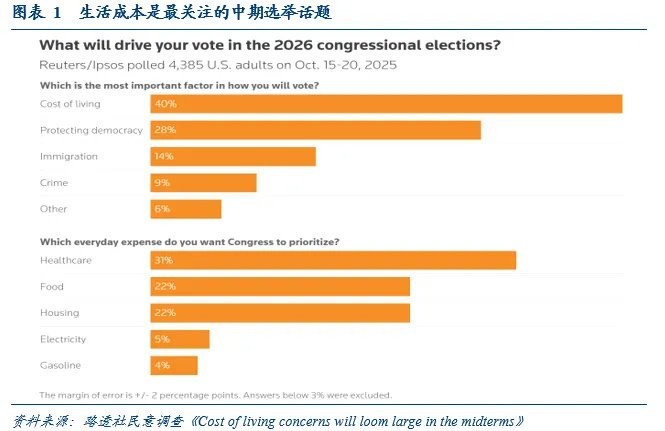
The focus is on potential fiscal stimulus under pressure from the midterm elections. K-shaped divergence and the "cost of living crisis" are the most concerning issues for voters driving midterm election turnout. Recently, Trump has been very assertive in various occasions about "winning the midterm elections." If the current non-spending measures (see "Can the American Public 'Lighten the Burden'? - Analysis of Trump's Seven Policy Proposals") do not yield satisfactory results, Trump may introduce additional fiscal stimulus to gain voter support, which would bring significant economic and inflationary upward risks. The primary elections for the midterm elections will take place from March to September, and as the election situation becomes clearer, if there is indeed additional fiscal stimulus, it is likely to occur around mid-year.
Report Body
What are the Focus Areas for Interest Rate Cuts This Year?
Regarding the pace and magnitude of the Federal Reserve's interest rate cuts this year, from an economic perspective, the focus is on the trend of employment recovery rather than the constraints of inflation. From a non-economic perspective, the focus is on potential fiscal stimulus under election pressure rather than personnel changes at the Federal Reserve.
From an economic perspective, the focus is on the trend of employment recovery rather than the constraints of inflation.
Regarding Employment: The weakening labor market since 2025 has been influenced by tightened immigration, government layoffs, and structural impacts of AI, as well as restrictive monetary policy, marginal fiscal contraction, and the general decline in employment demand due to trade policy "uncertainty." This year, the central tendency of new non-farm employment is 100,000 per month (which means that, disregarding structural factors, employment growth will be flat compared to 2024), or it may serve as the employment watershed for the Federal Reserve's interest rate cuts. If new employment steadily approaches 100,000 per month in the coming months, the Federal Reserve can pause rate cuts and maintain observation; if new employment rapidly recovers and stabilizes at 100,000 per month or more, the Federal Reserve may not find it necessary to cut rates further (see "100K! Or the Employment Watershed for U.S. Rate Cuts").
Regarding Inflation: This year's inflation in the U.S. should not be a preemptive constraint on the Federal Reserve's interest rate cuts, but rather a retrospective feedback from the economy. Tariff shocks may have peaked, and without additional trade policy disturbances, core goods inflation is unlikely to rise significantly. The probability of a rebound in food and energy inflation is low. Currently, the labor market has not shown a clear trend of recovery, and super-core services and housing inflation are still gradually declining. Under baseline conditions, the upward risk of inflation is weak (see "Fiscal Policy May Be More Important Than Tariffs - Analysis of U.S. Inflation Upward Risks in 2026").
From a non-economic perspective, the focus is on potential fiscal stimulus under election pressure (which may lead to the failure of rate cut expectations in the second half of the year), rather than personnel changes at the Federal Reserve.
Personnel changes at the Federal Reserve, under baseline conditions, are unlikely to lead to a significant shift from the current wait-and-see stance to an unexpectedly dovish rate cut. Firstly, based on Powell's neutral stance and firm commitment to maintaining the independence of the Federal Reserve, the so-called "shadow Fed chair" after the announcement of the new chair nomination is unlikely to exert pressure on him before he steps down. Secondly, the currently popular candidates for chair, whether it be BlackRock's Riedel, former governor Warsh, or current governor Waller, all have dovish stances supporting rate cuts, but they have expressed support for the independence of the Federal Reserve and do not lean towards unexpected rate cuts (the candidate with the highest probability, Riedel, supports two rate cuts this year) In line with market expectations), but does not rule out the possibility of changes in the views of these three candidates. Thirdly, the rotation of regional Federal Reserve presidents among this year's FOMC voting members will not bring additional dovish influence (see "What is the Policy Orientation of Next Year's FOMC Voting Members?").
The focus is on potential fiscal stimulus under pressure from the midterm elections. K-shaped divergence and the "cost of living crisis" are the most concerning issues for voters driving midterm election voting. Recently, Trump has been very firm in his statements about "winning the midterm elections" in various occasions. If the current non-spending measures (see "Can the American Public 'Lighten the Burden'? - Analysis of Trump's Seven Policy Ideas") are ineffective, Trump may introduce additional fiscal stimulus to gain voter support, which would bring significant economic and inflationary upward risks. The primary elections for the midterm elections will take place from March to September, and as the election situation becomes clearer, if there is indeed additional fiscal stimulus, it is likely to occur around mid-year.
January FOMC Review
(1) Pause in rate cuts, in line with expectations
The FOMC has paused rate cuts, maintaining the federal funds target rate range at 3.5%-3.75%, in line with market expectations. Among the 12 FOMC voting members, 2 voted against, with governors Milan and Waller advocating for a 25 basis point cut.
In line with the pause in rate cuts, the statement from this meeting has marginally shifted to a more optimistic tone regarding the economy and employment. The description of economic growth changed from "moderate pace" to "solid pace." Regarding employment, although "job gains have remained low," the unemployment rate shifted from "edged up" to "shown some signs of stabilization." The description of inflation removed "moved up since earlier in the year," but "remains somewhat elevated."
(2) Key points from the press conference: Neutral economic and policy statements
Powell's statements regarding the economy and monetary policy were relatively neutral, showing no significant changes compared to December of last year. The media focus during this month's press conference was on "Federal Reserve personnel" and "financial market volatility," which Powell did not address, instead emphasizing the importance of "Federal Reserve independence."
Regarding personnel and political issues at the Federal Reserve, Powell directly avoided (have nothing for you on that). Topics raised by reporters included: the reason for attending the Supreme Court Cook case, Powell's own criminal investigation and subpoena, whether he would continue as a governor after stepping down as chairman, and the nomination of the next Federal Reserve chairman, all of which Powell avoided, but emphasized that "central bank independence is the cornerstone of modern democratic systems... once lost, it is difficult to restore... I still have confidence in maintaining independence," hoping that his successor "stays away from electoral politics." "Emphasizing communication with Congress."
Regarding financial market volatility, Powell continues to evade. He avoided questions about the fluctuations in the dollar exchange rate and the driving factors, as well as the historic rise in precious metal prices, believing that long-term interest rate changes are influenced by multiple factors such as fiscal paths and policy risks, and are not closely related to short-term policy interest rates. He does not believe that the unchanged long-term interest rates weaken the effect of interest rate cuts.
On the economy: Thanks to consumer spending (though performance varies across income groups), the construction of AI-related data centers, and support from fiscal policy and the financial environment, the foundation for economic growth is solid. There is a disconnect between the pessimism in consumer confidence surveys and the positive spending data.
On employment: Signs of stabilization in the unemployment rate. 1) Employment is more reliable than GDP. The divergence between robust economic growth and a weak labor market can be partially explained by rising productivity; however, the current stabilization of the unemployment rate may indicate that this contradiction is gradually easing. Additionally, labor market data is generally more reliable than GDP data. 2) It is difficult to assess whether full employment has been reached. 3) The short-term impact of AI on employment is negative. AI has a positive effect on economic growth, but in the short term, it may lead to some job losses. In the long term, technological innovation typically creates new job opportunities and raises wage levels, but it is currently difficult to accurately judge the overall impact of AI.
On inflation: Upside risks are diminishing. Tariffs are considered a one-time price shock, and it is expected that the impact of tariffs on inflation will peak and then decline by mid-2026.
On monetary policy: 1) From the current perspective, the current interest rates are at the high end of the reasonable estimate range for neutral interest rates, in a favorable wait-and-see state. 2) Looking ahead, currently, no committee members have made interest rate hikes a basic assumption. Future policies will not have a preset path and will be adjusted based on data at each subsequent meeting. The data distortions caused by the government shutdown are gradually diminishing and no longer have a substantial impact.
(3) Market response: Asset performance is mild and flat, waiting for guidance from the earnings reports of major companies.
The market still expects two interest rate cuts, with little change, but the expectation for a June cut has slightly decreased. The futures market pricing for the number of interest rate cuts this year has slightly increased from 1.877 to 1.897, with the market pricing for the first rate cut still in June (probability decreased from 82.7% to 75.1%).
Asset performance is mild, with the market waiting for guidance from the earnings reports of the seven giants (Microsoft, Meta, Tesla reports on the evening of the 29th, Apple, Amazon on the evening of the 30th). The Dow Jones Industrial Average rose 0.02%, the S&P 500 index fell 0.01%, and the NASDAQ index rose 0.17%. The yield on the 10-year U.S. Treasury bond remained flat at 4.263%, the dollar index rose 0.61% to 96.35, and COMEX gold rose 4.47%.
Risk warning and disclaimer
The market has risks, and investment requires caution. This article does not constitute personal investment advice and does not take into account the specific investment goals, financial situation, or needs of individual users. Users should consider whether any opinions, views, or conclusions in this article are suitable for their specific circumstances. Investment based on this is at their own risk
