


"American version of ASML" performance skyrockets! Lam Research conference call: expects the global wafer fab equipment market to surge to $135 billion by 2026

The financial report shows that in 2025, Lam Research's revenue reached a record $20.6 billion, with earnings per share soaring by 49%, and the installation volume of the new product Aqara doubled. The CEO predicted during the conference call that the global semiconductor fab equipment market will surge to $135 billion in 2026. Although constrained by a shortage of clean rooms, strong growth is expected in the second half of the year. HBM and advanced packaging are the core engines, with the latter expected to grow by over 40%, and NAND upgrades are also accelerating
Driven by strong demand for AI, Lam Research, the "American version of ASML" and a global semiconductor equipment giant, has delivered an exceptionally impressive performance report. CEO Tim Archer stated that 2025 will be a "record-breaking year."
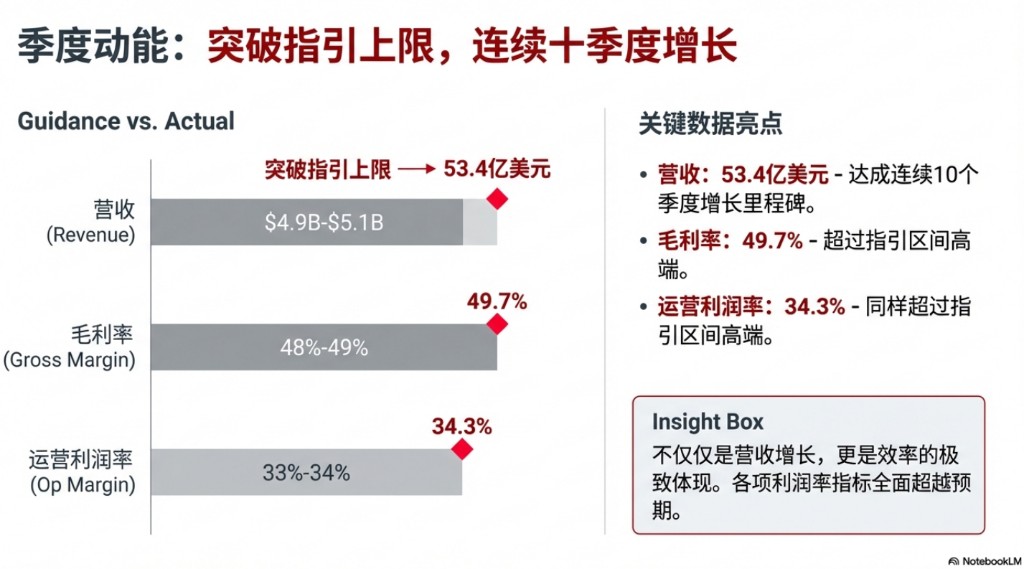
On January 28, Lam Research announced its fiscal year 2026 second quarter (ending December 28, 2025) earnings report, showing that revenue for the December quarter reached $5.34 billion, not only achieving growth for ten consecutive quarters, but also surpassing guidance limits for both gross margin and operating margin. The gross margin for the December quarter was 49.7%, exceeding the upper end of the guidance range, while the operating margin reached 34.3%, also surpassing the upper end of the guidance range.
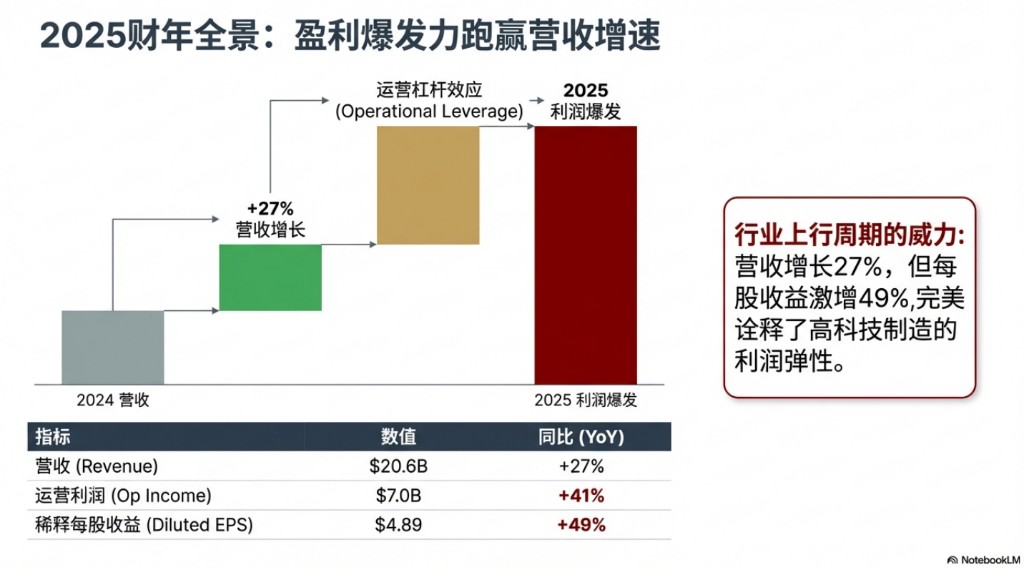
For the entire year of 2025, revenue soared to $20.6 billion, a year-on-year increase of 27%, with earnings per share (EPS) surging 49% year-on-year, demonstrating the company's strong profit explosion during the industry's upward cycle. The annual gross margin was 49.9%, the highest annual result for the merged company since the Novelis merger in 2012. The operating margin also set a record at 34.1%, with operating profit reaching $7 billion, a year-on-year increase of 41%.
The new product line continues to gain market recognition, with the Aqara conductor etching system doubling its installed capacity over the past year and achieving production tool records in advanced DRAM and EUV and high aspect ratio etching applications for foundry logic.
In terms of shareholder returns, Lam Research has maintained its consistent generous style. For the entire year of 2025, the company returned 85% of its free cash flow to shareholders, repurchasing $1.4 billion in stock in just the month of December.
Management's expectations for the future market have injected strong confidence into investors. CEO Tim Archer clearly pointed out during the earnings call that driven by the transformation of AI and high bandwidth memory (HBM) technology, the global wafer fabrication equipment (WFE) market is expected to leap from $110 billion in 2025 to $135 billion in 2026.
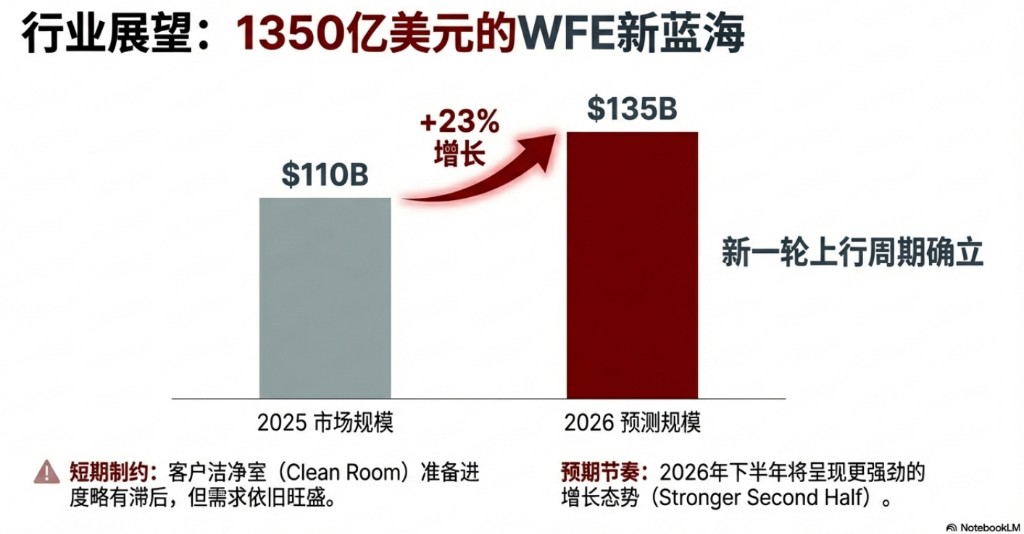
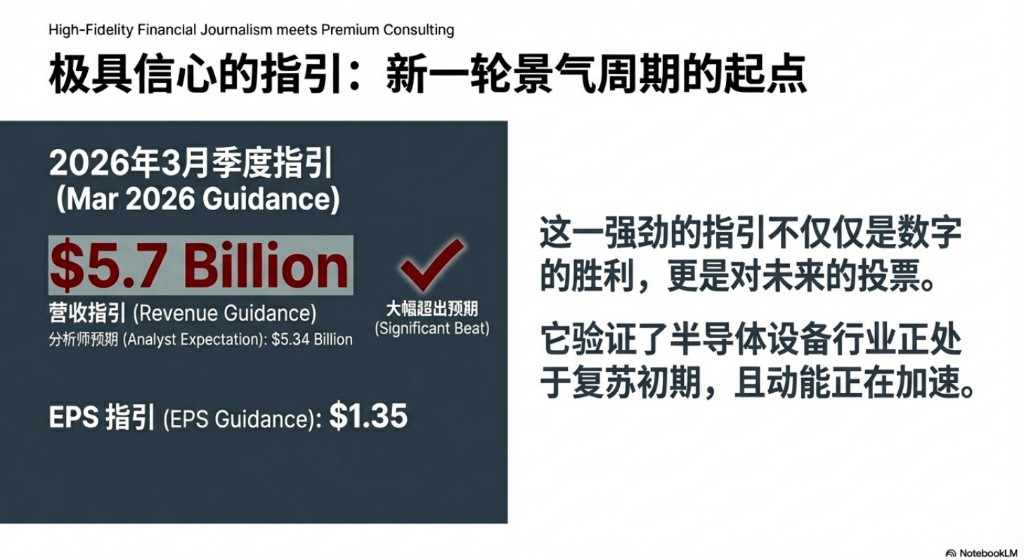
Although short-term growth is limited by the preparation progress of customers' clean rooms, the company expects to see "stronger growth in the second half" of 2026, with advanced packaging business growth expected to exceed 40% Looking ahead to the March 2026 quarter, the company provided strong guidance with revenue of $5.7 billion, significantly higher than analysts' expectations of $5.34 billion, and earnings per share of $1.35, further validating that the semiconductor equipment industry is at the starting point of a new boom cycle.
Clean Room Shortage Becomes the Biggest Bottleneck in the Industry
The semiconductor industry is facing physical limitations on capacity expansion. Chief Financial Officer Doug Bettinger stated:
"We agree with the general view that due to clean room space constraints, most markets will be undersupplied in 2026. Accordingly, we believe that the second half of 2026 will be a more significant year."
When asked about the specific impact of clean room limitations on the WFE market, Bettinger declined to provide exact numbers but acknowledged that the constraints are significant.
"It's hard for us to give a specific number; I have to refuse to do that while sitting here. The reason is, to be honest, the plans are somewhat fluid."
"People are working hard to find ways to obtain more clean room space and how to bring facilities online and slightly increase capacity."
Archer added, "There is a view that the constraints this year will continue until many new fabs come online." He noted that many fab announcements are aimed at capacity for 2027, 2028, and beyond. Bettinger believes this prepares for "2027 to also be quite a good year."
NAND Upgrade Path Accelerates
Management confirmed that the NAND business will see growth in 2026, with the upgrade pace faster than expected. Bettinger stated,
"When we look at 2026 now, it will be a growth year for NAND. There is no doubt about that." He observed that memory manufacturers "are prioritizing DRAM over NAND a bit because the profitability is slightly better there."
Regarding the previously mentioned $40 billion NAND upgrade opportunity, Archer stated, "We've said several times that the specific wording we used at the investor day was 'over the next few years, $40 billion.' Now it seems to be happening faster than expected in almost every earnings call."
He pointed out, "The progress on the NAND upgrade path is faster than we anticipated."
Management expects large-scale NAND greenfield capacity investments to materialize in 2027-2028, "when clean room space is sufficiently available, they can make large-scale investments in additional NAND capacity," Archer said.
Strong Growth in Advanced Packaging Business
The company expects its advanced packaging business to grow by over 40% in 2026, following good growth in 2025. Archer stated,
"HBM is indeed very strong. Clearly, there is strong demand there. However, I also talked about more complex packaging solutions across advanced foundry logic. This is also an important driver for us." He emphasized the company's technological advantages, "technologies like copper plating. Technologies like etching. Dielectric gap filling. These are the real foundational technologies for success." The management believes this is "a very important business" and will continue to invest in new technologies in this field.
Aqara Etching System Achieves Major Breakthrough
The new product line is driving the company's market position improvement. Tim Archer revealed that the Aqara conductor etching system "has doubled its installed base over the past year, winning production tool records in advanced DRAM and foundry logic EUV and high aspect ratio etching applications."
Multiple customers choose Aqara because "it has unparalleled capabilities in etching minimum dimensions and very high aspect ratios while maintaining profile control and reducing overall wafer variability," Archer said.
He stated that in next-generation gate-all-around devices, "we expect the number of applications using Aqara to grow by about two times, including key front-end silicon etching applications."
In terms of DRAM, "we have already won Aqara orders at the 1C node, which will begin mass production this year, and as applications using Aqara expand nearly three times at the subsequent 1D node, we expect momentum to continue to grow."
Breakthrough in Molybdenum Metallization Technology
Regarding the progress of ALD molybdenum (Moly) products, Archer confirmed, "Customers who have committed to producing with molybdenum in NAND have chosen Lam's equipment. We have a very strong position there."
He indicated that after NAND first adopts molybdenum, "the next will be foundry and logic chips, and finally DRAM."
Archer emphasized the company's single-wafer technology advantages, "It has multiple stations in one chamber to provide us with high productivity. That is the preferred production tool in today's industry. We intend to maintain this status."
Service Business Continues Transformation and Upgrade
The Customer Service Business Group (CSBG) achieved strong growth in December 2024.
Archer stated, "Much of the growth is actually due to our transformation of the service business to make it more focused on predictive maintenance using equipment intelligence as a way to get more output from the tools. We are also implementing Dextro collaborative robots for our automated maintenance."
He pointed out, "These two things will not only drive revenue growth but also improve profit margins, simply because of the efficiency with which we provide these services."
Bettinger added that the company still expects CSBG growth to be "high single digits, perhaps low double digits," in line with last year's investor day guidance.
Supply Chain Pressure Manageable but Requires Continued Investment
In the face of accelerating demand, Archer stated that the company's supply chain is well-prepared.
"Compared to when we encountered those shortages, today we have built a stronger, broader, and deeper supply chain," he said, "Today, I would say we are not the main constraint for any equipment. In contrast, cleanroom space is the industry's constraint." He emphasized, "We need to continue to work hard to further expand our capacity and make our operations faster." Over the past four to five years, the company's capital expenditures have doubled.
Bettinger stated, "We are enhancing capacity globally, with our Malaysia factory being our largest facility at the moment, and we are working to get more output from there as well as from all our other locations."
The full transcript of Lam's Q2 FY2026 earnings call is as follows:
Company Participants
Doug Bettinger, Executive Vice President and Chief Financial Officer
Ram Ganesh, Vice President, Investor Relations
Tim Archer, President and Chief Executive Officer
Other Participants
Atif Malik, Analyst, Citigroup
Blayne Curtis, Analyst, Jefferies LLC
Christopher Muse, Analyst, Cantor Fitzgerald
Harlan Sur, Analyst, JP Morgan
James Schneider, Analyst, Goldman Sachs
Joe Quatrochi, Analyst, Wells Fargo
Krish Sankar, Analyst, TD Cowen
Melissa Weathers, Analyst, Deutsche Bank
Srini Pajjuri, Analyst, Royal Bank of Canada Capital Markets
Stacy Rasgon, Analyst, Sanford C. Bernstein
Timothy Arcuri, Analyst, UBS Group
Vijay Rakesh, Analyst, Mizuho Securities USA LLC
Vivek Arya, Analyst, Bank of America Securities
Statement Section
Host
Hello everyone, welcome to the Lam Research Corporation Q4 FY2025 earnings call. All participants will be in listen-only mode. (Host note) There will be an opportunity for questions following today's presentation. (Host note) Please note that this event is being recorded.
Now I will turn the meeting over to Vice President of Investor Relations, Ram Ganesh. Please go ahead.
Ram Ganesh
Thank you, good afternoon everyone. Welcome to Lam Research Corporation's quarterly earnings call. Joining me today are President and CEO Tim Archer; and Executive Vice President and CFO Doug Bettinger. In today's call, we will share an overview of the business environment and review our financial performance for the quarter ending December 2025, as well as our outlook for the quarter ending March 2026
A detailed announcement regarding our financial performance will be released shortly after 1 PM Pacific Time. This press release can also be found in the investor relations section of the company's website, along with the presentation slides for today's conference call. Today's presentation and Q&A session will include forward-looking statements that are subject to the risk factors disclosed in our public filings with the U.S. Securities and Exchange Commission.
For more information, please refer to the accompanying slides in the presentation. Unless otherwise noted, today's discussion of our financial performance will be on a non-GAAP financial basis. A detailed reconciliation between GAAP and non-GAAP performance can be found in the accompanying slides of the presentation. This conference call is scheduled to last until 3 PM Pacific Time. Later this afternoon, a replay of this conference call will be available on our website.
Now, I will turn the call over to Tim.
Tim Archer
Thank you, Ram, and good afternoon, everyone. We ended the 2025 calendar year with strong performance, with December quarter revenues exceeding the midpoint of our guidance. Gross margin, operating margin, and earnings per share all exceeded the high end of the range. Our performance demonstrates sustained strong execution in an environment of accelerating semiconductor demand. At last year's Investor Day event, we outlined the significant opportunities to expand our market and gain share at each subsequent technology node. The vertical scaling of devices and packaging architectures is driving higher deposition and etch intensity, pushing the market into our areas of strength. Our vision shared is to more than double Lam's revenue and profits over the next five years.
Today, we are making steady progress toward that goal. As the industry ramps up capacity and adopts new technologies to meet the demands of AI transformation, Lam's deposition and etch capabilities have proven to be key drivers in the transition to fully depleted transistor, backside power deposition, high-performance materials, and 3D advanced packaging. We are prepared for this moment by launching a series of new products and advanced services aimed at expanding our exposure in DRAM, leading foundry logic, and NAND. We have also invested in expanding our manufacturing and R&D footprint to enhance operational speed in response to strong customer demand.
In 2025, we achieved a record revenue of over $20 billion and expanded our serviceable market share in wafer front-end equipment (WFE) to over 30%. This marks solid progress toward our multi-year goal of reaching the high 30% range. Our shipment share in WFE grew by more than a percentage point year-over-year. Our CSBG business reached a key milestone, with our installed base exceeding 100,000 chambers, and revenue growth outpacing the increase in installed units. We are proud of these achievements, but there is more to look forward to. The AI transformation is driving industry spending higher. WFE is approaching $110 billion in 2025.
Our preliminary outlook for 2026 is that WFE will be around $135 billion. Growth remains constrained by the shortage of available cleanroom space. Chip manufacturers have publicly stated that they are working to alleviate the constraints, but they have also commented that the sold-out conditions persist, indicating the severity of the challenges We expect this year's WFE to be concentrated in the second half, with strong growth in investments across all three device segments led by DRAM and leading foundry logic. All signs indicate that we are still in the early stages of AI construction. The end markets are releasing strong demand for greater computing and storage capabilities at the device and packaging levels.
In the foundry logic space, customers are accelerating their migration to nodes that adopt gate-all-around technology. If you recall, we previously mentioned that the transition to gate-all-around corresponds to an increase of approximately $1 billion in SAM for Lam per 100,000 wafers per month. Given the 3D characteristics of the gate-all-around structure, we are well-positioned with our deposition and etch product portfolio to gain share in this segment. Additionally, customers are integrating more functionalities through advanced packaging. We previously estimated that advanced packaging would account for a mid-single-digit percentage of overall foundry logic equipment spending. As more devices, including mobile application devices, adopt more complex packaging schemes, we see this number rising.
In terms of high-bandwidth memory (HBM), advanced packaging is crucial for the transition to HBM4 and 4E, as well as stacking up to 16 layers. Given our market leadership in plating and TSC etching, Lam is in an excellent position. We expect our overall advanced packaging business to grow over 40% by 2026, exceeding our expectations for WFE growth in this area. Finally, in NAND, demand is growing faster than previously expected. With new use cases for high-capacity SSDs emerging, non-volatile context memory layers supporting large-scale AI inference could add incremental growth to NAND bit demand. We estimate that for every 2 to 3 million accelerators sold, overall NAND bit demand growth will increase by one percentage point.
Lam has the largest installed base of NAND systems in the industry, and as the NAND market turns upward, we are in a favorable position to perform well. Against the backdrop of strong semiconductor demand and accelerated technological transformation, we see momentum for newly launched products continuing to strengthen. Aqara, our latest generation of conductor etching systems, has doubled its installed base over the past year. It has won production tool records in EUV and high aspect ratio etching applications for advanced DRAM and foundry logic. The critical dimensions in foundry logic are shrinking by approximately 10% to 20% per node.
Similarly, in DRAM, the aspect ratio increases with each node, and as we transition to 4F squared and 3D DRAM in the future, process complexity will further increase. Therefore, multiple customers have chosen Aqara due to its unparalleled capabilities in etching minimum dimensions and very high aspect ratios while maintaining profile control and reducing variability across the entire wafer. This has been achieved through new innovations, including our direct-drive solid-state power transfer hardware and tempo plasma pulses. In the next generation of gate-all-around devices, we expect the number of applications using Aqara to grow by approximately twofold, including winning key front-end silicon etching applications.
In terms of DRAM, we have already secured orders for Aqara at the 1C node, which will begin mass production this year, and as applications using Aqara expand nearly threefold at the subsequent 1D node, we expect momentum to continue to grow As we look towards the long term, the unprecedented growth of AI requires the entire ecosystem to operate with greater speed and agility. Our customers are accelerating at every stage of process development and manufacturing, and as a result, we are comprehensively enhancing our execution speed. We are strengthening our supply base, automating logistics, and improving our high-volume manufacturing capabilities. Over the past four years, we have nearly doubled our overall manufacturing capacity. In 2025, we launched a state-of-the-art automated warehouse, achieving higher production efficiency.
These investments have proven crucial in a rapidly growing market environment, and we will further expand our footprint to meet the demand we anticipate in the coming years. Our product sales and support teams are also executing at an accelerated pace in line with customer needs. During 2025, Lam received nearly 40 supplier awards, highlighting our rapid tool installation and outstanding production volume support in many cases. Looking ahead, we see Lam's intelligent equipment solutions and Dextro collaborative robots leading the way towards autonomous factories, with predictive and automated maintenance as well as precise global equipment fleet matching capabilities. Dextro continued to gain momentum in 2025, expanding to cover six different types of Lam tools.
Finally, in an environment where inflection points are becoming more complex and innovation timelines are continually compressed, we have transformed our R&D capabilities to help us stay ahead. We are leveraging customer proximity through our Velocity labs to screen new materials, new hardware, and new process solutions at an unprecedented speed. We are also utilizing Lam's digital twin capabilities to shorten product development cycles and converge more efficiently on next-generation tools and process solutions. In summary, the growth we envisioned for Lam at our investor event a year ago is materializing at a faster pace than we anticipated. We are making progress towards expanding our SAM, increasing market share, and achieving profitability goals.
As the demand environment continues to accelerate, we are enhancing our focus on scaling the company, delivering results for our customers, and excelling in the AI era. Thank you. Now, I would like to invite Doug.
Doug Bettinger
Great. Thank you, Tim. Good afternoon, everyone. Thank you for joining our call today during what I know is a super busy earnings season. Before I dive into the details, I want to say that we are very pleased with the company's strong execution in the calendar year 2025, which translated into record revenue and profit financial performance. In the calendar year 2025, revenue reached a record $20.6 billion, a 27% year-over-year increase. CSBG revenue also reached a record $7.2 billion. Gross margin was 49.9%, the highest full-year performance for the combined company since the Novelis merger in 2012. Gross profit increased by 31% year-over-year to $10.3 billion.
Our operating margin also set a record at 34.1%, with operating profit reaching $7 billion, a 41% year-over-year increase. Diluted earnings per share were $4.89, a 49% year-over-year increase. Overall, we achieved leverage from the top to the bottom of the income statement in 2025 Let me turn to the performance in December. Our revenue exceeded the midpoint of our guidance, while gross margin, operating margin, and earnings per share all surpassed the high end of our guidance range. December revenue set a record, reaching $5.34 billion. This marks our tenth consecutive quarter of revenue growth.
The deferred revenue balance at the end of the quarter was $2.25 billion, a decrease from the previous quarter due to a reduction of approximately $500 million in customer prepayments. From a market segmentation perspective, foundry accounted for 59% of our system revenue in December, slightly down from the previous quarter but up from 35% in December 2024. This highlights our strategic focus and execution success in the foundry sector. The strong performance in foundry comes from investments in cutting-edge technologies and spending on mature process nodes that we see in China. Memory accounted for 34% of system revenue, unchanged from the previous quarter. Within memory, we achieved record DRAM revenue, accounting for 23% of system revenue, up from 16% in September.
Investment in high bandwidth memory remains strong, driven by the transition to HBM3e and HBM4. We also see a migration from traditional nodes to 1B and 1C nodes, enabling the transition to DDR5. Non-volatile memory contributed 11% to our system revenue, down from 18% in September. This trend aligns with our expectations for customer plans at the beginning of the year. Despite the quarterly decline, Lam's NAND revenue saw strong growth in the first half of the 2025 calendar year, given its significant weight. As we enter 2026, we see solid end-market demand as customers prepare for the next phase of AI-driven growth in NAND. Finally, December system revenue saw a slight increase of 7% quarter-over-quarter.
Let’s turn to the regional distribution of total revenue. China accounted for 35%, down from 43% in the previous quarter but slightly above our initial expectations. This was due to updates in affiliate rules and the resulting changes in shipping times. The next largest geographic concentration was Taiwan, accounting for 20%, up from 19% quarter-over-quarter, and South Korea also at 20%, up from 15%. The Customer Support Business Group generated approximately $2 billion in revenue in December, a 12% quarter-over-quarter increase, driven by the increase in Reliant systems. We are 14% higher than the same period in 2024, primarily due to growth in spare parts.
CSPG is clearly still a key part of our growth strategy, leveraging our expanding installed base and innovations in advanced services. NAND spending led to record upgrade revenue in 2025, with a year-over-year increase of over 90%. In the thirteen years since we merged Lam and Novelis, I want to remind everyone that CSBG has grown every year except for one. Let’s look at profitability. The gross margin in December was 49.7%, exceeding the high end of our guidance range, due to a better-than-expected customer mix. Quarter-over-quarter, the gross margin decreased by about one percentage point, reflecting a less favorable customer mix than we saw in September. December operating expenses were $827 million, essentially flat quarter-over-quarter.
R&D expenses accounted for 68% of total operating expenses. We continue to invest to maintain our leadership position, providing customers with a differentiated product portfolio through innovative products like Bantex, Acara, Halo, and Dextro In December, the operating profit margin was 34.3%, exceeding the high end of our guidance range. The non-GAAP tax rate for this quarter was 13.2%, which is basically in line with our expectations. We continue to expect the tax rate for the calendar year 2026 to be in the low to mid-teens. Other income and expenses in December amounted to approximately $10 million in income, compared to $8 million in income in September. The slight fluctuations in other income and expenses were mainly due to the returns from our venture capital portfolio, partially offset by lower interest income.
As we have discussed in the past, you should expect seasonal fluctuations in other income and expenses. In December's capital return, we allocated approximately $1.4 billion for stock buybacks through open market repurchases. Our average repurchase price for this quarter was about $154 per share. In the calendar year 2025, we repurchased approximately 39 million shares at an average price of $104 per share. We also paid $328 million in dividends this quarter. In the calendar year 2025, we returned 85% of free cash flow. Our plan remains to return at least 85% of free cash flow to shareholders over time.
The diluted earnings per share for December were $1.27, above the guidance range. The diluted share count was 1.26 billion shares, a decrease from September, in line with our guidance. We have $5.1 billion remaining in the stock repurchase program authorized by the board. Let me turn to the balance sheet. As of the end of December, cash and cash equivalents totaled $6.2 billion, down from $6.7 billion at the end of September. The decrease in cash is attributed to capital returns and capital expenditures. Looking ahead, our strong cash position and ongoing free cash flow provide us with the flexibility to directly repay $750 million in bonds maturing in March 2026.
The accounts receivable turnover days in December were 59 days, down from 62 days in September. The inventory turnover rate improved from 2.6 times in the previous quarter to 2.7 times, up from 1.5 times over two years ago. As a company, we remain focused on utilization, and we are pleased with the continued progress. Our non-cash expenses in December included approximately $89 million in stock-based compensation, $91 million in depreciation, and $13 million in amortization. Capital expenditures in December were $261 million, an increase of $76 million from September. The expenditures were primarily for investments in manufacturing capacity, R&D, and laboratory infrastructure to support our technology roadmap and customer demand.
We also purchased a new building in Arizona to support our growing industry footprint there. This capital expenditure aligns with our global strategy of expanding capabilities near customer locations. Looking ahead, we continue to expect capital expenditures to be in the range of 4% to 5% of revenue. As of the end of December, we had approximately 19,700 full-time employees, an increase of about 300 from the previous quarter. The increase in headcount was mainly in on-site organizations to support customer growth, as well as in R&D to support our long-term product roadmap. Let’s turn to the non-GAAP guidance for the quarter ending March 2026. We expect revenue to be $5.7 billion, with a fluctuation of $300 million
We expect a gross margin of 49%, with a fluctuation of one percentage point up or down. We anticipate seeing slight adverse factors from the customer mix. The forecasted operating profit margin is 34%, also with a fluctuation of one percentage point. We expect to see a normal seasonal increase in operating expenses in March. Finally, we predict earnings per share of $1.35, with a fluctuation of $0.10, based on approximately 1.26 billion shares outstanding. Let me summarize. We achieved a record year in 2025, reflecting the strength and breadth of our product portfolio. Looking ahead to 2026, we expect to achieve meaningful year-over-year growth, driven by sustained demand in the AI-driven market and ongoing investments in capacity.
We agree with the general view that due to cleanroom space constraints, most markets will be undersupplied in 2026. In line with this, we believe that the second half of 2026 will be weighted more heavily. With our strong balance sheet, expanding installed base, and the strength of our product portfolio, we are confident in Lam's ability to continue to outperform and create long-term value for our customers and shareholders. Operator, that concludes our prepared remarks. Tim and I would now like to open the call for questions.
Q&A Session
Operator: Thank you. We will now begin the Q&A session. If you are using a speakerphone, please pick up the handset before pressing any keys. If your question has been answered and you wish to withdraw it, please press the star key followed by 2. A reminder to please limit your questions to one question and one follow-up. At this time, we will pause for a moment to prepare for the first question. Our first question comes from Tim Arcuri of UBS Group. Please go ahead.
Tim Arcuri: Thank you very much. Doug, I have a question about wafer fab equipment (WFE) this year. You mentioned that we would be constrained by wafer fab readiness. Can you elaborate on how significant those constraints are? I know you forecast WFE to reach $135 billion this year. I mean, if we take semiconductor revenue and assume a normal WFE number, it seems like it could be around $150 billion. So perhaps these constraints are costing the industry about $15 billion. Can you provide a specific number on how much these constraints are impacting WFE this year so we can make predictions?
Doug Bettinger: Tim, I knew someone would ask this question. I should have anticipated it would be you. Look, it's difficult for us to provide a specific number, and I have to decline to do so sitting here. The reason is, Tim, to be honest, the plans are somewhat fluid. It means that people are working hard to find more cleanroom space and how to bring facilities online and slightly increase capacity. So we won't provide a number. But I think it's safe to say that Tim can also weigh in on this.
I think this sets up 2027 to be quite a good year as well. I mean, the industry seems to have most of its supply sold out. Everyone is talking about these multi-year agreements they are entering into. I think this largely reflects the fact that demand is very strong, and there simply isn't enough cleanroom space out there
Tim Archer: Yes. Tim, I don't have much to add, just wanted to say that you have clearly seen a lot of announcements from the foundries. I mean, these foundry announcements are about capacity for 2027, 2028, and beyond. So I think there is a view that the constraints this year will continue until many new foundries come online. Therefore, I think we have given you a perspective that we believe WFE, as Doug mentioned, you know, we are working to improve productivity to gain a little extra output for our customers. That’s how we support them. But fundamentally, it’s quite a challenge. Thank you very much, Doug. And then you predict that gross margins will slightly decline with rising revenues.
It sounds like this is mainly related to China. So China accounted for 35% in December. Will it decline? Is that the reason for the decline in gross margins? If so, what do you think China's proportion will be in March?
Doug Bettinger: Yes. Tim, I won’t give you a specific number. But yes, it’s a customer mix issue. The March quarter will be less robust. I also want to remind you that this is not a fixed-cost business for us. So as sales fluctuate up and down, the portion that benefits solely from revenue growth is not large. The product mix and customer mix are both important factors. So you hit the nail on the head, Tim.
Tim Arcuri: Okay. Thank you.
Moderator: The next question comes from C.J. Muse of Cantor Fitzgerald. Please go ahead.
C.J. Muse: Yes. Good afternoon. Thank you for taking my question. I want to follow up on the previous question, Doug, could you talk about the work you are doing on the supply chain, the ramp-up of the Malaysia plant, and how we should view the impact on gross margins in the context of revenue growth for '26 and beyond?
Doug Bettinger: Yes. C.J., I mean, we have been discussing for some time the issue of capital expenditures growing due to expanded manufacturing capacity. Tim specifically mentioned that capital expenditures have doubled over the past four to five years. So this is clearly something we are very focused on. We are ramping up capacity globally, and you are right, the Malaysia plant is our largest plant currently, and we are working to get more output from there as well as from all our other locations. But C.J., the product mix factor will be more important in the near term than the ramp-up in output.
C.J. Muse: Okay. Thank you. And perhaps one more follow-up question. Regarding CSBG (Customer Service Business Group). I believe your customers are trying to extract as much capacity as possible. So the growth you saw in December, I guess, continued into March's strong momentum, will this situation persist throughout the calendar year? And should it drive, you know, beyond that 12% compound annual growth rate? Or will there be a pause at some point as the focus shifts to new investments?
Tim Archer: Yes, C.J., I will let Doug talk about the specific numbers. But I think you should remember that much of the growth in CSBG is certainly driven by recent actions from customers, as well as what we need to do to help them get the most output from existing tools. A lot of the growth is actually due to our transformation of our service business to be more focused on predictive maintenance using device intelligence as a way to get more output from the tools. At the same time, we are also implementing Dextro collaborative robots for our automated maintenance.
These two things will not only drive revenue growth but also improve margins, simply because of the efficiency with which we provide these services. So I think there are many active parts that are positive for CSBG.
Doug Bettinger: Yes. I just want to add one thing, C.J. You know, we are pleased to see the increase in the number of chambers. Obviously, we knew this was coming, and we are excited to share it with you. So this is a large-scale aspect that we will continue to leverage. However, this is very consistent with what we articulated at our investor day about a year ago. Therefore, I still hope you view CSBG's growth in the way we described at that time, which is high single digits, perhaps low double digits. We had a very strong performance in December. This was mainly due to Reliant Systems. That part may be a bit volatile.
It has always been this way. But, again, CSPG will continue to move steadily forward.
C.J. Muse: Thank you.
Doug Bettinger: Thank you, C.J.
Host: The next question comes from Atif Malik of Citigroup. Please go ahead.
Atif Malik: Hi. Thank you for taking my question. The first question is for Tim. Tim, regarding the DRAM market, when do you think we will see large-scale applications moving from 6F2 to 4F? Can you talk about your SAM market share when transitioning to 4F square? I know you mentioned Akara in your prepared remarks.
Tim Archer: Yes. So I think 4F, I mean, obviously, there are still some questions about the exact timing. You know, customers have talked about this possibly being something at the end of this decade, perhaps for full-scale production. But, obviously, we are working with customers today to study the technical requirements. You know, we mentioned Acara, and Aqara is very suitable for the kind of high aspect ratio, very small features that exist in 4F square, as well as, you know, the other devices we talked about, whether it's future full wrap gate (GAA) or even when foundry logic transitions to CFET.
So you know, Aqara is a foundational tool for us, and in terms of its capabilities, these capabilities will be important for all these transitions. But it should actually be considered, you know, that these types of technological transitions happen after the next wave of large-scale fabs opening However, returning to the constraint issue, you know, to some extent, if this is, as we believe, a multi-year wafer fab construction, then the wafer fabs that emerge at the end of the construction will benefit from the expansion of the Serviceable Available Market (SAM) and the share growth we will see from these new products we talked about.
So, in any case, I think 4F square may be at the backend. But there are many things in the meantime that will also drive our business.
Atif Malik: Great. Then, Doug, regarding NAND, I know the memory dynamics in December met your expectations, but NAND declined month-over-month while DRAM increased. Do you see NAND manufacturers slowing down technology migration as they focus more on profitability, considering the supply shortages are becoming apparent? When do you think we will see new NAND capacity increase?
Doug Bettinger: Got it. No. Listen. The performance of NAND is completely in line with what we see at the beginning of 2025. As we look at 2026 now, it will be a growth year for NAND. There is no doubt about that in our view. I observe that memory manufacturers, at least regarding their current simultaneous holdings of NAND and DRAM, are prioritizing DRAM a bit over NAND because the profitability there is slightly better. I think you all understand and know that. But that doesn’t mean people are not paying attention to demand. In fact, one of our largest customers announced a new wafer fab that will be quite focused, not exclusively, but will heavily emphasize NAND capacity.
So that is coming. We see this happening as we enter the growth of 2026. This is happening. We still stand by it. We believe the upgrades will occur before the real capacity increases, but you will see a combination of both. The $40 billion we have been talking about may be realized faster than we initially expected a year ago. So, in any case, we feel very good about the direction of NAND.
Atif Malik: Thank you.
Doug Bettinger: Thank you, Atif.
Host: The next question comes from Vivek Arya of Bank of America Securities. Please go ahead.
Vivek Arya: Thank you for taking my question. You expect wafer front-end equipment (WFE) to grow by 23%. I remember you mentioned last year that you gained a percentage point of market share. Tim, do you expect to maintain or increase market share this year? What are the pros and cons in different markets? And specifically, for the calendar year 2026, what assumptions do you have regarding China's contribution to overall WFE and what that means for Lam?
Tim Archer: Okay. Let me first address the first part. I think it’s important to remember the long-term plan we announced at last year’s Investor Day and what I said today on the call, that we expect to gain market share at each subsequent technology node and expand our Serviceable Available Market (SAM). So, to your question, do we plan to maintain or increase share? The answer is that we plan to increase our share in WFE again this year. What needs to happen is that the technological transformation needs to continue. What we are seeing in today's environment is that these transformations are accelerating.
This is a way for customers to achieve more output and to meet the strong demand for more AI-environment-driven equipment types. At the same time, these technological transformations are driving higher deposition and etching intensity, which is almost our entire business. So from this perspective, this is truly a positive for us. Then we have already talked about the success of new products. I mean, we have updated the conductor etching product line. We previously updated the dielectric etching product line. Launched Moly. Dry photoresists are gaining attention. We are strong in advanced packaging. Backside power is still in the future, and it will become our driving force.
So I think we are confident that no matter what WFE is, if it is technology-driven as it seems, we will continue to expand our SAM and gain market share in WFE. As for China, I think we expect China to be relatively flat year-on-year. Therefore, as the technology-driven portion of the business grows, China will become a smaller percentage of our total revenue.
Vivek Arya: Understood. My follow-up question is, I remember you mentioned in the past about a $40 billion addressable opportunity to upgrade the installed base to higher layers. I'm curious, relative to that $40 billion figure, where do we stand now? How much more is there to go? Given NAND's emerging role in AI inference, or I should say enhanced role, is there a new number relative to your previous $40 billion figure? Thank you.
Tim Archer: Yes. I think we might wait until later this year to update that number, but you know, we've said several times that the specific wording we used on Investor Day was "over the next few years, $40 billion." I think we've mentioned this almost every earnings call since then, and it seems to be happening faster than expected. Today, I reiterated that, meaning that the progress of NAND on the upgrade path is faster than we anticipated. I think we will come out and see. As Doug just mentioned, we are starting to see more interest in investing in NAND capacity. But there are trade-offs.
I mean, when you have cleanroom space, everyone has to decide where to use it today. But I think as we move forward, we see growth from AI inference and other use cases, NAND will have a place in AI data infrastructure and storage infrastructure, and I think you will see growth there. So the speed of executing customer demand today is faster than we previously expected. And we anticipate more.
Vivek Arya: Thank you, Tim.
Tim Archer: Thank you, Vivek.
Host: The next question comes from Srini Pajjuri of RBC Capital Markets. Please go ahead
Srini Pajjuri: Thank you. Tim, I want to return to the previous question. Regarding the one percentage point of wafer front-end equipment market share you gained, perhaps you can help us understand if this mainly comes from the foundry and logic chip sectors, or if it was achieved across various sectors. Because I believe that foundry and logic chips are the areas where you have made the most progress in recent years. Then Doug mentioned that you expect to achieve meaningful year-over-year growth this year. Considering your expectation of 22% growth in wafer front-end equipment, should we model revenue for over 22% growth? For the full year?
Tim Archer: Okay. Let me first answer the first question. The growth in market share comes from a combination of NAND flash memory and foundry logic chips. And you might think we already have a very high share in the NAND space, but with the technology transition and the increase in layers, we still have opportunities to gain share in new applications that support higher layers. Therefore, we have gained share in the NAND space. A lot of the focus we've discussed over the past few years has been on launching products that allow us to gain share in the all-around gate (GAA) node, more advanced foundry logic chips, and the upcoming transitions.
At the same time, in the advanced DRAM space, we are seeing some share growth in foundry logic chips this year reflected in the data you can see. So I would say this year is mainly about NAND and foundry logic chips. And sorry, could you repeat the second question?
Srini Pajjuri: Yes. I think my second question is about your expectations for this year. I know you mentioned it would be weighted towards the second half.
Tim Archer: Yes. No, no, no. Your comment basically is whether we will exceed the wafer front-end equipment growth we just talked about? I think that’s the message we are trying to convey, that we will expand the addressable market, gain share, and according to our current view, we will outperform the wafer front-end equipment market this year.
Srini Pajjuri: Okay. Got it. Thank you. Then a quick question about operating margin, Doug, I believe you gave us guidance of 34% to 35% at the analyst day, at a revenue scale of about $25 billion to $27 billion, which you have already reached. I think if you look at your guidance in March, your operating income was around $23 billion. So my question is, as we move into the next few quarters, how should we think about the growth of operating margin? I know you guided that operating expenses would have a slight increase, but I just want to understand how we should model future operating expenses.
Doug Bettinger: Yes, Srini, thank you for your question. Yes. No, we are quite satisfied with our performance. Obviously, we are ahead of the model. Right? I mean, that model was based on $28 billion, and we are currently at least at the level that the model suggested we could achieve on a percentage basis Ram, Tim and I had some discussions. We may need to come out later this year to update you on that model, and I think we will do so. A lot has changed over the past year or so. So, please stay tuned.
I think when considering this year, frankly, this is a management team that takes pride in being able to pass the leverage effect down to the bottom line. We did an excellent job in this regard last year, which is why I detailed everything we did last year. As this year progresses, we will also focus on achieving leverage. As I said, we may update you on that long-term model later this year.
Tim Archer: Thank you, Srini.
Doug Bettinger: Thank you, Srini.
Host: The next question comes from Jim Schneider at Goldman Sachs. Please go ahead.
Jim Schneider: Regarding your previous comments on NAND, I understand that DRAM is currently a higher priority. But when do you expect your customers to upgrade from NAND to more greenfield NAND capacity? We've recently seen at least one customer make some announcements in this regard. So I'm curious when you expect to see the upgrade business shift to greenfield business. Will this happen before the end of 2026, or is it more of a 2027 thing, or even later? Thank you.
Tim Archer: Yes, that's a great question. I think our current view is that, due to cleanroom space constraints, this could be part of that multi-year build-out period—2027-2028. When cleanroom space is sufficiently available, they can invest in additional NAND capacity at scale. So that’s our current view. In the meantime, we talked about the acceleration of technology transitions. You will indeed see significant growth. You will gain more high-performance bit capacity, which has strong demand in the AI space.
So I think these are the decisions people are making today—to push many key technology transitions as quickly as possible. Therefore, we are busy upgrading, which is our focus right now. But greenfield projects will eventually come, and you have already seen some preliminary announcements. I think this is encouraging for all of us.
Jim Schneider: Very clear. Thank you. And as a follow-up question, I think we can all see the current trends in foundry, DRAM, and NAND. They are playing out now. In terms of growth rate levels, do you see the potential ranking order of growth rates between these categories changing as we move into 2027 or 2026?
Doug Bettinger: Oh my goodness. Jim, that's a good question about 2027. We just gave you a number for 2026 for the first time. And you’re already asking about 2027. Listen. In 2026, we are confident that everything is growing. That is clear. And we are also very aware that when we look at it, frankly, everything is constrained Right? You've heard this from each of our customers when they talk about these things, they're talking about these multi-year agreements. Providing visibility for next year. Foundry and logic have grown a lot this year. DRAM has grown a lot this year. NAND has grown a bit less, but still quite well this year.
But at the end of the day, when you look at these system architectures, all of these things need to come together. You see one of the large accelerator companies talking about this at CES, like, hey, you know, we need these NAND products to come out. That's clearly happening. So by 2027, I think we will see another year of growth across all areas. However, I don't want to rank them yet, Jim.
Tim Archer: However, I think as we move through this year, we already know, I want to say, the visibility for next year is better than I can remember at any time. This is simply because, you know, customers know they are building these fabs. They are announcing it. They are signaling to their customers that they will have that capacity. Therefore, clearly, we are discussing what equipment is needed at this time, what technology nodes will run in these fabs, and they want to ensure they can secure capacity so that the fabs can start up and produce as soon as possible. So the discussions about these fabs have clearly extended to 2027.
But I think in terms of how these decisions are made this year, you know, once you have cleanroom space, it can, you know, in some cases, as we just talked about, they can sometimes weigh a bit of cleanroom space for DRAM or NAND, or what we've seen in a few cases for advanced packaging. You know, I talked about the tremendous growth in advanced packaging and the important role it plays. So, you know, we've been seeing that.
So I think we have to see this year continue to evolve, and how the market, where the demand is most scarce. But as we said, we expect strong investment across all equipment areas. I think this will continue through 2027, covering all three areas.
Jim Schneider: Thank you.
Doug Bettinger: Thank you, Jim.
Host: The next question comes from Krish Sankar of Cowen and Company. Please go ahead.
Krish Sankar: Yes. Hi, thank you for taking my question, and congratulations on your strong performance and guidance. Doug, my first question is, I know you talked about the global manufacturing footprint. It has doubled over the past four years. I just wanted to know, as your customers ramp up domestic manufacturing, will this lead you to increase shipments from your specialized factories in California and Oregon, rather than shipping some of your products from Malaysia? If so, what impact would that have on margins?
Doug Bettinger: Yes. Krish, listen. We have a global manufacturing footprint, right? We have factories in Oregon, California, Ohio, Malaysia, Taiwan, South Korea, and Austria. I think I haven't missed anything. If we have enough time, we have some flexibility in allocation if we really need to do that. And as customers tell us what they need and where they need it, we may adjust. But right now, I think we feel pretty good about the current layout.
Krish Sankar: Got it. Understood. Thank you. Then, Tim, I want to follow up with a technical question. Master (note: may be a slip of the tongue or product name), you have made very good progress in ALD molybdenum. Are customers transitioning from single-wafer ALD to batch ALD for molybdenum? If so, what impact would this have on Lam?
Tim Archer: No. I mean, well, at this point, if we look— we’ve said before that NAND would be the first to adopt molybdenum, and we are seeing that. Next is foundry and logic chips, and then finally DRAM. What we can say now is that those customers who have committed to producing with molybdenum in NAND have chosen Lam's equipment. We have a very strong position there. And I think the value— we’ve talked about this in the past— means that during the initial production ramp of ALD molybdenum, we are building an installed base. We are maturing the equipment. We are gaining process learning experience. You know, competitors are not going to give up.
This is an extremely important market and a significant inflection point we’ve talked about. We feel very good about our single-wafer— you know, we call it single-wafer molybdenum— but if you look at the equipment itself, it has multiple stations in one chamber to provide us with high throughput. So you know, that is the preferred production tool in the industry today. We intend to maintain that status.
Krish Sankar: Got it. Thank you very much, Tim.
Doug Bettinger: Thank you, Krish.
Host: The next question comes from Harlan Sur at JP Morgan. Please go ahead.
Harlan Sur: Good afternoon, great job on the quarterly execution. You know, just as many of your customers were surprised by the sudden increase in compute and storage demands, leading to increased demand for more GPUs, XPUs, CPUs, and related memory and storage, they are clearly somewhat caught off guard in terms of near to mid-term capacity to support this demand curve, right, as you outlined. Has the stronger demand velocity had a similar impact on your manufacturing capabilities and your ability to procure necessary components and subsystems, and are there any bottlenecks in your supply chain?
Tim Archer: Well, it's not without a lot of hard work. But, you know, one good piece of news is that we did a lot of research and investigation into the supply shortages that occurred after the COVID-19 pandemic within our own systems. We made many improvements. Doug just talked about the global nature of our manufacturing facilities, from the U.S. and Europe all the way across Asia. We studied the same issues in our supply chain. I would say that compared to when we faced those shortages, today we have built a stronger, broader, and deeper supply chain.
So, you know, I don't want to underestimate the hard work our supply chain team is doing today to meet all these urgent advance requests from customers. It's very hard work. But today, I would say we are not the main constraint on any equipment. In contrast, cleanroom space is a constraint in the industry. Therefore, as the industry continues to grow, we need to keep working to expand our capacity again, as I said, to make our own operations faster. That's why we are doing things like automated warehouses, which allow us to receive parts from suppliers to manufacturing faster and more efficiently.
So we are just continuously working to improve our operational speed. This way, we won't become a constraint.
Harlan Sur: Thank you. So my second question is, you know, obviously one of the important and incremental drivers of your business is advanced packaging and HBM. You achieved over $1 billion in advanced packaging revenue for the 2024 calendar year. I believe that's the case. You expect to see strong growth of over 40% this year. But can you quantify how much the team is growing in advanced packaging for the 2025 calendar year? And then within this year's 40% growth, is it more driven by 2.5D, 3.5D advanced packaging or by HBM?
Doug Bettinger: Yes, Harlan. Other than telling you that packaging growth is good in 2025, we haven't quantified specific numbers, and I think we'll just leave it at that. Tim mentioned the 40% for this year. So we are very excited about what's happening there. I'll let Tim talk about the technical aspects.
Tim Archer: Yes. We have grouped them together. I mean, HBM is indeed strong. Clearly, there is strong demand there. However, I also talked about more complex packaging solutions across advanced foundry logic. This is also an important driver for us. Now, the great thing about our advanced packaging capabilities is that they are used for advanced packaging of all types of devices. So, you know, technologies like copper plating. Technologies like etching. Dielectric gap filling. These are all the truly foundational technologies for success. So we believe this is a very important business, and we have talked about continuing to invest in new technologies in this area. Thank you.
Doug Bettinger: Thank you, Harlan
Host: The next question comes from Stacy Rasgon of Bernstein Research. Please go ahead.
Stacy Rasgon: Hi everyone. Thank you for answering my question. My first question is for you, Doug. You clearly stated that this is a year with a significant weight in the second half, which is fine. What does that mean for the first half? For example, is the March quarter the bottom? Do you think performance will remain relatively stable at the March level before a turning point in the second half? What is your outlook for the year?
Doug Bettinger: Yes, Stacy, that's a great question. Frankly, based on my current judgment, I believe we will see growth in each quarter compared to the previous one. I won't give you a precise number. We feel good about the March quarter. I think June may see growth on that basis. September will continue to grow. Ultimately, whether from the perspective of wafer front-end equipment (WFE) or our revenue, it will be a year with significant weight in the second half.
Stacy Rasgon: To achieve that goal, do you need a turning point in the growth rate in the second half? I guess part of it is related to the base effect, which makes things easier. But do you think there will be a turning point? Or do you think the growth will be steady? Or
Doug Bettinger: I think it will be quite stable. I mean, part of the reason will depend on, well, how much cleanroom space each customer has available? I think they are still trying to figure that out, and so are we. That's why I didn't give you more specific information. It will be a year with significant weight in the second half, but as I said, I think you will see quarter-over-quarter growth throughout 2026.
Tim Archer: Stacy, the only point I want to add is that I was about to mention earlier, you know, my comments about basically every customer asking for early delivery, so there is some degree of, you know, whether we can accelerate a small portion into, you know, the first half. We will still see growth in the second half because obviously, that may mean things start to move up from the first half of next year as well. We are in an environment where both demand and timing requirements are accelerating. You know?
So, you know, I think going back to the question about constraints that was asked earlier, I think we need to observe how those factors develop throughout the year to understand, you know, how much we can do.
Stacy Rasgon: Got it. Thank you. That’s very helpful. My second question, I want to ask about the situation in China. So, Doug, I think you said you expect China to be flat year-over-year. Is that a statement about the market or a statement about Lam's revenue? And the percentage should decline. I guess, I don't know, around 36% in the 2025 calendar year. You mentioned before, for example, a threshold of 30%. Do you think it will reach that 30%, or do you think it will just decline but not fully reach there?
Doug Bettinger: Yes, Stacy. This comment actually reflects our belief that China's wafer front-end equipment (WFE) will be flat from 2025 to 2026, while all other regions will grow. So as a percentage of the total, it will decline. We haven't given a precise number. Whether it's in the low 30s or close to 30%, it's roughly in that range. Part of the reason will also depend on how much growth there is outside of China. This is clearly also a numerator-denominator issue.
Stacy Rasgon: Yes. I understand. I understand. Thank you very much. Thanks.
Doug Bettinger: Thank you, Stacy.
Host: The next question comes from Blayne Curtis at Jefferies. Please go ahead.
Blayne Curtis: Hey, everyone. Thanks for letting me ask a question. I have a few questions. Maybe, Doug, I want to understand the strong performance of Reliant, you know, in the context of the decline in the Chinese market. Is this demand from multinational companies? I'm just curious where you see this demand coming from. I know you've mentioned it's volatile. I'm just curious why it has grown so much.
Tim Archer: It's from both multinational companies and China, Blayne.
Blayne Curtis: Got it. Thank you. Then regarding NAND, you know, obviously the demand is very strong. You mentioned that upgrades are happening earlier. Does this also fall under the heavier weighting in the second half of the year? I mean, it's not waiting for cleanroom space. I'm just a bit curious about the situation with NAND here.
Doug Bettinger: Possibly, it is indeed weighted a bit more towards the second half, Blayne.
Blayne Curtis: Okay. Thank you.
Doug Bettinger: Thank you, Blayne.
Host: The next question comes from Melissa Weathers at Deutsche Bank. Please go ahead.
Melissa Weathers: Hi. Thank you. I want to go back to NAND and talk about what Tim mentioned in his prepared remarks regarding the expansion of NAND in data center applications. And Doug, you also mentioned some announcements at CES. So, the correct understanding is that these applications in data centers have expanded compared to your previous expectations? Because you've been talking about NAND in data centers for several quarters now. Is that the right understanding? And what does this mean for your Moly ALD, 300-layer type equipment, and the market share expansion you can achieve?
Tim Archer: Yes, of course. I think we describe it as a new use case. So I don't think we foresaw this specific use case, which is related to AI inference and the expansion of TD caching, etc I believe our previous estimates were more based on traditional storage using enterprise-grade SSDs. So yes, this is an expansion and brings a longer-term growth opportunity for NAND. Therefore, this will exceed the forecast range we provided a year ago on Investor Day regarding the long-term outlook for NAND.
Melissa Weathers: Great. Thank you. Then there's a quick question regarding inventory. Doug, I just want to understand how you view component availability and your ability to scale production based on demand. Can you help us provide a framework for how you think about inventory in terms of days or dollar amounts?
Doug Bettinger: Yes, Melissa. That's a great question. Listen. If we judge the developments correctly, then it's likely that as the year progresses, we will need to build some inventory in total dollar amounts, right? When the business grows, you have to be prepared for the growing business. So I think that will definitely happen. We will continue to focus on asset utilization and efficiency, and hope to slightly improve turnover from now on. But we definitely need to build some inventory before revenue growth. So we will commit to all of these things and listen.
Melissa Weathers: Thank you.
Doug Bettinger: Thank you, Melissa.
Host: The next question comes from Joe Quatrochi of Wells Fargo. Please go ahead.
Joe Quatrochi: Hey. Thanks for taking my question. Maybe just a follow-up on this. Are there any areas in your supply chain where you are pressuring suppliers that could potentially become areas of shortage? Or do you feel there is available capacity to continue supporting the growth you mentioned?
Tim Archer: Well, I don't think we've seen any significant signs of issues at this point. I've commented on this several times. Given the nature of accelerating demand and high levels of demand, there is obviously a lot of work. And there are customer requests for early delivery, you know, all within our normal delivery times. But at this time, you know, we are working hard in our global supply chain to ensure we can meet demand.
Joe Quatrochi: Okay. Maybe as a follow-up, China is now expected to be flat. Does this reflect the impact of the subsidiary rules on the re-entry of wafer fab equipment (WFE) across the company base, or in relation to your peers? Or has the potential demand you see in China also changed?
Doug Bettinger: There may be a bit of an impact from the subsidiary rules. But frankly, I think, Joe, there is a broad customer base in China that is spending, unrelated to the subsidiary rules. So it's a composite of everything happening there. Very broad
Tim Archer: Thank you.
Doug Bettinger: Thank you, Joe. Moderator, let's answer the last question.
Moderator: Okay. Our next question comes from Vijay Rakesh of Mizuho Securities. Please go ahead.
Vijay Rakesh: Oh, thank you. Thank you for letting me ask a question. Hi, Tim and Doug. I have a brief question regarding foundry services. I think the Chinese market is declining, I guess. You mentioned the affiliate company rules, but your foundry business has grown almost over 100% year-on-year. I just wanted to know, as you look towards 2026-2027, with the accelerated development of some leading process foundries, how do you view this roadmap?
Tim Archer: Yes. Well, I think, from a roadmap perspective, what it will look like, you know, for each technology node, we’ve talked about Lam's opportunities from an etching and deep density perspective, and how our tools, you know, like Aqara and other tools fit into that. Our opportunities are becoming larger. As you move forward, you start to see some things, we again anticipate, you know, future nodes getting stuck in 2027, 2028. You know, introducing technologies like backside power delivery. Again, advanced packaging being used more in leading process foundry areas. All these things are favorable for us, both from a SAM (Serviceable Available Market) and share perspective.
So from a product perspective, this is a very good outlook for us.
Vijay Rakesh: Got it. And then on DRAM, I know you briefly mentioned HBM4 with 16 layers. Clearly, this is a significant improvement over the current HBM levels. Can you talk about what this means for your, you know, foundry equipment spending and what impact the growth in DRAM HBM will have?
Tim Archer: Thank you. Yes. I mean, in general terms, what happens is you turn to the next generation of HBM chips becoming larger. This is usually the cause of most issues when we talk about cleanroom space limitations, you need more cleanroom space and more tools and equipment to meet the demands coming out of the foundry. So that’s what we’re trying to convey—obviously, performance has improved. But the space required and the equipment needed have increased.
Doug Bettinger: Yes. Thank you everyone for your questions today. The conference call is now concluded. We look forward to seeing everyone on the conference tour, we will be out on the roadshow. So thank you all for your time today.
Moderator: Thank you everyone. The meeting is now over. You may disconnect now
