


MSCI warns + Goldman Sachs strikes again, Indonesia's stock market plummets 15% in two days, multiple circuit breakers triggered

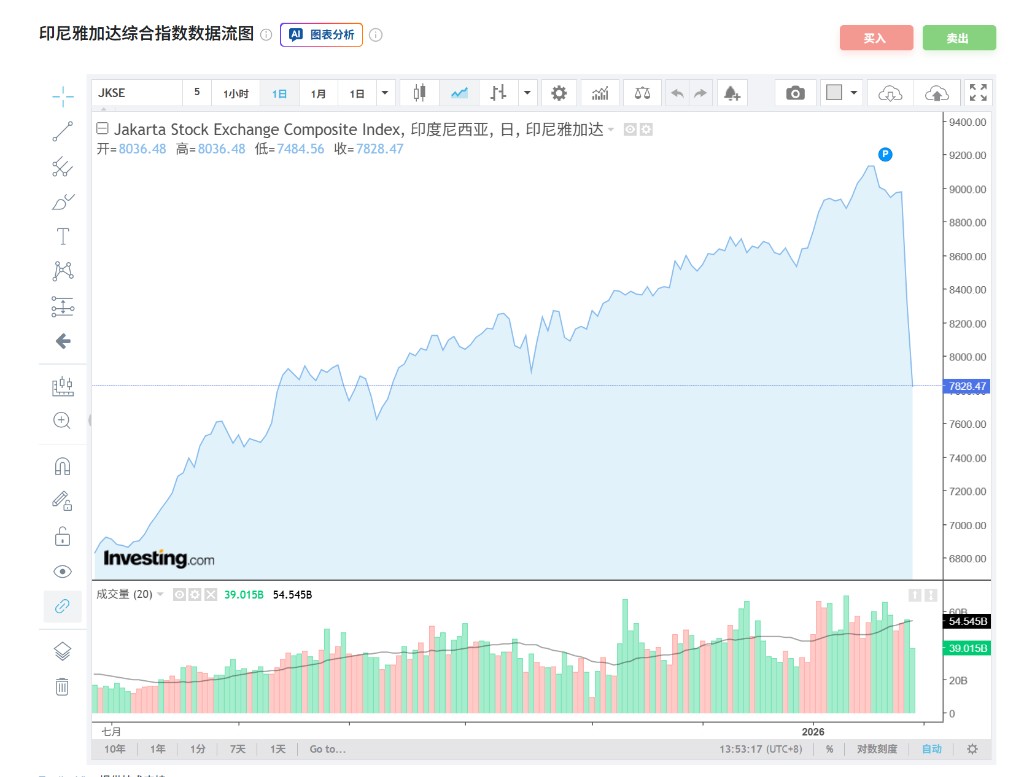
Affected by the MSCI warning of a downgrade and Goldman Sachs' rating cut, the Indonesian stock market has plummeted over 15% for two consecutive days and has experienced multiple circuit breakers. MSCI has criticized the fundamental issues with market transparency, stating that if improvements are not made before May, a downgrade may occur. Goldman Sachs has warned that this move could trigger an outflow of $8 billion. Coupled with concerns over Indonesia's fiscal deficit and central bank independence, Indonesia is facing a severe capital outflow crisis
Global index provider MSCI has issued a warning regarding the transparency of the Indonesian market and threatened a downgrade. Coupled with Goldman Sachs' downgrade, this has led to a more than 15% plunge in the Indonesian stock market over two days, triggering multiple circuit breakers, marking the latest blow to the country's financial market.
On the 29th, the Jakarta Composite Index plummeted by as much as 10% during Thursday's trading, triggering a 30-minute trading halt. The day before, the index had already dropped over 7%, also triggering a circuit breaker. Since MSCI released its warning report on Tuesday, the index has cumulatively fallen by more than 15%.
In its report, MSCI pointed out that there are "fundamental investability issues" with the publicly traded stock data sources on the Indonesia Stock Exchange and stated that it would stop adjusting Indonesian securities in its indices, including halting the inclusion of new stocks. The agency warned that if the issues are not resolved by May, Indonesia may be downgraded from emerging market to frontier market.
Goldman Sachs downgraded Indonesian stocks to "underweight" on Thursday and warned that the downgrade threat from MSCI "could trigger a massive sell-off." In another report, Goldman Sachs estimated that the Indonesian stock market could face nearly $8 billion in capital outflows, a risk that "the market has not fully digested."
MSCI Freezes Index Adjustments and Warns of Downgrade
MSCI stated that it would freeze updates to Indonesian-related items in its products while negotiating with regulators to resolve the so-called "investability risk." The agency noted that the issues are concentrated on the lack of transparency in stock ownership, trading, and price formation mechanisms.
This warning has significant implications for the Indonesian market. MSCI is one of the largest index providers globally, with billions of dollars in passive investment funds tracking its indices. A downgrade would force tracking funds to sell Indonesian stocks, while actively managed fund managers whose performance benchmarks are based on the index may also need to reduce their holdings.
If downgraded to frontier market status, Indonesia would be on par with Bangladesh, Pakistan, Sri Lanka, and Vietnam. However, analysts currently believe that the likelihood of this happening is low.
Goldman Sachs Warns of Scale of Capital Outflows
According to Reuters, Goldman Sachs stated during its downgrade that if MSCI downgrades, it could lead to capital outflows of between $2.2 billion and $7.8 billion, although the bank believes the likelihood of a downgrade is low.
Goldman Sachs strategists noted:
"We expect the market to remain under pressure, and now is not the time to enter. Indonesia is facing macro challenges, including weak private consumption, slowing credit growth, and a fiscal deficit nearing the statutory limit of 3% of GDP."
Wee Khoon Chong, a senior strategist at Bank of New York Mellon in Hong Kong, stated that foreign investors have been selling Indonesian stocks, and the "aggressive" decline in stock prices "could increase further outflow pressure on investors." He added:
"The timing is very unfavorable, as the Indonesian currency is simultaneously facing depreciation pressure related to fiscal and deficit issues."
Broader Economic and Political Concerns
The backdrop of the turmoil in the Indonesian stock market is the increasing concerns from the outside world regarding the country's economic outlook and fiscal situation under President Prabowo Subianto's leadership. Prabowo has promised to increase social spending, while government revenues are declining.
The Indonesian rupiah has been hovering near historical lows, driven by concerns over the independence of the central bank. Prabowo nominated his nephew Thomas Djiwandono as the deputy governor of the central bank, a nomination that was confirmed by parliament this week. Previously, he abruptly dismissed the respected Finance Minister Sri Mulyani Indrawati last year, actions that have undermined external confidence in his fiscal management.
According to Reuters, citing LSEG data, foreign investors have sold Indonesian stocks worth IDR 13.96 trillion (approximately USD 834 million) by 2025, marking the most severe capital outflow since 2020, with sales continuing in January.
Rahul Ghosh, a portfolio specialist at T. Rowe Price in Singapore, stated:
"The warning from MSCI and any future actions could have broader negative impacts on the economy if it makes capital raising more difficult or costly, thereby increasing the risk of a negative feedback loop—thus some market participants may preemptively reduce their risk exposure."
