


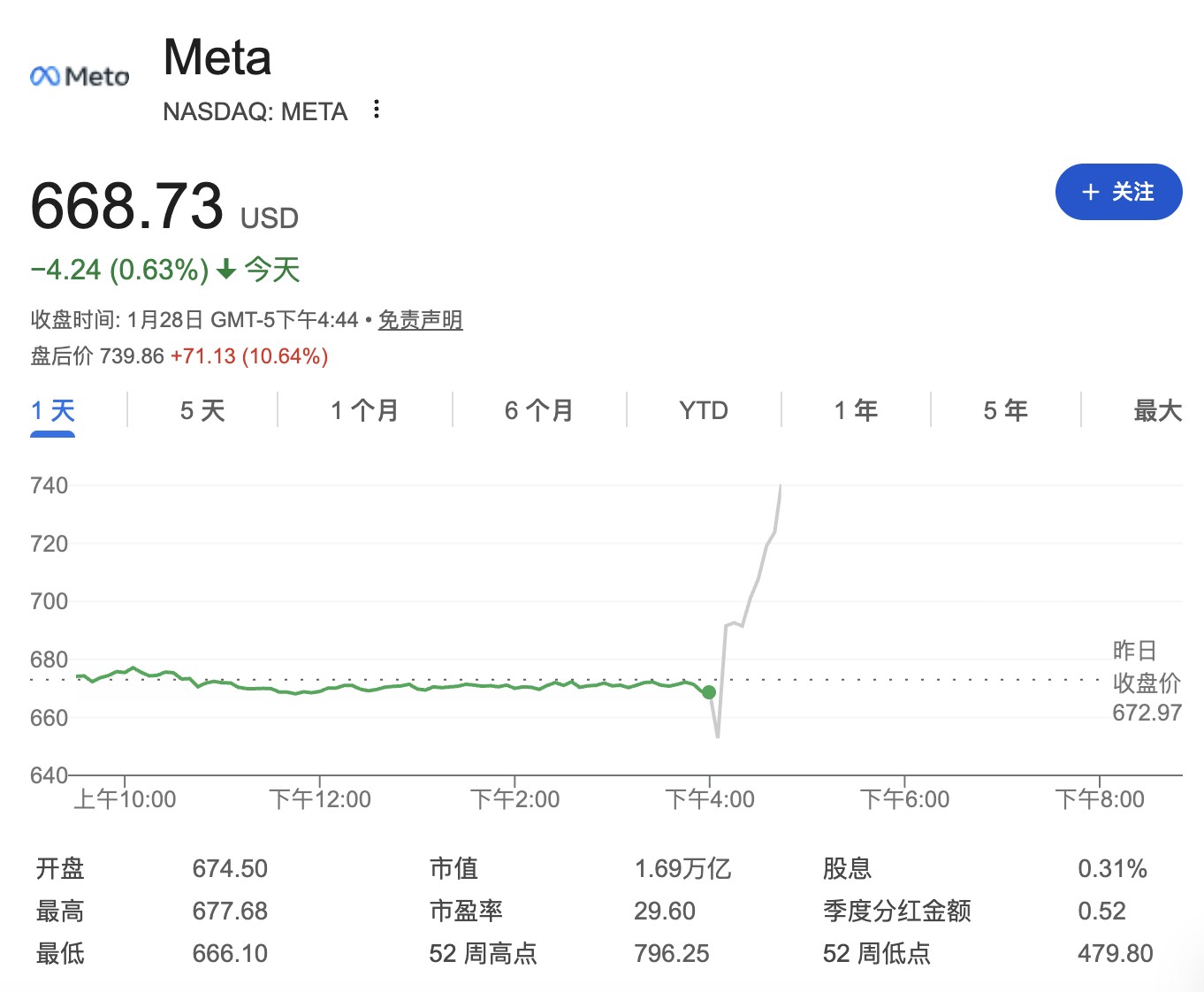
Meta's fourth-quarter performance, first-quarter guidance, and full-year capital expenditures exceeded expectations, with the stock price soaring over 11% in after-hours trading | Earnings Report Insights

Meta announced its financial report, showing that driven by AI-enhanced advertising business, the company's fourth-quarter revenue and guidance for the first quarter of 2026 significantly exceeded market expectations. At the same time, the full-year capital expenditure guidance provided was also substantially higher than analysts' forecasts. Meta expects capital expenditures to reach up to $135 billion in 2026, nearly double that of last year. The strong performance and aggressive investment plans gained investor recognition, pushing Meta's stock price to rise over 11% in after-hours trading
Meta announced its earnings report after the market closed on Wednesday, showing that strong advertising business drove the company's revenue for the fourth quarter of last year and the revenue guidance for the first quarter of this year, both exceeding analysts' expectations. At the same time, the company's full-year capital expenditure guidance range also surpassed analysts' expectations, causing the company's stock price to rise by more than 11% in after-hours trading.
Here are the key points from Meta's earnings report:
Fourth Quarter Key Financial Data:
Revenue: Fourth quarter revenue was $59.893 billion, higher than analysts' expectations of $58.42 billion; for the full year 2024, it is expected to be $48.385 billion, a year-on-year increase of 24%
Costs and Expenses: $35.148 billion, expected to be $25.020 billion in 2024, a year-on-year increase of 40%
Operating Profit: $24.745 billion, expected to be $23.365 billion in 2024, a year-on-year increase of 6%
Operating Profit Margin: 41%, expected to be 48% in 2024
Net Profit: $22.768 billion, expected to be $20.838 billion in 2024, a year-on-year increase of 9%
Diluted Earnings Per Share (EPS): $8.88, expected to be $8.02 in 2024, a year-on-year increase of 11%
Capital Expenditure: Including principal repayment of finance leases, fourth quarter was $22.14 billion, full year was $72.22 billion
Daily Active Users (DAP) of Family of Apps: Averaged 3.58 billion in December 2025, a year-on-year increase of 7%
Ad Impressions: Increased by 18% year-on-year in the fourth quarter, and increased by 12% year-on-year for the full year
Average Price Per Ad: Increased by 6% year-on-year in the fourth quarter, and increased by 9% year-on-year for the full year
2025 Full Year Performance Highlights:
Revenue: $200.966 billion, expected to be $164.501 billion in 2024, a year-on-year increase of 22%
Costs and Expenses: $117.690 billion, expected to be $95.121 billion in 2024, a year-on-year increase of 24%
Operating Profit: $83.276 billion, expected to be $69.380 billion in 2024, a year-on-year increase of 20%
Operating Profit Margin: 41%, expected to be 42% in 2024
Net Profit: $60.458 billion, expected to be $62.360 billion in 2024, a year-on-year decrease of 3%
Diluted Earnings Per Share (EPS): $23.49, expected to be $23.86 in 2024, a year-on-year decrease of 2%
Performance Guidance:
Revenue: It is expected that total revenue for the first quarter of 2026 will be between $53.5 billion and $56.5 billion, higher than analysts' expectations of $51.27 billion.
Capital Expenditure: It is expected that total capital expenditure for 2026 will be between $115 billion and $135 billion, higher than the average analyst expectation of $110.6 billion.**
Total expenses for the entire year of 2026: Total expenses for the entire year of 2026 are expected to be between $162 billion and $169 billion.
Media reports indicate that Meta founder and CEO Mark Zuckerberg is pushing for an aggressive strategy, significantly investing in infrastructure, computing power, and talent, which he believes is essential to succeed in the fierce AI competition. Zuckerberg stated that the core of his strategy is to prepare for the company's goal of achieving "superintelligence" by laying out computing power in advance. "Superintelligence" is a theoretical milestone referring to the ability of artificial intelligence to perform multiple tasks at a level equal to or exceeding that of humans.
"Our business performed strongly in 2025. In 2026, I look forward to advancing personal superintelligence for global users."
Due to fourth-quarter performance, first-quarter guidance, and full-year capital expenditures far exceeding expectations, Meta's stock price surged more than 11% in after-hours trading on Wednesday.
This year's capital expenditures expected to be double last year's
The company stated that capital expenditures for 2026 could reach up to $135 billion, approximately 20% higher than Wall Street's expectations, nearly double last year's investment scale. The company noted that the year-on-year growth primarily comes from increased investments to support the Meta Superintelligence Labs and core business. Despite a significant increase in infrastructure investment, the company expects operating profits in 2026 to still be higher than in 2025.
Last October, Chief Financial Officer Susan Li indicated that capital expenditures for 2026 were expected to be "significantly higher" than in 2025, mainly due to rising infrastructure costs, which had previously caused some investors to feel uneasy. Meta stated on Wednesday that capital expenditures for 2025 had already exceeded $72 billion.
Media reports suggest that investors seem to support Meta's plan to significantly increase spending. This contrasts sharply with last year when shareholders reacted more cautiously to the company's high spending plans and demanded more details from management.
Meta stated that it would seek more external financing for a series of infrastructure projects. Zuckerberg previously planned to build new data centers globally, launch a brand new cutting-edge AI model this year, and further integrate AI deeply into the company's core advertising business.
Zuckerberg said during a conference call with investors and analysts:
"In 2025, we rebuilt the foundation of our AI projects. In the coming months, we will begin to roll out new models and products. I expect our first batch of models to perform well, but more importantly, they will demonstrate the trajectory we are rapidly advancing."
Meta stated that total expenses for the entire year of 2026 are expected to be between $162 billion and $169 billion, with the main sources of expense growth being infrastructure costs, including increased spending on third-party cloud services, higher depreciation expenses, and higher infrastructure operating costs The second largest source of expense growth is employee compensation, primarily due to ongoing investments in technical talent. This includes new hires in 2026 to support the company's key areas, especially AI, as well as the full-year costs of new employees added in 2025.
From a business segment perspective, expense growth mainly comes from the family applications business, while the operating losses of Reality Labs are expected to remain at levels similar to those in 2025.
AI Strengthens Advertising Business
Media reports indicate that investors have long been concerned about whether Meta's business can truly achieve corresponding returns from such high levels of investment.
An analyst pointed out in a report last week:
"Compared to cutting-edge large language models, Meta's shortcomings in model capabilities create uncertainty regarding the monetization prospects of its AI investments compared to large cloud computing peers."
However, analysts believe that at least at the current stage, AI has significantly strengthened Meta's advertising business. Meta stated that its fourth-quarter revenue exceeded expectations, primarily benefiting from strong performance in its advertising business. Meta executives have repeatedly stated that the company's investments in AI are enhancing the precision and effectiveness of ad placements.
Continuing to Invest in AI, Results Remain a Mystery
Meta has previously made large-scale investments in AI and has recently further increased its commitment. Earlier this month, the company announced the appointment of former Goldman Sachs partner Dina Powell McCormick as the new president, responsible for establishing partnerships with governments and supporting financing and deployment for global data centers.
To align with this strategy, Meta also announced the establishment of a new "top-tier" initiative—Meta Compute, responsible for ensuring the massive power supply needed to run AI models and social media operations.
Zuckerberg posted on the Threads platform:
"Meta plans to build tens of gigawatts of computing infrastructure within this decade, ultimately reaching hundreds of gigawatts or more. How we design, invest, and build this infrastructure through collaboration will become a strategic advantage."
Meanwhile, investors, analysts, and the entire tech industry are closely watching what results this newly revamped AI department at Meta can deliver after Zuckerberg spent billions on large-scale hiring last summer.
It has been nearly eight months since Meta acquired a 49% stake in Scale AI and appointed its CEO Alexandr Wang as Chief AI Officer. The company has yet to launch a successor model to Llama 4. Llama 4, released last spring, performed poorly, prompting Meta to restructure its AI business and establish a new "Super Intelligence Lab."
However, there are already rumors in the market that a new model is on the way. Wang stated in an internal Q&A session last December that Meta's latest AI models are codenamed "Avocado" and "Mango," and are expected to be released in the first half of this year
The Metaverse Remains Costly
At the same time, Meta is still incurring high costs for the "Metaverse."
Financial reports show that Meta's Reality Labs division recorded an operating loss of $6.02 billion in the quarter, with revenue of $955 million. Analysts had previously estimated that Reality Labs would have an operating loss of $5.67 billion in the fourth quarter, with revenue of $940.8 million.
The quarterly loss for Reality Labs expanded by 21% year-on-year, while revenue grew by 13%. Since the end of 2020, the division's cumulative operating loss has approached $80 billion.
Earlier this January, Meta laid off over 1,000 Reality Labs employees to shift resources from virtual reality to artificial intelligence and wearable devices, including the Ray-Ban Meta smart glasses developed in collaboration with global eyewear giant EssilorLuxottica. Media reports indicated that Meta also shut down several VR-related projects, including internal studios, raising market concerns about the arrival of a "VR winter."
Meta's Chief Technology Officer Andrew Bosworth stated to the media last week that Meta has not abandoned its VR business, but he also acknowledged that the growth rate of the market is lower than management's previous expectations.
Last fall, Meta did not launch a new Quest VR headset but instead released the Meta Ray-Ban Display smart glasses equipped with AI features. These glasses are priced at $799, with a digital display embedded in one of the lenses
