The Federal Reserve paused interest rate cuts as scheduled, with two dissenting votes, and Fed Chair nominee Waller supports a further cut of 25 basis points

This time, there was one less dissenting vote in the interest rate decision compared to the last time, with Waller voting against for the first time, aligning with the views of Trump-appointed Governor Milan. The Federal Reserve's statement noted that economic activity is steadily expanding and the unemployment rate shows signs of stabilization, removing the phrase "the downside risks to employment have increased in recent months," and reaffirming that inflation remains slightly elevated. Market predictions indicate that Waller's chances of being nominated as Federal Reserve Chair have slightly increased. The "New Federal Reserve News Agency" stated that the Fed did not provide a clear indication of when it might resume actions, suggesting that it is not in a hurry to restart interest rate cuts
Key Points:
The Federal Reserve paused its actions after cutting rates by 25 basis points for the third consecutive time, as the market expected.
There was one less dissenting vote in this rate decision compared to the last, with Waller voting against for the first time, aligning with the rate cut proposal of Trump-appointed Governor Milan, which may help increase his chances of being nominated as Federal Reserve Chair.
The statement noted that economic activity is steadily expanding, rather than the previous characterization of a slowdown in expansion, and indicated that the unemployment rate shows signs of stabilization, removing the phrase "the risk of job losses has increased in recent months," while reiterating that inflation remains slightly elevated.
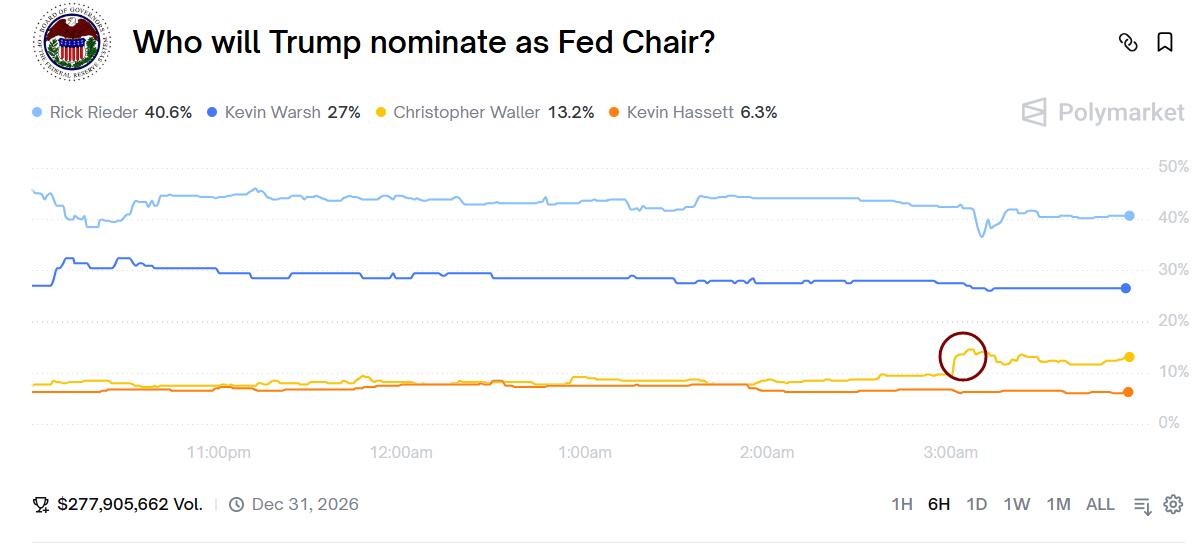
Market predictions show that Waller's chances of being nominated as Federal Reserve Chair have slightly increased.
The "New Federal Reserve News Agency" indicated that the Fed did not provide a clear statement on when it might resume actions, suggesting there is no rush to restart rate cuts.
As expected by the market, the Federal Reserve decided to pause its actions for the first time since July of last year. The Fed's decision statement once again exposed internal divisions, with one of the candidates for the next Federal Reserve Chair, Waller, becoming part of the minority opposing this rate decision, while another Trump-appointed Governor, Milan, supported continuing rate cuts.
On Wednesday, January 28, Eastern Time, the Federal Reserve announced the decision of the Federal Open Market Committee (FOMC) to maintain the target range for the federal funds rate at 3.50% to 3.75%. This is the first pause in action after three consecutive rate cuts since September 2025. In 2025, the Fed cut rates by a total of 75 basis points, each time by 25 basis points. From September 2024 to December 2025, the Fed's current easing cycle totaled 175 basis points in rate cuts.
The Federal Reserve's decision to hold steady was entirely in line with market expectations. By the close of trading on Tuesday, the Chicago Mercantile Exchange (CME) tools indicated that the futures market expected a probability of slightly over 97% for no rate cut this week, with probabilities of less than 40% for no action in the subsequent meetings in March and April, and a probability of over 64% for a rate cut in June. By the end of 2026, the probability of at least two rate cuts of 25 basis points within the year also exceeded 60%.
Nick Timiraos, a senior reporter known as the "New Federal Reserve News Agency," pointed out that the Federal Reserve has entered a new wait-and-see period regarding its rate policy, suggesting that after three controversial rate cuts, it is not in a hurry to restart cuts. Fed officials did not provide a clear statement on when rate cuts might resume. Their changes to the post-meeting statement were quite minor, retaining the usual language that hints at possible future actions but did not suggest immediate action.
This statement shows that both Waller and Milan support a 25 basis point rate cut. The prediction market Polymarket indicates that bets on Waller receiving the Federal Reserve Chair nomination have increased to 13%, while the chances for two popular candidates—BlackRock executive Riedel and former Federal Reserve Governor Warsh—have slightly decreased, standing at over 40% and about 27%, respectively.
Waller Votes Against for the First Time, Aligning with Milan's Proposal, May Help Secure Fed Chair Nomination
Compared to the last FOMC meeting decision in early December, the biggest difference in this meeting's statement is that there were two dissenting votes among the 12 FOMC voting members.
The statement released this Wednesday shows that ten FOMC members, including Federal Reserve Chairman Jerome Powell and Fed Governor Christopher Waller, who was publicly threatened with dismissal by Trump last year, supported keeping interest rates unchanged. The two dissenters both supported a further rate cut of 25 basis points, namely Fed Governor Stephen Miran and another governor, Waller.
Thus, the Federal Reserve has seen dissenting votes in five consecutive FOMC meetings. Miran has consistently voted against the interest rate decision since he took office as a governor in July last year. The difference this time is that he previously sought a 50 basis point cut in the last three meetings, but this time he supported a reduction of half that amount.
Compared to Miran, a staunch dove following Trump, Waller cast his dissenting vote for the first time since the Fed's decision statement revealed divisions in the decision-making body last year.
Timiraos from the "New Federal Reserve News Agency" previously wrote that Waller's voting stance might attract particular attention. This is because he is one of the candidates Trump is considering to potentially replace Fed Chairman Powell. If he votes in favor of a rate cut, it would align with Trump's repeated statements that he "will not choose anyone who opposes his demand to lower financing costs," which would help enhance his prospects of being nominated, which are currently low.
This meeting saw one less dissenting vote than the last meeting. The last meeting's decision was the first to face opposition from three voting FOMC members since 2019, and among the non-voting members, four also supported maintaining the status quo, resulting in a total of seven opposing the decision. In terms of numbers, the divisions seen in the last meeting were the largest in 37 years.
In addition to Miran and Waller, analysts previously believed that another Fed governor, Michelle Bowman, might also vote in favor of a rate cut, as she and Waller expressed greater concerns about the labor market than some of their colleagues. However, the post-meeting decision statement indicated that Bowman did not "defect" like Waller this time.
Referred to steady expansion of economic activity, unemployment rate shows signs of stabilization
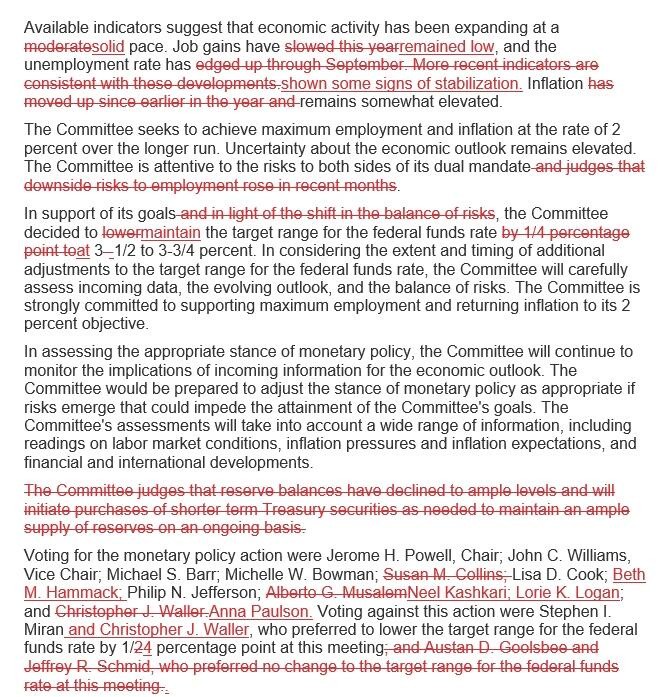
Compared to the last meeting's decision, this decision statement made slight adjustments in commenting on the economic situation. Overall, the Federal Reserve's assessment of the economy is more positive than before.
The last statement reiterated that "available indicators show that the pace of economic activity has been moderating," while this time it stated that existing indicators suggest economic activity has "been steadily expanding."
The last statement noted that "the unemployment rate edged up slightly as of September" and reiterated that "the downside risks to employment have increased in recent months." This time, it removed the wording about increased downside risks to employment and stated that the unemployment rate "shows some signs of stabilization."
Regarding inflation, this time it continued to reiterate that the inflation rate remains slightly elevated, but no longer mentioned that the inflation rate has risen since the beginning of the year In addition, the last meeting announced the initiation of what is called reserve management, stating that the FOMC believes "the reserve balances have fallen to adequate levels and will begin purchasing short-term Treasury securities as needed to maintain a sufficient supply of reserves." At that time, the New York Fed announced plans to start buying $40 billion in short-term Treasury securities over the next 30 days beginning December 11.
This statement removed the sentence regarding the FOMC's belief that it needs to start buying short-term Treasury securities, indicating that the New York Fed's Reserve Management Purchase (RMP) actions are proceeding as planned and have not changed.
The following red text shows the deletions and additions in this resolution statement compared to the last one.