


The net profit attributable to the parent company increased by over 20%, and Bank of Qingdao is rapidly "expanding its balance sheet" with ROE being restored

In the current environment where the banking industry is generally facing multiple pressures such as narrowing interest margins, asset shortages, and risk exposures, Bank of Qingdao has disclosed a rather "aggressive" report card: …
In the current banking industry, which is generally facing multiple pressures such as narrowing interest margins, asset shortages, and risk exposures, Bank of Qingdao has disclosed a rather "aggressive" report card:
By 2025, it aims to achieve an operating income of 14.573 billion yuan, a year-on-year increase of 7.97%, and a net profit attributable to shareholders of 5.188 billion yuan, an increase of 21.66%.
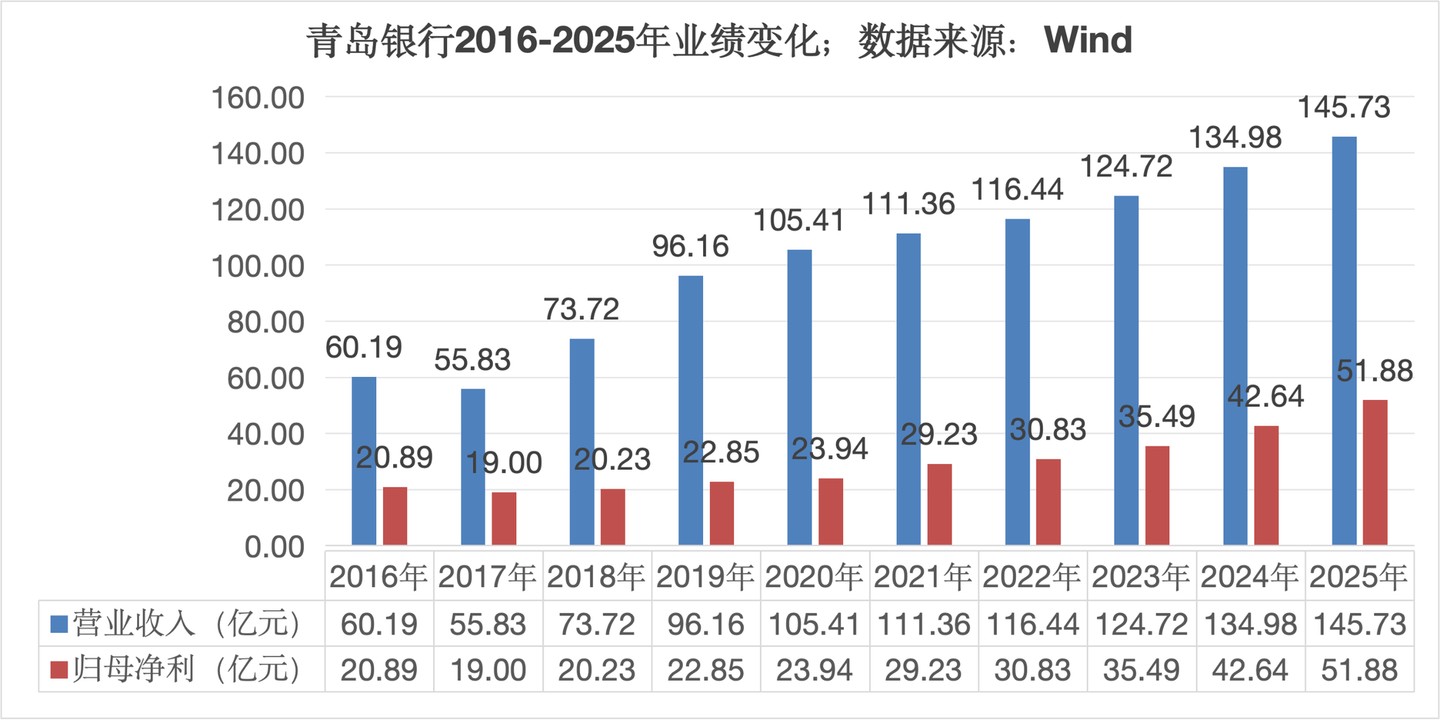
The profit growth rate is nearly three times that of the revenue growth rate, a significant "scissors gap" that is rare in recent financial reports of listed banks.
Generally speaking, a significantly higher growth rate of net profit compared to revenue often stems from extreme compression of operating costs or savings in credit costs—i.e., releasing profits by reducing provisions.
However, the situation at Bank of Qingdao seems to be more complex and robust. Coupled with a substantial increase in its provision coverage ratio, this indicates that the bank's real profitability elasticity may be stronger than what is reflected in the reported revenue data.
The cornerstone supporting this high growth performance is the counter-cyclical expansion of Bank of Qingdao's balance sheet.
By the end of 2025, the total assets of Bank of Qingdao will exceed 800 billion yuan, reaching 814.96 billion yuan, with a year-on-year growth rate of 18.12%;
Among them, the total customer loans increased by 16.53% to 397.008 billion yuan, and the total customer deposits increased by 16.41% to 502.9 billion yuan.
The credit growth rate of over 16% far exceeds the industry average, demonstrating that the bank still maintains strong momentum in asset acquisition, which also means that during a period when many peers choose to "shrink their balance sheets" or "slowly expand their balance sheets" to avoid risks, Bank of Qingdao has opted for an aggressive scale expansion strategy.
Does such aggressive credit issuance come at the expense of asset quality?
The answer from the performance report is that, against the backdrop of significant loan scale expansion, Bank of Qingdao's non-performing loan ratio has decreased to 0.97%, down 0.17 percentage points from the end of the previous year;
This has been achieved on the basis of an absolute decrease in the non-performing loan balance. During the same period, the bank's non-performing loan balance decreased by 32 million yuan, with the denominator (total loans) increasing and the numerator (non-performing balance) decreasing, leading to a dual effect that lowered the non-performing loan ratio.
At the same time, Bank of Qingdao has also significantly increased its safety cushion;
Its provision coverage ratio soared to 292.30%, a substantial increase of 50.98 percentage points year-on-year, approaching a 300% provision coverage ratio, which is at a relatively high level among city commercial banks.
The "high growth + high defense" financial performance has directly driven the recovery of shareholder returns.
In 2025, Bank of Qingdao's weighted average return on equity (ROE) will rebound to 12.68%, an increase of 1.17 percentage points year-on-year; basic earnings per share will be 0.85 yuan, a year-on-year increase of 23.19%.
Although the preliminary report data is impressive, attention must still be paid to the sustainability of the bank's "volume compensating for price" strategy.
With an 18% growth in asset scale, revenue has only increased by less than 8%, which indicates that the bank's yield on interest-earning assets may still be under significant downward pressure The aggressive flash report from Bank of Qingdao establishes the fundamentals of its growth in both scale and profit, but before the formal annual report is disclosed, the specific loan allocation structure and the trend of net interest margin changes remain key risk factors that need to be closely monitored.
After all, following the explosive growth in scale, ensuring sustained organic growth is the key to navigating through the cycle
