


Memory prices have doubled, will the iPhone become more expensive? Tianfeng's Guo Mingqi: Apple's strategy is to "bear costs to gain market share and earn it back through services."

Ming-Chi Kuo stated that the price increase of iPhone memory in the second quarter of 2026 will be close to that of the first quarter. Apple's strategy is clear: leverage strong bargaining power to ensure chip supply, bear cost pressures to seize market share, and later make up for losses through service businesses. Memory pricing has been changed to quarterly negotiations, but Apple plans to keep the starting price of the new iPhone 18 unchanged to avoid price increases affecting marketing
Tianfeng International Securities analyst Guo Mingqi stated that Apple will face a similar magnitude of memory price increases in the second quarter of 2026 as in the first quarter, and Apple's response strategy is very clear: leverage market chaos to ensure chip supply, bear cost pressures, and seize market share, subsequently compensating for losses through service business.
This judgment is based on the fact that Samsung Electronics and SK Hynix have recently successfully raised the prices of low-power DRAM supplied to Apple by nearly double compared to the previous quarter. According to a previous article by Wall Street Insight, on January 27, South Korean media zdnet reported that Samsung Electronics' LPDDR chip prices rose by over 80% in the first quarter, while SK Hynix's increase was about 100%. As a key customer with an annual shipment of approximately 250 million iPhones, Apple had no choice but to accept this increase.
On January 28, "the analyst who knows Apple best," Guo Mingqi, posted on social media platform X, stating that Apple is able to lock in memory supply agreements in a tight supply environment, fully demonstrating its strong bargaining power.
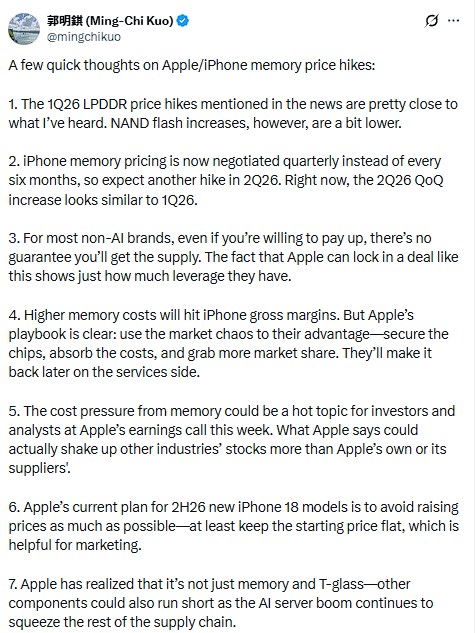
He pointed out: "For most non-AI brands, even if you are willing to pay a high price, there is no guarantee that you can secure a supply. The fact that Apple can reach such deals is enough to prove how strong their bargaining power is."
However, higher memory costs will directly impact iPhone gross margins. Guo Mingqi analyzed that Apple's strategy is clear: take advantage of the chaotic market situation to profit—ensure chip supply, bear costs, and capture more market share, and then compensate for losses in services.
Guo Mingqi also noted that iPhone memory pricing has shifted from negotiations every six months to quarterly negotiations, indicating that price increases will continue. He revealed that the quarter-on-quarter increase expected for the second quarter of 2026 is basically on par with the first quarter, while the increase in NAND flash memory is slightly lower than that of LPDDR.
Analysts believe that the signing of short-term contracts reflects the current uncertainty in the memory market and shows a weakening of Apple's bargaining power in a tight supply environment. For Samsung Electronics and SK Hynix, this means they may gain greater pricing initiative in the new round of negotiations in the second half of the year.
Cost Pressure May Become Focus of Financial Report
Guo Mingqi expects that memory cost pressure may become a hot topic of interest for investors and analysts during Apple's earnings call this week. He specifically pointed out:
"Apple's statements may have a greater impact on the stock prices of other industries than on Apple itself or its suppliers."
According to Wall Street Insight, market data shows that LPDDR5 prices rose by about 40% in the fourth quarter of last year. TrendForce predicts that general DRAM prices will increase by 55-60% quarter-on-quarter in the first quarter. An industry insider stated that the increase in the first quarter is even larger, with an overall increase of at least 60% If the rise in Apple's memory prices is fully reflected, the overall profitability of memory suppliers is expected to further improve in the first quarter. This means that for Samsung Electronics and SK Hynix, which experienced a low point in the industry cycle last year, the profitability of the DRAM business will be maximized in the first quarter.
New Product Pricing Strategy Remains Cautious
Despite facing rising cost pressures, Ming-Chi Kuo revealed that Apple's current plan for the new iPhone 18 models in the second half of 2026 is to avoid price increases as much as possible—at least to keep the starting price unchanged, which is helpful for marketing.
The Wallstreetcn article pointed out that, unlike previous practices, Apple has only completed the memory unit price negotiations for the first half of this year, rather than signing a long-term agreement for the entire year. A semiconductor industry insider explained:
"Apple usually signs long-term memory agreements every year, but considering the recent memory crisis, as far as I know, they only completed the unit price negotiations for the first half of this year."
The insider added that prices may rise further with the launch of new products in the second half of the year. Apple is expected to release the latest flagship smartphone, the iPhone 18, in the second half, which will significantly increase the demand for LPDDR.
Supply Chain Shortage Risks Spread
Ming-Chi Kuo warned that Apple has realized that supply chain risks are spreading. He stated: "It's not just memory and T-glass— as the booming development of AI servers continues to squeeze other parts of the supply chain, other components may also face shortages."
The Wallstreetcn article also mentioned that the fundamental reason for the sharp rise in memory prices is the imbalance in supply and demand structure. The massive investments by large global tech companies in AI infrastructure have driven a surge in DRAM demand, while suppliers like Samsung Electronics and SK Hynix have shifted their production capacity to more profitable HBM products, leading to tight supplies of traditional DRAM and LPDDR
