


AI-driven demand for data centers is strong! Storage giant Seagate Tech's Q2 revenue increased by 21.5%, with operating profit margin reaching a record high. Q3 revenue guidance exceeded expectations, and the stock price rose about 9% in after-hours trading

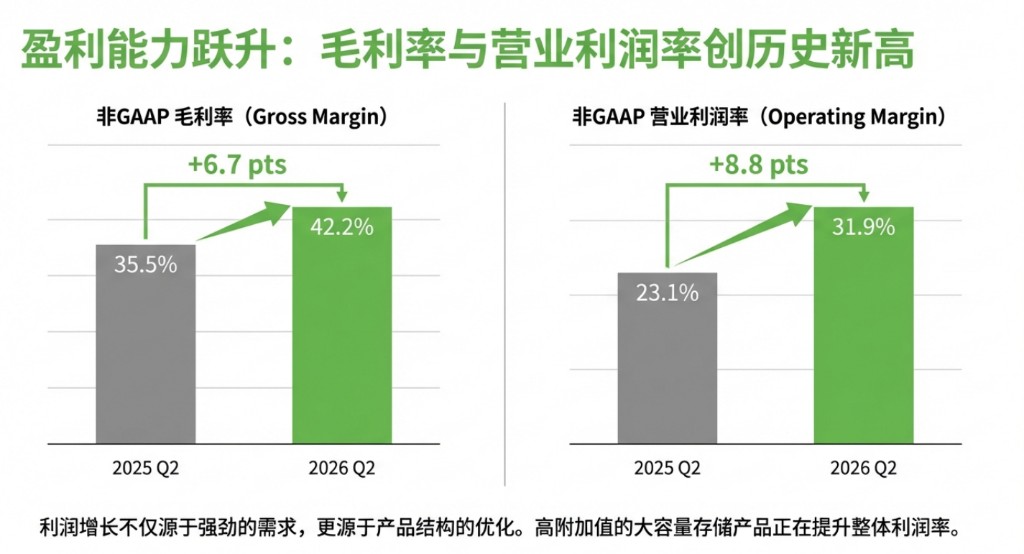
The financial report shows that Seagate's Q2 non-GAAP gross margin reached 42.2% (35.5% in the same period last year), and operating profit margin rose to 31.9% (23.1% in the same period last year), both setting historical highs; the non-GAAP earnings per share were $3.11, also a record high, far exceeding last year's $2.03. Q3 revenue is expected to be $2.9 billion, surpassing Wall Street's expectations. CEO Mosley attributed this sustained strength to the "persistence of data center demand" and the amplifying effect of AI applications on data creation
Storage giant Seagate Technology delivered a quarterly performance report that far exceeded Wall Street expectations, driven by the ongoing demand for large-capacity storage in data centers, with significant growth in both revenue and profit, while the company's gross margin and operating profit margin reached historical highs.
On January 27, Seagate Technology announced that its revenue for the second quarter of fiscal year 2026 reached $2.825 billion, a 21.5% increase from $2.325 billion in the same period last year. The non-GAAP earnings per share were $3.11, far exceeding last year's $2.03. The gross margin improved to 42.2%, significantly up from 35.5% in the same period last year.
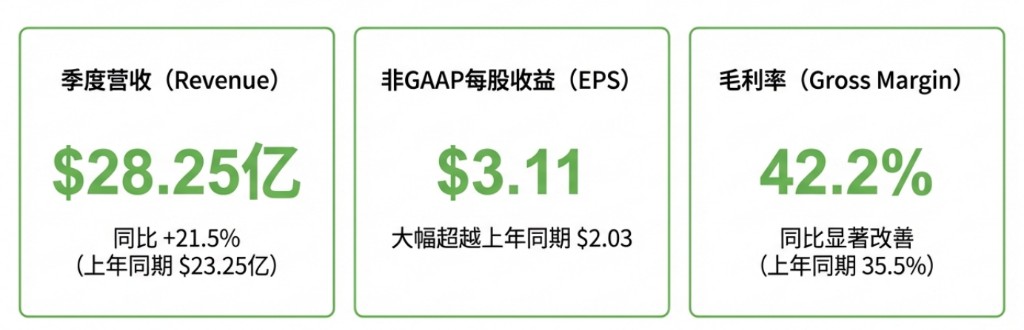
The financial report also indicated that the company expects third-quarter revenue to be $2.9 billion (with a fluctuation of $100 million), higher than analysts' expectations of $2.77 billion. The adjusted earnings per share are expected to be $3.40 (with a fluctuation of 20 cents), also exceeding market expectations of $2.96.
Seagate's Chairman and CEO Dave Mosley stated that the company, with its areal density-driven product roadmap, is able to meet the modern data center's demand for performance and cost-effective exabyte-scale storage solutions. As artificial intelligence applications expand data creation and economic value, this positioning will create long-term value for customers and shareholders.
Mosley emphasized that as artificial intelligence applications amplify data creation and economic value, modern data centers increasingly require storage solutions that balance performance and cost-effectiveness at the exabyte scale. The company's areal density-driven product roadmap can meet the evolving storage demands and the growth in exabyte-scale needs.
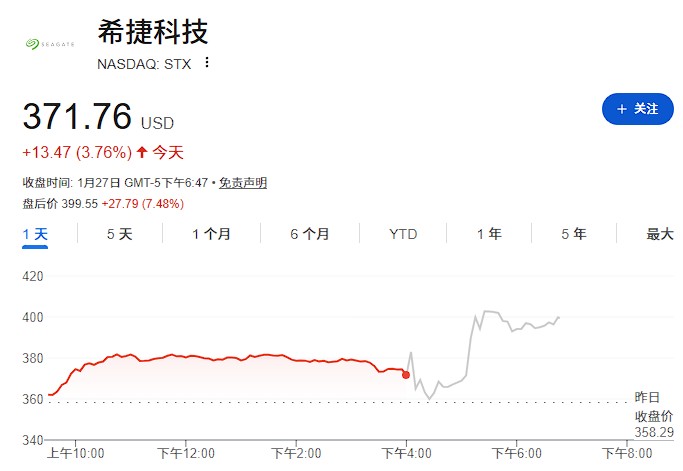
After the financial report was released, Seagate Technology's stock rose nearly 9% in after-hours trading. Previously, the stock had more than doubled in 2025 and rose another 6% last week before the earnings report, driven by investor optimism regarding AI-related infrastructure.
Significant Improvement in Profitability
More noteworthy than revenue growth is the improvement in Seagate's profitability.
The financial report showed that Seagate's operating profit margin reached 31.9% (non-GAAP) in the second quarter, an increase of 8.8 percentage points from 23.1% in the same period last year. The company's non-GAAP gross margin reached 42.2%, up 6.7 percentage points from 35.5% in the same period last year. Both of these figures set historical highs for the company.
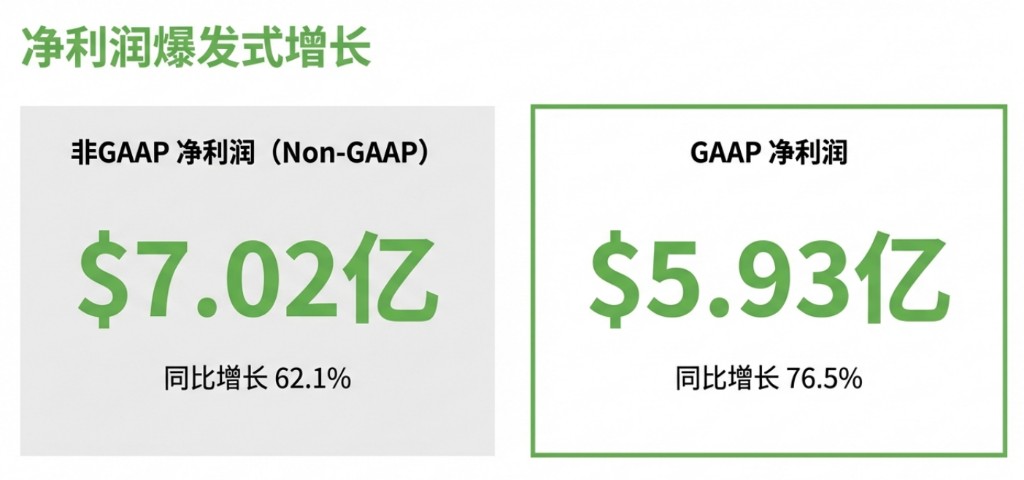
In terms of net profit, the non-GAAP net profit was $702 million, a year-on-year increase of 62.1%; the GAAP net profit was $593 million, a year-on-year increase of 76.5%
Analysis suggests that data center customers indeed have a strong demand for large-capacity storage, but more critically, it is the optimization of product structure.
CEO Dave Mosley specifically emphasized the key information of "the continuous mass production of Mozaic products based on HAMR technology" in the financial report.
HAMR (Heat-Assisted Magnetic Recording) technology represents the next-generation breakthrough in hard disk storage, capable of storing more data in the same physical space, which is exactly what AI data centers need—a balance between performance and cost-efficient EB-level (exabyte) storage solutions.
While revenue and profits have significantly increased, Seagate has also demonstrated strong cash generation capabilities. The company generated $723 million in operating cash flow and $607 million in free cash flow in the second quarter.
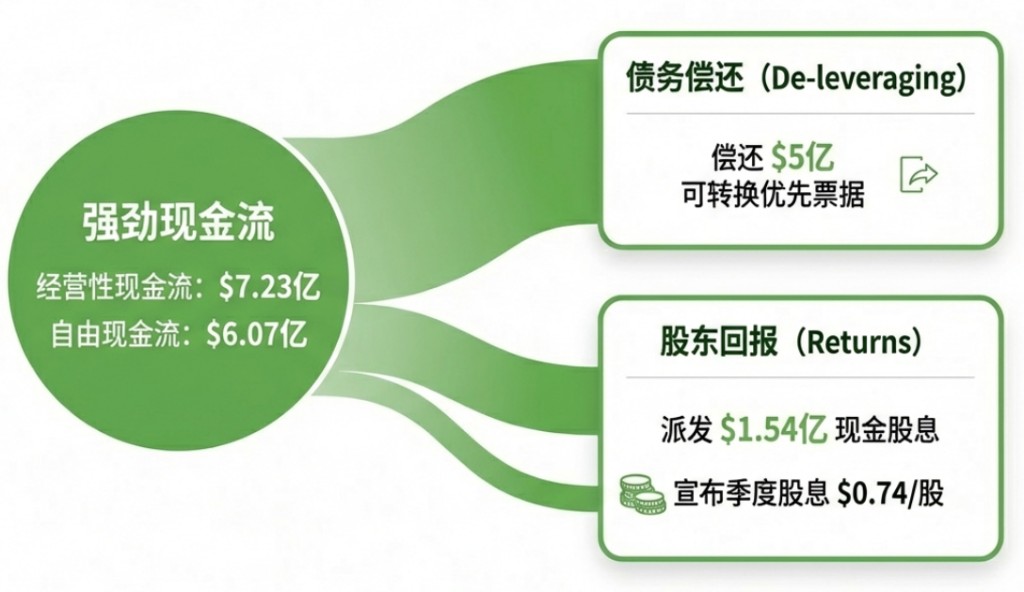
It is noteworthy that the company's capital allocation strategy: on one hand, it repaid $500 million of convertible preferred notes to optimize its capital structure; on the other hand, it distributed $154 million in cash dividends and announced a quarterly dividend of $0.74 per share to be paid in April 2026.
Analysis points out that this dual operation of "de-leveraging + shareholder returns" demonstrates management's confidence in future cash flows, but it may also imply that the company believes there are currently no expansionary capital expenditure opportunities with higher returns.
Q3 Guidance Exceeds Expectations
Seagate's guidance for the third quarter may be more noteworthy than the actual performance in the second quarter.
The financial report states that the company expects Q3 revenue to be approximately $2.9 billion (with a fluctuation of $100 million), and non-GAAP earnings per share to be approximately $3.40 (with a fluctuation of $0.20).
Comparing these figures with Wall Street's previous expectations reveals the expectation gap: Analysts had previously estimated Q3 revenue to be around $2.77 billion, with earnings per share of $2.94. Seagate's median guidance revenue is 4.7% higher, and earnings per share are 15.6% higher.

CEO Mosley attributes this sustained strength to "the persistence of data center demand" and the amplifying effect of AI applications on data creation. With the explosive growth in the training and inference demands of large language models, massive data storage has become a necessity for AI infrastructure
