


Boeing's Q4 revenue surged 57% year-on-year, with annual deliveries reaching the highest level since 2018, boosted by asset sales, and adjusted EPS hitting a new high in over a decade | Earnings Report Insights

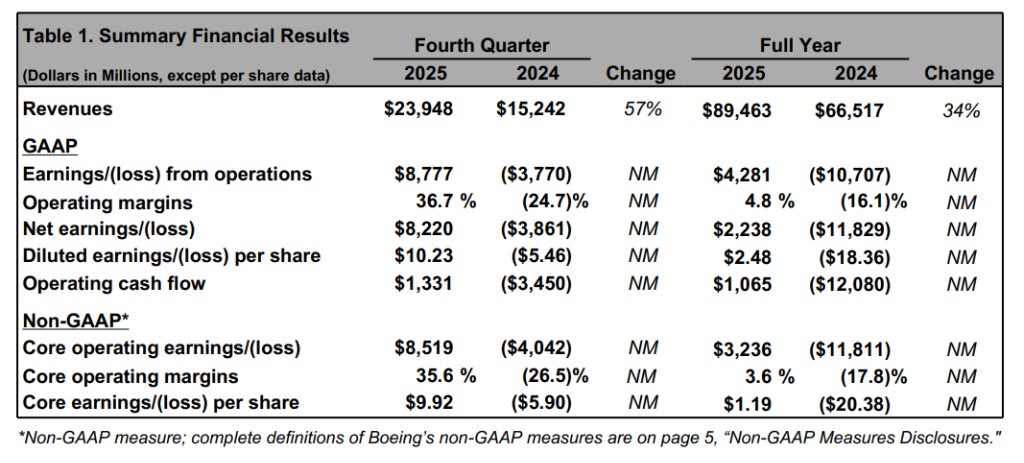
Boeing achieved a year-on-year revenue growth of 57% to $23.95 billion in the fourth quarter of 2025, and recorded positive free cash flow for the second consecutive quarter ($375 million), indicating a recovery in production and delivery. Boosted by a one-time gain from the sale of its digital aviation business, the adjusted earnings per share reached a record high for a single quarter in over a decade. However, excluding this factor, the actual earnings per share loss exceeded analysts' expectations, and the commercial aircraft division continued to face pressure. Despite a record backlog of $682 billion and steady capacity ramp-up, uncertainties such as certification delays, project cost overruns, and labor negotiations still pose challenges to Boeing's overall recovery
With aircraft deliveries reaching the highest level since 2018, Boeing achieved positive free cash flow for the second consecutive quarter, with revenue significantly increasing year-on-year, adjusted earnings per share hitting a record high for a single quarter in over a decade, and core sectors like commercial airplanes narrowing losses, indicating that it is gradually emerging from years of operational and quality crises.
On Tuesday evening, Boeing released its fourth-quarter earnings report, with the following key points:
Financial Performance: Fourth-quarter revenue was $23.95 billion, a year-on-year increase of 57%; free cash flow was $375 million, marking positive for the second consecutive quarter; full-year revenue of $89.46 billion and 600 aircraft deliveries both set new highs since 2018.
Profit Structure: Fourth-quarter GAAP earnings per share of $10.23 primarily relied on a one-time gain of $9.6 billion from the sale of its Digital Aviation Solutions subsidiary; excluding this gain, the actual per-share loss exceeded analysts' expectations.
Production Recovery: 160 aircraft were delivered in the fourth quarter, a year-on-year increase of 181%; 737 production capacity increased to 42 aircraft per month, and 787 reached 8 aircraft per month, focusing on stabilizing that capacity.
Order Backlog: Total order backlog soared to a record $682 billion, with over 6,100 commercial aircraft orders valued at $567 billion; customers leveraging aircraft purchases to improve relations with the White House became a significant driver of the order surge.
Business Integration: The acquisition of Spirit AeroSystems was completed in December, strengthening supply chain control; the defense sector's operating loss narrowed from $2.267 billion to $507 million, but the KC-46 program still recorded an additional loss of $600 million.
Certification Progress: The 737-10 received FAA approval to enter the final certification flight testing phase; the 777-9 entered TIA 3 certification testing phase, with first delivery expected in 2027.
Future Focus: The commercial aircraft sector remains in a loss position (Q4 loss of $632 million); certification delays for three commercial aircraft models; negotiations for the expiration of contracts for 16,000 Seattle engineers in October.
Boeing's stock price erased earlier gains in pre-market trading and is now down 1.5%.
Asset Sales Support "Brilliant" Performance
Boeing delivered a seemingly impressive report card for the fourth quarter, but investors need to look beyond the numbers to see the true operational situation.
The quarterly revenue of $23.95 billion surged 57% year-on-year, primarily due to a significant increase in aircraft deliveries—160 aircraft were delivered in the fourth quarter, nearly three times the 57 delivered in the same period last year. For the full year, the delivery of 600 aircraft and revenue of $89.46 billion indeed set the highest records since 2018, which can be seen as a sign of phased recovery for a company that has just experienced half a decade of quality and operational crises.
However, the $10.23 GAAP earnings per share hides a huge discrepancy—$9.6 billion in gains from the sale of the Jeppesen digital aviation subsidiary, which contributed $11.83 per share Excluding this one-time gain, Boeing's actual loss per share was worse than analysts' expectations of 46 cents.
CEO Kelly Ortberg cautiously stated in a letter to employees that "we have made good progress," but emphasized that "with progress comes expectations, and customers and stakeholders will have higher expectations of us this year"—this is clearly a precautionary note regarding ongoing operational pressures.
Cash Flow Improvement but Commercial Aircraft Still Bleeding
The $375 million in free cash flow is one of the few highlights. This marks Boeing's second consecutive quarter of positive cash flow, with $1.31 billion in operating cash flow primarily reflecting higher commercial aircraft delivery volumes and working capital timing differences. Coupled with the $10.6 billion in cash from the sale of Digital Aviation Solutions, Boeing's cash and cash equivalents at the end of the quarter reached $29.4 billion, a significant increase from $23 billion at the beginning of the quarter.
However, this does not mask the ongoing weakness in its core business. The commercial aircraft division still posted a loss of $632 million in the fourth quarter, although the operating margin improved from -43.9% in the same period last year to -5.6%. For the full year, this division lost $7.079 billion. This division contributed $11.38 billion in quarterly revenue (up 139% year-on-year) but still failed to turn a profit, reflecting cost pressures during the production ramp-up and the impact of the integration with Spirit AeroSystems.
The 737 program has increased its production capacity to 42 aircraft per month and received FAA approval for the final certification flight testing phase of the 737-10, but it is still far from profitability. The 787 program is transitioning to 8 aircraft per month, and the company has clearly stated its focus on "stabilizing at that production level"—this cautious wording suggests that the production ramp-up is not going smoothly. The 777X program has entered the TIA 3 phase of certification flight testing for the 777-9, with the first delivery still scheduled for 2027, which is several years behind the project's original timeline.
Defense Sector Stops the Bleeding but KC-46 Continues to Drag
The performance of the defense, space, and security sector is relatively reassuring. The operating loss in the fourth quarter was $507 million, which, while still negative, has significantly narrowed from a loss of $2.267 billion in the same period last year. Quarterly revenue of $7.42 billion increased by 37% year-on-year, reflecting a stabilization in operational performance and an increase in business volume.
However, the KC-46 tanker program recorded an additional loss of $600 million, primarily due to higher expected production support and supply chain costs. This fixed-price contract has become a long-term bleeding point for Boeing. Ironically, in this quarter, Boeing also received new orders for 15 KC-46s from the U.S. Air Force, as well as a contract for 96 AH-64E Apache helicopters from the U.S. Army. The defense sector's backlog grew to a record $85 billion, with 26% coming from customers outside the United States.
The global services sector reported fourth-quarter revenue of $5.21 billion, with an operating margin of 202.4%—this is entirely due to the inclusion of $9.6 billion in asset sale gains. Excluding this factor, the sector's actual performance was stable, with a record $28 billion in orders and a backlog of $30 billion indicating the resilience of the aftermarket services market
Commercial Aircraft Support, Record Order Backlog
The record order backlog of $682 billion is undoubtedly the most eye-catching figure in this financial report, with the commercial aircraft division accounting for $567 billion. In the fourth quarter, Boeing received 336 net orders, including 105 737-10s and 5 787-9s from Alaska Airlines, as well as 65 777-9s from Emirates. For the entire year, the commercial aircraft division secured 1,173 net orders.
However, there is an intriguing detail: customers are purchasing aircraft to improve their relationships with the White House and President Trump. This suggests that some orders may carry political considerations rather than being purely based on commercial demand. Considering that Boeing and Airbus's delivery volumes are still 20%-30% lower than the peak levels of a decade ago, and that supply chain and labor shortages have not been fully resolved, there remains uncertainty about when these backlog orders will convert into actual revenue and profit.
Agency Partners analysts commented in a report on January 26: "Capacity is increasing, but not beyond expectations; achieving expectations itself is a significant accomplishment by historical standards." This cautious optimism may best represent the market's true view of Boeing's current state.
Integration Challenges and Labor Risks
The acquisition of Spirit AeroSystems, completed in December, is a core part of Ortberg's strategy to reintegrate this former major subcontractor and strengthen control over safety, quality, and production stability. However, integrating a large supplier is never an easy task, and this quarter's performance in the commercial aircraft division "also includes impacts related to the acquisition of Spirit."
More pressing is the potential for labor disputes. The union contract representing 16,000 engineers and technical workers in the Seattle area will expire in October, and Ortberg needs to avoid labor disputes while increasing capacity—this has historically been a tricky balancing act for Boeing.
Delays in the certification of three commercial aircraft models remain an unresolved issue. While the 737-10 entering the final certification testing phase is a step forward, the term "extensive delays" indicates that the complexity of these projects has exceeded expectations.
The Road to Recovery Remains Long
Boeing is indeed recovering, as evidenced by two consecutive quarters of positive cash flow, record order backlogs, and significantly increased delivery volumes. However, true profitability has not yet returned—after excluding asset sale gains, the company's core business is still operating at a loss.
Ortberg stated in the financial report: "We have made significant progress in our recovery by 2025 and laid the foundation to maintain momentum for the coming year." The CEO, who took office last year, defined 2026 as "a critical year." Based on current data, Boeing is moving in the right direction, but the pace is not fast, and there are still many obstacles ahead—from ongoing losses in the commercial aircraft sector to the cost black hole of the KC-46, and the upcoming labor negotiations.
For investors, it is essential to distinguish between improvements in the balance sheet (thanks to asset sales) and the true recovery of operational performance. Boeing's story remains a multi-year transformation narrative rather than a short-term trading opportunity that can be judged in a single quarter. The $29.4 billion in cash and $10 billion in unused credit lines provide sufficient financial buffer, but the real test for Ortberg will be whether he can achieve stable profitability in the commercial aircraft division by 2026 And prove that the $682 billion order backlog can be converted into sustainable cash flow
