


The "Invisible Winner" in the AI Arms Race: ASML

As the demand for AI chips surges and NVIDIA's computing power falls short, ASML, with its global exclusive monopoly on EUV lithography machines, has locked in the critical entry point for advanced chip manufacturing. With customers like Taiwan Semiconductor and Samsung significantly increasing capital expenditures, ASML is experiencing an explosion in orders—fourth-quarter orders could reach as high as €7.27 billion, and 2027 is seen as a key inflection point for its performance acceleration
As the global artificial intelligence craze sweeps across the market, with attention focused on chip giant NVIDIA, ASML, positioned upstream in the supply chain, is becoming an indispensable invisible winner in this trillion-dollar arms race due to its absolute monopoly in the lithography machine sector. This Dutch tech giant not only controls the key "printing machine" for manufacturing high-end AI chips but is also set to experience explosive performance growth with the surge in capital expenditures from chip manufacturers.
ASML will announce its financial report this Wednesday (January 28), and investors are closely watching its sales forecast. Driven by tight chip supply and signs of increased investment from customers, ASML's stock price has doubled since last April, with a 25% increase this month, pushing its market value beyond $500 billion, firmly establishing it as one of Europe's most valuable tech companies. According to related media reports, Morgan Stanley has maintained its "overweight" rating and set a target price of €1,400, expecting the upcoming fourth-quarter order data to significantly exceed market expectations.
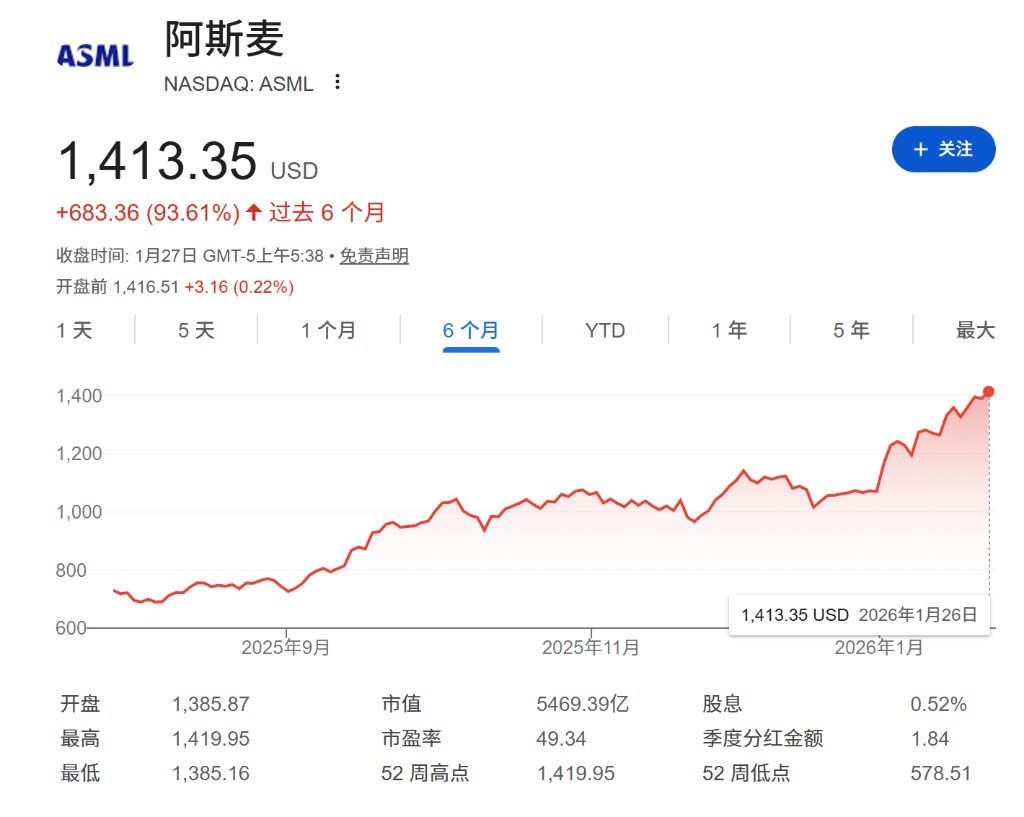
Market focus is shifting from merely looking at current performance to longer-term growth potential. Morgan Stanley's analyst team predicts that ASML's fourth-quarter orders could reach €7.27 billion, significantly higher than the previous market expectation of €5 billion. Analysts point out that the market has largely digested the expectations of moderate growth in 2026, and the current investment logic is rapidly shifting towards 2027, which is expected to be a key turning point for ASML's performance explosion, with revenue expected to grow by 28% year-on-year.
This optimistic expectation is strongly supported by the capital expenditure plans of downstream chip manufacturers. With the surge in demand for AI-related cloud services and the memory chip shortage driving up prices, major customers, including Taiwan Semiconductor, Samsung, and SK Hynix, are planning to significantly increase capital expenditures in 2026 to enhance production capacity. As the core supplier of lithography systems, ASML will directly benefit from this investment frenzy aimed at competing for future computing power dominance.
Monopoly on EUV Technology, "The Only Player"
ASML's core position in the supply chain stems from its exclusive control over extreme ultraviolet (EUV) technology. EUV lithography machines use a light beam that is only 13.5 nanometers thick—compared to the human hair diameter of about 80,000 to 100,000 nanometers—to print tiny circuits on silicon wafers. This precision equipment is essential for producing high-end microprocessors designed by companies like NVIDIA.
John West from semiconductor consulting firm Yole Group points out that in the EUV field, ASML is "the only player in town." Analysts estimate that with high-throughput machines, ASML controls about 90% of the lithography system market and is the sole manufacturer of EUV technology. In this technology, tin droplets are vaporized by lasers 50,000 times per second to generate the required light source.
This technological monopoly allows ASML to keep pace with chip design giant NVIDIA, sharing in the trillions of dollars of value created by the global AI arms race. Although facing competition in the low-end deep ultraviolet (DUV) market from Nikon, Canon, and China's SMEE, experts believe that ASML's dominance in the advanced chip sector is unlikely to be shaken in the coming years
Downstream Giants Ignite Capital Expenditure Frenzy
In response to the explosive demand for AI chips, major global chip manufacturers are significantly increasing their capital expenditures, which directly benefits ASML. Analysts estimate that about a quarter of chip manufacturers' capital expenditures are allocated to lithography equipment, and this proportion may be even higher in the AI chip sector.
According to Reuters, citing LSEG data and analyst estimates, the expenditure plans of major manufacturers for 2026 are as follows:
Taiwan Semiconductor: As ASML's largest customer, plans to increase capital expenditures by 37% to $56 billion.
Samsung: Expected to increase spending by 24% to $40 billion.
SK Hynix: Plans to increase by 25% to $22 billion.
Micron: Plans to significantly increase by 45% to $20 billion.
Strong demand from companies like Apple, Google, and High-Speed Transmission further drives this trend. Mizuho analyst Kevin Wang also pointed out that growth in the Chinese market is expected in 2026. Dan Hutcheson, a senior researcher at TechInsights, vividly compared the chip industry, which invests billions in ASML tools, to changing the engine of a Formula 1 car mid-race, highlighting the high risks involved.
2027: Performance Explosion and Capacity Challenges
Morgan Stanley's analysis indicates that while market expectations for 2026 mainly focus on revenue growth of about 10% and a stable gross margin of around 52.5%, the real investment opportunities lie in 2027.
The firm expects that driven by three major factors, demand for EUV equipment may reach 80 units in 2027, pushing revenue to €46.769 billion and gross margins up to 56%. These three driving forces include: Taiwan Semiconductor's early expansion of A14 process capacity, large-scale catch-up investments by DRAM manufacturers, and a rebound in demand from logic chip manufacturers including Intel and Samsung.
However, this explosive growth also brings potential supply bottlenecks. ASML's current cleanroom space aligns with the capacity target of approximately 90 low numerical aperture (Low-NA) EUV devices by the end of 2027. If demand indeed surges to 80 units in 2027 as expected, capacity margins will be very limited. Analysts warn that due to technical limitations, ASML cannot simply convert DUV production lines to EUV production lines; to break through the capacity of over 100 units per year, new cleanrooms must be built, which requires time and substantial capital investment.
It is noteworthy that the upcoming financial report will be ASML's last to disclose quarterly order data. Starting next quarter, the company will only provide annual backlog order updates, making the disclosed order data particularly critical for investors to assess future trends
