


"We really messed up"! Ultraman rarely live-streams "reflection": GPT-5 once took a detour, writing code will no longer be important

Ultraman acknowledged that OpenAI has become "specialized" in the development of GPT-5 due to an excessive focus on programming and reasoning, and in the future, it will return to the path of general models. He predicted that the software development paradigm will undergo a complete transformation: writing code will no longer be important, and "achieving goals with the system" will be the core, leading to an increase in demand for engineers. In addition, he warned about AI biosafety risks in 2026, emphasizing the need to build a "resilient" defense system, while human attention and creativity will become the ultimate scarce resources in an abundant era
Highlights of the Ultraman Interview
- Transformation of Software Development Paradigms: Ultraman believes that the demand for engineers will not decrease but will significantly increase in the future. However, the focus of work will shift from the foundational tasks of "coding and debugging" to higher-level goals of "achieving system objectives," leading to a significant decline in the importance of the specific act of writing code.
- The Arrival of Personalized Software Era: With the enhancement of AI capabilities, a large number of software tailored for individuals or very small groups will emerge in the coming years, allowing everyone to continuously customize their own exclusive tools at a very low cost.
- Evolution of Models Will Outpace Humans: Ultraman predicts that in the future, models will learn new skills faster than humans, achieving milestones such as mastering unfamiliar environments and complex tools with "just one explanation" or even "self-learning."
- Self-Correction of OpenAI's Route: Ultraman acknowledges that in the development of the ChatGPT-5 series, an excessive focus on reasoning and programming capabilities led to a "lopsided" development of general abilities. In the future, there will be a recalibration aimed at creating a well-rounded "general-purpose" model.
- Shift in AI Safety Focus to "Resilience": In the face of increasingly severe risks such as biological safety, Ultraman advocates that safety strategies should shift from mere "prohibition and blocking" to enhancing the system's "resilience," building safety infrastructure similar to fire regulations through AI's own technological advancements.
- Redefinition of Scarce Resources: In a world where AI greatly reduces the costs of creation and production, software products themselves are no longer scarce. Human "attention" and "original good ideas" will become the most core and scarce resources in commercial competition.
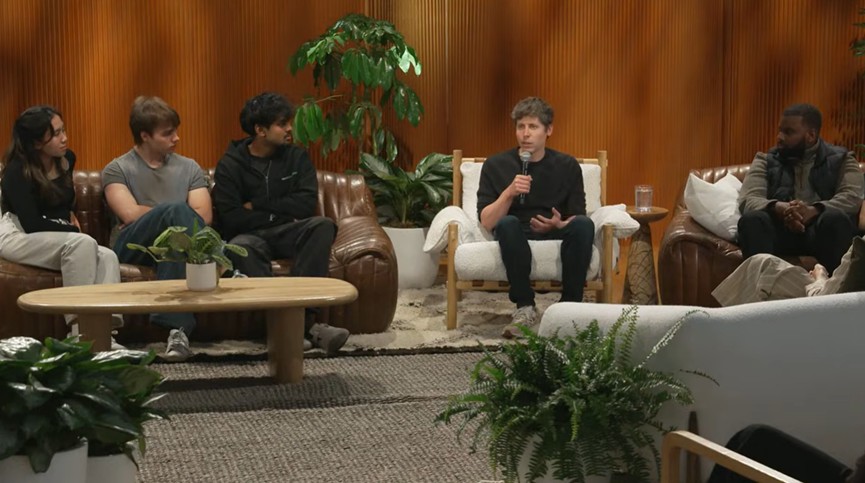
OpenAI CEO Ultraman admitted in a recent live discussion that the company deviated from its path in the development of the ChatGPT-5 series models, overly focusing on programming and reasoning capabilities at the expense of other abilities. He also predicted that as AI reshapes the way software is developed, traditional "coding" work will become less important, while the demand for engineering positions will significantly increase.
In this live discussion with AI industry practitioners, Ultraman stated that OpenAI "really messed up" on the ChatGPT-5 series models, leading to a noticeable imbalance in capabilities. He clearly stated that OpenAI will return to the development path of "truly high-quality general-purpose models," rapidly addressing other capability shortcomings while advancing programming intelligence.
Ultraman also expressed concerns about the biological safety risks that AI may trigger. He stated that he feels "very anxious" about the potential safety issues that may arise in AI by 2026, with biological safety being the greatest hidden danger. He believes that the strategy must shift from a blocking approach of "preventing everything from happening" to enhancing overall resilience against risks
OpenAI Acknowledges Model "Specialization," Will Return to General-Purpose Route
Altman admitted that in the development of the ChatGPT-5 series models, OpenAI intentionally focused most of its energy on intelligence, reasoning ability, and programming skills, but "sometimes focusing on one thing inevitably leads to neglecting other areas." This has resulted in the writing ability of this series of models being less stable than that of the 4.5 model.
He emphasized that, in the long run, the mainstream will definitely be truly high-quality general-purpose models. "When you want the model to help you generate a complete application, you not only need it to write the code correctly, but you also hope it has a clear, organized, and expressive personality when interacting with you."
Altman stated that OpenAI is confident in achieving strong capabilities across multiple areas within a single model, "this moment is especially critical." The company will continue to advance programming intelligence while quickly addressing shortcomings in other capabilities. He revealed that OpenAI is internally using a special version of the GPT-5.2 model, and feedback from scientists shows that "the scientific progress brought by these models is no longer at a level that can be considered optional."
Shift in Software Development Paradigm, Demand for Engineers Will Increase Rather Than Decrease
Regarding whether AI will reduce the demand for software engineers, Altman provided a counterintuitive answer: the number of people working as engineers may "increase significantly" in the future.
He explained that AI allows engineers to capture more work value and enables computers to achieve expected functions. This means that the time engineers spend on coding and debugging will significantly decrease, and more energy will be spent on "having the system get things done for you." In the future, there will be a large number of software tailored for individuals or very small groups, and everyone will continuously customize tools for themselves.
Altman believes that the demand for software engineering positions will not decrease but will only increase, "and the scale will be much larger than today, with a greater portion of global GDP being created in this way."
He also predicted that in the coming years, models will learn new skills faster than humans. When models first encounter completely unfamiliar environments, tools, or technologies, they can explore and use them reliably and stably with just one explanation or even without any explanation. "And to be honest, this moment doesn't feel far off."
Cost Is No Longer the Only Consideration, Speed Becomes a New Dimension
When discussing the economic aspects of models, Altman pointed out that model development has entered a new stage. "The issues people are concerned about are no longer just how to reduce costs, but more and more people are starting to demand faster output speeds and are even willing to pay higher prices for speed."
Historically, OpenAI has performed well in reducing model costs, with a very clear downward trend in the cost curve from the earliest preview versions to now. But the key change now is that, in addition to cost, the previously less emphasized dimension of "speed" is becoming equally important.
"In some scenarios, people are actually willing to pay a higher price for faster output, even if the price is much higher, as long as they can get results in one percent of the original time." Altman stated that OpenAI is now facing not just the issue of simply reducing costs, but finding a reasonable balance between the goals of cost and speed He stated that if the market indeed needs to continue lowering costs, OpenAI is confident in reducing model costs to a very low level, making "large-scale operation of agents" truly economically viable.
Biosafety Becomes the Biggest Concern for 2026
Regarding safety issues, Altman revealed clear time-related concerns. He expressed that he is "very nervous" about potential AI problems in 2026, with the greatest worry being biosafety.
"These models are already quite powerful in the biological field, and our current main strategy relies on restricting access and adding various classifiers to prevent people from using the models to harm humanity. But to be honest, I don't think this 'blocking' method can hold up for long."
Altman believes that AI safety, especially biosafety, must shift from preventing everything from happening to enhancing overall risk resilience, which he describes as "resilient safety." He compares this to humanity's history with fire: initially trying to ban its use, only to find that impractical, and then moving towards establishing fire safety regulations, fire-resistant materials, and urban infrastructure, ultimately making fire controllable and usable.
"AI will certainly pose many real risks, but it will also become part of the solution to these problems; it is both the problem itself and part of the solution." Altman stated that if a significant and serious accident involving AI were to occur this year, the most likely area for such an incident would be biosafety.
In the field of education, Altman takes a conservative stance. He stated that before understanding the long-term effects of technology on teenagers, there is no need to introduce AI at the kindergarten level, saying, "I have always believed that there should be no computers in kindergarten." He believes that at this stage, it is most important for children to learn and communicate through real things and real people, rather than staring at a screen.
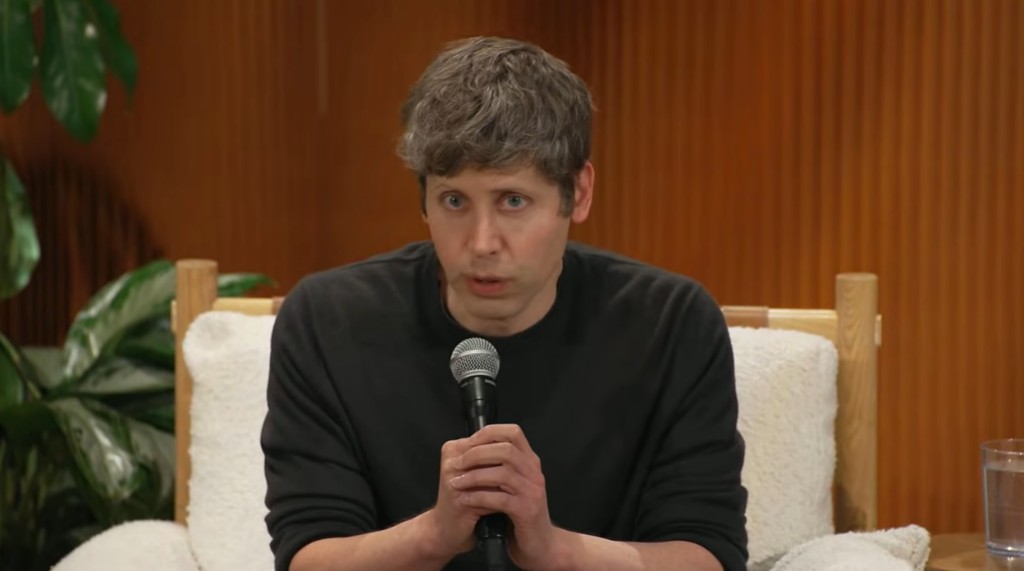
The following is the full interview:
Sam Altman:
Okay. Thank you very much for coming.
As we begin to envision the next generation of tools for developers and think about how to leverage the extremely powerful models that are about to be launched, we are very eager to hear your voices. We want to know what you want, what you are thinking, and answer your questions. But I hope today's communication will help us better understand what to build for you and how to make these powerful models truly effective.
I would like to start with a question from Twitter.
Question: What is your view on the "Jevons Paradox" in the field of software engineering? If AI significantly increases the speed of coding and reduces costs, will this reduce the demand for software engineers? Or will cheaper custom software greatly increase demand, allowing engineers to still have jobs in the coming decades?
Sam Altman: I believe the definition of the profession "engineer" will undergo tremendous changes.
In the future, more people may have computers execute their intentions or fulfill the needs of others, finding ways to create useful experiences for others. These individuals will create value far beyond what we see today and gain more returns from it.
However, the nature of this work, as well as the time you spend coding, debugging, or on other trivial tasks, will change significantly. This has happened many times in the history of engineering. So far, each transformation has allowed more people to participate and become efficient, resulting in more software for the world. There seems to be no sign of a slowdown in the demand for software.
My speculation about the future is that much of the software we use today was originally written for one person or a very small number of people, and we are continuously customizing software for ourselves. Therefore, I believe that in the future, more people will be able to command computers to do what they want, and the methods will be drastically different from today.
If you consider this behavior as "software engineering," then I believe we will see a significant increase in this demand, and I think a larger proportion of GDP in the world will be created and consumed in this way.
Are there any questions from the audience? If not, I have a long list here. Please go ahead.
Audience Question:
First, thank you for giving us the opportunity to ask you questions here.
From a consumer perspective, I am a heavy user of ChatGPT. I often see people on Reddit doing development, whether using Codex, Lovable, or Cursor. But now it seems the new bottleneck has become "go-to-market" (GTM). I can create things, but how do I find those who can derive value from my product? I feel this has become a bottleneck. I'm curious about your thoughts on this issue.
Sam Altman:
Before working at OpenAI, I managed Y Combinator (YC). I often heard entrepreneurs unanimously agree: I thought the hardest part was developing the product, but it turns out the hardest part is getting others to care about your product, or to use it, or to connect the product with people.
So I think this has always been extremely difficult. It's just that development has become so easy now that you feel this gap more acutely.
I don't have a simple answer to this. I believe building a business has never been easy; finding ways to create differentiated value and getting the go-to-market mechanisms to work, all the previous rules still apply here.
AI can make software development extremely easy, but that doesn't mean other aspects will become easy as well.
However, just as AI has changed software engineering, you are now starting to see people using AI to automate sales, automate marketing, and achieving some success. But I think this will always be a challenge because even in a materially abundant world, human attention remains a very limited resource So you always have to compete with others, trying to build your own marketing capabilities and figuring out how to distribute products. And every potential customer is busy with various other things.
I can paint a future version: even if "radical abundance" becomes a reality, human attention will still be the only remaining scarce commodity. So I expect it will still be difficult; you need to come up with creative ideas and build great products.
Audience Question:
Hello Sam, I’m George. I’m an independent developer. I’m building a method to orchestrate multiple agents based on the Codex SDK. I want to ask about your Agent Builder tool and your vision for the future of this product.
Currently, it’s just a series of workflows and prompts. I want to know, as a builder based on the Codex SDK, am I safe? In other words, do you think there will be room for many different types of multi-agent orchestration UIs in the future? Or will OpenAI take care of this area as well?
Sam Altman:
No, I think we still don’t know what the "right" interaction interfaces should look like. We don’t know how people will use it.
We see people building incredible multi-agent systems; we also see people building very nice single interaction threads. We can’t do everything on our own. And not everyone wants the same thing.
Some people might want to be like those old movies, facing 30 computer screens, staring at crazy data here and operating things there, moving things around. And I think there will also be people who want a very calm voice conversation mode, where they only say one thing to the computer every hour, and the computer handles a lot of things in the background without them needing to keep an eye on it. They are trying to seriously think about what they are saying and don’t want that feeling of being continuously "supervised" by a pile of agents.
Like many other things, people have to try different approaches to see what they like. The world may converge on a few mainstream patterns, but we can’t explore all patterns.
I think building tools to help people leverage these extremely powerful models to increase productivity is a very good idea. This is currently completely missing.
There is a huge gap between the capability ceiling of these models and the value that most people can currently extract from them, and this gap is widening. There will definitely be people building tools to really help everyone achieve this. No one has completely gotten it right yet.
We will also try to make our own version, but this seems to be a field with huge space, and people will have different preferences. If you have any features you hope we build, please let us know, and we can try.
Audience Question:
Hey Sam, I’m Valerie Chapman, and I’m building Ruth on the OpenAI platform. I’d love to hear your thoughts on the fact that women are currently losing about $1 million in income due to the wage gap I am very curious, how do you think AI can be used to address the economic disparities that have existed for decades?
Sam Altman:
I think the good news is—although there are many complex situations—one of the main pieces of good news is that AI will bring about a significant deflationary effect.
I have thought about this issue repeatedly because you can imagine some strange scenarios happening, such as all the money in the world being invested in self-replicating data centers or something like that. But overall, given the progress made in the work that can be done in front of a computer, and the transformations that seem likely to happen soon in robotics and other fields, our economy will face tremendous deflationary pressure.
I say "mainly good news" because there will also be some complex issues to deal with.
Aside from areas where prices cannot be lowered due to social or government policy restrictions (like building more housing in San Francisco), I expect other things to become extremely cheap, and this trend will be very strong and rapid.
Whether social structures naturally confer all advantages to certain people or not, this empowerment of individual capabilities seems to be on the rise, increasingly so. Until now, I still find it hard for people to fully grasp this point. You know, I mean by the end of this year, you could spend $100 to $1,000 on reasoning costs, plus a good idea, and you could develop software that in the past would have taken an entire team a year to complete. The scale of this economic transformation is, at least for me, hard to fully conceive in my mind.
This should be a very empowering thing for people. It means tremendous abundance and accessibility, meaning the costs of creating new things, new companies, discovering new sciences, and so on, will be significantly reduced. I think this should serve as a balancing force in society, giving those who have not been treated fairly in the past a real opportunity—as long as we don’t make major mistakes in related policies, although that is indeed possible.
I do worry, you can imagine in certain worlds, AI could lead to a high concentration of power and wealth. Therefore, preventing this from happening feels like it must become one of the main goals of policy.
Audience Question:
Hey, I’m Ben Hilac. I’m the CTO of a company called Raindrop. I’m curious, when you look to the future, how do you view the "specialization" versus "generalization" of models?
For example, GPT-4.5 is the first model that I feel truly excels at writing. I remember seeing its output at the time and thinking, "Well, this is really well written." But recently there has been a lot of discussion on Twitter and X about GPT-5's writing performance in ChatGPT, saying it feels a bit clunky and hard to read.
Clearly, GPT-5 is a better agent model, very capable in tool usage, and has great intermediate reasoning abilities, and so on. But it feels like the model's capabilities have become a bit "spiky," or more specialized—like the "spike" in programming ability is very high, but it’s not as prominent in writing. So I’m curious how OpenAI views this characteristic? Sam Altman:
I think we really messed this up. We will improve in future versions of GPT-5.x, hoping that its writing ability will be much better than 4.5.
At that time, we did decide— and I think the reasoning was quite sufficient— to focus most of our energy on version 5.2 to make it super strong in areas like intelligence, reasoning, programming, and engineering. Our resources (bandwidth) are limited, and sometimes focusing on one thing means neglecting another. But I believe the future mainly belongs to very excellent general models.
Even if you want to create a model that is very good at programming, it would also be great if it can write good articles. For example, if you want it to generate a complete application for you, you would want the copy inside to be good; when it interacts with you, you would want it to have some thoughtful, sharp personality and communicate clearly. Here, "good writing" refers to clear thinking, not flowery prose.
So I hope we can push future models to excel in all these dimensions, and I think we will. I believe "intelligence" is a surprisingly fungible capability, and we can do all these things well in a single model.
At the moment, it does seem to be a particularly important time to push what is called "programming intelligence." But we will strive to catch up and excel in other areas quickly as well.
I will now answer a few questions from Twitter. Please go ahead.
Audience Question:
I am the CTO of Unifi. Following up on what you just said, what we do is market automation (GTM Automation). One area we think a lot about and invest a lot of time in is the concept of "always on AI," a ubiquitous AI.
You said something that resonated with me, which is "intelligence too cheap to meter." For us to run millions, tens of millions, or even hundreds of millions of agents for our clients, the limiting factor is cost. What is your view on small models and the drastic cost reductions that developers will face in the coming months or years?
Sam Altman:
I think by the end of 2027, we should be able to provide some level of intelligence equivalent to GPT-5.2x or higher. Want to take a guess at a number? Otherwise, I’ll make a prediction. Does anyone want to guess?
I would say costs will drop at least 100 times.
But there is another dimension we haven't really considered in the past, and now, as model outputs become so complex, more and more people are urging us to increase delivery speed rather than reduce costs. That is: we are doing well in terms of descending along the cost curve. You can look at the progress we've made from the initial o1 preview to now.
But we haven't really thought about how to deliver the same output in 1/100 of the time (perhaps at a much higher price). I think for many of the application scenarios you mentioned, people will really want that speed We must figure out how to balance prioritizing both. Unfortunately, these are two very different issues. But assuming we push hard to reduce costs, and assuming this is also what you and the market want, then we can go a long way down the path of cost reduction.
Alright, let me answer a few questions from Twitter.
Twitter Question:
The current interface is not designed for agents, but we see the rise of "apps built for me." Why will innovation in custom interfaces further accelerate the trend of micro apps?
Sam Altman:
Yes, this is a phenomenon I noticed recently when using Codex. I no longer see software as a static thing.
If I have a small problem, I expect the computer to write a piece of code to help me solve it immediately. I think this trend will go further. I suspect the way we use computers and operating systems will change fundamentally.
I don't think it will turn into, "Oh, every time you need to edit a document, the system will write a new version of the word processor for you on the spot," because we are already very accustomed to the existing interface, and it's important that the buttons are still in the same place as last time.
But for many other things we do, I think we will find that we expect software to be specifically written for us. Maybe I want to use the same word processor every time, but I do have some repetitive quirks that I hope the software can increasingly customize.
You know, this could be static or slowly evolving software, but it is written for me, and the way I use it is different from the way you use it. The idea that our tools continuously evolve and "converge" specifically for us seems inevitable.
Of course, within OpenAI, people are now very accustomed to using Codex in their workflows. Everyone has their unique custom habits, and the ways of use are vastly different. This seems to be an inevitable trend, and I think it's a very good direction for building products. Figuring out the future forms and how people will operate looks great.
Questioner:
When the functionalities of startups will soon be replaced by model updates, how should builders think about the "durability" of their products? What layer of the tech stack do you commit to never swallowing?
Sam Altman: We touched on this topic a bit before. It's easy for people to mistakenly believe that the "physical laws" of business have completely changed, but they haven't. They may change over time, but the real change right now is that you work faster, and the speed of creating new software is much faster.
However, all the other rules for building a successful startup—finding ways to acquire users, solving the go-to-market (GTM) problem, providing sticky products, establishing some kind of moat, network effect, or competitive advantage, whatever you call it—none of that has changed The good news is that these rules haven't changed for us either. There are many things that startups are doing that we should have done a long time ago in a perfect world, but it's too late, and others have already established real, lasting advantages, and this situation will continue to happen.
When people ask me these kinds of questions, I always provide a general thinking framework: If GPT-6 is an amazing, huge update, will your company be happy or sad?
I encourage everyone—because we really want to continue making significant progress—I encourage everyone to build those products that you desperately want the model to improve. There are many directions for such building. Conversely, if your product is just a small patch on the edge of the model, while it might work if you have established enough advantages before the model upgrade, it is a much harder and more stressful path.
Questioner:
Let me ask another one. Back to the question in the room. What is the realistic timeline for agents that can autonomously run long workflows without continuous human intervention? After all, even simple on-chain tasks often crash after 5 to 10 steps. Does anyone at OpenAI want to weigh in? Please go ahead.
OpenAI Employee:
I think it really depends on the type of task. Internally at OpenAI, we see people prompting Codex (the code model) in very specific ways. Maybe they are using the SDK, like a custom harness that keeps prompting it to continue, but they can basically let it run indefinitely. So I don't think it's a question of "when," but rather a question of broadening the vision.
If you have a very specific task that you know well, you can try it now. If you start thinking, "Okay, I want to prompt the model to start a startup," that's a much more open question, and the verification loop is much harder. So I suggest figuring out how to break it down into different questions that allow the agent to self-verify, or that allow you to verify its final output at the end. Over time, we can enable agents to perform more and more tasks.
Audience Question:
Thank you. Hi, Sam. I want to return to the question about "human attention" and GTM (go-to-market). I always think of human attention as the limiting factor on the consumer side. On the production side, for all builders, the limiting factor is "the quality of ideas." I spend a lot of time helping AI companies with GTM, and often the products aren't even worth the users' attention. So I want to ask, what tools can you build to improve the quality of ideas that people come up with?
Sam Altman:
It's popular now to refer to AI's output as "slop," but there is also a lot of human-made slop in the world. Coming up with good new ideas is very hard, and I increasingly believe that our thinking is limited by our tools.
I think we should try to build tools that help people come up with good ideas. I believe there are many opportunities for this. As the cost of creation continues to plummet, we will have such tight feedback loops to try ideas that we will find good ideas faster Moreover, as AI is able to discover new sciences and write very complex codebases, I am confident that a whole new realm of possibilities will emerge.
However, many people have had the experience of sitting in front of an AI (like a code generator) and being unsure of what to ask next. If we could build tools to help you come up with good ideas—I believe we can do that. I believe we can analyze all your past work and code to try to figure out what is useful or interesting to you and continuously provide suggestions.
If we could provide a truly great "brainstorming partner." I have three or four people in my life, and every time I spend time with them, I leave with a lot of ideas. They are very good at asking questions or providing you with a foundation to build on. For example, Paul Graham (founder of Y Combinator) is incredibly strong in this regard.
If we could build a "Paul Graham robot" that you could interact with in the same way to help generate new ideas, even if most of them are bad ideas, even if out of 100 ideas, 95 of them you say "absolutely not." But I believe things like this would make a significant contribution to the number of good things emerging in the world. And the model should feel capable of this.
For GPT-5.2 (a special version we use internally), we heard for the first time from scientists that the advancements of these models in science are no longer trivial. Since a model can propose new scientific insights, I can't believe it can't propose new insights about product building—as long as there are different guiding mechanisms and slightly different training methods.
Audience Question:
Hello everyone. I am Theo, a developer YouTuber and also a founder of Y Combinator. I really want that Paul Graham robot. I want to ask a slightly different question, more about the technical side. I really love how the building blocks (technology) we use are constantly evolving. I have experienced some crazy revolutions in the web space, like the shift to TypeScript and Tailwind, etc.
As the models and the tools we use to build get better, one concern I have is: we might get stuck in our existing ways of working, just like the American power grid was built in a certain way, leading to things getting worse and we can't really change it. Do you see this potential? Are we laying the groundwork with existing technology that makes it harder to change in the future? Because even trying to get the current models to use technology updated two years ago feels like pulling teeth. Do you think we can guide the models to use new things, or are we just patching things up on the existing technology foundation?
Sam Altman:
I think we will really do well in getting the models to use new things. Essentially, if we use these models correctly, they act like general reasoning engines. The current architecture indeed has a lot of world knowledge built in. But I believe we are moving in the right direction I hope that in the coming years, models will be able to update knowledge and learn new skills faster than humans. One milestone we will be proud of is when the model can reliably use and correctly respond to entirely new things—new environments, new tools, new technologies, etc.—after just one explanation (or one exploration). This doesn't feel far off.
Audience Question:
Sorry, I have a question that I think you might have touched on. As a scientist, and one who is a bit older. When you do a scientific project, it often generates multiple ideas for further research. So the ideas grow exponentially, while the time a scientist has to execute those ideas decreases linearly. The way these tools accelerate it is incredible.
But we are all greedy and want more. You mentioned this earlier, but do you think there will be a shift, aside from helping us pursue those interesting ideas in a shorter time, where models take over entire research endeavors? If so, do you think this will come from existing algorithms, or will it require new ideas or something like a world model?
Sam Altman:
I think we are a long (or quite a long) way from models conducting truly fully closed-loop autonomous research in most fields.
We can look at fields like mathematics and say, “Okay, that doesn’t require a wet lab or physical input.” Maybe you can make great progress through very hard thinking and continuously updating the model. But even there, the mathematicians who are currently making the most progress using models are still very deeply involved. They look at intermediate progress and say, “No, this doesn’t feel right; my intuition tells me there’s something different on this path.” But I’ve met a few mathematicians who now say they spend their whole day collaborating with the latest models and making rapid progress, but what they are doing is very different from what the model does.
Honestly, it feels a lot like the period in chess history after “Deep Blue” defeated Kasparov. There was a time when AI was stronger than humans, but “human + AI” (where humans pick the best move from AI’s 10 options) was stronger than pure AI. But soon after that, AI became stronger again, and human intervention only tended to mess things up.
I have a hunch that for many types of research, over time, it will become extremely complex to the point where AI’s performance in understanding multi-step tasks will surpass most people, if not everyone.
However, in terms of creativity, intuition, and judgment, the current generation of models seems to be quite far off. I can’t think of any principled reason why we wouldn’t be able to reach that level, so I assume we will eventually get there.
But today, I don’t think just telling GPT-5 or GPT-6 “go solve math problems” will outperform a few very talented individuals using AI assistance to do mathematical research. These individuals can judge “this is a good direction,” or even if we can verify and say “hey, you made a great proof, put it back in the training set,” there are other things happening in between However, you mentioned a point about workflow, which is that you solved one problem but raised many new questions. This is exactly what is so cool about communicating with scientists who actively use AI. I mean, they consume a lot of GPU power in the process, but I think a new skill has emerged, which is the ability to list 20 new questions and then conduct a "breadth-first search" on them. I won't delve too deeply into any one question, but rather use AI as an "infinite graduate student"—as someone has described it. In fact, I've recently upgraded this description to "infinite postdoc."
Regarding the automation of physical sciences, we often discuss whether we should establish automated wet labs for every field. We are open to this, but it’s also possible that the world will design great experiments on its own, utilizing existing equipment and willingly providing data. Watching the scientific community embrace our new models and their eagerness to help seems to indicate that this model is viable. This will clearly build a world that is more relaxed, better, more distributed, and brings together more smart people and different devices.
Questioner:
Hi Sam, I'm Emmy. I'm a student at Stanford and run a biosafety startup. Following your discussion on scientific experiments and the future of cloud labs, my team has spent a lot of time thinking about how to prevent the dangers posed by AI-assisted biological recombination, while also considering how to leverage AI to enhance safety infrastructure. So my question is, what position does safety hold in this future roadmap? How do you view these issues?
Sam Altman:
Are you referring to safety in general or specifically biological safety?
Questioner:
Both, but preferably biological safety.
Sam Altman:
Well, by 2026, AI may have problems in many areas. One area we are very concerned about is biology.
Current models perform quite well in biology. Our strategy—not just OpenAI, but the whole world—is to try to limit who can access these models and set up a bunch of classifiers to prevent helping people create new pathogens. But I think this approach won't hold up for long.
I believe the shift the world needs to make in AI safety (especially AI biological safety) is from "blocking" to "resilience."
My co-founder Wojtek used an analogy about fire safety that I really like. Fire has brought many wonderful things to society, but it also started burning down cities. We have tried various measures to limit the use of fire. I just learned this weekend that the term "curfew" actually comes from the old practice of not allowing fires to prevent cities from burning down. Later, we got better at resilience in dealing with fires; we established fire codes, invented flame-retardant materials, and so on. Now, as a society, we have done quite well in this regard I think we need to think about AI in the same way. AI does pose real problems for bioterrorism and cybersecurity, but AI is also part of the solution to these problems. It is also the solution to many other issues.
I believe we need a collective effort from society to provide this resilient infrastructure, rather than relying on laboratories to always block what needs to be blocked. After all, there will be many excellent models emerging in the world.
We have been communicating with many biological researchers and companies to discuss how to respond to new pathogens. Many people are interested in this issue, and many have provided feedback that AI does seem to be very helpful in this regard, but this will not be a purely technical solution. You need the whole world to think about these things in a way that is different from before.
So I am very anxious about the current situation, but apart from this resilience-based approach, I see no other path. And it seems that AI can indeed help us achieve this quickly. If something major goes wrong with AI this year—something obvious—I think the biological field is a reasonable area to speculate.
If you look ahead to next year and the year after, you can imagine that there are many other things that could also go awry.
Questioner:
Hi, my name is Magna. My question is a bit about human collaboration. When we talk about the advancements in AI models, I think they become very good at allowing you to quickly learn a subject or topic on your own. This is something we've explored in ChatGPT with educational labs, and I value and appreciate that. But one thing I often reflect on is the role of other humans and human collaboration. If you can get answers at your fingertips, why would you still take the time, or even overcome friction, to ask another person?
Sam Altman: Well, this is also something I've been thinking deeply about, related to the point you made earlier. Since all AI programming tools can complete human team tasks at a faster pace, when we think about collaboration, cooperation, and the output of collective intelligence, I know that "humans + AI" is a very powerful approach.
Audience:
But what about "multiple humans + AI"? Does that make sense?
Sam Altman:
Absolutely makes sense. There are many layers to this.
I am older than most of you; I was in middle school when Google first came out. At that time, teachers tried to get kids to promise not to use it because they felt that if you could look anything up with a flick of your finger, then why bother coming to history class? Why memorize anything?
That seemed completely crazy to me. My thought at the time was: actually, I would become smarter, learn more, and do more things. This is a tool I will coexist with as an adult. If I don't learn to use it and am forced to learn something that assumes it doesn't exist, that is absurd. It feels like being forced to learn how to use an abacus (or a slide rule; I don't even know what came before calculators) just because that is an "important skill to learn." That is no longer a valuable skill I have the same feeling about AI tools. I understand that under the current teaching methods, AI tools are a problem. But this indicates that we need to change the way we teach. It's not that we don't want you to use ChatGPT to help you write—because the world is going to be like that. You still need to learn to think, and learning to write or practicing writing is very important for learning how to think. But it's likely that the way we teach you to think and the way we assess your thinking ability has changed, and we shouldn't pretend it hasn't.
So I completely feel that this is fine. Those extreme autodidacts in the top 10% have already done very well. We will figure out new teaching methods to help other students catch up.
Then there's the other point you mentioned: how to make this a collaborative thing, rather than just you alone at your computer learning, performing, and doing amazing things?
We haven't seen concrete evidence in this area yet, which is also something we are trying to measure. I suspect that in a world where AI is ubiquitous, human connections will become more valuable, not less. People will place more value on coming together to work with others.
We are already starting to see people exploring interfaces that make this easier. When we think about making our own hardware, our own devices, we have thought a lot—perhaps even first thought—about what a "multiplayer collaboration + AI" experience would look like.
My feeling is that while no one has completely cracked this yet, we will be surprised to find that AI empowers this in a way that no other technology ever has. You could have five people sitting around a table with a small robot in the middle, and as a team, your productivity would be much higher, and you would get used to this norm. For example, every team brainstorming session, every attempt to solve a problem, would involve AI helping the team do better.
Audience:
That's great. Just a reminder, if there's any demand, just let you know, and you might be able to make it, right? (laughs)
Sam Altman:
Oops, I let that slip.
Audience: Thank you. I want to ask, as agents start to run and operate production systems more, especially at scale, where do you think the most severely underestimated failure modes are? For example, safety, cost, reliability? Related to this, where is the daunting work currently underfunded?
Sam Altman:
There are problems everywhere. You mentioned one point that personally surprises me a lot, and I think it will surprise many people here.
When I first started using Codex (the code generation model), I said, "Listen, I don't know how this thing will develop, but I absolutely will not give this thing complete, unsupervised access to a computer." I was very confident about that.
But I only held out for about 2 hours. Then I thought, "You know what, this seems reasonable, what this agent is doing seems really reasonable. I hate having to approve these commands every time. I'll just open the permissions for a while and see what happens." Then I never turned off full permissions again. I think others have similar experiences.
So my general concern is: the power and convenience of these tools are so high that, although the failure rate is very low, when a failure occurs, it can be catastrophic. We may slide into a "YOLO" (You Only Live Once) mentality, thinking "I hope nothing goes wrong."
As the capabilities of models become stronger, it becomes increasingly difficult to understand everything they do. If there is a misalignment in the model, if some complex issue arises after weeks or months of use, or if you introduce some security vulnerability into what you are creating... You may have different views on the sci-fi level of AI going out of control, but what I believe will happen is: the pressure to adopt these tools, or the joy and power of using them, is so immense that people will be swept along without fully considering the complexity of running these things and how to ensure that the sandboxes they set up are safe.
My general concern is that capabilities will rise sharply. We will become accustomed to how models operate at a certain level and decide to trust them. If we do not establish very good, what I call "macro safety infrastructure," we will fall into some crisis as if we were sleepwalking.
I believe establishing this safety infrastructure will be a great entrepreneurial direction.
Audience:
Hi, I want to return to the topic of education. My name is Claire, and I am a sophomore majoring in Cognitive Science and Design at Berkeley. I saw classmates using ChatGPT to write papers and assignments in high school. Now that I am in college, we are discussing issues related to AI policy, coursework, computer science, and the humanities. I want to go back to the concept of kindergarten and middle school, during those formative years that really shape how you solve problems, write, and think. What would it be like for AI to enter the classroom? As a current father, how do you foresee AI shaping education during these growth periods?
Sam Altman:
Overall, I support keeping computers away from kindergarten. I believe kindergarten children should be running around outside, playing with tangible objects, and trying to learn how to interact with each other. So, not only do I not recommend using AI in most kindergartens, but I also wouldn't put computers in most of the time.
I think in developmental psychology, we still do not understand all the impacts of technology. There have been many articles about the effects of social media on teenagers, and it looks quite bad. But I have a feeling that, unfortunately, the impact of a lot of technology on young children is even worse, and it is currently discussed relatively little. I think before we better understand this, kindergartens may not need to use a lot of AI.
Audience:
Hi, my name is Alan, and I work in the biopharmaceutical industry. Generative AI has been very helpful in writing clinical trial documents, accelerating many things, which is great. We are also trying to use it for drug design, especially compound design. One problem we encounter is 3D reasoning. I wonder if there will be a turning point, or if you see a future in this area? Sam Altman: We will solve this problem. I don't know if it can be solved by 2026. But it's a super common need, and I think we know how to do it. We just have a lot of other urgent areas to push forward, but we will get there.
Audience:
Thank you. Hi Sam, I'm Dan. I just dropped out of a university in London and joined the W26 Y Combinator batch. I have two quick questions. First, my parents are still somewhat pressuring me to finish my degree. Do you think the current state of universities can sometimes be a limitation? Second, do you do angel investing?
Sam Altman:
I also dropped out of university, and it took my parents 10 years to stop asking me when I would go back. So I feel like parents are like that; they love you and try to give you what they think is the best advice. You just keep explaining to them: if you want to go back, you can go back anytime, but the world is different now, and it will continue to become different.
Everyone has to make their own decisions, but I think you need to make your own decisions rather than doing what society tells you to do.
Personally, I think if you are an AI builder, staying in university right now might not be the best use of your time. If you are an ambitious, high-agency, and driven person, this is an extraordinary time. And you know, you can always go back later. I think you just tell your parents that this doesn't mean university isn't the right thing for many people, nor does it mean it won't be the right thing for you someday in the future, but right now you need to do this, and I think they will eventually understand.
Regarding the second point, I respect that entrepreneurial spirit, but I no longer do angel investing. I miss it. But I'm busy with OpenAI, and it would get weird—if the company I end up investing in is a major client of OpenAI, I decided it's simpler not to invest.
Audience:
Hey Sam, I'm Michael from WorkOS. We do a lot around authentication, identity, and login. So I have a feature request: sign in with my ChatGPT account. I think a lot of people would like this.
Sam Altman: We will do this. People have been asking me for this feature. What do you need? Do you want people to bring their Token budget, or do you want them to bring ChatGPT's memory?
Audience:
Yes, that's my question. The Token budget definitely needs to be there. But I think there are other things, like what MCP servers does my company have access to? Or what memories does ChatGPT have about me? What projects am I working on? I'm curious how you think about this because ChatGPT knows a lot about me from both a work perspective and a very personal perspective. How should developers leverage this? Sam Altman: Yes. So we really want to figure out how to do this. But it's quite scary because ChatGPT knows too much about you.
If you tell a close friend a bunch of secrets, you can be relatively confident that they know the exact social nuances—when to share what with whom, and when one thing is more important than another. Our models haven't fully reached that level yet, although they are getting quite good.
If I connect my ChatGPT account to a bunch of websites and then say, "Use the information you know from all my chat logs and connected content to judge when to share what," I would feel uncomfortable.
But when we can do that, it’s obviously a cool feature. In the meantime, I think just doing something about the Token budget—like if I pay to use the Pro model, then I can use it on other services—seems like a cool thing. So I think we will at least do that, and we will try to find the right way to share information, but we really don’t want to mess this up.
Audience:
Hey Sam, my name is Oleg. I think we all agree that software development as a craft has changed dramatically recently. But at the same time, there are still job postings for software developers at OpenAI on LinkedIn. I'm curious, how have interviews changed over the past few months or years?
Sam Altman:
We will continue to hire software developers. But for the first time—I know every other company and startup is thinking about this too—we plan to significantly slow down our growth rate (referring to headcount) because we believe we can do more with fewer people.
I think many of the obstacles we face right now, or that other companies face, are simply because the internal policies most companies have established do not account for the situation where "most colleagues are AI." It will take some time to adapt.
But what I think we shouldn't do—and I hope other companies don't do this either—is to hire like crazy and then suddenly realize that AI can do a lot of things, and you don't need that many people, and then have to have some very uncomfortable conversations (layoffs).
So I think the right approach for us is to slow down hiring but keep hiring. I don't believe that in the future OpenAI will have zero employees, but for a long time, we will have a gradually increasing number of people doing a lot more things. This is also how I expect the overall economic landscape to look.
As for what interviews are like, they haven't changed as much as they should have, but I was just discussing with someone at a meeting how we want them to change. We basically want to sit you down and have you do something that would have taken a person two weeks to complete last year, and then see you complete it in 10 or 20 minutes.
That's the high priority point: you want to see people being able to work very efficiently in this new way through interviews. I think software engineering interviews have been bad for a long time, perhaps not very relevant, but now they are becoming even less relevant There is a more general point here, which these questions imply: Will future companies hire fewer people and have a lot of AI colleagues? Or will the future winners be completely AI companies—like a cabinet full of GPUs, with no humans? I really hope it's the former.
There are many reasons to suggest it might lean towards the latter. However, if companies do not actively adopt AI, if they do not figure out how to hire people who can effectively use these tools, they will ultimately be eliminated by fully AI companies that have no humans and do not need to adhere to foolish policies that prevent large companies from using AI. This feels like it would be a very unstable situation for society.
We have been trying to figure out how to talk about this issue because it sounds like we are tooting our own horn, but I think it is very important for companies to rapidly and widely adopt AI.
Audience:
Hi Sam, I'm Cole. I'm a creator and filmmaker. I think especially in the past year, AI has completely changed the way we tell stories, and thus changed the way we see ourselves. There have been many interesting experiments in the creative field, like Sora, which is a very interesting use of "self" as a canvas, allowing you to use AI to place yourself in all these fantastical scenarios. I'm really curious, as these models continue to advance, where do you think the relationship between human creative identity and AI-assisted creation will head?
Sam Altman: The area we can study and learn the most from right now is image generation. It has been around the longest. The creative community uses it, hates it, and loves it the most.
There are many interesting observations in this, one of which is: if consumers are told that an image was created by a human rather than AI, they report significantly higher appreciation and satisfaction.
I think this will be a profound trend for decades to come: we care a lot about other people and are indifferent to machines. Among all the derogatory terms for AI, "Clanker" is my favorite. I think it evokes a strong emotional response from people.
You can see these incredible, beautiful images that, at least in my opinion, are "Clanker-made." Once you are told that it was made by AI, many people's subjective appreciation drops sharply.
Last year I saw something online where they went to find people who claimed to really hate AI-generated art (static images). These people would also say, "I can definitely tell which ones are AI-generated because they are terrible."
Then they showed them 10 images and asked them to rank their favorites. Half were completely human-made, and half were completely AI-generated. The results were quite consistent; they would rank the AI-generated ones at the top. Then once told the truth, they would say, "Actually, I don't like it; it's not what I wanted."
This is a kind of test: what do you really like? When I finish a book I enjoy, the first thing I want to do is look up the author, learn about their life, and what led them to write that book because I feel a connection with this person I don't know, and I want to understand them I think if I read a great novel and then found out it was written by AI, I would feel a sense of sadness and loss.
I believe this will be a profound and lasting trend. However, if an artwork has even a little bit of human guidance—how much counts as little, we will have to observe over time—people seem to not have that strong (negative) emotional reaction. This has been the case for a long time; if digital artists use Photoshop, people still appreciate their art.
So based on the behaviors I see now from creators and consumers, my expectation is that people, their life stories, and their editing or curatorial processes will become very important. Broadly speaking, at least from what we have learned in images, we do not want art that is completely generated by AI.
Audience:
Hey Sam, my name is Keith Curry, and I just graduated from San Francisco State University. My question revolves around personalization and memory. The first part is how do you think this will evolve over time? The second is your thoughts on more granular views, like memory grouping? For example, this is my work identity, this is my personal identity. This way, when you make different prompts, you can be more selective about what to include.
Sam Altman:
Yes. We will push hard on memory and personalization. It’s clear that people want it, and it provides a better tool usage experience.
I’ve gone through a shift myself, but at this point, I’m ready for ChatGPT to look at my entire computer and the whole internet and know everything. Because the value it brings is too high, I don’t feel uncomfortable about it like I used to. I really hope all AI companies take safety and privacy very seriously, and I hope society does too, because the utility is just too great.
AI will understand my life. I won’t hinder that. I also feel like I’m not ready to wear those glasses that record everything, for many reasons that still make it uncomfortable, but I am ready to say, “Hey, you can access my computer. Figure out what’s going on, what’s useful to me, understand everything, and have a perfect mapping of my digital life.”
I’m lazy. I think most users are lazy too. So I don’t want to sit there having to group: this is work memory, this is personal memory. What I want, and I believe is possible (which we touched on a bit earlier), is that AI has such a deep understanding of the complex rules, interactions, and hierarchies in my life that it knows when to use what and where to expose what.
We better figure this out because I think this is also what most users want.
Audience:
Hi Sam, my name is Luan. I’m an international school student from Vietnam. My question is, what do you think are the most important skills people should learn in the age of AI?
Sam Altman: These all fall under soft skills. None of them are the kind of advice that was obviously correct like “go learn programming” was for a while but isn’t anymore.
These skills include: becoming highly proactive (high agency), being good at generating ideas, being very resilient, and being able to adapt to a rapidly changing world I believe these will be more important than any specific skills, and I think they are all learnable.
This is one of the surprises I've encountered as a venture capitalist: you can take a group of people and, in a three-month boot camp-like environment, make them extremely formidable and achieve all the points I just mentioned across all dimensions. This is very surprising. It was a significant cognitive update for me. So I think these might be the most important skills, and they are very easy to acquire.
Sam Altman: Thank you all for coming to share. We really hope to get feedback on what you want us to build.
Assuming we have a model that is 100 times stronger than the current model, with 100 times the context length, 100 times the speed, costs reduced by 100 times, perfect tool invocation capabilities, and extreme coherence... we will get there.
Tell us what you want us to build. We will be around for a while. If you feel like, "Hey, I just need this API" or "I just need this primitive" or "I just need this runtime" or whatever it is—we are building it for you, and we want to get it right.
Thank you all for coming
