


Focus of the earnings reports of the four tech giants in the US stock market: Apple's execution ability, Microsoft's computing power, Meta's investment, Tesla's imagination

The trading logic of this earnings report is extremely clear: instead of focusing on the earnings per share over the past three months, it is better to pay attention to the guidance on capital expenditures and the realization rate of growth stories. Meta faces a serious risk of uncontrolled capital expenditures, and if the guidance exceeds expectations, the valuation will come under heavy pressure; Microsoft is at the sweet spot of the "computing power arms race"; Apple will once again prove its iron-fisted control over the supply chain; Tesla's fundamentals have shifted away from car manufacturing and evolved into a game regarding the SpaceX IPO and the timeline for Robotaxi
As the VIX index hovers around 16, the market holds its breath for the earnings season of tech giants. The trading logic for this earnings season is extremely clear: rather than focusing on the earnings per share (EPS) from the past three months, it is better to pay attention to the guidance on capital expenditures (Capex) and the realization of growth stories.
For investors, the most direct risk lies in the mismatch between narrative and cash flow: Meta faces a serious risk of uncontrolled capital expenditures, and if guidance exceeds expectations, valuations will come under heavy pressure; Microsoft, on the other hand, is at the sweet spot of the "computing power arms race," with Goldman Sachs expecting Azure's growth rate to return to over 40%, and any pullback is a buying opportunity.
Apple will once again prove its ironclad control over the supply chain. JPMorgan points out that even during a rising cycle of storage costs, Apple can still maintain its profit margins and exceed expectations with the iPhone 17 cycle; meanwhile, Tesla's fundamentals have shifted away from car manufacturing, evolving into a game about Musk's business empire (SpaceX IPO) and the timeline for Robotaxi.
Tesla: Electric vehicles are just a facade; shareholders want tickets to SpaceX
On the eve of the earnings report, Tesla shareholders' focus has fundamentally shifted. Retail investors have posed a very straightforward question on Say.com: "You once said that loyalty should be rewarded with loyalty. If SpaceX goes public, will long-term Tesla shareholders be prioritized?"
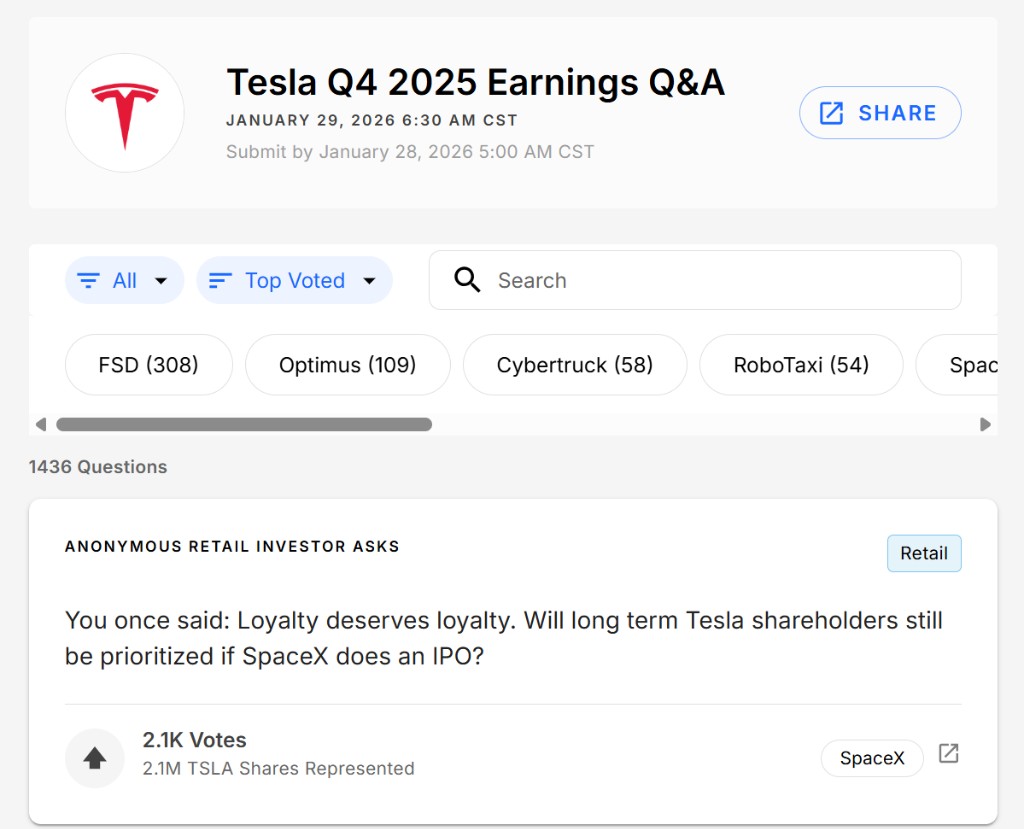
This anxiety stems from the valuation inversion and the weakness of the core business. SpaceX is seeking a valuation of $1.5 trillion, nearly double Tesla's current market value of $800 billion. In contrast, Tesla's own car manufacturing business has been disappointing: only 20,237 Cybertrucks were sold in 2025, a 48% drop from the previous year.
Investors are essentially demanding Musk to pay a "loyalty premium." Although Musk has verbally expressed a desire to take care of Tesla shareholders, the specific path implemented through the "directed share program" remains unclear.
Apart from the allure of SpaceX, Tesla's remaining story relies entirely on "imagination."
Management needs to address specific bottlenecks regarding Robotaxi during the earnings call, as well as when the so-called "unsupervised" FSD (Full Self-Driving) will truly be realized. Although Musk claims that autonomous driving is a "solved problem" and predicts it will be widespread by the end of the year, the market needs to see the expansion timeline for Robotaxi beyond Austin and the San Francisco Bay Area. As for the humanoid robot Optimus, despite Musk providing a timeline for sales by the end of 2027, the current situation of "no supply chain" makes this commitment full of uncertainties
Meta: A High-Stakes Gamble, Capital Expenditure May Exceed $110 Billion in 2026
Bank of America analyst Justin Post stated in a preview report that Meta's focus this quarter is not on whether Q4 performance can exceed expectations (which is highly likely, with revenue expected to be $59.2 billion), but on management's guidance for 2026 expenses—this sword of Damocles hanging over their heads.
The data is staggering. Bank of America predicts that Meta's total expenses in 2026 will soar to $153 billion to $160 billion, a year-on-year increase of 30-36%. Even more outrageous is the capital expenditure (Capex), which is expected to reach $109 billion to $114 billion. This insane investment primarily stems from infrastructure construction, including power transactions with nuclear energy companies and the newly established "Meta Compute" team.
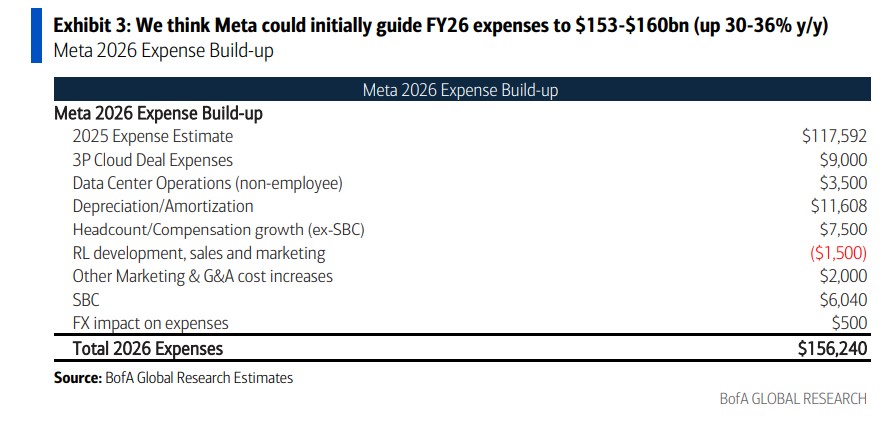 Despite Reality Labs laying off about 10% (1,000-1,500 people) to signal a contraction in the VR/metaverse business, the savings are far from enough to fill the AI gap.
Bank of America believes that as long as Meta can prove that these expensive GPUs and data centers can drive growth in its core advertising business (such as AI-driven precise targeting), the market will accept it. Additionally, the next-generation LLM model codenamed "Avocado" is expected to launch in the spring of 2026, which will be a key point to validate whether its massive investments are effective.
Microsoft: Azure's Growth Rate Returning to 40% is the Last Line of Defense for Bulls
Microsoft's stock price has fallen 13% since the Q1 earnings report, underperforming the Nasdaq index. Goldman Sachs analyst Gabriela Borges believes that the market's concerns about the OpenAI ecosystem and Azure's competitive position are overstated.
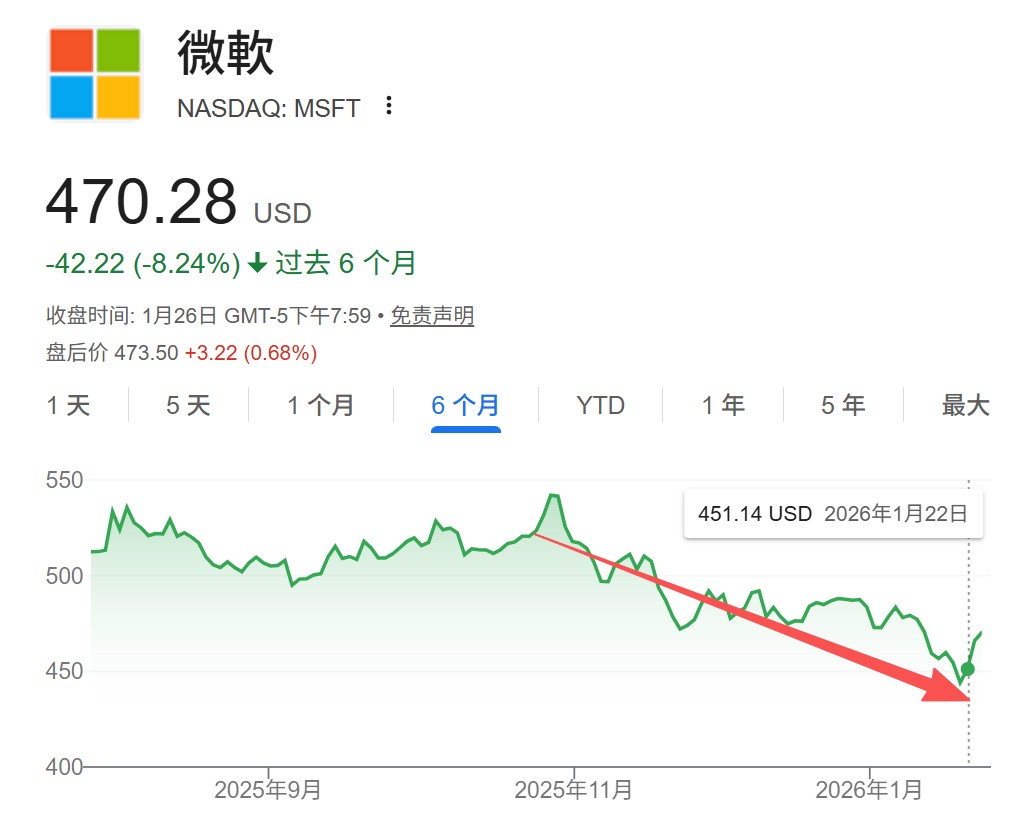
Goldman's core judgment is: Azure's growth is rebounding from the bottom. Analysts expect Q2 Azure revenue growth (at constant exchange rates) to reach 39%, with a path to rebound to the range of 40%-45% over the next four quarters. Regarding the market's criticism of the massive Capex investment, Goldman calculated that Microsoft's investment efficiency is not low—revenue generated per gigawatt (GW) for Azure will approximately double from Q4 of fiscal year 2025 to Q4 of fiscal year 2027.
Goldman's on-the-ground research shows that the corporate IT budget environment is more relaxed than a year ago, the adoption rate of Copilot is increasing, and despite discount promotions, customers are transitioning from the experimental phase to full deployment.
Microsoft is not blindly burning cash; its allocation of GPU computing power is very strategic: prioritizing first-party applications like Copilot (which have better unit economics) and internal R&D For this quarter's financial report, as long as Azure's growth rate can stabilize around 39% and maintain a range of 38%-40% in the guidance for the next quarter, it will effectively restore market sentiment.
Apple: An Execution Machine Ignoring Cost Pressures
When the market is concerned that rising storage chip prices will erode hardware profits, JP Morgan analyst Samik Chatterjee provided a completely opposite judgment: Apple's scale effect is sufficient to absorb these costs.
JP Morgan significantly raised Apple's target price to $315, with the core logic being the strong demand for the iPhone 17 series. Analysts predict that iPhone revenue for F1Q (December quarter) will reach $80.2 billion, a year-on-year increase of 6%, far exceeding the market's implied expectation of 13%. This better-than-expected hardware revenue growth, combined with a robust gross margin of 47.6%, will overshadow the slight noise in the services business.
Although the revenue growth rate of the App Store may slow to around 7%, this is only part of the services segment. Apple has enough leverage (such as iCloud, Apple Care, etc.) to maintain the overall service revenue growth rate at a high level of 14%.
More importantly, the market is waiting for the arrival of the iPhone 18 cycle (including foldable models), and the current strong execution is just paving the way for the next super cycle. Additionally, since the AI-related Gemini model access fees have not yet generated large-scale impacts in F1Q, the operating expenses (Opex) for the quarter are expected to be below guidance, further releasing surprises in earnings per share (EPS)
